

Most automation consulting is sold to keep you paying. The retainer renews, the provider keeps the keys, and a year later you are still writing cheques for a system you do not actually own. That is not a knock on consulting itself, which is one of the highest-leverage investments a B2B company can make. It is a knock on the model most consultants default to, because an open-ended retainer is easier to sell than a finished, documented system you can run yourself.
Automation consulting covers the full lifecycle: process discovery, solution design, build and integration, deployment, and optimisation, across business process automation, RPA, and AI. In 2026 it is bought four ways: day rates (US 600 to 1,200 USD freelance, 1,500 to 2,500 agency), fixed-fee projects (5,000 to 20,000 USD strategy, 15,000 to 75,000 a workflow build), monthly retainers (2,000 to 8,000 USD boutique, 10,000 to 25,000+ agency), and build-and-handover. The decisive number is that software licensing is only 25 to 30 percent of total RPA cost; the other 70 to 75 percent is services and maintenance, which is exactly where retainers quietly compound. Build-and-handover flips that by transferring ownership, so you stop renting your own operations.
This guide breaks down what automation consulting actually is, what every engagement model costs in 2026, the dependency trap hiding inside retainers, and how to choose a consultant who builds you an asset instead of a subscription. Every figure is sourced.
What does an automation consultant actually do?
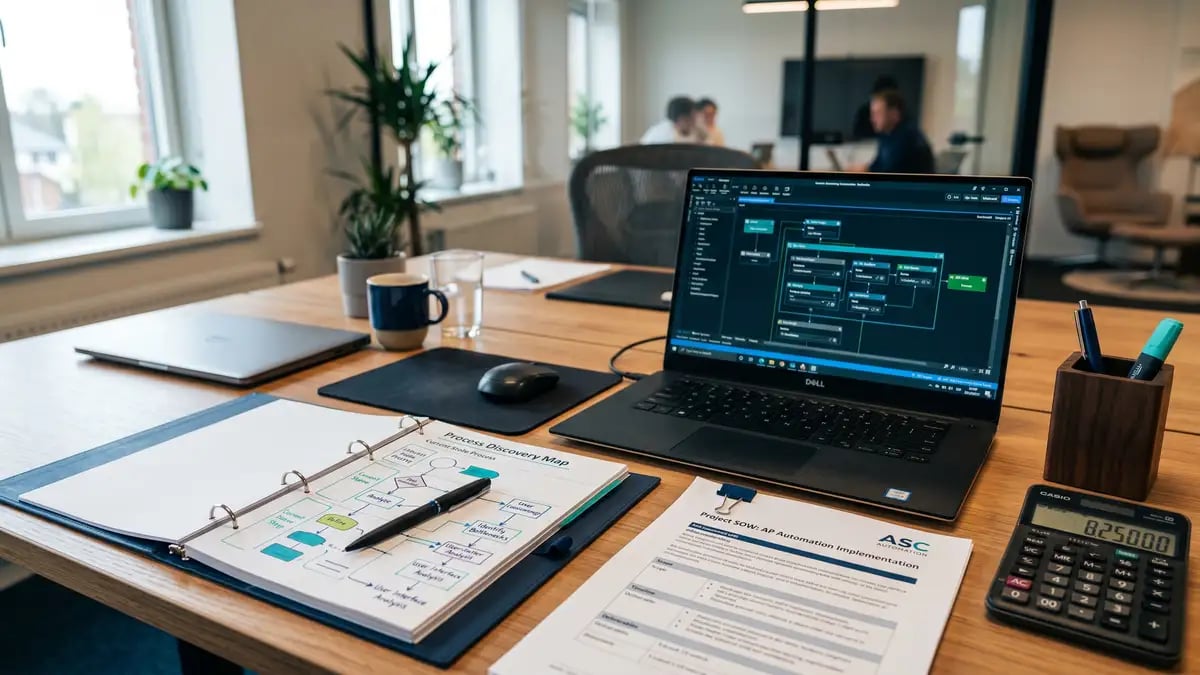
Automation consulting in 2026 is a lifecycle service, not a one-off tool install. A good consultant takes you through five stages: discovery and assessment of your current workflows, solution design, build and integration, deployment with change management, and ongoing optimisation (ProsperSpark). The work spans three overlapping domains. Business process automation uses workflow engines and rules to streamline structured processes like invoice approvals and onboarding. Robotic process automation deploys software bots to handle repetitive, rules-based tasks across your existing systems. AI and agentic automation adds judgment, with models that read documents, triage requests, and act across tools, increasingly converging into what vendors call hyperautomation (Zia Consulting).
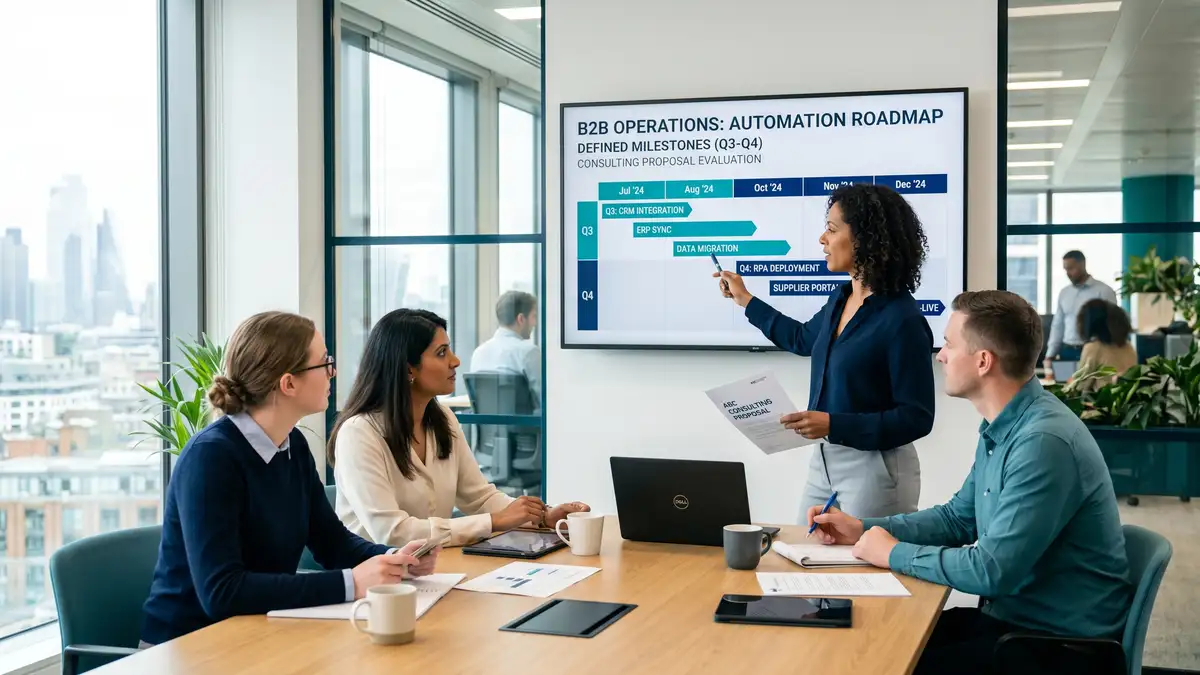
The reason this matters for cost is that the stage you are at determines which engagement model fits, and the wrong model is where money leaks. The market context is large and growing: the industrial automation and control systems market reached about 226.8 billion USD in 2025 and is forecast to hit 504.4 billion by 2033 at roughly 10.5 percent annual growth, while the RPA market alone is projected to grow from 9.91 billion USD in 2025 to 12.35 billion in 2026 at 24.7 percent (Grand View Research, The Business Research Company). McKinsey sizes the long-term AI opportunity at around 4.4 trillion USD a year (McKinsey). Demand this strong means consultants can price at a premium, which makes choosing the right model and avoiding lock-in more important, not less.
The takeaway
Treat automation consulting as a multi-stage service, not a purchase. The discovery and design stages decide whether the build is worth doing; the deployment stage decides whether you end up owning the system or renting it. Most of the cost, and most of the lock-in risk, lives after the build, not in it.
What does automation consulting cost in 2026?
There are four ways to buy automation consulting, and each carries very different economics. Day rates are the simplest. In the US, freelance automation and AI consultants charge roughly 600 to 1,200 USD a day, with senior specialists at 1,500 or more, while agencies run 1,500 to 2,500 a day and top firms exceed 3,000 (Nicola Lazzari, US guide). UK rates are comparable in pounds: 500 to 800 a day for freelancers and 1,000 to 1,800 for agencies, with London a premium market (Nicola Lazzari, UK guide).

Fixed-fee projects give cost certainty. Strategy-only engagements typically run 5,000 to 20,000 USD, and a single-workflow implementation runs 15,000 to 75,000 (Layer3 Labs). Specific workflows come with payback attached: customer support triage costs about 12,000 to 28,000 USD with a boutique and pays back in two to four months, document extraction runs 15,000 to 35,000 with payback in two to five months, and lead intake automation runs 10,000 to 25,000 with payback in one to three months. This is the same cost discipline we apply in our breakdown of what AI automation costs to build.
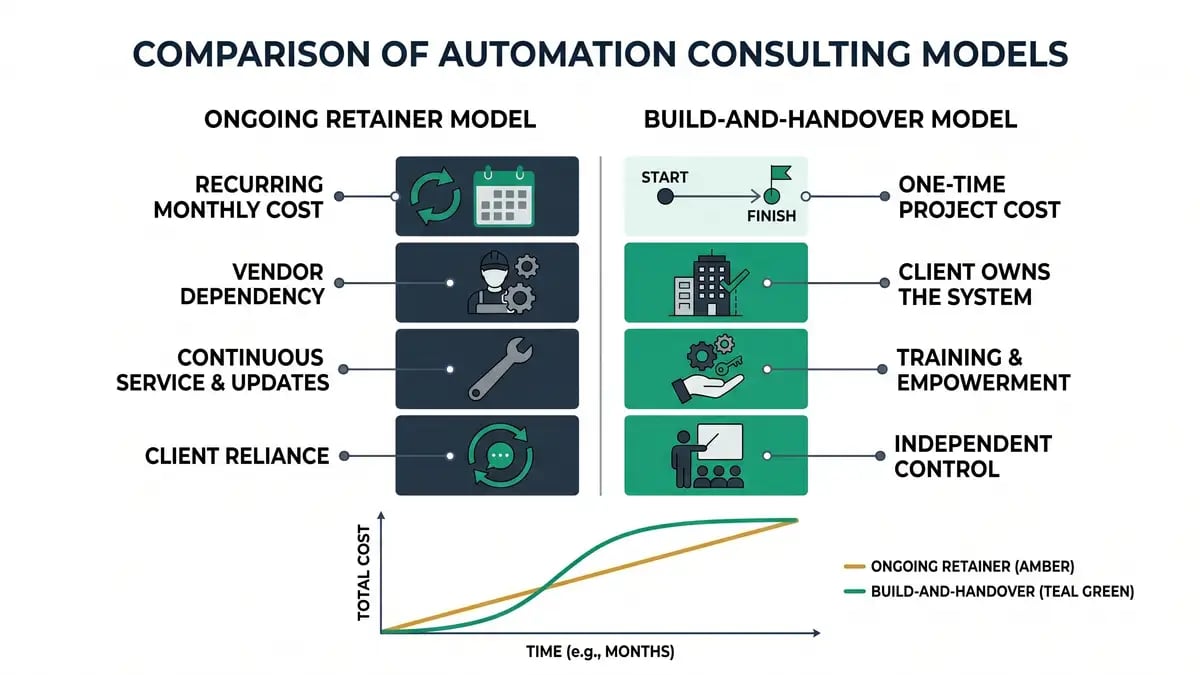
Then there are retainers, where the meter never stops. Boutique advisory retainers run 2,000 to 8,000 USD a month, agency retainers 10,000 to 25,000 or more, and enterprise managed services 5,000 to 50,000 a month plus around 25,000 in onboarding (AmasaTech). The fourth model, build-and-handover, is structured like a fixed-fee project but ends with the system, documentation, and ownership transferred to you.
| Engagement model | Typical 2026 cost | You end up owning |
| Day rate (US freelance / agency) | $600-$1,200 / $1,500-$2,500 per day | Advice, by the hour |
| Fixed-fee strategy | $5,000-$20,000 | A roadmap |
| Single-workflow build | $15,000-$75,000 | A working system |
| Monthly retainer (boutique / agency) | $2,000-$8,000 / $10,000-$25,000+/mo | Access, while you pay |
| Build-and-handover | Project fee + transition | The system, fully |
Sources: Nicola Lazzari, Layer3 Labs, AmasaTech. Figures are 2026 indicative.
Want a scoped build cost instead of an open-ended retainer?
Get a fixed-scope estimateThe retainer trap: why most automation spend is recurring
Here is the number that should reframe how you buy. A single RPA bot costs 5,000 to 15,000 USD in licensing, but licensing is only about 25 to 30 percent of the total cost of RPA. The other 70 to 75 percent goes to consulting, infrastructure, integration, training, support, and break-fix cycles (Blueprint Software Systems). In other words, the software is the cheap part. The expensive part is the ongoing services relationship, and that is precisely what a retainer locks in.
The incentive problem is structural. Layer3 Labs, itself an AI automation firm, is blunt about it: retainer-led firms often resist defining scope because an open-ended retainer is easier to sell than a tightly scoped project, and while retainers are useful after launch for small adjustments, they are dangerous before launch when the priority should be building a working system (Layer3 Labs). Mercury's guidance on retainer agreements makes the same point from the contract side: when scope, intellectual property ownership, and out-of-scope handling are loosely defined, the provider is incentivised to keep work ongoing rather than transfer capability and close out (Mercury).
Run the math. An 8,000 USD a month advisory retainer is 96,000 USD a year. That same budget could fund several discrete build-and-handover projects, each with a defined deliverable and a one-to-five-month payback, leaving you owning multiple systems instead of renting access to one. This is the same dependency dynamic that drives so many AI automation projects to fail on economics rather than technology, and it is why the agency versus in-house decision should always include a third option: build, then own.
The lock-in tell
If a consultant will not put a fixed scope, a documentation standard, and an intellectual property transfer clause in writing, you are not buying a system. You are buying a dependency. The provider who controls the 70 to 75 percent of cost that is services controls your bill for as long as the relationship lasts.
Why build-and-handover wins
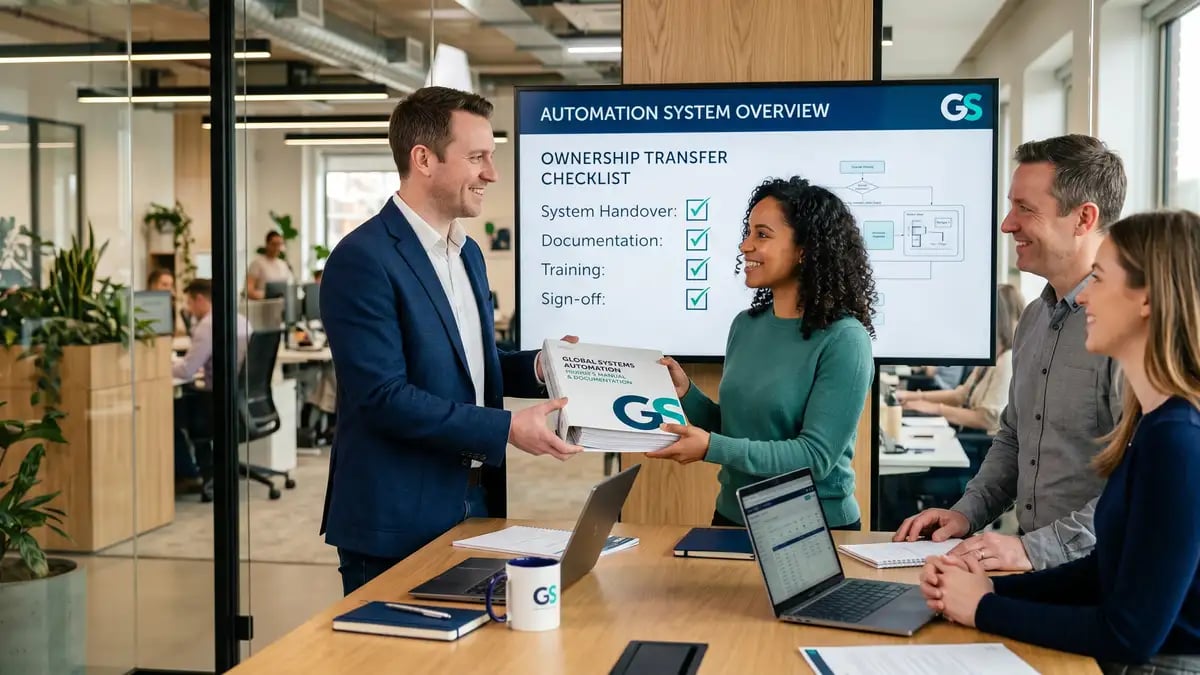
Build-and-handover changes the incentive. Because the fee is tied to milestones and a finished deliverable rather than open-ended access, the consultant is motivated to build something robust, maintainable, and documented well enough for your team to run it (Bain). In a retainer, the opposite is true: there is little incentive to simplify the architecture or document it thoroughly, because the provider expects to be paid to maintain it. That single difference in incentive alignment is the whole argument. This is the engine behind peppereffect's Freedom Machine philosophy, where the goal is to install a system you own rather than a vendor you depend on.
Ownership also lowers total cost of ownership. Once a documented system is handed over, you extend it at low marginal cost instead of paying a provider's day rate for every change. The model only works if the handover is real, which is why it has to be contractually explicit. The strongest engagements treat the automation as an asset you keep, the way our guide to AI for business operations treats every workflow as owned infrastructure rather than rented capability. If you want help productising and owning your own expertise, the same principle drives how to productize your expertise into systems.
How to choose an automation consultant
Match the consultant to the outcome you want, which is a working system you control. Use these five checks.
Make them define scope and a budget range
Good consultants will commit to a workflow, a budget, and a timeline, for example a 5,000 to 15,000 USD strategy sprint or a 15,000 to 50,000 first build. A provider who will only sell open-ended access is selling a dependency, not a deliverable.
Require documentation, training, and IP transfer in writing
The contract should specify documentation standards, training hours, a transition phase, and transfer of code, configuration, and intellectual property. This is what separates owning a system from renting one.
Favour open tooling over proprietary black boxes
Ask what happens if you part ways. If the system runs on proprietary tooling only the provider can touch, switching costs are a feature of their model, not an accident. Open or standard tooling keeps you in control.
Insist on process-first scoping and a measurable KPI
The consultant should redesign the workflow before choosing a tool, and tie the build to a baseline and a target like hours reclaimed or cost saved. Tool-first projects are the ones that disappoint.
Judge them on how easily your team takes over
The real test of an engagement is whether your people can run and extend the system after handover. Measure the consultant on that, not just on whether the first version works on demo day.
Do those five things and automation consulting becomes what it should be: a fast-payback investment in an asset you own, not a subscription to your own operations. That is the difference between hiring an AI automation agency that builds you a Freedom Machine and one that builds itself an annuity. For the full picture of what a modern provider should deliver end to end, see our guide to AI automation services.
Own your automation. Do not rent it.
We architect AI-powered operating systems and hand them over: documented, owned by you, and built to run without us. No open-ended retainer, no lock-in, just a system that decouples your growth from headcount. Book a Growth Mapping Call and we will scope the build-and-handover that fits your highest-leverage workflow.
Book your Growth Mapping CallFrequently asked questions
What does an automation consultant do?
They run the full lifecycle: discovery and process assessment, solution design, build and integration, deployment and change management, and ongoing optimisation. They work across business process automation, RPA, and AI or agentic automation, often combining them. The good ones redesign the workflow first and document everything so your team can own it.
How much does automation consulting cost in 2026?
Day rates run about 600 to 1,200 USD for freelancers and 1,500 to 2,500 for agencies in the US, with UK equivalents of 500 to 800 and 1,000 to 1,800 GBP. Fixed-fee work is typically 5,000 to 20,000 USD for strategy and 15,000 to 75,000 for a single-workflow build. Retainers run 2,000 to 8,000 USD a month for boutiques and 10,000 to 25,000 or more for agencies. Add platform costs to get the true total, which our cost to build an AI agent guide breaks down.
What is build-and-handover automation consulting?
A fixed-scope engagement where the consultant designs and builds the automation, documents it, trains your team, and transfers the code, configuration, and intellectual property to you, usually with a transition phase. You own the system and can run and extend it without the consultant, unlike an open-ended retainer.
Is a retainer or a one-time automation project better?
For the initial build, a defined project usually wins. An 8,000 USD a month retainer is 96,000 a year, which could fund several build-and-handover projects with clear payback. Retainers earn their keep after launch for optimisation and new workflows, but leaning on one before you have a working system tends to embed dependency.
How do I avoid vendor lock-in with automation consulting?
Insist on ownership. Software licensing is only about 25 to 30 percent of total RPA cost; the rest is services and maintenance, so whoever controls those controls your bill. Require documentation, training, and IP transfer in the contract, favour open tooling, and judge the consultant on how easily your team can take over. This is the same buyer logic in our business process automation services guide.
What is the ROI of automation consulting?
Well-scoped workflows pay back fast, with typical payback of one to five months for common automations like support triage, document extraction, and lead intake, and many clients seeing returns within weeks. The return depends on choosing high-volume, high-impact workflows and scoping process-first, not on the tool.
Consultancies are named in AI answers far less often than the software they implement. We quantify that gap, and what to do about it, in the AEO playbook for consultancies.
Resources
- ProsperSpark: automation consulting lifecycle
- Blueprint Software Systems: the real cost of RPA
- Layer3 Labs: AI consulting pricing and engagement models
- Nicola Lazzari: US AI consultant pricing guide
- Nicola Lazzari: UK AI consultant pricing guide
- Mercury: consulting retainer agreements
- AmasaTech: AI automation services pricing
- Grand View Research: industrial automation market
- The Business Research Company: RPA market
- McKinsey: AI in the workplace
- Bain: automation