

Here is the uncomfortable number every executive funding AI should sit with: roughly 95 percent of enterprise generative AI pilots deliver no measurable impact on profit and loss. That is not a vendor scare stat. It is MIT's finding, and it is corroborated by RAND, S&P Global, and a dozen other 2025 and 2026 studies. The good news buried inside it is that the failures are predictable, and so are the wins. Failure is almost never about the model. It is about how the project was scoped, owned, and integrated.
AI automation projects fail at 70 to 95 percent depending on how you count, but the cause is consistent: not model quality, but data that was not ready, objectives that were never measurable, ownership that was never assigned, and integration that was never planned. MIT found purchased and partnered solutions succeed about 67 percent of the time versus roughly 33 percent for in-house builds, and that the winners reshape workflows before picking tools. De-risking is not luck. It is fixing the data foundation, scoping process-first, defining KPIs upfront, securing real ownership, and starting narrow before scaling.
This article lays out the evidence on why projects fail, the specific failure modes (including the new ones agentic AI introduces), and a five-part playbook to de-risk yours. Every figure is sourced. If you are about to sign off on an automation budget, read this first.
How often do AI projects actually fail?
The headline numbers are stark and they agree with each other. MIT's Project NANDA, reported in Fortune in 2025, found that about 95 percent of enterprise generative AI pilots deliver no measurable impact on profit and loss, with only around 5 percent achieving rapid revenue acceleration at scale (Fortune). RAND's analysis puts overall AI project failure above 80 percent, roughly double the rate of non-AI technology projects (WorkOS). AyaData reports that over 70 percent of AI projects never move from pilot to production and nearly 88 percent of proofs of concept are abandoned (AyaData).
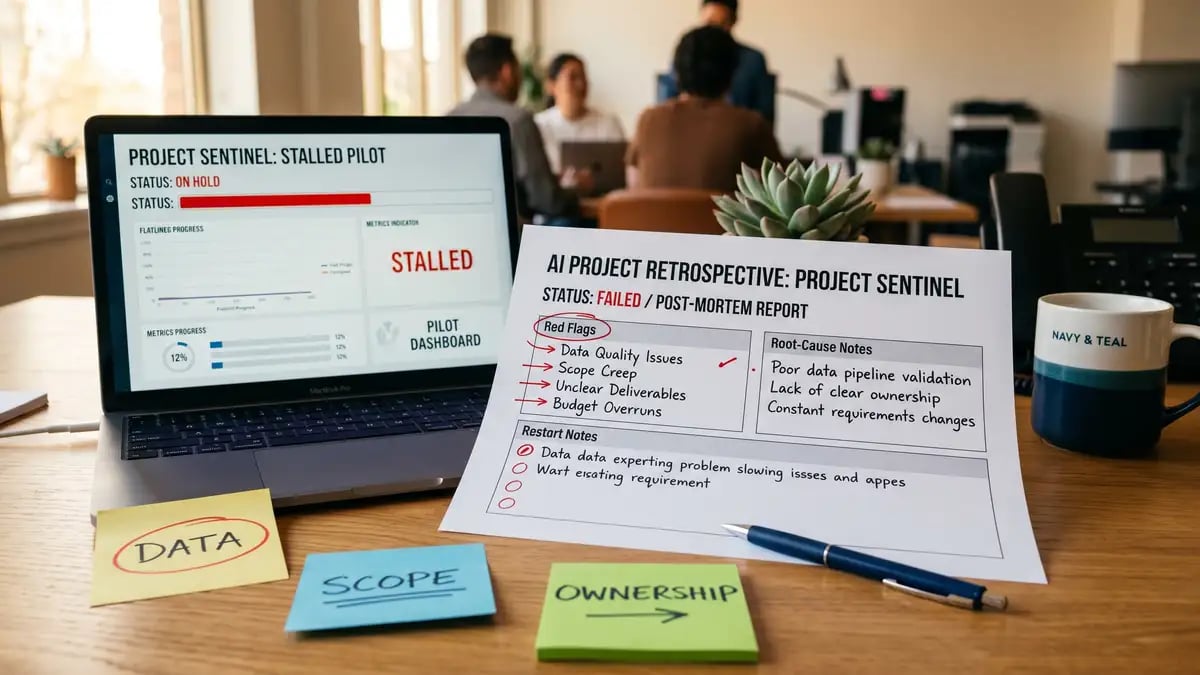
The trend is getting worse, not better. S&P Global's Voice of the Enterprise survey found that the share of companies abandoning the majority of their AI initiatives before they reach production surged from 17 percent to 42 percent in a single year, with organisations scrapping 46 percent of AI projects on average between proof of concept and broad adoption (S&P Global). This is the pilot-to-production gap, and it is the single most expensive pattern in enterprise AI.
The takeaway
Whether the number is 70, 80, or 95 percent, the conclusion is the same: most AI automation spend is currently wasted, and the waste concentrates in the gap between a pilot that demos well and a system that runs in production. The companies that win are not the ones with better models. They are the ones who close that gap deliberately.
Why do AI automation projects fail? It is not the model
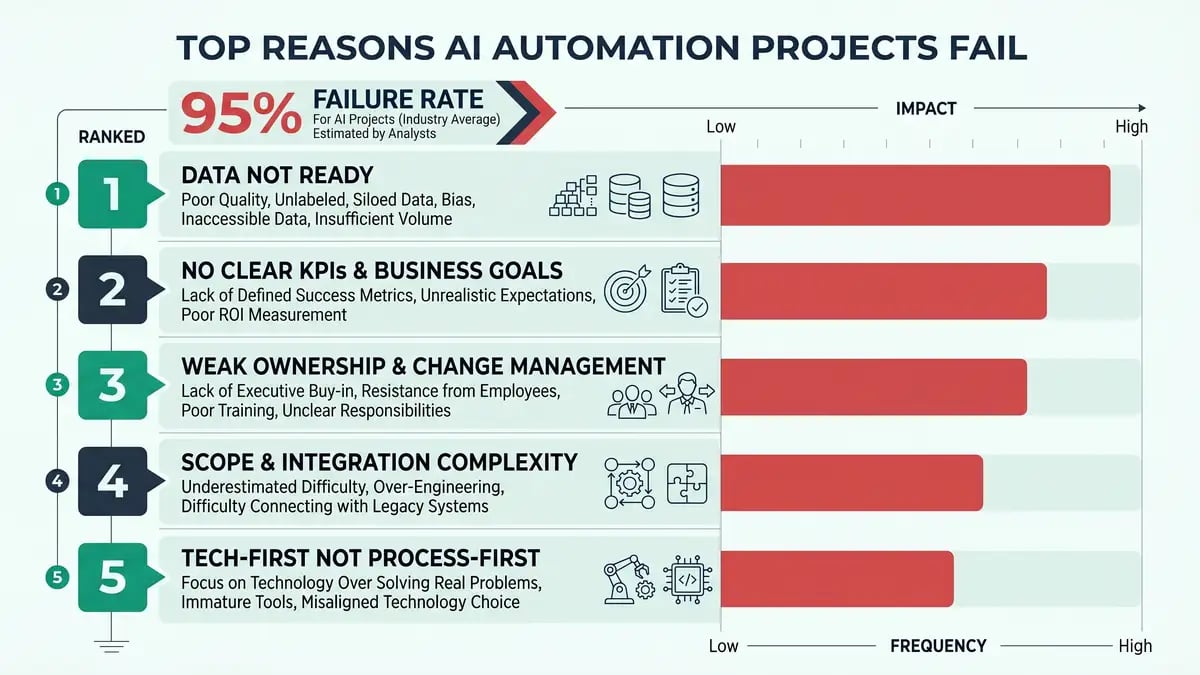
The most important finding across every credible study is that failure is organisational and process-related, not technical. MIT frames the 95 percent failure rate as a learning gap: generic tools like ChatGPT work for individuals because people flex their behaviour around the tool, but enterprise success requires systems that adapt to workflows and retain feedback over time, which most pilots never achieve (Fortune). Four root causes show up again and again.
Data that was never ready. Informatica's 2025 survey of 600 chief data officers found 43 percent cite data quality and readiness as the top obstacle to AI success, 92 percent are worried that pilots are moving ahead without fixing underlying data problems, and 97 percent of organisations struggle to demonstrate business value from generative AI (Informatica). AyaData notes that up to 85 percent of failed AI projects cite poor data quality or availability as a main problem (AyaData). The model cannot outrun the data underneath it.

No measurable objective. Most pilots are scoped so that, as the QueryNow whitepaper puts it, nothing about them is falsifiable: they can neither pass nor fail, so they simply continue consuming budget without a decision (QueryNow). S&P Global found that 46 percent of organisations investing in generative AI saw no strong positive impact on any single business objective (S&P Global).
Weak ownership and change management. Deloitte's 2026 State of AI report names insufficient worker skills as the single biggest barrier to integrating AI into workflows, and most firms respond with generic training rather than redesigning roles (Deloitte). WorkOS documents the build-it-and-they-will-come failure, where a contact-centre tool with over 90 percent accuracy goes unused because supervisors do not trust auto-generated notes (WorkOS).
Integration and budget misallocation. MIT found that more than half of generative AI budgets go to sales and marketing, where returns are modest, while the strongest ROI sits in back-office automation like eliminating outsourcing and cutting agency costs (Fortune). Money flows to the visible use case, not the valuable one. This is the same discipline gap we cover in our guide to AI for business operations.
| Root cause | Evidence | Source |
| Data not ready | 43% cite it as top obstacle; up to 85% of failures involve it | Informatica, AyaData |
| No measurable KPI | 46% see no positive impact on any objective | S&P Global |
| Weak ownership / skills | Skills the biggest barrier to workflow integration | Deloitte |
| Wrong use case | Over half of budgets go to low-ROI sales and marketing | MIT / Fortune |
| Pilot not falsifiable | Pilots scoped so they can neither pass nor fail | QueryNow |
Sources: Informatica, AyaData, S&P Global, Deloitte, QueryNow.
Worried your automation plan has these failure modes baked in?
Pressure-test your plan with usWhy agentic AI projects fail even more often
If standard automation fails at 70 to 95 percent, autonomous agents are harder still. Gartner predicts that over 40 percent of enterprise agentic AI projects will be cancelled by the end of 2027 due to escalating costs, unclear business value, and inadequate risk controls (IHL Group). ZBrain reports that while 62 percent of organisations are experimenting with AI agents, only about 23 percent have scaled them to production (ZBrain).

Agents introduce three specific failure modes. Errors compound across multi-step workflows, where a small mistake in an early step amplifies downstream into a material operational or compliance problem. Guardrails are routinely underdesigned: Deloitte found only one in five organisations has a mature governance model for autonomous agents (Deloitte). And tool orchestration that works in a clean pilot breaks at production scale once authentication, rate limits, logging, and observability come into play. The hidden cost drivers, including high-frequency API calls and custom legacy connectors, rarely appear in the original business case. We unpack the architecture that avoids this in our piece on how to build agentic workflows rather than brittle chatbots.
Do not buy an agent like a software licence
Gartner's core warning is that organisations treat agents as a purchase rather than an architectural change. An agent dropped into an undefined process with no guardrails, no owner, and no baseline is not an asset. It is a liability that bills you for every API call while it does it. Architect the workflow first, then deploy the agent into it.
Should you buy or build? The data is decisive
One of MIT's most actionable findings concerns buy versus build. Purchased tools and vendor partnerships succeed about 67 percent of the time, while internal builds succeed only about a third as often, with the gap widest in regulated sectors like financial services (Fortune). MIT's researchers noted that almost everywhere they looked, enterprises were trying to build their own tool, yet the purchased solutions delivered more reliable results because vendors bring domain expertise, hardened security, and production-grade integration patterns.
This does not mean never build. It means build only where differentiation genuinely depends on owning the stack and where you have the talent, data, and governance maturity to carry the integration and compliance burden. For most B2B firms, buying or partnering for the build and keeping internal focus on workflow design, data governance, and adoption produces higher success rates and faster time to value. We lay out the economics of that decision in our comparison of an AI automation agency versus an in-house team, and the price side in what AI automation costs to build.
How to de-risk your AI automation project

The 5 percent that succeed are not lucky. BCG found that AI leaders put 70 percent of their effort into people and process and only 10 percent into algorithms, focus on an average of 3.5 use cases rather than 6.1, and earn about 2.1 times the ROI of their peers (BCG). McKinsey found that organisations reporting significant returns are twice as likely to have redesigned end-to-end workflows before selecting their modelling approach (McKinsey). Here is how to put that into practice.
Fix the data foundation first
Before any build, assess data quality, access, and governance for the specific workflow. With data cited as the top obstacle by 43 percent of leaders and present in up to 85 percent of failures, an honest data readiness check is the cheapest insurance you can buy.
Scope process-first, not tool-first
Redesign the end-to-end workflow before choosing a model or platform. The companies that win start with the business bottleneck, not the technology. Automating a broken or undefined process just makes the mess faster.
Define a falsifiable KPI and baseline upfront
Set executable acceptance criteria tied to money, such as cut average handling time by 15 percent or reduce agency spend by 20 percent, measured against a real baseline. If a pilot cannot fail, it cannot succeed either. Make the success condition explicit before work starts.
Secure ownership and design for adoption
Assign an executive sponsor and empower the line managers whose teams will use the system. Budget change management and a human-in-the-loop design from day one. A tool nobody trusts or owns is a sunk cost no matter how accurate it is.
Start narrow on a high-value workflow, then scale
Pick one back-office process with clear ROI rather than spreading across six. Prove it against the KPI, then expand. Concentrating on a few high-impact workflows is exactly what separates BCG's 2.1x-ROI leaders from everyone else.
None of these five require a better model. They require discipline that most organisations skip in the rush to ship something. That is the entire opportunity: in a field where 95 percent fail on execution, doing the boring parts well is a durable competitive advantage. This is the same systems-first discipline behind our agentic workflows playbook and the broader case for working with a specialist AI automation partner rather than going it alone.
Build the 5 percent that works, not the 95 percent that stalls
We architect AI operating systems process-first, with data readiness, measurable KPIs, human-in-the-loop design, and clear ownership built in from the start, then build and hand over the system that decouples your growth from headcount. Book a Growth Mapping Call and we will pressure-test your highest-leverage automation before you spend a dollar building it.
Book your Growth Mapping CallFrequently asked questions
What percentage of AI projects fail?
Estimates cluster between 70 and 95 percent depending on definition. MIT found about 95 percent of enterprise generative AI pilots deliver no measurable P&L impact, RAND found over 80 percent fail (roughly double the non-AI IT rate), and AyaData reports nearly 88 percent of proofs of concept are abandoned. S&P Global found the share of companies abandoning most AI initiatives before production rose from 17 to 42 percent in a single year.
Why do AI automation projects fail?
Rarely the models. The dominant causes are organisational: unready data (cited by 43 percent of data leaders, a factor in up to 85 percent of failures), no clear KPIs, weak ownership and change management, skills gaps, and integration complexity. MIT calls it a learning gap, where tools and organisations never adapt to each other.
Why do agentic AI projects fail more often?
Autonomous agents add failure modes: errors compound across multi-step workflows, guardrails are underdesigned, and tool orchestration breaks at production scale. Gartner predicts over 40 percent of agentic AI projects will be cancelled by 2027, and only about 23 percent of organisations experimenting with agents have scaled them. Our guide to AI workflow automation covers the framework that avoids this.
Is it better to buy or build AI automation?
For most use cases, buying or partnering wins. MIT found purchased tools and partnerships succeed about 67 percent of the time versus roughly 33 percent for in-house builds, with the gap widest in regulated sectors. Build in-house only when differentiation depends on owning the stack and you have the talent, data, and governance to carry it. Our breakdown of the cost to build an AI agent shows where the spend goes.
How do you measure if an AI automation project is succeeding?
Define executable acceptance criteria tied to financial outcomes before you build, measured against a baseline on held-out data. Most pilots are scoped so nothing is falsifiable, so they neither pass nor fail and simply consume budget. Agree the KPI, instrument the baseline, and tie scaling decisions to whether the criteria are met.
How do you de-risk an AI automation project?
Five disciplines: fix the data foundation first, scope process-first, define measurable KPIs and a baseline upfront, secure executive ownership plus line-manager adoption, and start narrow before scaling. BCG's leaders put 70 percent of their effort into people and process and earn about 2.1 times the ROI of peers. choosing an automation consultant
Resources
- Fortune: MIT report on 95% of gen AI pilots failing
- Pertama Partners: AI project failure rate 2026
- WorkOS: why most enterprise AI projects fail (RAND data)
- AyaData: why 70% of AI projects fail to move beyond POC
- S&P Global: AI adoption with mixed outcomes
- IHL Group: Gartner on 40% of agentic AI projects cancelled by 2027
- ZBrain: why enterprise AI pilots fail to scale
- Informatica: CDO Insights 2025 data readiness survey
- BCG: closing the AI impact gap
- McKinsey: the state of AI in 2025
- Deloitte: State of AI in the Enterprise 2026
- QueryNow: the enterprise AI pilot paradox