

Ask three agencies what AI automation costs and you will get three non-answers: "it depends," "let's scope it," and a number with no explanation behind it. That vagueness is not a coincidence. It keeps buyers anchored to whatever the vendor wants to charge. This guide does the opposite. It gives you the actual 2026 ranges, what drives a quote up or down, and how to tell whether a price is fair before you sign anything.
In 2026, a single automated workflow typically costs 1,500 to 12,000 USD one-time, a multi-workflow system runs 15,000 to 60,000 USD or more, and a custom AI agent ranges from about 15,000 to 75,000 USD for mid-market builds up to 150,000 USD and beyond for enterprise multi-agent systems. On top of the build, expect platform and LLM subscriptions plus ongoing maintenance of roughly 15 to 25 percent of the build cost per year. The biggest price driver is integration complexity, not the number of steps, and the projects that deliver ROI are scoped process-first with a human in the loop, not bought on price alone.
Below is the transparent breakdown: cost by build complexity, the pricing models agencies actually use, what an AI agent costs and why, the tooling and LLM bills nobody quotes upfront, the in-house versus agency math, and a framework to make sure the spend pays back. Every figure is sourced.
What does AI automation cost by build complexity?
The single most useful thing you can do before requesting a quote is to place your project on the complexity ladder. Cost scales with complexity, not with how impressive the demo looks. There are three rungs.
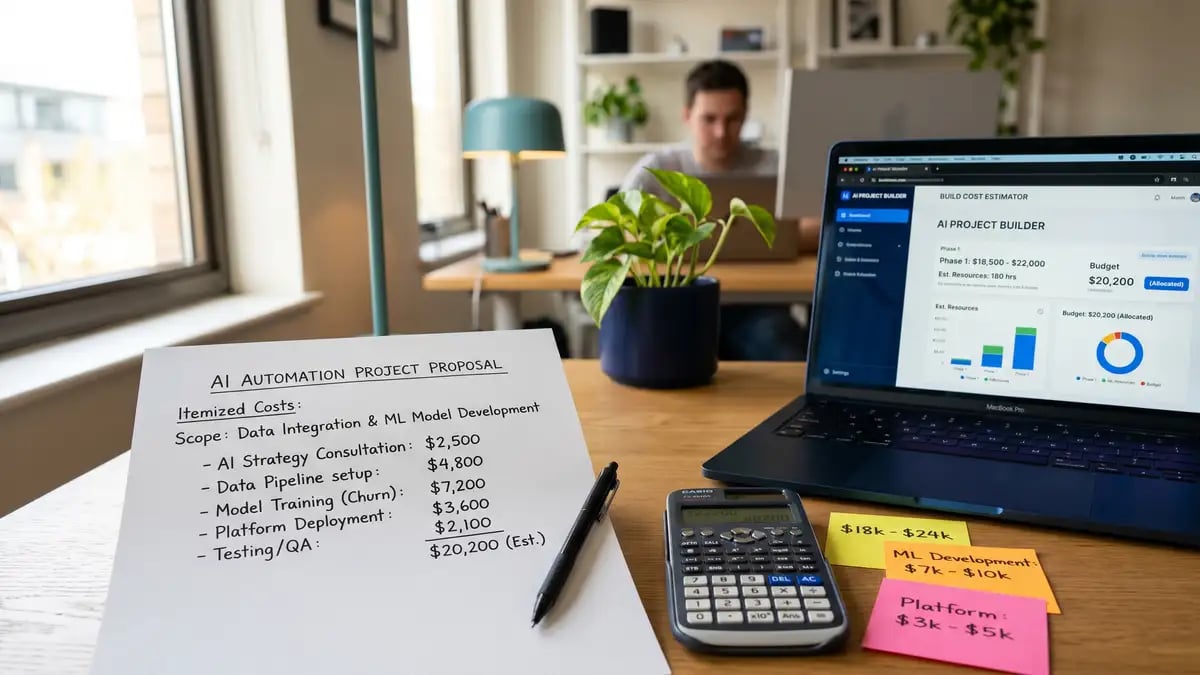
A single automated workflow or integration, such as syncing a CRM to an email platform or auto-routing invoices, typically costs 1,500 to 12,000 USD as a one-time build, with most simple workflows landing between 1,500 and 6,000 USD (Taskip). A broader agency survey puts automation setup projects at 2,500 to 15,000 USD and up (Digital Agency Network).
A multi-workflow automation system spanning sales, operations, and finance, with reporting and error handling layered on, commonly runs 15,000 to 60,000 USD for an enterprise stack build, and project-based work overall spans 1,500 to 40,000 USD (Taskip). Orchestration, cross-workflow dependencies, and observability typically add 30 to 50 percent over the raw build estimate, which is why a system is never just the sum of its workflows.
A full custom AI agent sits at the top. Building an AI agent typically costs between 5,000 and 500,000 USD depending on complexity, with low-code agents at 5,000 to 15,000 USD, custom agents with integrations at 15,000 to 75,000 USD, and enterprise multi-agent systems exceeding 150,000 to 500,000 USD (ProductCrafters). We break the agent tiers down in detail in our guide to the cost to build an AI agent.
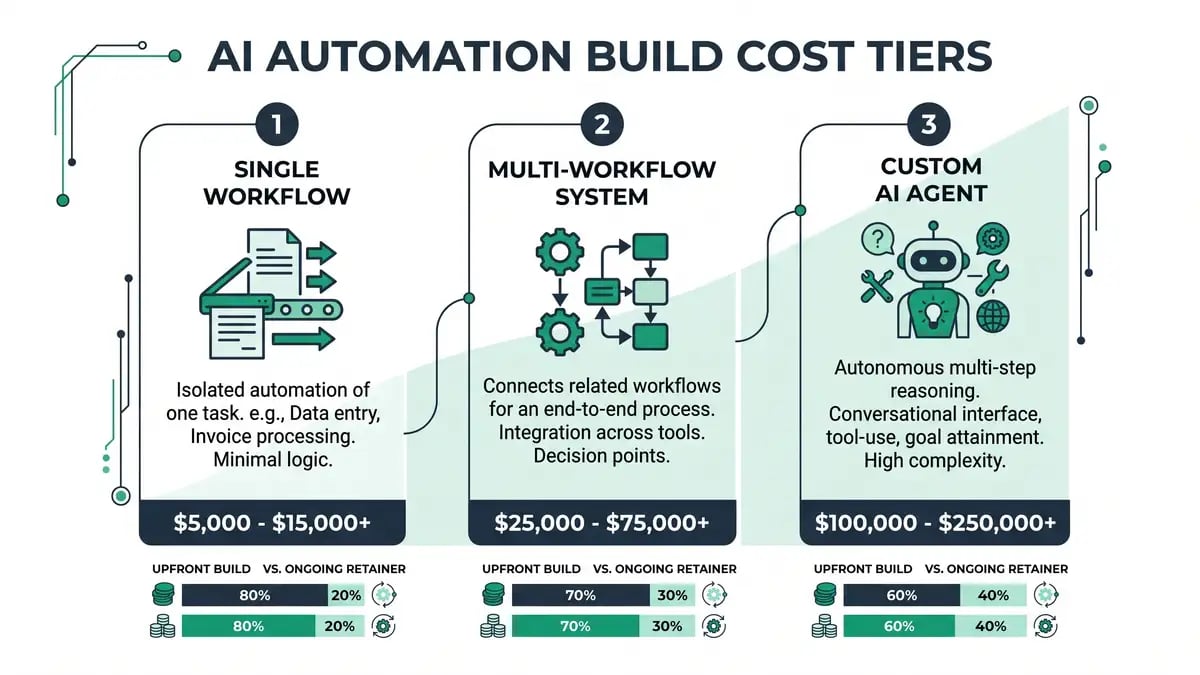
| Build type | Typical one-time cost (USD) | What you get |
| Single workflow / integration | $1,500 - $12,000 | One process automated, standard APIs |
| Multi-workflow system | $15,000 - $60,000+ | Several processes, reporting, error handling |
| Reactive / simple agent | $20,000 - $35,000+ | Rule-based chatbot or FAQ assistant |
| Contextual / model-based agent | $40,000 - $70,000+ | Short-term memory, multi-step flows |
| Autonomous agent | $80,000 - $120,000+ | Planning, tool orchestration, decisions |
| Enterprise multi-agent system | $150,000 - $500,000+ | Reasoning, memory, SLA-backed support |
Sources: Taskip, ProductCrafters, Digital Agency Network. Ranges are 2026 indicative.
The takeaway
Place your project on the ladder before you ask for a price. If a vendor quotes a single-workflow number for what is really a multi-system build, or an agent price for what a simple workflow would solve, you have found either a misunderstanding or a markup. Both are worth catching early.
How do AI automation agencies price their work?
Three pricing models dominate, and knowing which one you are being sold tells you where the risk sits.
Fixed project fees are the most common for discrete builds. A defined deliverable typically costs 1,500 to 40,000 USD, with scope risk sitting mostly on the agency (Taskip). Project minimums vary: boutique agencies and specialists often set 3,000 to 5,000 USD floors, mid-size firms closer to 10,000 to 15,000 USD, and custom agents rarely fall below 15,000 USD given the discovery and testing involved (ProductCrafters).

Monthly retainers cover managed automation. Light maintenance retainers run 1,000 to 3,500 USD a month, while full-service packages with multi-workflow operations, reporting, and new builds run 4,000 to 12,000 USD a month (Taskip). By company size, small businesses budget 1,000 to 3,500 USD a month, mid-market firms 4,000 to 10,000 USD, and enterprises 8,000 to 25,000 USD. This is the same buyer logic we lay out in the comparison of an AI automation agency versus an in-house team.
Hourly rates apply mostly to smaller jobs and maintenance. AI consulting generally runs 150 to 450 USD an hour, AI content and technical work 100 to 149 USD, and nearshore software development 44 to 82 USD as a baseline that AI work usually sits above (FullStack Labs). Value-based pricing is the emerging fourth model: the fee is anchored to business impact, with a common rule of thumb that the client should see roughly a 10x return in year one, so a build expected to save 100,000 USD justifies a 10,000 USD fee (How to Price AI Workflows, 2026).
Want a transparent quote instead of a vague "it depends"?
Get a scoped estimateWhat drives the cost of an AI agent up?
Agent pricing has the widest range of anything in automation, so it pays to understand the levers. Reactive agents that answer with rule-based logic and no memory cost 20,000 to 35,000 USD and up. Contextual agents with short-term memory and multi-step flows run 40,000 to 70,000 USD. Autonomous agents that plan, orchestrate tools, and make decisions reach 80,000 to 120,000 USD, and domain-specific agents for regulated industries hit 100,000 to 200,000 USD (ProductCrafters).
Four drivers move you within those bands. Each external API integration adds 3,000 to 10,000 USD depending on documentation quality and authentication. Data preparation and cleaning add 20 to 40 percent to the timeline. Retrieval setup with a vector database adds ongoing cost, covered below. And the model approach matters: prompt-engineering-only builds cost 5,000 to 15,000 USD, fine-tuning a foundation model runs 10,000 to 50,000 USD and needs over 1,000 labelled examples, and a fully custom model reaches 50,000 to 200,000 USD and up (ProductCrafters). Most B2B agents never need fine-tuning; prompt engineering plus retrieval is enough.
The tooling and LLM costs nobody quotes you
The build fee is only part of total cost of ownership. Three recurring bills sit underneath every automation, and they scale with usage.
Platform subscriptions are modest at entry and steep at scale. Zapier runs free for 100 tasks, then 19.99 USD a month for Professional and 69 USD for Team (Zapier). Make starts free with 1,000 monthly credits (Make). n8n Cloud is 24 USD a month for Starter and 60 USD for Pro, while self-hosting costs as little as 3 to 8 USD a month, roughly one-eighth of the Cloud Starter plan (ExpressTech); our n8n pricing breakdown covers where the execution model bites. Enterprise iPaaS like Workato starts at 10,000 USD a year and commonly runs 15,000 to 50,000 USD (Spendflo). Our breakdown of n8n vs Zapier vs Make pricing shows how the metering models diverge at scale.
LLM API costs are usage-based and can rival platform fees. Priced per million tokens in 2026, GPT-5.4 is 2.50 USD in and 15 USD out, its mini variant 0.75 and 4.50 USD (OpenAI). Claude Haiku 4.5 is 1 and 5 USD, Sonnet 4.6 is 3 and 15 USD, and Opus 4.7 is 5 and 25 USD, with batch processing offering a 50 percent discount (EvoLink). For a mid-sized agent, LLM usage commonly runs 500 to 5,000 USD a month.
Vector database and infrastructure costs round it out. Hosting runs 100 to 2,000 USD a month and total real-time data costs 500 to 10,000 USD a month for retrieval-heavy agents (ProductCrafters). Watch the hidden fees: embeddings, reranking, backups, reindexing, and egress can double the real bill, and an October 2025 shift to 50 USD monthly minimums forced 400 to 500 percent increases for some steady low-volume workloads (Actian).
Watch the usage-based bills
Platform, LLM, and vector database costs are quoted small and grow non-linearly as adoption spreads. A pilot for a handful of users can jump from tens of dollars to thousands a month once an agent rolls out company-wide. Insist on a usage forecast and a cost-sensitivity scenario in any proposal that involves usage-based pricing.
In-house vs agency vs DIY: the real cost math
The build quote is only half the decision. The other half is who runs it, and the numbers favor different answers at different stages.
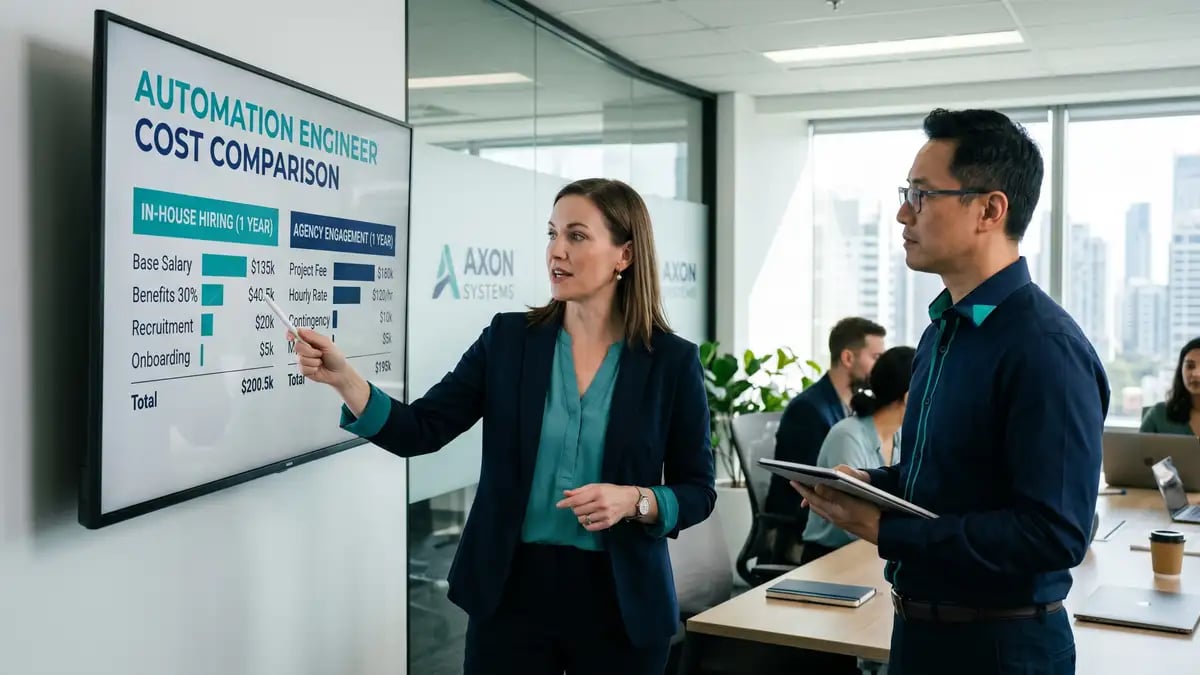
An in-house automation engineer in the US averages 92,597 USD a year, or about 44.52 USD an hour (Zippia), and an automation consultant averages 135,265 USD (Glassdoor). Loaded with benefits and overhead at 25 to 40 percent, a senior hire exceeds 170,000 USD a year, roughly 14,000 to 15,000 USD a month. A full-service agency retainer of 5,000 to 10,000 USD a month is often cheaper than one in-house hire while giving you a whole team (Taskip).
DIY with no-code tools looks cheapest and frequently is not. The platform might cost 20 to 70 USD a month, but if an operations manager earning 40 USD an hour spends 20 hours a month building and debugging automations, that is 800 USD a month in hidden labor that dwarfs the subscription, before counting the risk of amateur builds breaking on business-critical workflows (Zippia). The pattern that works for most mid-market firms is staged: buy to validate value fast, move to hybrid, then build in-house once the talent, data, and clarity exist to maintain it. If you are weighing providers, our framework for choosing an AI automation agency and the wider field of workflow automation tools both help size what you are really buying.
Get a transparent build cost, not a vague estimate
We architect AI-powered operating systems with the scope, ranges, and total cost of ownership laid out before you commit, then build and hand over the system that decouples your growth from headcount. Book a Growth Mapping Call and we will map your highest-leverage automations and what they actually cost to build.
Book your Growth Mapping CallThe hidden costs and how to de-risk the spend
The figures above are the visible costs. The ones that wreck budgets are quieter. Integration complexity is the single biggest driver of price: a workflow touching a legacy system with poor documentation, rate limits, or non-standard authentication can cost many times more than connecting two modern APIs (Taskip). Data quality issues and undocumented edge cases surface mid-build and force rework, since data preparation alone adds 20 to 40 percent to timelines (ProductCrafters). Change management and training carry real cost too, and ongoing technical and maintenance spend often runs 20 to 40 percent of total cost of ownership every year after the build.
None of that means automation is a bad investment. It means the spend has to be structured. The projects that pay back share four disciplines, and they matter far more than the size of the budget.
Scope process-first, not tool-first
Map the manual process end to end before choosing any platform or agent. Most cost overruns come from automating a process nobody fully understood. Clear process maps also let you reject the steps that should be eliminated rather than automated.
Keep a human in the loop
Design approval gates and exception handling for the judgment calls. Human-in-the-loop design is what separates automation that compounds value from automation that quietly makes expensive mistakes at scale.
Define measurable KPIs before you build
Agree the hours reclaimed, cost saved, or cycle time reduced that will define success, and instrument them. A build targeting roughly a 10x first-year return needs a baseline to prove it against.
Assign clear ownership for outcomes
Name who owns the automation after handover and budget the 15 to 25 percent annual maintenance upfront. Orphaned automations decay, and a decayed automation is pure cost with no return.
Do those four things and the price ranges in this guide become an investment with a knowable payback. Skip them and even a cheap build becomes a sunk cost, which is the real reason so many automation projects disappoint. If you want help turning a vague brief into a scoped build with transparent ranges, that is precisely what our AI automation services are built to do, and our business process automation approach starts with exactly this process-first discipline.
Frequently asked questions
How much does AI automation cost to build in 2026?
It depends on complexity. A single automated workflow typically runs 1,500 to 12,000 USD one-time, a multi-workflow system commonly lands at 15,000 to 60,000 USD or more, and a full custom AI agent ranges from about 15,000 to 75,000 USD for mid-market builds and 150,000 USD and up for enterprise multi-agent systems. Add platform and LLM subscription costs, plus ongoing maintenance at roughly 15 to 25 percent of the build per year.
What pricing models do AI automation agencies use?
Three main models. Fixed project fees of about 1,500 to 40,000 USD for a defined build, monthly retainers of 1,000 to 3,500 USD for light maintenance or 4,000 to 12,000 USD for full-service operations, and hourly rates of roughly 150 to 450 USD for AI consulting. Value-based pricing is emerging, where the fee is anchored to business impact and a target of roughly 10x first-year return.
How much does it cost to build an AI agent?
Roughly 5,000 to 500,000 USD depending on type. Low-code agents start around 5,000 to 15,000 USD, custom agents with integrations run 15,000 to 75,000 USD, autonomous agents reach 80,000 to 120,000 USD or more, and enterprise multi-agent systems exceed 150,000 USD. Each external API integration typically adds 3,000 to 10,000 USD. The full tier-by-tier breakdown is in our cost to build an AI agent guide.
Is it cheaper to hire in-house or use an AI automation agency?
For most mid-market firms an agency is cheaper to start. A US automation engineer averages about 92,000 USD and a consultant about 135,000 USD a year, and fully loaded a senior hire exceeds 170,000 USD or roughly 14,000 to 15,000 USD a month. A full-service agency retainer of 5,000 to 10,000 USD a month gives access to a whole team without that fixed cost.
What are the hidden costs of AI automation?
The biggest is integration complexity: workflows touching legacy systems with poor documentation cost far more than connecting modern APIs. Others include data cleaning, which adds 20 to 40 percent to timelines, ongoing LLM and vector database usage that can double on hidden fees, change management, and the cost of failed projects. Ongoing technical and maintenance costs often run 20 to 40 percent of total cost of ownership each year.
How do I make sure AI automation spend delivers ROI?
Scope process-first, keep a human in the loop, define measurable KPIs before you build, and assign clear ownership for outcomes. A well-scoped build should target around a 10x first-year return. Success depends far more on disciplined scoping and accountability than on how much you spend. When choosing a partner, our agency versus in-house comparison walks through the trade-offs. how to de-risk an automation build automation consulting engagement models
Resources
- Taskip: AI automation agency cost guide 2026
- ProductCrafters: how much it costs to build an AI agent
- Digital Agency Network: AI agency pricing 2026
- ExpressTech: the real cost of self-hosting n8n in 2026
- Zapier: plans and pricing
- Make: pricing
- OpenAI: API pricing
- EvoLink: Claude API pricing guide 2026
- Actian: hidden costs of vector database pricing
- Spendflo: Workato pricing guide
- Zippia: automation engineer salary
- Glassdoor: automation consultant salary