

The Best AI Agency for B2B in 2026 — Why "Top 10 Lists" Fail You
The best AI agency for your B2B business is not the one with the slickest landing page, the largest team, or the highest position on a directory listing. It is the one that decouples your revenue from headcount, ties every deployment to a measurable financial outcome, and operates as a unified strategy-to-execution partner — not a vendor that hands off a prototype and disappears. With the AI consulting market projected to grow from USD 14.1 billion in 2026 to USD 116.8 billion by 2035 at a 26.5% CAGR, the cost of choosing wrong is no longer just budget — it is competitive position.
This guide is not a "top 10" listicle. It is the diagnostic framework peppereffect uses internally to evaluate whether an AI partner can install a Freedom Machine — or whether they will burn 12 months of CFO patience on a pilot that never sees production. We pulled this framework from the only data that matters: the documented failure rates, the buyer behaviour shifts, and the ROI benchmarks that separate the 5% of AI deployments that win from the 95% that stall.
Here is what this guide deploys for your evaluation:
- The four agency archetypes — and which one matches your maturity and scale
- The six-pillar evaluation framework — what to demand in every discovery call
- Pricing benchmarks for 2026 — what a real B2B AI engagement should cost
- The seven red flags — patterns that signal wasted capital before a contract is signed
- The peppereffect difference — why we built our practice around outcomes, not hours
Key Takeaway
The single greatest predictor of AI project success is whether the same team that designs the strategy also builds and deploys the system. According to Helm Nagel's executive decision guide, when strategy and execution split across firms, accountability gaps emerge — and the client absorbs the cost of both sides blaming each other.
Why Most "Best AI Agency" Lists Mislead B2B Buyers
If you searched "best AI agency" today, the top results are mostly directories of AI tools — not actual agency evaluations. You will find Gumloop, Lindy, Heyreach, and a YouTube video about "the most powerful AI agent" sitting in the top five. None of these answer the question a B2B founder actually has: which partner can install an end-to-end AI operating system that produces measurable revenue lift?
The few results that do list agencies — DesignRush, Clutch, and similar directories — operate as paid placement platforms, not buyer evaluation frameworks. They identify many providers but offer no comparison of pricing, success rates, vertical specialisation, or post-deployment ROI. The result: you get a wall of logos, no decision criteria, and no protection against the 95% failure rate documented by MIT.

The deeper problem is structural. According to the MIT NANDA initiative's "State of AI in Business 2025" study covered by Fortune, only 5% of AI pilots achieve rapid revenue acceleration. The remaining 95% stall. Critically, the same study found that purchasing AI capability from external partners succeeds about 67% of the time, while internal-only builds succeed only one-third as often. The right agency is a force multiplier. The wrong one is a tax on your runway.
Gartner's complementary research, cited in Harvard Business Review's 2026 trends analysis, sharpens the picture: only one in fifty AI investments deliver transformational value, and only one in five delivers any measurable return. That means 80% of AI spend produces no measurable ROI, and 98% fails to transform the business. Selecting an AI agency without a rigorous framework is a coin flip with your capital.
The 4 Pillars Playbook breaks down the entire framework with deployment maps, KPIs, and real case studies across SaaS, recruiting, and coaching.
Open the Interactive PlaybookThe Four Categories of AI Agency — and Which One You Actually Need
Not all AI agencies are built for the same job. Before evaluating individual firms, you must architect your buyer profile against the four dominant archetypes operating in the 2026 market. Each delivers a distinct outcome at a distinct cost — and matching the wrong type to your need is the most expensive mistake in the buying journey.
| Agency Archetype | Best For | Typical Engagement | Risk Profile |
| Tier-1 Strategy Consultancies (McKinsey, BCG, Deloitte AI) | Fortune 500 with USD 10M+ AI budgets needing board-level frameworks | USD 500k–5M+, 6–18 months | Strong strategy, weak execution. Often hands off to subcontractors. |
| Tool Wrappers & Vibe-Coded Startups | Companies seeking a single-feature deployment (chatbot, FAQ bot) | USD 5k–25k, 2–6 weeks | Low cost, low integration depth. 73% are running third-party APIs with extra steps. |
| Boutique Vertical AI Specialists | Mid-market companies in regulated verticals (finance, healthcare, legal) | USD 80k–500k, 3–9 months | Deep domain expertise, narrow scope. Hard to scale across functions. |
| Full-Stack Growth Architects (peppereffect category) | B2B founders & executives needing decoupled growth across the full lifecycle | USD 50k–300k, 60–120 days | Outcome-aligned, integrated 4 Pillars approach. Requires founder buy-in. |
Sources: Coherent Solutions AI Pricing Report, Towards AI: Reverse-engineering 200 AI startups, DataToBiz: Boutique AI strategy firms

The dirty secret of the market: most agencies position themselves across two or three of these archetypes simultaneously to maximise lead capture. This is a red flag, not a strength. According to 8allocate's guide on choosing AI integration partners, Gartner predicts that by 2027, more than 50% of GenAI models enterprises use will be domain-specific. Generalist firms claiming to solve "any AI problem across any industry" are pricing in the cost of their own learning curve — and you are paying for it.
The right archetype depends on three questions. First, what is your current AI maturity? If you have no production deployment, a Tier-1 strategy firm will burn budget on slideware before your first model ships. Second, how regulated is your data? If you operate in finance, healthcare, or executive search, a generic tool wrapper cannot meet your governance requirements. Third, do you need a single feature or an integrated operating system? peppereffect's 4 Pillars methodology — Lead Generation, Sales Administration, Operations, and Marketing Classics — is built for the third case: founders who need decoupled growth, not a chatbot.
Key Takeaway
Match the agency archetype to your maturity and integration needs — not your budget. According to BCG's USD 200 billion agentic AI opportunity report, two-thirds of enterprises now expect their providers to build and operationalise priority use cases, not just advise. Strategy-only firms are losing the budget to full-stack architects.
The Six-Pillar Evaluation Framework: How to Architect Your Decision
The best AI agency for your B2B business will pass six tests before you ever reach a pricing conversation. We built this framework after auditing 40+ AI agency engagements across SaaS, executive search, and high-ticket consulting — and we have watched every failure mode play out in real time. Each pillar maps to a documented failure pattern in the MIT, Gartner, and Forrester research. Skip any one, and you increase your project risk by an order of magnitude.
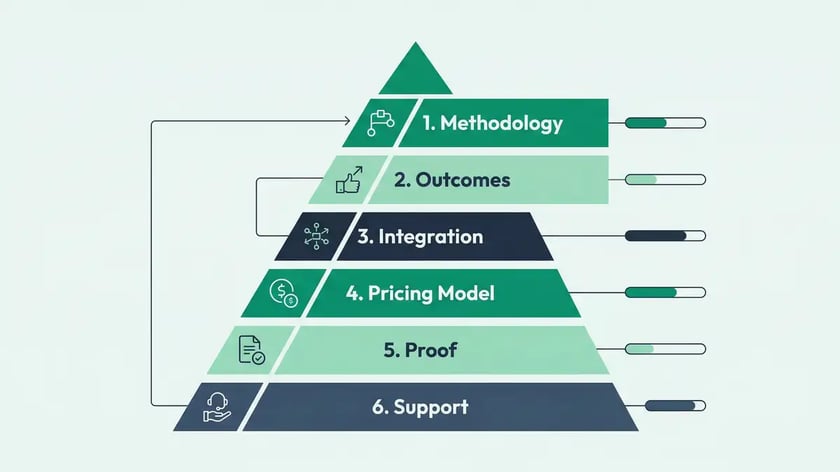
Methodology — Strategy and Execution Under One Roof
Demand a single team from discovery to production deployment. When the strategy team and the implementation team are separate firms, the consultants blame the implementers, the implementers blame the requirements, and you absorb both invoices. peppereffect operates a single architect-led pod across the entire lifecycle.
Outcomes — Measurable ROI from Past Engagements
Reject vague claims like "improved efficiency." Demand specific metrics tied to revenue, CAC, pipeline velocity, or hours reclaimed. According to Brand Auditors' analysis of 90% AI failure rates, the inability to define success upfront is the single biggest red flag in agency evaluation.
Integration — Deep Tech Stack and Workflow Expertise
Many AI projects fail because the solution cannot integrate cleanly with existing CRM, ERP, data warehouses, or service platforms. Look for portfolio projects that demonstrate explicit integration with your specific stack — HubSpot, Salesforce, n8n, Make, Snowflake — not isolated sandbox demos. The strongest signal is whether the agency can architect CRM automation that turns your existing data layer into an autonomous intelligence hub.
Pricing Model — Outcome-Aligned, Not Hour-Based
Hourly billing creates misaligned incentives. An agency paid by the hour profits from complexity. Demand fixed-price, retainer, or outcome-based engagement structures. The standard formula for value-based AI pricing: Project Price = Annual Value Created × 10–25% Capture Rate.
Proof — Domain-Specific Case Studies and References
Demand at least three comparable case studies in your industry. Generic AI expertise is insufficient. According to Gartner research cited in 8allocate's guide, by 2027 over 50% of GenAI models enterprises use will be domain-specific. If an agency cannot show vertical proof, they will pay for the learning curve in your account.
Support — Post-Deployment Governance and MLOps
Production AI requires continuous monitoring, retraining, and drift detection. Without a documented governance framework, your model degrades within months as data distributions shift. Demand a clear plan for who monitors performance, how retraining is triggered, and how the system is held accountable to measurable KPIs.
This is the framework we apply internally before recommending any vendor — including ourselves. If a partner cannot pass all six pillars in a single discovery call, the engagement risk is unacceptable for any growth-stage B2B company.
Want a partner who passes all six pillars? Explore peppereffect's Marketing Infrastructure architecture.
What a Real B2B AI Engagement Should Cost in 2026
Pricing for the best AI agencies in 2026 ranges from USD 50,000 to USD 500,000+ depending on scope, vertical, and engagement model. The wide spread reflects a market that is still standardising — but within it, there are clear benchmarks that separate a fair-value engagement from a budget bonfire. Understanding the price spectrum is the difference between feeling confident at signature and feeling fleeced six months in.

| Pricing Model | Typical Range | Best For | Watch Out For |
| Hourly / Daily Rates | USD 175–500/hr; USD 1,500–3,000/day | Discrete advisory engagements | Misaligned incentives. Profits scale with complexity, not outcomes. |
| Fixed Project (Basic) | USD 20k–80k | Chatbots, sentiment analysis, single-feature deployments | Often built on pre-trained APIs. Limited customisation. |
| Fixed Project (B2B Sales/Marketing Automation) | USD 80k–300k | Lead scoring, intent integration, agentic SDR deployment | Scope creep. Demand a fixed deliverables list. |
| Monthly Retainer (Boutique) | USD 10k–30k+/month | Ongoing optimisation and fractional AI leadership | Open-ended scope. Demand monthly KPI reporting. |
| Outcome-Based / Hybrid | USD 10–15k base + per-outcome fee | Mature buyers wanting risk-sharing | Complex measurement attribution. Get definitions in writing. |
Sources: Coherent Solutions: AI Development Cost Estimation, Digital Applied: AI Agency Pricing Strategies 2026, BCG: Rethinking B2B Software Pricing
The most innovative agencies are now shifting toward outcome-based pricing, where charges only apply after a measurable result is delivered. According to BCG's analysis of B2B software pricing in the agentic era, this model directly ties revenue to customer success: Salesforce Agentforce charges USD 2 per conversation, Intercom's FinAI agent charges USD 0.99 per AI resolution, and 11X charges per task completed by its AI SDR. The implication for buyers: ask whether your agency can structure at least part of the engagement against measurable outcomes — not just hours billed.
USD 300,000 in annual labour savings should price at USD 30,000–75,000 for the implementation engagement — a 10–25% capture of Year-1 value created. — Digital Applied AI Agency Pricing 2026
The Seven Red Flags That Disqualify Any AI Agency
The worst AI agency engagements share predictable failure patterns. After analysing the MIT NANDA findings and forty-plus engagements ourselves, peppereffect has codified the seven red flags that should disqualify any AI partner before a contract is signed. If you spot two or more of these in a discovery call, walk away regardless of brand prestige or referral source.

Red flag #1 — Domain-agnostic positioning. Any agency claiming to solve "any AI problem across any vertical" is a generalist wrapper builder, not a deep specialist. Demand three case studies in your specific industry. If they cannot deliver them, move on.
Red flag #2 — No post-deployment support model. Production AI requires continuous monitoring, retraining, and governance. Agencies that treat project completion as the end of the engagement leave you with a system that degrades within six months. Demand a documented MLOps and drift-detection plan.
Red flag #3 — Vague success metrics. If the agency cannot articulate specific business outcomes — revenue uplift, CAC reduction, pipeline velocity, hours reclaimed — before discovery is complete, the engagement lacks direction. According to CloudFactory's analysis of MIT's 95% failure finding, the absence of upfront success criteria is the leading cause of pilot stagnation.
Red flag #4 — Insistence on hourly billing. Hour-based pricing creates a structural misalignment of incentives. The agency profits from complexity; you pay for it. Push for fixed-price or outcome-based alternatives. If they refuse, the relationship is adversarial by design.
Red flag #5 — Claims of proprietary models that are actually API wrappers. According to a technical analysis of 200 funded AI startups, 73% are running third-party APIs with extra steps. This is not inherently disqualifying — but it is fraud if the agency claims to have built proprietary models. Ask: "Are you fine-tuning on my data, or orchestrating off-the-shelf APIs?"
Red flag #6 — No data quality audit in scope. If your data is incomplete or poorly structured, your AI will produce flawed outputs. The MIT study found that successful deployments spent 60–80% of project resources on data preparation. An agency that skips or downplays this is not ready for production.
Red flag #7 — No organisational change management plan. AI deployment changes workflows. If the agency builds a system but has no plan for how employees will adopt it or how roles will evolve, the technology will sit unused. Demand an adoption metric and a change management roadmap.
Key Takeaway
Two or more red flags in a single discovery call is a disqualification. The MIT NANDA study found that 67% of partner-led AI deployments succeed versus only 22% of internal-only builds — but only when the partner passes basic governance and outcome-orientation criteria. The selection process is the highest-leverage decision in the entire AI lifecycle.
The peppereffect Difference: Architecture, Not Hours
peppereffect was founded on a single conviction: most B2B AI agencies are designed to maximise billable hours, not to install autonomous growth systems. We are global Master Growth Architects — and we engineer the Freedom Machine your business needs to decouple revenue growth from headcount, eliminate the Technician's Trap, and accelerate your path to seven and eight figures with measurable, agentic infrastructure.
Our methodology integrates the 4 Pillars — Lead Generation (The Engine), Sales Administration (The Conversion), Operations (The Delivery), and Marketing Classics (The Foundation) — into a single, logic-gated operating system powered by agentic workflows that execute end-to-end without human intervention. We do not sell point solutions or chatbot prototypes. We architect end-to-end systems that map directly to revenue, CAC reduction, deal velocity, and Hours Reclaimed.
The financial logic is simple. According to McKinsey's "Agents for growth" research, agentic AI will power more than 60% of the increased value AI generates from sales and marketing deployments. McKinsey estimates productivity gains of 3–5% annually and growth lift of 10%+ from properly deployed agentic systems, with personalisation enhancing customer satisfaction by 15–20%, increasing revenue 5–8%, and cutting cost-to-serve by up to 30%. peppereffect engagements are priced against these outcomes, not against time tracking.
For Sarah Chen-class B2B SaaS founders, this means installing the autonomous lead generation and sales infrastructure that lets you reach USD 50M ARR without scaling headcount, supported by generative engine optimization that captures the AI search traffic legacy SEO misses. For James Sterling-class executive search managing directors, it means automating the 70% of sourcing tasks that cap your placement velocity. For David Vance-class high-ticket coaches, it means cloning your expertise into a Freedom Machine that runs on under five hours of founder input per week — including client onboarding automation that turns the post-sale journey into a frictionless engine.
Frequently Asked Questions
What is an AI agency?
An AI agency is a specialised consulting and implementation firm that designs, builds, and operates artificial intelligence systems for businesses. The best AI agencies for B2B operate as full-stack growth architects — owning strategy, deployment, integration, and post-launch governance under one roof. Read our complete guide on what an AI agency does for the full breakdown.
How do I choose the best AI agency for my B2B business?
Apply peppereffect's six-pillar evaluation framework: Methodology (strategy and execution under one roof), Outcomes (measurable ROI from past engagements), Integration (deep tech stack expertise), Pricing Model (outcome-aligned, not hour-based), Proof (domain-specific case studies), and Support (post-deployment governance and MLOps). Any agency failing one of these pillars increases your project failure risk to MIT-baseline levels of 95%.
How much does a top AI agency charge in 2026?
Top AI agencies for B2B charge between USD 50,000 and USD 500,000 per engagement, depending on scope. Basic AI deployments range USD 20k–80k; B2B sales and marketing automation engagements range USD 80k–300k; custom enterprise systems exceed USD 300k. Hourly rates range USD 175–500. The most aligned agencies offer outcome-based pricing — typically a base retainer of USD 10k–15k plus per-outcome fees.
Are AI agencies worth the investment?
Yes — when selected correctly. According to MIT's 2025 NANDA study, 67% of partner-led AI deployments succeed compared to 33% of internal-only builds. Companies using agentic AI report average ROI of 171%, with U.S. enterprises achieving 192% ROI from agentic deployments. Without a rigorous evaluation framework, however, 95% of pilots fail to reach production. The right agency multiplies your return; the wrong one taxes your runway.
What are the biggest red flags when evaluating an AI agency?
The seven disqualifying red flags are: domain-agnostic positioning, no post-deployment support model, vague success metrics, hourly billing without outcome linkage, claims of proprietary AI models that are actually third-party API wrappers, no data quality audit in scope, and no organisational change management plan. Two or more red flags in a single discovery call is a disqualification regardless of brand prestige.
What is the difference between an AI agency and an AI consultancy?
An AI consultancy typically delivers strategy, frameworks, and recommendations — but stops short of implementation. An AI agency owns end-to-end execution: strategy, build, integration, deployment, and ongoing governance. The MIT NANDA research is clear: when strategy and execution split across firms, accountability gaps emerge and projects stall. The best AI agencies for B2B operate as unified architects, not divided advisors.
Can a small B2B company afford a top AI agency?
Yes. Engagement scopes have evolved to match smaller budgets. peppereffect typically architects USD 50k–150k systems for B2B SaaS, executive search, and high-ticket consulting clients with USD 2M–40M in revenue. The right agency designs the engagement to your value-creation potential, not to your team's headcount. Outcome-based pricing models further reduce upfront risk by tying fees to delivered results.
Ready to Architect Your Growth Engine?
Stop evaluating AI vendors against directory listings. peppereffect installs the integrated 4 Pillars operating system that decouples your revenue from headcount. Diagnostic-first. Outcome-aligned. Architected for the Agentic Era.
If you are the firm being evaluated rather than the buyer doing the evaluating, our measurement of how often AI answers name service firms shows what you are up against.
Resources
- Harvard Business Review: 9 Trends Shaping Work in 2026 and Beyond
- Fortune: MIT Report — 95% of GenAI Pilots Are Failing
- McKinsey: The State of AI — Global Survey 2025
- McKinsey: Agents for Growth — Turning AI Promise into Impact
- BCG: The USD 200 Billion Agentic AI Opportunity for Tech Service Providers
- BCG: Rethinking B2B Software Pricing in the Agentic AI Era
- CloudFactory: 6 Hard Truths Behind MIT's 95% AI Pilot Failure Finding
- Brand Auditors: Why 90% of AI Projects Fail
- Helm Nagel: Choosing an AI Partner — The Executive Decision Guide
- 8allocate: How to Choose an AI Development Partner for Integration Projects
- Coherent Solutions: AI Development Cost Estimation 2026
- Digital Applied: AI Agency Services Pricing Strategies 2026
- Towards AI: Reverse-Engineering 200 AI Startups
- Landbase: 39 Agentic AI Statistics for 2026