

The Chief AI Officer has moved from an experimental corporate title to a strategic imperative in under three years. In 2023, only 11% of large organisations had a dedicated AI executive. By 2025, that figure reached 26%. By year-end 2026, 40% of Fortune 500 companies are projected to have a CAIO in post — a tripling of adoption inside thirty-six months, according to Fortune's tracking of enterprise AI leadership. hire an AI consultant
Yet for B2B companies between $5M and $100M in revenue, the decision is rarely about whether AI leadership is needed. It is about how to structure that leadership without breaking the capital model. A full-time CAIO commands $310,000–$1,000,000+ in total compensation. A fractional engagement delivers the same governance, architecture, and vendor discipline at a fraction of the cost — typically $5,000–$25,000 per month.
What you'll learn in this article:
- What a Fractional Chief AI Officer actually does — and how the role differs from CTO, CIO, or consultant
- The adoption curve, market data, and ROI benchmarks driving mid-market demand
- When fractional leadership makes sense — and when full-time commitment becomes necessary
- A 90-day engagement blueprint you can use to evaluate any Fractional CAIO
- Red flags that separate architects from implementation contractors
- The governance mandate: EU AI Act, NIST AI RMF, and the compliance stakes no SMB can ignore
Key Takeaway
The Fractional CAIO is not a cost-optimisation hack — it is a deliberate architectural choice. Mid-market B2B companies that install fractional AI leadership before scaling pilot projects compress their time-to-ROI from 18–24 months to 90–120 days, while avoiding the 95% failure rate that consumes companies trying to scale AI without senior governance.
What Is a Fractional Chief AI Officer?
A Fractional Chief AI Officer is a senior executive — typically with 10–20+ years of AI, data, or digital transformation leadership — who serves multiple client organisations on a part-time contractual basis, usually delivering between one and three days per week per engagement. Unlike a consultant, the Fractional CAIO holds executive accountability: signing off on AI strategy, sitting on the leadership team, owning governance and risk registers, and reporting directly to the CEO or board.

This distinction matters. A consultant leaves a deck; a Fractional CAIO leaves a functioning AI operating system. According to Hatchworks' 2025 CAIO benchmark, the role's core responsibilities cluster into five domains: strategy alignment with business outcomes, governance and compliance, vendor and platform selection, internal capability building, and measurable ROI tracking. A fractional operator handles all five — but without the overhead of a permanent C-suite seat.
The model is a structural response to a capital problem. Mid-market B2B companies need the same AI discipline as Fortune 500s — the regulatory stakes, the model governance, the build-versus-buy decisions are identical — but they cannot justify $500,000+ in annual base compensation before the first automation has shipped. The Fractional CAIO collapses the gap.
Why CAIO Demand Is Tripling: The Adoption Data
The trigger is failure. MIT's 2025 enterprise AI study found that 95% of generative AI pilots fail to deliver measurable business value — not because the technology is immature, but because leadership, governance, and integration layers are missing. McKinsey's State of AI 2025 confirms the pattern: organisations report high AI adoption, but only 5.5% of companies capture material bottom-line impact.
The gap is architectural. Companies without a senior AI accountable person tend to run parallel pilots across departments, duplicating vendor spend, fragmenting data pipelines, and producing dashboards instead of margin. Companies with centralised or hub-and-spoke AI leadership models see 36% higher ROI on their AI investments — because someone owns the entire portfolio, not a single function.

CAIO vs CTO vs CIO vs Consultant: What's the Difference?
Founders often ask whether they need a CAIO when they already have technical leadership. The answer depends on scope and accountability. The table below decodes the distinction using the governance framework from CloudFactory's AI leadership analysis.
| Role | Primary Mandate | AI Governance Scope | Typical Cost Structure |
| CTO | Product engineering & technical architecture | Limited — product-layer ML only | $220k–$450k base + equity |
| CIO | Internal IT, systems & infrastructure | Limited — tooling and vendor management | $200k–$400k base |
| Chief AI Officer | Enterprise-wide AI strategy, governance, ROI | Full — strategy, risk, compliance, capability | $310k–$1M+ total comp (full-time) |
| Fractional CAIO | Same as CAIO, part-time contract | Full — executive accountability retained | $5k–$25k/month (1–3 days/week) |
| AI Consultant | Advisory deliverables, no accountability | Advisory only | $300–$800/hour, no ownership |
Sources: Hatchworks CAIO Role Benchmark 2025, CloudFactory AI Leadership Gap Report, The AI Hat CAIO Compensation Guide
The critical difference is accountability. A CTO cannot also own regulatory AI risk at the scale the EU AI Act now demands. A consultant has no equity in outcomes. The Fractional CAIO sits in the executive seat — and is legally and strategically answerable to the board — whilst the company pays only for the capacity it actually uses.
When Does Fractional Make Sense? The $5M–$50M Revenue Sweet Spot
Fractional AI leadership is not universally correct. It fits a specific set of company profiles. Based on engagement data from PrimeAI Solutions and Vendux's 2025 Fractional Executive Report, the sweet spot is clear.
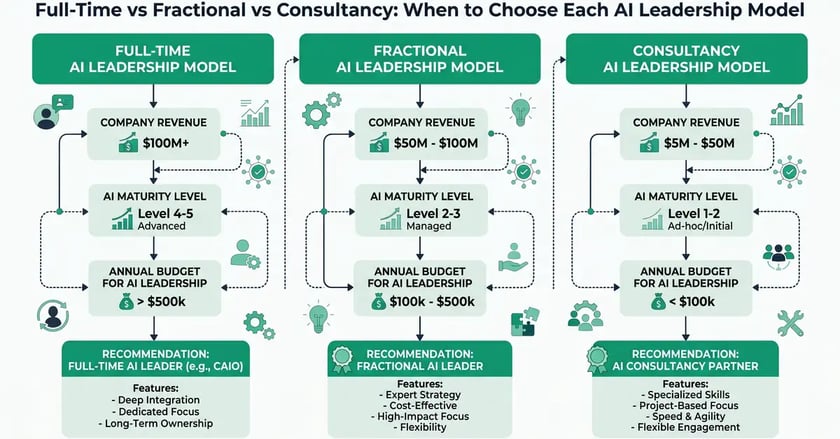
Fractional fits when:
- Revenue is between $5M and $50M and AI investment will be $100k–$1M over 12 months
- The company is running 2+ uncoordinated AI pilots with no central owner
- Compliance risk is material (regulated industry, EU customers, sensitive data) but no senior AI accountability exists
- Leadership wants a 90-day decision: scale, kill, or consolidate the AI portfolio
- The CEO is functioning as the de facto CAIO — and it is consuming the wrong hours
Full-time becomes necessary when:
- Revenue exceeds $100M or AI is core to the product (ML-as-product companies)
- AI headcount surpasses 15–20 engineers requiring daily executive management
- Regulatory scrutiny demands a named, permanent accountable officer
- Board or investors require a full-time AI leader for funding milestones
Common Mistake
Hiring a full-time CAIO before the company has a validated AI roadmap almost always destroys value. The new executive spends 6–9 months discovering what a fractional operator would have scoped in 30 days. Install fractional first; convert to full-time only when capacity genuinely exceeds 3 days per week for 6+ months.
The 90-Day Fractional CAIO Engagement Blueprint
A credible Fractional CAIO does not start with tools or pilots. They start with diagnosis. The engagement model below reflects the structure deployed by senior fractional operators in peppereffect's network and corroborates patterns documented in MBO Partners' 2025 State of Independence report, which now tracks over 500,000 fractional executives globally.
Days 1–30: AI Portfolio Audit
Inventory every AI pilot, vendor contract, data pipeline, and internal champion. Classify each by business outcome (revenue, cost, risk). Identify duplication, shadow AI, and governance gaps. Output: a single AI investment register with kill/keep/scale decisions. This phase alone typically reclaims 15–30% of AI spend from tools that duplicate capability.
Days 31–60: Governance & Architecture Installation
Deploy a lightweight AI governance framework aligned to the NIST AI Risk Management Framework. Establish model review, data handling policies, and vendor due diligence. Architect the target-state AI operating system — connecting Lead Generation, Sales, Operations, and Marketing pillars into a single logic-gated workflow. Output: risk register, governance charter, 12-month architectural blueprint.
Days 61–90: First Measurable ROI
Deploy 1–2 high-leverage agentic workflows with clear ROI metrics — typically cold email, proposal generation, or fulfilment automation. Establish weekly measurement cadence with CFO sign-off on ROI methodology. Output: at least one workflow producing verifiable Hours Reclaimed or margin expansion, validated by the finance function.
Unsure whether your AI portfolio needs a Fractional CAIO or a full systems overhaul? Our Growth Mapping Call diagnoses the gap in 45 minutes.
Book Your Growth Mapping CallHow Do You Measure Fractional CAIO ROI?
The discipline of the fractional model is measurable ROI — otherwise it becomes expensive advisory. The table below captures the benchmark KPIs used by senior fractional operators engaged with B2B SaaS, executive search, and coaching firms — the three ICPs peppereffect specialises in.

Strong engagements produce three categories of measurable outcome: margin expansion from workflow automation, velocity gains in sales or fulfilment cycles, and governance outcomes that reduce regulatory or reputational risk. Weak engagements produce dashboards. The difference is always accountability — which is why the structural question is whether the fractional operator will sign up to KPIs the CFO validates, or to activity reports.
The Fractionus 2025 market analysis estimates the fractional executive market at $5.7 billion globally, growing 14% annually through 2028, with AI leadership being the fastest-growing subsegment. Demand is outpacing supply — which is why due diligence on any individual operator matters.
| KPI Category | Benchmark | Measurement Window |
| AI spend efficiency | 15–30% reduction from portfolio consolidation | 90 days |
| Workflow Hours Reclaimed | 40–80 hours/week across go-to-market | 120 days |
| Sales cycle compression | 20–35% shorter for B2B SaaS deals | 180 days |
| Governance posture | NIST AI RMF alignment achieved | 60 days |
| Revenue per FTE | 15–25% increase within 12 months | 12 months |
Sources: Fractionus 2025 Market Trends, MBO Partners State of Independence, peppereffect engagement benchmarks

Red Flags When Hiring a Fractional CAIO
The fractional category has attracted both genuine senior operators and repackaged consultants. The distinction is material — weak hires cost 6–12 months of strategic drift. Apply the following filters before engaging anyone.
- No recent hands-on experience. If they have not personally deployed an AI system in the last 18 months, they are advising from memory. Decline.
- Platform agnosticism that becomes vagueness. A serious operator will have opinions on multi-agent architectures, MLOps stacks, and governance tooling. Vagueness indicates thin practitioner experience.
- No published thinking. Senior fractional operators publish. If there is no LinkedIn track record, podcast presence, or written framework, assume the authority is borrowed.
- Reluctance to commit to CFO-validated KPIs. If they will not sign up to measurable outcomes the finance function validates, they are advisory, not fractional.
- Single-client dependency. Fractional means multiple engagements. An operator with only one client is a contract employee — and usually priced as if they were one.
The Agentic Era Shift: Why the CAIO Role Is Accelerating
The Fractional CAIO is becoming structurally more important as the market transitions from tool-based AI (dashboards, single-task models) to autonomous agentic workflows. Agentic systems do not just produce analysis — they take action, spend budget, and change system state. That shift moves AI from a reporting function to an operating function — which requires executive oversight, not IT supervision.
The governance stakes are now material. The EU AI Act imposes binding obligations on high-risk systems, including internal accountability, technical documentation, and post-market monitoring. The NIST AI Risk Management Framework is rapidly becoming the de facto baseline for US enterprise procurement. For mid-market B2B companies selling into regulated buyers — financial services, healthcare, government — having a named, senior AI-accountable executive is no longer optional. The fractional model makes that compliance posture affordable.
Strategic Implication
Every mid-market B2B company with more than one active AI pilot now requires senior AI accountability. The only open question is whether that accountability sits in a full-time hire, a fractional engagement, or — dangerously — with a founder whose time is capped. The fractional model is the capital-efficient answer for the vast majority of $5M–$50M B2B companies.
How Does This Apply to Your Business?
peppereffect deploys Fractional AI leadership across three distinct ICPs, and the value equation differs meaningfully in each.
B2B SaaS ($10M–$40M ARR): The Fractional CAIO installs the AI maturity model, architects the governance framework, and deploys agentic workflows across the sales motion — compressing cycle times and letting the company reach $50M ARR without scaling management overhead.
Executive Search (Elite Global Firms): The Fractional CAIO automates the 70% of sourcing time consumed by manual filtering, installs a research-and-outreach engine, and protects brand quality through AI governance — lifting placement capacity per consultant by 2–3x.
Coaching & Consulting ($2M–$10M Firms): The Fractional CAIO builds the Freedom Machine — automating content, fulfilment, and student journeys so the founder's time is reclaimed without diluting the brand. This is where the Technician's Trap dissolves.
Install Fractional AI Leadership Without the Full-Time Cost
peppereffect is the Master Growth Architect for B2B founders and executives. We install the AI operating system your company needs to scale without headcount — with senior accountability, logic-gated execution, and CFO-validated ROI from day 30. Book a Growth Mapping Call to diagnose whether your company needs a Fractional CAIO engagement, a full systems overhaul, or a targeted intervention.
Book Your Growth Mapping CallRead: AI Automation Agency vs In-House Team →
Frequently Asked Questions
What does a Fractional Chief AI Officer cost?
Fractional CAIO engagements typically range from $5,000 to $25,000 per month, depending on scope, days per week, and the size of the AI portfolio. A two-day-per-week engagement with a senior operator who has 15+ years of AI leadership usually settles around $12,000–$18,000 monthly. This compares against $310,000–$1,000,000+ in total compensation for a full-time CAIO. The fractional model is typically 60–85% cheaper whilst delivering equivalent executive accountability for companies in the $5M–$50M revenue band. For peppereffect engagements, the model is bundled with our 4 Pillars workflow architecture for a fully installed outcome.
How long does a typical Fractional CAIO engagement last?
The baseline engagement is 90 days — long enough to audit the AI portfolio, install governance, and deploy at least one measurable ROI workflow. After that, successful engagements typically extend for 12–24 months on a rolling basis as the company deepens its AI operating system. Approximately 35% of engagements convert to full-time hires as the company scales past $75M in revenue and AI leadership demand exceeds three days per week. The transition is deliberately planned, so there is no strategic discontinuity between fractional and permanent leadership.
Can a Fractional CAIO really hold executive accountability?
Yes — and this is the structural difference from consulting. A credible Fractional CAIO signs a board-level engagement letter, attends executive leadership meetings, owns the AI risk register, and reports into the CEO. They are named as the accountable AI officer in governance documentation and compliance filings. What is fractional is the time, not the accountability. The model works because experienced senior operators can exercise judgement across multiple engagements in parallel — the same way a Fractional CFO holds financial accountability for multiple companies.
Fractional CAIO vs AI consultant — what's the real difference?
A consultant delivers recommendations. A Fractional CAIO delivers implemented systems and carries executive accountability. The consultant leaves a PowerPoint; the Fractional CAIO leaves a functioning AI workflow automation stack, a governance framework, and a measurement system the CFO can audit. Consultants typically bill at $300–$800 per hour with no outcome ownership. Fractional operators commit to KPIs the finance function validates. If an advisor will not sign up to CFO-measured outcomes, they are a consultant regardless of what their engagement letter calls them.
When should we convert from fractional to full-time CAIO?
Convert when the fractional operator is genuinely working more than three days per week on your engagement for six consecutive months, or when your AI team exceeds 15 engineers requiring daily executive management. Both signals indicate that the capital efficiency of the fractional model has been exhausted. Companies that try to convert earlier typically lose strategic momentum during the hiring process — which can take 4–9 months for credible CAIO candidates given supply constraints. Staying fractional for an extra 12 months is usually the right call when uncertain.
Does a Fractional CAIO integrate with our existing C-suite?
Properly structured, yes — the Fractional CAIO attends executive team meetings, has a seat in strategic planning, and collaborates with the CTO on technical architecture, the CIO on systems integration, and the CFO on ROI methodology. Integration friction occurs when the fractional operator is treated as an external vendor rather than an executive peer. Founders who get the most value from the model introduce the Fractional CAIO with full C-suite status from day one. The model fails when it is positioned as "the consultant who sits in the weekly" — because that reverts to advisory dynamics.
What's the first 30 days of a Fractional CAIO engagement actually like?
Expect intensive diagnosis, not deployment. The operator will interview every department leader, audit every AI vendor contract, map every data pipeline, and quantify every active pilot against a clear ROI or kill criterion. By day 30, you should have a complete AI investment register, a prioritised 90-day roadmap, and at least two decisions made — usually one pilot killed and one scaled. If the first 30 days produce tools or pilots rather than clarity, the engagement is mis-scoped. Diagnosis always precedes deployment in a disciplined engagement.
Resources
- Fortune — Chief AI Officer Hiring Shortage and the Most In-Demand Tech Role
- MIT Enterprise AI Report (via Unframe) — Why 95% of GenAI Pilots Fail
- McKinsey — The State of AI 2025: Value Capture and Leadership Gap
- Hatchworks — The Chief AI Officer Role Benchmark 2025
- The AI Hat — CAIO Compensation and Responsibilities Guide
- CloudFactory — The AI Leadership Gap in Mid-Market Companies
- PrimeAI Solutions — Fractional Chief AI Officer Engagement Models
- Fractionus — 2025 Fractional Executive Market Trends ($5.7B)
- Vendux — Fractional Executive Statistics and Benchmarks
- MBO Partners — State of Independence Research 2025
- NIST — AI Risk Management Framework (AI RMF)
- EU AI Act Service Desk — Official Act Text and Guidance
- Gartner — Multi-Agent Systems and Enterprise AI Architecture