

Building an executive search practice is a different operational problem from launching a recruitment agency. The launch question, covered in our recruitment agency business blueprint, is whether the founder can secure first clients and complete first placements. The practice-building question is whether the founder can engineer the people systems, methodology infrastructure, compensation architecture, and origination engine required to traverse the 5 maturity stages from solo consultant to scale boutique. The data is unforgiving. Most solo retained search practitioners remain stuck at Stage 1 (150,000 to 500,000 USD revenue, 4 to 8 mandates per year) for 5 years or more. The minority who advance beyond Stage 1 do so by making 6 to 8 specific decisions correctly in a specific sequence, often anchored in the financial model framework required to fund the transitions.
This article maps the practice-building decisions that determine whether an executive search firm scales from solo to small team to mid-boutique to scale boutique. Audience: solo retained search practitioners considering scaling, mid-career boutique founders at Stage 2 evaluating the path to Stage 3, and search firm Managing Partners architecting the next stage of growth. Coverage: the 5 maturity stages with revenue and headcount benchmarks, solo founder economics with effective hourly rate analysis, the first hire decision and researcher-versus-junior-consultant ROI calculation, the Stage 2 to Stage 3 team build, the practice methodology system requirements, specialisation versus generalisation trade-offs, the origination engine architecture, brand-building investment levels, scale-up investments for Stage 4, common failure patterns, compensation architecture across roles, PE-backed roll-up considerations, and the 7-phase practice building roadmap.
The 5 Maturity Stages of an Executive Search Practice
Executive search practices traverse 5 distinct maturity stages, each with defined revenue ranges, headcount structures, mandate concurrency, and margin profiles. The transition between stages requires structural decisions about people systems, methodology, and origination architecture that solo founders often delay or skip. Understanding the stage architecture is the prerequisite for designing the practice-building plan.
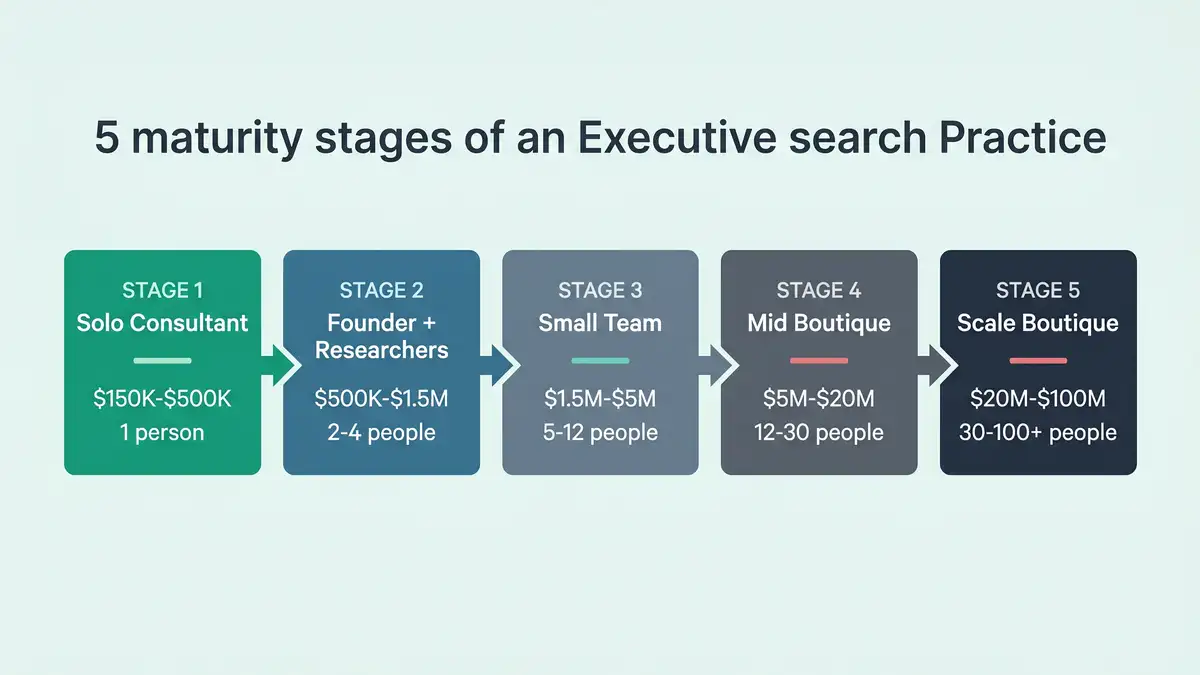
| Stage | Annual Revenue (USD) | Consultants / Researchers | Annual Mandates | Net Margin |
| 1. Solo Consultant | 150K - 500K | 1 / 0 | 4 - 8 | 60-70% |
| 2. Founder Plus Researchers | 500K - 1.5M | 1 / 1-3 | 8 - 20 | 35-55% |
| 3. Small Team Boutique | 1.5M - 5M | 3-8 / 2-6 | 20 - 50 | 25-35% |
| 4. Mid Boutique | 5M - 20M | 8-25 / 6-20 | 50 - 200 | 20-30% |
| 5. Scale Boutique | 20M - 100M | 25-100 / 20-80 | 200 - 800 | 18-28% |
Sources: Hunt Scanlon industry transformation analysis, IBISWorld US Executive Search Recruiters 2026
Stage transition timelines: Stage 1 to Stage 2 typically takes 2 to 4 years from first hire to a stable 500K to 1.5M USD operation. Stage 2 to Stage 3 takes another 2 to 3 years and requires the addition of consultants (not just researchers). Stage 3 to Stage 4 takes 3 to 5 years and demands operational infrastructure (COO or Practice Director, dedicated TA, formal methodology). The most consequential structural failure is Stage 1 stagnation: most solos remain stuck at the solo level for 5 plus years because the first-hire decision and the methodology investment are perpetually deferred.
Solo Founder Economics: The Maths That Drive the First-Hire Decision

The solo founder operates a high-margin but capacity-constrained business. Retained search fees at the standard 25 to 35 percent of placed executive's first-year compensation produce per-search economics of 90,000 to 180,000 USD on roles paying 300,000 to 600,000 USD all-in, per our analysis of executive search pricing models. Per Cowen Partners' analysis of executive search fee structures, the typical solo carries 4 to 6 active searches steady-state and completes 8 to 12 mandates per year. Average cycle time per retained search is 10 to 16 weeks.
The hourly economics are the constraint. Across 1,800 working hours per year, the solo producing 400,000 to 900,000 USD in gross fees realises an effective hourly rate of 220 to 500 USD. The FinancialModelsLab executive recruiting business plan documents that exceeding approximately 70 hours per search compresses margin materially; targeting 50 hours per search preserves the 60 to 70 percent solo net margin. Time allocation typically splits 40 percent on sourcing and research, 25 percent on client and business development, 20 percent on candidate management, and 15 percent on administration. The administrative tax is the lowest-leverage allocation and the first to delegate.
The economic ceiling on solo practice is approximately 500,000 USD revenue. Beyond that level the founder is operating at greater than 80 percent utilisation across the year, declining mandates due to capacity, and missing business development opportunities. The first hire becomes mathematical, not aspirational.
The First Hire Decision: Researcher Beats Junior Consultant
The single most consequential practice-building decision is who to hire first. The data is clear and counterintuitive: hire a researcher or search associate, not a junior consultant. The RecruiterU analysis of solo-to-firm transitions explicitly recommends starting with a recruiting coordinator or search associate rather than a full-desk consultant.

The economics: a researcher costs 45,000 to 80,000 USD base salary (per Glassdoor's executive search researcher salary data, average total pay USD 137,811 across all levels). The researcher amplifies founder capacity by handling time-intensive sourcing, longlist development, candidate screening, and initial outreach, freeing 25 to 35 percent of founder time. The founder reallocates that time to origination and client management, producing approximately 360,000 USD incremental annual revenue on 100,000 USD incremental fully-loaded cost (3.25x ROI).
A junior consultant at the same stage costs 80,000 to 150,000 USD base plus commission and requires senior consultant time for training and quality control. The result is 5 to 15 percent net margin drag without proportional capacity relief because the junior consultant cannot originate at meaningful levels and the founder must still drive both origination and assessment quality. The researcher-first sequence preserves founder economic leverage and accelerates the path to Stage 2.
The decision criteria for the first hire: revenue covers 2 to 3 times the fully loaded cost of the role, consistent 80 percent plus capacity utilisation for several consecutive quarters, 6 to 12 months of salary reserves to weather the ramp period, and total firm revenue of at least 400,000 USD.
The first-hire decision rule
Researcher first, consultant second. The researcher is a capacity multiplier on the founder's existing origination engine. The junior consultant is a salary line that requires the founder to invest training time before producing meaningful origination. Solos who reverse this sequence stall at Stage 1 for years.
Building the First Team: Stage 2 to Stage 3 Transition

Stage 2 to Stage 3 transition requires adding fee-earning consultants (not just researchers). The typical Stage 3 team structure: Founder Managing Partner plus 1 to 2 senior consultants plus 2 to 4 researchers plus 1 admin, totalling 5 to 8 people. Per-consultant origination expectations differ by seniority: founder MP at 800,000 to 1.5 million USD annual fee origination, senior consultants at 600,000 to 1 million USD, mid-level consultants at 400,000 to 700,000 USD. The researcher-to-consultant ratio of 2 to 3 consultants per researcher is the operational sweet spot.
Compensation architecture at Stage 3 produces both retention and economic discipline. Senior consultants typically earn 150,000 to 400,000 USD base plus 10 to 20 percent commission on personally originated and executed fees, with senior executive search consultant US average compensation at USD 213,601 per Glassdoor. Total compensation lands at approximately 25 to 35 percent of personally produced billings. Mid-level consultants earn 80,000 to 200,000 USD base plus 10 to 20 percent commission. Researchers earn 50,000 to 90,000 USD base plus 5 to 10 percent firm bonus. Target firm net margin at Stage 3 is 25 to 35 percent.
The Stage 3 risk: "pitch and switch" quality erosion. KiTalent's analysis of executive recruiting failures documents that the founder MP increasingly sells the work and junior consultants increasingly deliver it, producing the quality decline that AESC data correlates with 40 percent workload increase over the past decade and 25 percent decline in placement quality metrics. The defence is documented methodology and structured peer review.
The Practice Methodology System
The Stage 3 firm requires documented methodology that operates independently of founder presence. Quality control at solo scale runs through founder review of every assessment. Quality control at 5 to 8 person scale requires explicit frameworks, templates, peer review, and KPI tracking aligned with the 7-pillar executive search methodology framework.
Documented Search Process
Per Clockwork Recruiting's 8 stages of successful retained search, the workflow runs: find work, win work, strategy, research, outreach, assessment, decision, close and grow. JRG Partners documents a 12-week retained search timeline with explicit weekly milestones from briefing through onboarding. Each stage requires a documented template.
Quality Control Mechanisms
Peer review of shortlists before client presentation, MD sign-off on offer extensions, structured competency-based interview guides per BHCAG's behavioural interviewing methodology, post-placement reference reports with standardised templates. Quality control is the most common system failure in the Stage 2 to Stage 3 transition.
Knowledge Management Infrastructure
Candidate database with mandatory field structures, off-limits tracking with typical 1 to 2 year client restrictions per Caldwell's off-limits documentation, organisation charts as "talent treasure maps" per industry research. The ATS or CRM is the firm's institutional memory. Poor data hygiene at Stage 1 becomes a structural constraint at Stage 3.
KPI and NPS Measurement
Per HelloSky's executive search KPI benchmarking framework, the 5 core KPIs are time to shortlist, client satisfaction, candidate satisfaction, placed executive 6 to 12 month performance, and repeat business rate. NPS measurement at search conclusion segmented by consultant, sector, and service line provides the quality and growth signal.
Training and Career Progression
Structured analyst-to-consultant progression with documented competencies at each level, behavioural interviewing certification, shadow assignments before solo mandate ownership, and explicit revenue and quality thresholds for promotion. The career progression structure is what retains researchers and prevents the chronic mid-firm attrition that erodes Stage 3 firm economics.
Specialisation versus Generalisation
The structural decision that determines Stage 3 to Stage 4 transition velocity is whether the firm specialises or remains generalist. Specialisation produces higher service quality, deeper candidate pools, faster market mapping, and fewer off-limits conflicts than generalist firms attempting to cover all sectors. The three specialisation axes are sector (PE, healthcare, technology, financial services), function (CFO-only, CHRO-only, board-only), and geography (regional dominance). Hybrid specialisation combines axes: for example, CFOs for PE-backed mid-market tech and healthcare companies in North America.
Specialist boutiques outperform generalist Big Five firms in their target verticals. TGS US analysis of technology executive search firms documents the outperformance of vertical specialists like Riviera Partners, Heller Search, and Daversa Partners. The Big Five "SHREK" tier (Spencer Stuart, Heidrick & Struggles, Russell Reynolds, Egon Zehnder, Korn Ferry) offers broad coverage but carries extensive off-limits restrictions and elevated "pitch and switch" risk because of practice breadth.
The generalist trap: chasing every mandate produces methodology dilution, network shallowness across verticals, weakening positioning, and longer time-to-shortlist. The specialisation discipline is the procurement defence against generalist mediocrity. European specialist boutiques have particularly benefited as the region's recruitment market reached over 30 percent of global value in 2024 with 7.3 percent CAGR forecast through 2033.
The Origination Engine Architecture
Origination capacity is the binding constraint on practice growth above Stage 2. The mature practice operates a diversified channel mix: 40 to 60 percent of fee revenue from repeat business and direct referrals from existing clients and placed candidates, 20 to 30 percent from targeted outbound business development to PE firms, boards, and CHROs, 10 to 20 percent from inbound thought leadership (especially LinkedIn), and 5 to 10 percent from conferences, events, and association presence.
The structural target is 80 percent of fee revenue from repeat clients within 3 years of practice maturity. Per Hunt Scanlon's industry analysis, PE-backed portfolio companies represent the fastest-growing recurring mandate source, as documented in our guide to executive search for private equity. Founder origination targets at Stage 2 to Stage 3 are 2 to 4 new client relationships per quarter. Post-placement client cadence (30-day, 90-day, 180-day check-ins) is the operational discipline that converts one-time placements into multi-year relationships.
The CAC math at retained search scale: SaaS-style benchmarks suggest CAC payback under 12 months and CLV/CAC ratio above 3 to 1. On a 600,000 USD annual revenue target with 100,000 USD average fee per search, the math: 6 searches required, 50 percent pitch win rate, 90 percent completion rate, requiring approximately 12 credible pitches per year. Sustaining 12 credible pitches requires structured outbound business development plus inbound demand from thought leadership.
Architecting the recruiting operating system that compounds origination capacity across your practice?
Book a Growth Mapping CallBrand-Building Investments at Stage 2 and Stage 3
Brand-building is the long-cycle investment that produces 10 to 20 percent of new-client engagements within 3 years when executed consistently. The Stage 2 and Stage 3 firm typically allocates 5 to 10 percent of annual revenue (100,000 to 200,000 USD on a 2 million USD Stage 3 firm) to brand-building activities.
The content cadence target: 1 substantial article every 2 to 4 weeks plus 3 to 5 LinkedIn updates per week from the Managing Partner. Higher-value brand assets include annual benchmark reports on compensation, executive turnover, and leadership trends in the firm's specialisation vertical. Speaking engagement target: 3 to 6 industry events per year for the Managing Partner. AESC workshops and AESC events across global summits, regional events, and virtual sessions provide structured industry engagement.
Senior partner time allocation: 5 to 10 percent of working hours dedicated to thought leadership. The brand-building goal is to produce 10 to 20 percent of new-client engagements from thought-leadership inbound within 3 years, with the bulk of mandate volume still coming through repeat and referral channels.
Scale-Up Investments: Stage 3 to Stage 4

Stage 3 to Stage 4 transition requires operational infrastructure that the Stage 3 firm could run without. The investments cluster into four categories: technology stack, operational leadership, talent acquisition, and office or geographic expansion.
Technology stack: CRM and ATS systems are foundational. Bullhorn pricing runs 99 to 315 USD per user per month at base tier with total annual contracts for small teams starting around 20,000 USD. Alternatives include Recruiterflow, TrackerRMS, and Manatal at 15 to 100 USD per user per month. Per HRShelf's ATS implementation guide, 78 percent of ATS implementations fail when the 9-step roadmap is ignored, with key stakeholders typically committing 5 to 10 hours per week over a 6 to 12 week deployment window. Annual tech spend per consultant ranges 2,000 to 8,000 USD across CRM, sourcing tools (LinkedIn Recruiter, hireEZ, Gem), assessment platforms, and video interviewing.
Operational leadership: COO or Practice Director at 150,000 to 300,000 USD typically only justified above 3 million USD revenue. Dedicated Talent Acquisition role typically only justified above 5 million USD revenue. Premature operational hiring at Stage 3 produces salary drag without commensurate productivity gain.
The 5 Common Failure Patterns
Practice-building failures cluster into 5 patterns that compound over time and become structurally difficult to reverse.
Failure pattern 1: Wrong first hire
Hiring a junior consultant before a researcher produces 5 to 15 percent net margin drag without capacity relief and stalls Stage 1 to Stage 2 transition.
Failure pattern 2: Pitch and switch quality erosion
Founder MP sells the work, junior consultants deliver it, KiTalent documents 87 percent of firms underperforming because of this dynamic. The defence is documented methodology and peer review.
Failure pattern 3: Overloaded consultants
Stage 3 consultants carrying 8 to 12 concurrent searches (vs healthy 3 to 4) produce time-to-shortlist degradation, candidate experience failures, and chronic mid-search abandonment. Capacity discipline is the operational defence.
Failure pattern 4: Founder bottleneck
Founder MP unwilling to delegate origination, client management, or quality control creates a capacity ceiling that no amount of headcount can scale past. The Freedom Machine framework directly addresses this.
Failure pattern 5: ATS or CRM implementation failure
78 percent of ATS implementations fail when the structured 9-step roadmap is ignored. Poor data hygiene at Stage 1 becomes a structural constraint at Stage 3 that requires expensive remediation.
Compensation and Equity Architecture
Compensation architecture at each maturity stage determines whether the firm retains talent through transitions or loses senior consultants to competitors. The stage-by-stage compensation framework reflects the changing economics and reward structures required as the firm scales.
| Role | Base Salary | Variable Comp | Equity Eligibility |
| Founder Managing Partner | Profit distribution USD 500K-3M | Full firm profits | 100% (sole or majority) |
| Senior Consultant | USD 150K-400K | 10-20% commission + bonus | 0.5-5% above $3M revenue |
| Mid-Level Consultant | USD 80K-200K | 10-20% commission + bonus | Rare below $5M revenue |
| Research Analyst | USD 50K-90K | 5-10% firm bonus pool | Profit-share at scale firms |
| COO / Practice Director | USD 150K-300K | Performance bonus + equity | 0.5-3% typically |
Sources: Glassdoor Senior Consultant Compensation, Glassdoor Researcher Compensation
Equity programs typically only become meaningful above 3 to 5 million USD revenue. Below that level, equity dilution exceeds operational benefit. Profit-sharing structures are common at small boutiques as a bridge to formal equity programs. Senior consultant equity grants of 0.5 to 5 percent with 4-year vesting and exit acceleration are typical at Stage 4 boutiques.
PE-Backed Roll-Up Considerations
The executive search M&A market has consolidated meaningfully through PE-backed roll-up activity, particularly in the mid-market boutique tier. M&A multiples for executive search firms range from 1 to 3 times revenue for smaller boutiques (500K to 2M USD revenue) to 4 to 8 times EBITDA at scale (3M USD plus revenue with 20 percent plus net margin), per FirstPageSage's industry EBITDA multiples analysis.
Strategic acquirer landscape includes ZRG Partners, True Search, and Caldwell Partners on the PE-backed side, plus traditional Big Five expansion. Earn-out structures are typically 50 to 70 percent of total consideration paid over 3 to 5 years tied to revenue or EBITDA milestones, with founder lock-up periods of 3 to 4 years and rollover equity participation typically 10 to 30 percent of consideration. The cultural integration challenge is the most consistent failure mode in PE roll-ups: senior consultants and Managing Partners often depart 18 to 30 months post-close as earn-out incentives diminish and acquirer operating models clash with boutique founder culture. Per A Simple Model's PE roll-up overview, the structural success rate of search-firm roll-ups depends heavily on retention engineering during the earn-out period.
The 7-Phase Practice Building Roadmap
Year 1 to 2: Solo Foundation
Establish brand, complete first 8 to 12 mandates, build CRM hygiene from day one, formalise methodology documentation in parallel with execution. Target 250K to 500K USD year-one revenue. Begin LinkedIn thought leadership cadence.
Year 2 to 3: First Researcher Hire
At 400K to 500K USD revenue with consistent 80 percent plus utilisation, hire researcher at 45K to 80K USD base. Reallocate 25 to 35 percent of founder time to origination. Target Stage 2 revenue of 600K to 900K USD by year 3.
Year 3 to 4: Specialisation Decision
Commit to specialisation axis (sector, function, geography, or hybrid). Build vertical-specific candidate pool, content thought leadership, and client portfolio. Publish first annual benchmark report in the vertical. Target 1M to 1.5M USD revenue.
Year 4 to 5: First Senior Consultant Hire
Add first senior consultant at 150K to 250K base plus commission. Implement structured search methodology with peer review. Target Stage 3 entry at 1.5M to 2.5M USD revenue. Begin profit-sharing or limited equity program.
Year 5 to 6: Methodology Industrialisation
Document all search lifecycle templates, implement KPI dashboard, deploy NPS measurement, formalise off-limits tracking, establish quality control gates at shortlist and offer stages. Target 3M to 4M USD revenue with 5 to 8 person team.
Year 6 to 8: Stage 3 to Stage 4 Transition
At 3M USD plus revenue, hire COO or Practice Director. At 5M USD plus, add dedicated TA. Implement enterprise ATS and full tech stack. Expand to second office or geography. Target Stage 4 entry at 5M to 8M USD revenue.
Year 8 to 12: Scale Boutique or Exit
Two paths diverge at Stage 4. Path A: continue organic scale to 20M USD plus through partnership equity programs, geographic expansion, and vertical depth. Path B: evaluate PE-backed roll-up exit at 4 to 8 times EBITDA multiple with 3 to 5 year earn-out. Both require formal practice valuation work.
Architect the recruiting operating system that compounds practice capacity across all 5 maturity stages
Building a scalable executive search practice requires deliberate decisions about methodology systems, compensation architecture, origination infrastructure, and operational leadership at each stage transition. peppereffect installs the agentic workflows that decouple practice capacity from founder hours, automate the 70 percent of manual sourcing work, and protect the AESC-tier methodology that justifies premium fee positioning. The Freedom Machine framework directly addresses the founder bottleneck failure pattern that stalls most solos at Stage 1 indefinitely.
Book a Growth Mapping CallFrequently Asked Questions
What are the 5 maturity stages of an executive search practice?
The five maturity stages are: Stage 1 Solo Consultant (150K to 500K USD revenue, 4-8 mandates per year, 60-70 percent net margin); Stage 2 Founder Plus Researchers (500K to 1.5M USD revenue, 1 founder plus 1-3 researchers, 35-55 percent margin); Stage 3 Small Team Boutique (1.5M to 5M USD revenue, 3-8 consultants plus 2-6 researchers, 25-35 percent margin); Stage 4 Mid Boutique (5M to 20M USD revenue, 8-25 consultants, 20-30 percent margin); Stage 5 Scale Boutique (20M to 100M USD revenue, 25-100 consultants, 18-28 percent margin). Most solos remain stuck at Stage 1 for 5 plus years.
How much revenue can a solo executive search consultant generate?
A solo retained search consultant typically generates 150,000 to 500,000 USD in year one, ramping to 400,000 to 900,000 USD in years two and three at maturity. The solo consultant runs 4 to 6 active searches steady-state and completes 8 to 12 mandates per year at 25 to 35 percent retainer fees on first-year compensation. Effective hourly rate ranges from 220 to 500 USD across 1,800 working hours. Net margin sits at 60 to 70 percent because the solo carries no overhead, producing pre-tax personal income of 240,000 to 630,000 USD.
When should a solo executive search consultant make their first hire?
A solo consultant should make their first hire when revenue covers 2 to 3 times the fully loaded cost of the new role, when consistent 80 percent plus capacity utilisation has been achieved for several consecutive quarters, when 6 to 12 months of salary reserves exist, and when total firm revenue reaches at least 400,000 USD. The first hire should be a researcher or search associate at 45,000 to 80,000 USD base salary, NOT a junior consultant. The researcher frees 25 to 35 percent of founder time and lifts annual mandate capacity from 8 to 12, producing approximately 360,000 USD incremental revenue on 100,000 USD incremental cost, a 3.25x ROI.
Why hire a researcher before a junior consultant?
Researchers cost 45,000 to 80,000 USD base and amplify founder origination capacity by handling time-intensive sourcing, market mapping, longlist development, and candidate screening. Junior consultants at Stage 1 typically cost 80,000 to 150,000 USD base plus commission and require senior consultant time for training and quality control, producing 5 to 15 percent net margin drag without proportional capacity relief. The researcher-first sequence preserves founder origination time and accelerates the path to Stage 2.
What is the per-consultant origination expectation in a Stage 3 boutique?
Per-consultant origination expectations in a Stage 3 small team boutique are: founder Managing Partner 800,000 to 1.5 million USD annual fee origination; senior consultants 600,000 to 1 million USD; mid-level consultants 400,000 to 700,000 USD. Senior consultant compensation typically runs 150,000 to 400,000 USD base plus 10 to 20 percent commission on personally originated and executed fees, producing total compensation of 250,000 to 600,000 USD or approximately 25 to 35 percent of personal billings.
What is the practice methodology system requirement at Stage 3?
Stage 3 firms require documented frameworks across the full search lifecycle: kickoff briefing templates, market mapping protocols, structured competency-based interview guides, reference report templates, peer review of shortlists, MD sign-off on offer extensions, organised candidate database with mandatory field structures, off-limits tracking with typical 1 to 2 year client restrictions, post-placement NPS measurement, and KPI tracking across time-to-shortlist, client satisfaction, candidate satisfaction, placed executive 6-12 month performance, and repeat business rate. Without documented methodology, the firm cannot scale beyond founder-led quality control.
How do specialisation choices affect search practice growth?
Specialisation produces materially higher service quality, deeper candidate pools, faster market mapping, and fewer off-limits conflicts than generalist firms attempting to cover all sectors. The three specialisation axes are sector (PE, healthcare, technology, financial services), function (CFO-only, CHRO-only, board-only), and geography (regional dominance). Hybrid specialisation combines axes: example, CFOs for PE-backed mid-market tech and healthcare companies in North America. Specialist boutiques like Riviera Partners, Heller Search, and Daversa Partners have outperformed generalist Big Five firms in their target verticals.
Resources
- Hunt Scanlon: Executive Search Industry Transformation Analysis
- IBISWorld: US Executive Search Recruiters 2026
- Cowen Partners: Executive Search Fee Structures
- FinancialModelsLab: Executive Recruiting Business Plan
- The RecruiterU: Solo to Firm Transition
- Glassdoor: Executive Search Researcher Compensation
- Glassdoor: Senior Executive Search Consultant Compensation
- Clockwork Recruiting: 8 Stages of Successful Retained Search PDF
- JRG Partners: 12-Week Retained Search Timeline
- KiTalent: Executive Recruiting Failures Analysis
- Caldwell: Off-Limits Documentation
- HelloSky: Executive Search KPI Benchmarking
- BHCAG: Behavioural Interviewing Methodology
- HRShelf: ATS Implementation Guide
- TGS US: Top Technology Executive Search Firms
- FirstPageSage: EBITDA Multiples by Industry
- A Simple Model: Private Equity Roll-Up Overview
- AESC: Workshops
- AESC: Events
executive search KPI dashboard architecture multi-channel sourcing playbook Boolean search templates by executive role RPO encroachment on executive search executive search marketing operating system recruitment firm profitability operating discipline scaling a recruitment firm from 5 to 50 consultants scaling from 5 to 50 consultants without losing culture executive search client relationships recruitment operations manual for boutique firms 7-pillar BD operating system strategic positioning matrix for boutique search firms EBITDA multiple framework for exit planning succession planning as the advisory layer 7-pillar brand architecture for boutique firms technology executive search practice build