

A recruitment agency business plan is not a 40-page PDF that sits in a drawer. It is a working financial model and a growth-strategy framework that determines whether the agency hits £1M in revenue inside 24 months or burns through working capital chasing margin that never arrives. The recruitment industry is large, the unit economics work, and the failure modes are predictable. The plan that survives contact with reality is the one that quantifies the variables, models the cash flow honestly, and sequences the growth levers in the right order.
This article installs the financial-model and growth-strategy components of a working recruitment agency business plan, designed for prospective founders building the plan for the first time and for established Managing Directors restructuring the firm to scale past £1M revenue. Industry context anchors the work: the UK recruitment sector contributed £40.6 billion in gross value added in 2024, per the REC's economic contribution report, while the US staffing market reached $180.2 billion in 2026 per SIA's industry forecast. The opportunity is there. The execution is the bottleneck.
What you will learn in this article:
- The 9-section business plan structure used by SBA and growth-stage investors
- The 3-year financial projection model across three founder scenarios
- Realistic placement fee economics, revenue per recruiter, and operating expense ratios
- The cash conversion cycle math that breaks undercapitalised agencies
- A 36-month hiring cadence with realistic team economics and ramp curves
- The four growth strategy frameworks (vertical depth, horizontal expansion, geographic, M&A)
- Capital structure options from bootstrap through growth equity
- The 12 KPIs that distinguish operationally excellent agencies from struggling ones
Key Takeaway
A recruitment agency business plan is a financial model with a growth strategy attached, not a narrative document. The unit economics either work (revenue per recruiter above £200K, gross margin above 50%, net margin compounding to 20%+ by year three) or they do not. Model the numbers honestly, then sequence the levers. Founders who skip the financial model land in working-capital crises in month nine; founders who build it find the levers that pull the firm to £1M.
What Does a Recruitment Agency Business Plan Actually Contain?
The format that survives investor scrutiny and operational use is the 9-section structure documented in the SBA business plan framework and codified for recruitment in Growthink's recruiting company plan template. The sequence is the executive summary first, market analysis second, then service offering and unit economics, marketing and sales plan, operations plan, management team, financial projections, funding request, and the appendix. Each section drives a decision the founder must defend.
| Section | Length | Critical content |
| 1. Executive Summary | 1-2 pages | Niche, model, 3-year financial summary, capital ask |
| 2. Market Analysis | 3-5 pages | TAM/SAM/SOM for the niche, competitor landscape, regulatory environment |
| 3. Service Offering & Unit Economics | 3-4 pages | Engagement model, fee structure, unit margin, placement count assumptions |
| 4. Marketing & Sales Plan | 3-4 pages | BD strategy, content engine, channel mix, cost per client acquisition |
| 5. Operations Plan | 2-3 pages | Tech stack, sourcing infrastructure, delivery process, vendor relationships |
| 6. Management Team | 1-2 pages | Founder bio, advisory board, hiring plan with named role profiles |
| 7. Financial Projections | 5-8 pages | 3-year P&L, cash flow, balance sheet, sensitivity analysis |
| 8. Funding Request | 1-2 pages | Capital ask, use of funds, valuation if equity, exit scenario |
| 9. Appendix | Variable | CVs, legal documents, market research detail, contracts |
Sources: SBA Business Plan Framework, Growthink Recruiting Plan Template, Growthink Recruitment Plan Help Center
The financial projections section carries the most weight. Investors and bank lenders go there first, and operational founders return to it every quarter. The rest of the plan justifies the assumptions in the model.
How Do You Build the Financial Model?

The financial model rests on three layers: unit economics (the math of a single placement), revenue model (the math of a recruiter's annual production), and operating model (the math of the whole firm). Build them in that order. Financial Models Lab's headhunter cost framework and RecruitHub's agency owner economics document the benchmarks that hold up under stress.
Unit economics at the placement level. Contingency: 15 to 25 percent of first-year salary, paid only on placement, with a 20 percent benchmark for executive roles. A £60,000 placement at 20 percent yields £12,000 revenue, against roughly £6,000 to £8,000 of fully-loaded recruiter time. Fusion Recruiters' fee analysis documents the structural difference. Retained: 25 to 35 percent of total comp, billed in thirds (engagement, shortlist, placement). A £150,000 executive search at 30 percent yields £45,000 across three invoices, with positive cash flow from day 30. Temp and contract: 20 to 75 percent markup over the candidate pay rate, settling at roughly 25 percent gross margin after employer burden, per Advance Partners' payroll funding analysis.
Revenue model at the recruiter level. Industry benchmark for a mature contingency recruiter is £150,000 to £450,000 in annual billings, per Juicebox's 2026 commissioning guide. Top-quartile recruiters bill £500,000-plus annually with case studies of £300,000 monthly. The ramp curve matters: a new recruiter typically hits 20 to 30 percent of full target in months 1-3, 50 to 60 percent by month 6, and 80 to 100 percent by month 12. Plan for the ramp in your model, not for the steady state.
Operating model at the firm level. Financial Models Lab's owner-income data and Iota Finance's 2026 agency margin benchmarks give the cost structure: recruiter compensation including commission runs 40 to 55 percent of revenue, technology stack 3 to 8 percent, office and facilities 5 to 10 percent, BD and marketing 5 to 10 percent, professional services around 1 to 2 percent. The residual is net margin, which is loss-making to marginal in year one, 5 to 15 percent in year two, and 20 to 30 percent in year three at scale.
What Do the 3-Year Financial Projections Look Like?
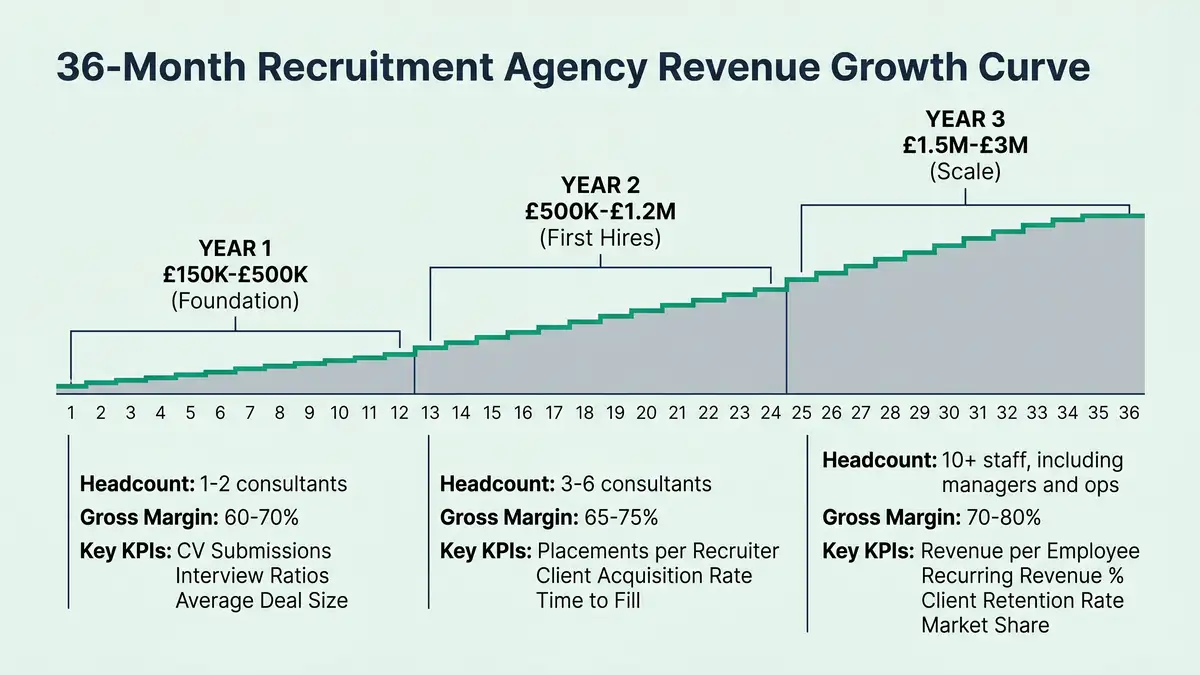
The three founder scenarios below cover the realistic universe of recruitment agency starts. Pick the scenario that matches the founder profile, capital base, and target market, then run sensitivity analysis on the key variables.
| Scenario | Year 1 | Year 2 | Year 3 | Year-3 net margin |
| Solo founder contingency | £100K (8-12 placements) | £200K (founder + part-time) | £400-500K (founder + 1 recruiter) | 15-20% |
| Team-based contingency / retained hybrid | £500K (3 recruiters) | £850K-£1.0M | £1.5M-£1.8M | 30-35% |
| Specialist retained search | £320K (2 senior recruiters, 8 mandates) | £480K | £1.0M-£1.2M | 40-45% |
Sources: RecruitHub Owner Economics, Financial Models Lab, Iota Finance 2026 Margins, Fusion Recruiters
The specialist retained scenario produces the highest net margin because of fee structure and lower mandate concurrency. The team-based hybrid produces the highest absolute revenue at year three because of recruiter leverage. The solo contingency scenario produces the lowest risk because of the bootstrap capital base. There is no objectively right scenario, only fit-to-profile. peppereffect's earlier recruitment agency business blueprint details the 12-step launch sequence that sits underneath the financial projections, and our retained vs contingency analysis covers the model selection that drives the unit economics in the table above.
Why Is Cash Flow More Important Than Revenue in Year One?

The undercapitalisation failure mode that kills 30 to 40 percent of new recruitment agencies in year one is almost always a cash flow problem, not a revenue problem. Advance Partners' cash flow research documents the structural mismatch: invoices typically settle on Net 30 to Net 60, MSP contracts run Net 45 or longer, and temp staffing requires payroll funding 30 to 45 days ahead of client payment.
The worked math: a temp staffing agency with 50 contractors at £18 per hour for 40 hours per week generates £36,000 in weekly payroll commitments. At Net 45 client terms, that is approximately £216,000 of working capital tied up before the first invoice settles, per Encore Funding's cash conversion cycle calculator. Permanent placement agencies face a milder version of the same problem: a £500,000 revenue contingency firm needs roughly £10,000 to £20,000 in working capital just to bridge the typical 30 to 60 day DSO. Retained search is the only model with materially positive cash flow from day 30, because the first retainer tranche is billed at engagement signing.
The working capital options are well-mapped. Bank overdraft facilities of £50,000 to £100,000 become available after 12 months of trading at 4 to 8 percent interest. Specialist recruitment factoring providers like Sonovate advance 70 to 90 percent of invoice value at 1 to 3 percent service charge plus setup fees. The Commercial Factor's 2026 staffing analysis documents the structural role factoring plays in growing recruitment firms.
What Are the Key Operating KPIs?

The operating KPIs that distinguish well-run agencies from struggling ones are documented across Bullhorn's 10 KPIs research, RecruitBPM's 2026 KPI guide, and Pin's cost-per-hire benchmarks. Three layers matter: universal recruitment metrics, model-specific metrics, and recruiter-level metrics.
Universal metrics. Time to Fill benchmark sits at 36 to 42 days for non-executive roles. Fill Rate target is 85 percent or higher. Cost per Hire ranges from £3,000 for mid-tier to £30,000 plus for executive search. Revenue per Recruiter target is £150,000 to £300,000 for permanent placement. Gross Margin target is 50 percent or higher. Net Profit Margin is tracked quarterly and trended over the rolling 12 months.
Model-specific metrics. Retained: Mandate Close Rate (30 to 40 percent for new firms, 50 to 70 percent for mature operators) and Average Fee per Mandate. Temp and contract: Utilisation Rate (75 to 85 percent target for front-line consultants) and Redeployment Rate (70 to 80 percent of departing contractors should be redeployable). RPO contracts: cost per hire (£3,000 to £10,000 typical range) or monthly retainer (£8,000 to £15,000) plus net margin (15 to 25 percent, lower than direct placement), per Spectraforce's RPO cost analysis.
Recruiter-level metrics. Pipeline coverage (3x to 4x of monthly placement target), conversion rate at each stage, average days between first contact and placement, and revenue per recruiter year-on-year trend. These KPIs feed into the weekly business review cadence that peppereffect installs through its executive search process framework.
What Are the Four Growth Strategy Frameworks?

Once the unit economics work and the firm crosses £500K in annual revenue, the growth strategy decisions become the highest-leverage choices. The four canonical levers are vertical deepening, horizontal expansion, geographic expansion, and M&A.
Vertical Deepening
Concentrate on two or three adjacent verticals (e.g. fintech, RegTech, capital markets) for 18 to 24 months. Outcome: 30 to 40 percent premium fees, 20 to 30 percent shorter time-to-fill, 80 percent or higher client retention. This is the highest-margin growth lever and the one peppereffect recommends first for boutique firms.
Horizontal Expansion
Add one new function or vertical per year (e.g. banking ops to compliance/audit, then to risk and to data engineering). Slower than vertical deepening but builds long-term breadth that supports cross-mandate referrals and larger client wallets.
Geographic Expansion
Hire a local branch leader, not a junior consultant. Geographic moves take 12 to 18 months before meaningful revenue and the failure mode is weak branch leadership. London and New York are the natural first international moves for UK firms; Singapore and Dubai for executive search firms with finance and tech focus.
M&A and Acqui-hire
Acquire small founder-led teams (£500K to £2M revenue) at 1 to 3x revenue or 4 to 8x EBITDA at scale, per Raincatcher's staffing M&A multiples. M&A is the fastest path to £5M+ revenue but requires growth equity or bank acquisition financing.
A fifth growth lever is channel expansion through RPO, MSP, or master vendor contracts, often unlocked through AI-augmented executive search workflows that reduce delivery cost without compromising depth. These produce recurring revenue at lower margin (15 to 25 percent versus 25 to 35 percent for direct placement) and should typically cap at 30 percent of total revenue to protect blended margin.
Your business plan should compound through disciplined execution, not optimistic spreadsheets. peppereffect installs the operating system that elite recruitment firms use to scale predictably.
See the Freedom Machine Architecture →What Capital Structure Options Should You Consider?
The capital structure decision determines the founder's equity dilution, the funding runway, and the strategic flexibility for years two and three. The realistic options for recruitment agencies range from pure bootstrap through bank debt and angel investment to growth equity.
| Capital structure | Capital range | Cost | Use case |
| Bootstrap | £10K to £30K founder capital | Zero dilution, 3-6 months to first placement | Solo founder, contingency or container model |
| Bank debt / overdraft | £50K to £100K facility after 12 months | 4 to 8% interest | Working capital for £500K+ revenue agency |
| Invoice factoring | 70 to 90% advance on invoices | 1 to 3% service charge plus setup fees | Temp/contract or fast-growing perm agency |
| Angel / seed | £200K to £500K for 10-30% equity | Valuation £1M-£2M post-money | Founders without trading history; ambitious roadmap |
| Growth equity (Series A) | £500K to £2M for 20-25% equity | Pre-money £4M-£5M, 25-30% IRR target | £1M+ revenue agency with 20-25% margins |
Sources: Sonovate Factoring Costs, Advance Partners Payroll Funding, Raincatcher Staffing Multiples
The majority of UK and US recruitment agencies bootstrap and never raise equity. The exception is high-growth specialist firms that target a defined exit window, where growth equity at year two or three accelerates the team build and the M&A roll-up strategy. The right capital structure is the one that matches the operating plan, not the most ambitious option available.
How Should You Sequence the Hiring Cadence?
The hiring cadence is the second-most-important variable in the financial model after gross margin. The wrong first hire absorbs 6 to 12 months of founder bandwidth without producing meaningful revenue. The right sequencing compounds.
| Phase | Team | Revenue range | Operating focus |
| Months 1-6 | Founder solo | £50K-£150K cumulative | First placements, brand, client acquisition |
| Months 7-12 | Founder + 1 researcher | £300K-£500K cumulative | Founder bandwidth multiplication; first recruiter on-ramp |
| Months 13-24 | Founder + 3 to 4 recruiters | £700K-£1.2M annual | Recruiter ramp, KPI discipline, second-tier hires |
| Months 25-36 | 5 to 6 recruiters + operations support | £1.5M-£2M annual | Process formalisation, gross margin defence, growth lever selection |
Sources: Pin Commission Structures, Juicebox 2026 Commissioning Guide
Single recruiter cost: £75,000 to £85,000 all-in (£40,000 to £45,000 base plus commission, plus desk costs and tech) against £250,000 annual billings produces roughly £50,000 gross profit per recruiter, or about 20 percent margin. The math works because the founder retains the high-fee strategic mandates while the team builds the recurring placement engine. peppereffect's guide to hiring senior commercial talent covers the structural decisions for senior partner hires beyond the first two recruiters.
What Are the Failure Modes from a Financial-Model Lens?
| Failure mode | Symptom | Antidote |
| 1. Undercapitalisation | Year-one cash crunch in month 7-9; founder takes wage cuts | £50K working capital per new recruiter before launch |
| 2. Margin compression | New recruiters discount to 15% to win first deals | Fee policy: no discounts on contingency below 18%; refuse contingency on retained roles |
| 3. Cash conversion mismatch | Paying weekly contractor payroll, collecting Net 60 | Invoice factoring at 70-90% advance; client diversification |
| 4. Recruiter turnover | £300K biller leaves; immediate £60K revenue loss, 6-12 month replacement ramp | Equity for second hire, structured progression, founding-team commission |
| 5. Vertical concentration | Single client more than 30% of revenue; one contract loss collapses the firm | Cap any single client at 20% of revenue; broaden by vertical or function |
Sources: Advance Partners Cash Flow Research, Margin Compression Analysis, Bullhorn GRID 2026
Avoid This Mistake
Do not let any single client exceed 20 percent of revenue in years one to three. The single fastest path to an existential cash crunch is the loss of a large client whose receivables dominate the balance sheet. UK permanent placements fell 33.5 percent from 2023 to 2024 (806,400 to 536,400 placements per the REC), and firms with concentrated client books were the ones that exited the market. Diversification is the cheapest insurance you will ever buy.
What KPIs Should the Plan Track and Report on Quarterly?
Key Takeaway
The recruitment agencies that scale to £1M and beyond are the ones that treat the business plan as a working financial model and operating dashboard, not a static document. Three rules: review actual vs forecast every quarter, recalibrate annually, and never let any single variable drift more than 15 percent without renegotiating the operating decisions that depend on it.
The quarterly report should cover six dimensions. Revenue: actual vs forecast, broken by recruiter, vertical, and engagement model. Gross margin: actual percentage versus the 50 percent target floor. Cash position: closing balance, DSO, and 90-day cash forecast. Pipeline: active mandates, weighted pipeline value, conversion rate at each stage. Team: headcount, recruiter ramp curves, attrition. Strategic: progress against the growth strategy framework chosen (vertical, horizontal, geographic, or M&A). This is the same operating cadence peppereffect installs through its CEO dashboard framework and the agentic infrastructure documented in our executive search automation playbook.
Frequently Asked Questions
How much working capital do I need to start a recruitment agency?
Realistic working capital depends on the engagement model and team size. A solo founder running a bootstrapped contingency model needs £10,000 to £30,000 plus 6 to 12 months of personal living expenses. A team-based hybrid agency launching with three recruiters needs £200,000 to £500,000 to cover salaries through the recruiter ramp curve plus working capital to bridge 30 to 60 day client DSO. A specialist retained search firm at the same headcount needs less working capital because the first retainer tranches produce day-30 cash flow. The single most common failure mode in year one is undercapitalisation, so plan for the worst case in your model and validate the runway before launch.
What revenue should a new recruitment agency target in year one?
Realistic year-one revenue ranges by scenario. A solo founder contingency agency typically lands at £100,000 to £150,000 in year one (8 to 12 placements at an average £12,000 fee). A team-based agency with three recruiters can reach £500,000 if the founder has an existing network. A specialist retained search firm with two senior recruiters typically books £300,000 to £400,000 in year one because mandates are larger but cycles are longer. These benchmarks come from RecruitHub's owner economics data and Financial Models Lab's headhunter benchmarks.
What is a healthy gross margin for a recruitment agency?
The benchmark gross margin for a recruitment agency is 50 percent or higher, scaling to 60 to 70 percent at maturity for specialist retained search firms. For temp and contract staffing the gross margin is lower (typically 25 percent after employer burden) because of the pay-rate markup model. Gross margin is the single most predictive financial KPI for long-term agency health, per Iota Finance's 2026 benchmarks. Firms that let gross margin slip below 45 percent are typically discounting fees to win business, which compresses net margin to zero and accelerates founder burnout.
How long does it take to be profitable?
Year one is typically loss-making or marginal for a recruitment agency. Year two should produce 5 to 15 percent net margin as the recruiter ramp completes and overhead absorbs across higher revenue. Year three produces 20 to 30 percent net margin at scale for well-run boutique agencies. Retained search firms reach the 20 percent mark faster because of fee structure and lower mandate concurrency. Bootstrapped solo founders running contingency typically retain 30 to 50 percent of total billings as personal income, which is structurally higher than team-based agencies but caps at the founder's personal billing capacity.
What multiples do recruitment agencies sell for?
M&A multiples for recruitment agencies range from 1 to 3x revenue for smaller firms (£500K to £2M revenue) to 4 to 8x EBITDA at scale (£3M+ revenue with 20 percent plus net margin), per Raincatcher's staffing M&A multiples. The multiple depends on niche specialisation, recurring revenue share, client diversification, retained-search positioning, and recruiter retention. Specialist firms in high-margin verticals (executive search, biotech, financial services) consistently command higher multiples than generalist contingency agencies. The exit pathway is the strategic backstop for founders who want a defined liquidity window inside five to seven years.
Should I use invoice factoring?
Invoice factoring is a useful working capital tool for temp and contract recruitment agencies and for fast-growing permanent placement firms with concentrated DSO. Specialist providers like Sonovate advance 70 to 90 percent of invoice value at 1 to 3 percent service charge plus setup fees. The trade-off is cost: a 2 percent factoring fee on a £500,000 revenue agency is £10,000 per year, which is meaningful margin compression. Use factoring as a growth bridge, not as a permanent capital structure. Most established agencies replace factoring with a bank overdraft after 18 to 24 months of trading.
How do I choose between bootstrap and equity funding?
The choice depends on the founder's personal financial runway, the agency's capital intensity, and the strategic ambition. Bootstrap is the right choice for solo founders or two-partner teams with existing client networks who can produce first placements inside 90 days. Bootstrap preserves 100 percent equity and forces operational discipline. Equity funding is the right choice for agencies pursuing aggressive scale (M&A roll-ups, geographic expansion, or specialist verticals requiring heavy upfront investment), where £200,000 to £2 million of capital accelerates the team build by 12 to 18 months. The dilution cost is real (10 to 30 percent equity), but the operational acceleration can be worth it if the founder has a defined exit window and the unit economics are proven. Most UK and US recruitment agencies bootstrap and never raise equity.
Build the Operating System That Lets Your Recruitment Agency Scale Past Founder Capacity
peppereffect installs the integrated growth architecture for elite recruitment firms: agentic sourcing, candidate intelligence, placement velocity workflows, and the founder-led brand engine that wins mandates at the top of the market. The Freedom Machine for the Agentic Era.
Book Your Growth Mapping CallSee the 4 Pillars Architecture → retained search fee benchmarks practice building roadmap across 5 maturity stages recruitment firm profitability playbook 4-stage scaling journey for recruitment firms
Resources
- REC: UK Recruitment Sector £40.6B Economic Contribution
- SIA: US Staffing Market $180B in 2026
- Mordor Intelligence: Executive Search to $94.73B by 2030
- KPMG and REC: May 2026 Report on Jobs
- Bullhorn GRID 2026 Industry Trends Report
- SBA: Write Your Business Plan
- Growthink: Recruiting Company Business Plan Template
- Fusion Recruiters: Contingency vs Retained Fees
- Leonar: 2026 Recruitment Agency Fee Calculator
- Pin: Recruitment Agency Commission Structures
- Juicebox: 2026 Commissioning Guide
- Iota Finance: 2026 Agency Profit Margins
- Financial Models Lab: Headhunter Operating Costs
- Financial Models Lab: Headhunter Owner Income
- RecruitHub: How Much Could You Make Running Your Own Agency
- Encore Funding: Cash Conversion Cycle Calculator
- Sonovate: Invoice Factoring Costs
- Advance Partners: Why Staffing Agencies Struggle With Cash Flow
- Bullhorn: 10 KPIs Top Staffing Firms Use
- RecruitBPM: 2026 Recruitment KPIs Guide
- Pin: Cost Per Hire Benchmarks 2026
- Spectraforce: RPO Cost Analysis
- Raincatcher: Staffing Company Valuation Multiples
- Commercial Factor: Margin Compression in Staffing