

The first VP of Sales hire breaks more SaaS companies between $10M and $40M ARR than any other executive decision. Sixty-seven percent fail inside eighteen months. The ones that survive frequently still drag the company sideways for a year before the founder accepts the misfit and resets. The financial cost is real, but the strategic cost is worse: a wrong VP locks the founder back into deal-closing, kills momentum on the product roadmap, and resets the sales motion just when the board expects acceleration.
This article installs the diagnostic framework the founder needs before signing the offer. Three questions, answered in this order: WHEN is the company actually ready, WHO is the right archetype for this stage, and HOW does the first ninety days get architected so the role compounds rather than collapses. The data points are 2026 benchmarks. The framework is engineered for Sarah Chen at $10M to $40M ARR, but the structural logic applies anywhere founder-led sales is hitting its ceiling. The decision interlocks with the broader question of how to scale revenue without scaling headcount proportionally.
Strategic intent
A VP Sales is a force multiplier only when three conditions hold simultaneously: a proven sales motion, founder capacity to hand off deal authority, and an archetype matched to the current ARR band. Skip any one and the $1.2M failure tax is priced in.
WHEN: The Stage Signals That Make the Hire Real
The dominant founder error is confusing calendar milestones (Series B closed, 50 employees, twelve months past launch) with operational readiness. Stage in dollars and motion stability matter; stage on the cap table does not. The most reliable quantitative trigger sits at $1M-$2M ARR for sales-led SaaS, where founder-led selling has typically closed twenty to fifty customers across three to five repeatable cohorts. For a vertical SaaS where founder credibility carries the relationship, the trigger pushes back to $10M ARR. For PLG-influenced motion where sales is assist rather than lead, the trigger drops to $3M-$5M ARR.

Sarah Chen's $10M-$40M ARR window typically arrives eighteen to thirty-six months after founder-led selling first plateaued. The trigger is not the ARR number itself; it is the convergence of five operational signals all firing at once. The founder spends fifty percent or more of weekly time in active selling. Two to three Account Executives are independently hitting quota and developing their own pipeline. The sales motion is documented to a level any reasonable rep could execute (ICP, qualification, discovery, objection responses, pricing logic), as outlined in our SaaS sales playbook framework. Monthly qualified pipeline volume of ten to fifteen opportunities exceeds founder and rep capacity. And NRR is above 100%, churn is below 3% monthly, and product-market fit is no longer the bottleneck.
If any one of those five signals is missing, the VP arrives into a vacuum and the eighteen-month clock starts immediately. Hustlex's 2025 analysis is unambiguous: the highest-correlation predictor of VP failure is hiring before founder-led selling has produced a documented, repeatable motion that two reps have already validated.
The Five Anti-Signals That Guarantee a Failed Hire
Equally important: the operational conditions that mean the VP cannot succeed regardless of credentials. Each of these is observable; none requires a recruiter to surface.
Anti-signal: hire postponed, not denied
If even one of these five is true, the VP hire is premature. Fix the underlying condition first. Continuing founder-led selling for six additional months costs less than $300K in opportunity cost. A failed VP hire costs $1.2M-$3M and resets the team.
| Anti-signal | What it means | Fix before hiring |
| Founder still owns deal-closing authority | VP arrives as middle manager. Reps recognise founder controls outcomes. VP exits inside 12 months. | Founder commits to full handoff of deal authority, customer relationships, pricing decisions by Day 60 of VP tenure. |
| Product-market fit unstable (churn >5%/month, NRR <90%) | Sales process can not overcome product gap. VP scales broken motion. | Stabilise product, tighten ICP, prove repeatability before recruiting begins. |
| GTM strategy unwritten or contested | VP expected to define strategy AND execute simultaneously. Scope exceeds first-VP bandwidth. | Founder writes ICP, positioning, channel, and pricing strategy first. VP executes against that document. |
| Pipeline below 5 qualified opportunities/week | Demand-gen problem, not sales-capacity problem. VP can not close what does not exist. | Solve top-of-funnel through marketing or outbound infrastructure before adding sales leadership. |
| Existing reps not at quota | Motion is not yet repeatable. Founder credibility still required to close. | Coach two reps to consistent quota attainment first. That validates the motion is teachable. |
Source: synthesis of SaaStr playbook, SaaStr founder-transition guide, and Inflection Group stage analysis.
WHO: The Four Archetypes and Why Most Founders Pick the Wrong One
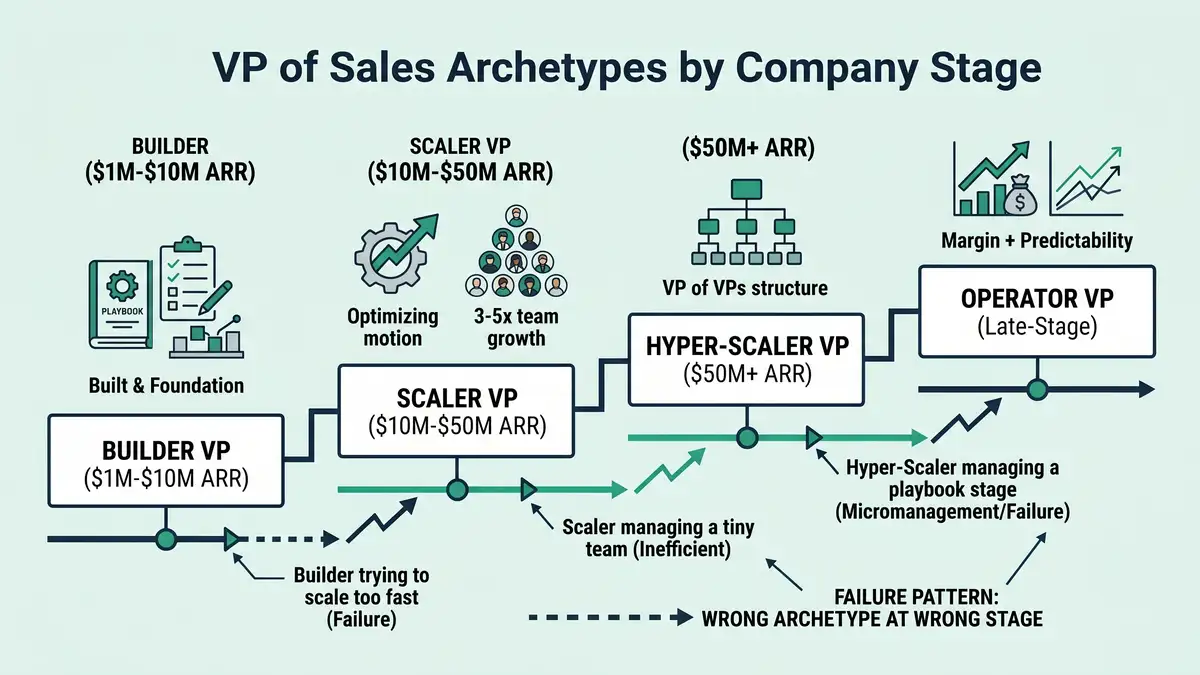
The single most common cause of VP failure is hiring on resume brand instead of archetype fit. Ex-Salesforce credentials, unicorn logos, and big personal deal wins are weak predictors of $10M-$40M ARR success. The market presents four archetypes, each optimised for a different ARR band. Mismatching archetype to band produces the predictable eighteen-month exit even when the candidate is individually excellent.
| Archetype | Optimal ARR Band | Core Skill | Risk if Mismatched |
| Builder VP | $1M-$10M ARR (lower end of Sarah Chen's range) | Architects playbook from founder-led chaos. Hires first 3-8 AEs. Establishes operating cadence. | Misfit at $30M+ where complex management infrastructure required. |
| Builder-Scaler hybrid | $15M-$30M ARR (Sarah Chen's mid-range) | Bridges playbook construction and team-scaling. Optimises existing process while expanding. | Rare profile. Most candidates lean strongly to one side. |
| Scaler VP | $30M-$100M ARR (upper end and beyond) | Scales 8 reps to 40. Layers management, ops, enablement. Optimises rather than invents. | At $10M-$15M, Scaler VP demands documented playbook that does not yet exist. Frustrated exit at month 12-18. |
| Hyper-Scaler / Operator VP | $100M+ ARR | Multi-region team management. Margin and predictability optimisation. | Over-hire below $50M. Culture friction, process drag, founder energy mismatch. |
Source: Scale with Strive 2025, Inflection Group archetype analysis.
The Scaler trap
The most expensive misfire at $10M-$15M ARR is hiring a Scaler VP from a $50M-$200M unicorn because the resume looks impressive. The Scaler arrives expecting documented playbook, finds founder-led chaos, layers in operations and enablement infrastructure prematurely, overwhelms the small team with administrative weight, and exits at month 12-18. Cost: roughly $1.2M, plus an additional six to nine months of motion reset.
The Five Evaluation Criteria That Predict Stage Fit
Resume credentials and interview chemistry are the two least predictive evaluation inputs. The five criteria below have measurable answers and surface archetype fit reliably. Run every shortlisted candidate through all five, in this order, before the founder commits.
Comparable stage and ACV experience
Ask the candidate to walk through one deal of approximately your ACV that they closed in the past three years. Take it from first contact through signature. Strong answers include named buyer roles, specific objections, exact negotiation paths, and timeline milestones at months three, five, and seven. Weak answers generalise ("I have done hundreds of deals") or describe deals well outside your range. A VP who scaled $50K-$100K ACV deals at a 20-person team typically struggles selling $25K-$75K to a 3-person team. The team management approach, deal pace, and customer engagement model do not transfer cleanly.
Proven recruitment and team-building track record
"How many sales reps have you personally hired in your career? How many are still at the company after two years? How many were promoted?" Strong answer: "Eight AEs over three years at Company X. Six are still there, four were promoted, two left for reasons I expected." Weak answer: vague generalisation. Many "VP" titles at large companies are senior individual contributor roles. Screen out those candidates explicitly. The role at $10M-$40M ARR requires the VP to recruit, close, and onboard at least four to six hires in the first eighteen months.
Operating cadence and forecast accuracy
"What was your forecast accuracy at your last role? How did you structure deal review? What metrics did you track daily, weekly, monthly?" Strong answers reference specific cadence (twice-weekly deal review, Monday-evening pipeline submission, daily mojo metric of deals added/killed/moved/shrunk) and historical accuracy at 90% within 10%. Weak answers describe forecast as ad-hoc intuition. A VP without operating cadence can not produce predictable results no matter how charismatic they are in front of customers.
Ability to articulate and document a sales playbook
"Walk me through your discovery process. How do you train a new AE to run discovery calls? What is the first question?" Strong answers reference documented framework (MEDDPICC, Sandler, Challenger, hybrid), name the first standardised question, and describe a written discovery template trained in week two of onboarding. Weak answers describe intuitive or relationship-based methodology. The Builder archetype requires playbook construction. If they can not articulate one, they will not build one for you.
Founder chemistry and team fit, observed not asserted
Have the candidate spend a half-day at your office. They observe two sales calls, attend a team meeting, and meet existing reps without the founder present. Ask the team afterwards: would they work for this person? Ask the customer success leader: will this VP collaborate on handoff and retention, or only optimise for new acquisition? Ask the founder: can you see being challenged by them productively for three to five years? Generic "executive presence" is the most common false-positive signal. Specific working chemistry within your context is the only valid one.
HOW: Architecting the First 90 Days

The ninety-day onboarding period largely determines whether the eighteen-month outcome is success or termination. Companies with documented onboarding frameworks show meaningfully higher VP success rates. Without structure, the VP arrives into immediate quota pressure, cuts short the learning phase, implements changes based on incomplete information, and optimises for the wrong variables. The framework below comes from Charlie Cowan's RevOps 90-day plan structure, validated against Leadbeam's onboarding cadence research, and tightened for $10M-$40M ARR contexts.
Days 1-30: Listening and shadow everything
Zero quota. Zero outbound process changes. The VP shadows every sales call, attends every customer meeting, reviews every lost-deal analysis, and meets every AE one-on-one. They demand full visibility: complete CRM database for the past 18 months, all customer contracts, NRR and churn data, win-loss analysis from at least 10 recent deals, objection patterns across the team, and current compensation structure. By Day 15, the VP can articulate observed reality. By Day 30, the VP passes a readiness checkpoint with the founder: documented understanding of current motion, accurate team-capability assessment, identification of top two to three process gaps.
Days 31-60: Diagnostic plan and board alignment
The VP writes a 90-day plan grounded in 30-day observation. The plan includes seven sections: current sales-process assessment with specific gaps, AE performance mapping (top performers, bottom performers), pipeline assessment with stage integrity and forecast accuracy, GTM strategy validation or pivots, first-quarter hiring plan with role descriptions, compensation-structure assessment, and enablement-and-training gap analysis. The plan is presented to founder and board by Day 65. This presentation tests synthesis ability and surfaces founder-VP disagreement on diagnosis. If the founder believes the motion is repeatable while the VP sees fundamental ICP misalignment, the conflict surfaces here, before tenure is six months in.
Days 61-90: Operationalisation and first hire
The plan converts to action. Sales methodology gets documented and socialised by week 7 (MEDDPICC, Sandler, or hybrid). Pricing and discount policy gets tightened by week 9. The customer-success handoff process gets reviewed by week 10. CRM upgrades and pipeline software get spec'd and implemented by mid-month-three. The first new hire (Demand Gen, Sales Ops, or AE) gets initiated in week 5-6, offer extended by week 10, onboarded by week 12. By Day 90: documented methodology, first strategic hire onboarding, twice-weekly deal-review cadence established, daily mojo-metric tracking implemented, clear quota set for next quarter, second-and-third-hire candidates identified, preliminary results presented.
Performance Markers: 6, 12, 18 Months
Top SaaS organisations establish written performance markers at the three intervals below. Without these, marginal VPs consume two to three years of resources before termination becomes obvious. With them, the founder has the right reasoning structure for the eighteen-month exit decision.
| Marker | 6 Months | 12 Months | 18 Months |
| Playbook | Documented (ICP, qualification, discovery, demo, objection responses, proposal, close) | Used by every AE, refined based on win-loss data | Iterated through one full annual cycle, second-version published |
| Hires made | 2 new hires onboarded, third in pipeline | 4-6 hires made, ramp time stabilised at 3-4 months | Team size grown 2-3x baseline; second-layer manager hired if >15 reps |
| Quota attainment (team) | Pre-existing AEs at baseline+5% | 70%+ of team hitting 70%+ quota | 80%+ of team hitting quota; top performers at 120%+ |
| Forecast accuracy | Within 30% of plan (improvement vs baseline) | Within 20% of plan | Within 10-15% of plan, quarterly |
| AE attrition | Zero AE departures beyond natural attrition | Positive attrition (more applying than leaving) | Tenure stabilised at 12-month minimum |
Source: Hustlex 2025, peppereffect SaaS Sales Playbook, Quotapath benchmarks.
Want a SaaS sales operating system that lets a Builder VP move at three times normal speed in their first 90 days?
Book a Freedom Machine DiagnosticThe 2026 Compensation Framework
VP of Sales compensation at $10M-$40M ARR follows a tight band. The structure is as much a recruiting signal as a financial decision: under-pay and the strongest candidates self-select out at first conversation; over-pay and the role becomes politically untouchable when termination is required at month 18.
| Component | $10M-$15M ARR | $20M-$30M ARR | $35M-$40M ARR |
| Base salary | $250K-$280K | $300K-$330K | $330K-$350K |
| Variable (target) | $200K-$220K | $220K-$250K | $250K-$280K |
| OTE | $450K-$500K | $520K-$580K | $580K-$630K |
| Equity (Series B-C) | 1.0%-2.0% | 0.75%-1.25% | 0.5%-1.0% |
| Vesting | 4-year, 1-year cliff | 4-year, 1-year cliff | 4-year, 1-year cliff (often w/ milestone acceleration) |
Source: Closedwon Talent 2026 GTM Comp Benchmarks, SaaStr first-VP comp guide, Fullcast enterprise comp benchmarks.
Variable structure should not be 100% tied to new-customer acquisition. The structure that produces the best 18-month outcomes splits variable across four metrics: 60% team quota attainment, 20% forecast accuracy (within 10% quarterly), 15% new-AE ramp success (hires hitting 70% of quota by month four), 5% NRR or expansion. Uncapped commission with 1.5x-2.0x accelerators above 100% quota is standard. This structure aligns the VP with sustainable predictability rather than only headline ARR, and ties directly to customer-retention outcomes rather than logo churn risk.
Total VP compensation at this stage represents approximately 1-1.5% of ARR. If the percentage feels excessive, the company likely cannot yet afford to outsource sales leadership and should grow existing AEs first or focus on ACV optimization to expand revenue per customer before adding executive overhead.
The Eight Failure Patterns Founders Keep Repeating
Eighteen months of Scale with Strive's failure-pattern analysis across 2024-2026 surfaces eight recurring patterns. Six of them trace back to founder behaviour, not VP behaviour. Each is observable in advance.
| # | Failure pattern | Prevention |
| 1 | VP hired to figure out GTM strategy (not execute one) | Founder writes ICP, positioning, channel before recruiting begins. |
| 2 | Scaler hired when Builder needed | Explicit archetype screening at evaluation. Reject candidates whose only comparable experience is at $50M+ companies. |
| 3 | VP hired without recruiting plan or budget | Pre-build sourcing channels, recruiting fee budget, and candidate pipeline before VP arrival. |
| 4 | Founder retains deal-closing authority | Written transition plan: founder hands off deal authority, customer relationships, pricing decisions by Day 60. |
| 5 | VP hired before product-market fit | Validate: monthly churn <3%, NRR >100%, founder-led win rate >40%, reps closing independently. |
| 6 | "VP" who is actually a senior AE in a different uniform | Evaluate team-building track record separately from personal sales record. Concrete hiring numbers required. |
| 7 | Vague success criteria, undefined ramp timeline | Written 6/12/18-month markers signed by founder and VP before offer extended. |
| 8 | Treating ramp as 30 days | Quota schedule: 0% month 1, 50% month 2, 75% month 3, 100% month 4. Documented in offer letter. |
Source: Scale with Strive 2025 failure-trap analysis, Hustlex VP Graveyard data.
The Founder's Job During VP Tenure
The VP can be flawless and the hire can still fail if the founder under-engages. SaaStr's transition guide documents the asymmetry: hands-off delegation produces higher failure rates than active partnership. The founder commitment is non-negotiable.
During recruiting: the founder articulates current sales-process gaps with specificity, identifies frustrations the VP must solve, and writes the success criteria before the offer is extended. The founder should also have a clean operational view of the business through their weekly CEO dashboard so the VP arrives into transparent reality rather than narrative. If the founder can not articulate why a VP is needed, the hire is solving the wrong problem.
During the first 90 days: three hours minimum per week of founder-VP CEO time. One hour administrative check-in. One hour strategy conversation. One hour observing sales calls or customer meetings together. This is not optional. Founders who skip this time produce the "hands-off delegation" failure pattern.
Throughout tenure: explicit customer-relationship transition. Communicate to top customers that the VP is now primary contact, founder maintains visibility but VP owns account strategy and pricing. Without this, the team learns the founder still controls outcomes and the VP becomes a figurehead.
And manage the board: prevent the unrealistic month-one revenue expectation that boards routinely create. Communicate the 90-day learning period and 18-month performance window clearly upfront so the VP is evaluated against realistic outcomes, not investor enthusiasm.
Frequently Asked Questions
When should a B2B SaaS founder hire their first VP of Sales?
For sales-led SaaS, the operational trigger sits at $1M-$2M ARR with three conditions: founder-led selling has closed 20-50 customers across repeatable cohorts, two to three Account Executives are independently hitting quota, and the founder spends 50%+ of weekly time on sales. For vertical SaaS where founder credibility is irreplaceable, the trigger pushes back to $10M ARR. For PLG-influenced motion, $3M-$5M ARR. Sarah Chen's $10M-$40M ARR window typically arrives 18-36 months after founder-led sales first plateaued, when five operational signals (capacity constraint, AE validation, documented motion, pipeline volume, stable PMF) all fire simultaneously.
What is the failure rate of first VP of Sales hires?
67% of first VP Sales hires fail within 18 months according to Hustlex 2025 data, with average failure tenure at 11 months. Total cost of a failed hire exceeds $1.2M when accounting for $250K-$350K base, severance, recruiting fees (18-25% of first-year salary), team attrition, and productivity loss from resetting sales motion. Opportunity cost can run to $3M when factoring missed revenue targets.
How much should I pay my first VP of Sales in 2026?
For $10M-$40M ARR B2B SaaS: base $250K-$350K, variable $200K-$280K, OTE $450K-$630K, equity 0.5%-2.0% depending on funding stage. The $10M-$15M end runs $250K base and 1.0-2.0% equity; $35M-$40M end runs $330K-$350K base and 0.5-1.0% equity. Variable should split 60% team quota attainment, 20% forecast accuracy, 15% new-AE ramp, 5% NRR. Uncapped commission with 1.5x-2.0x accelerators above 100% is standard.
Builder VP vs Scaler VP: which do I need?
Builder VP fits $1M-$10M ARR (architects playbook from chaos, hires first 3-8 AEs). Builder-Scaler hybrid fits $15M-$30M ARR (bridges playbook construction and team-scaling). Scaler VP fits $30M-$100M ARR (scales 8 to 40 reps, layers management and ops). For Sarah Chen's $10M-$40M range, the answer depends on motion maturity: $10M-$15M with founder-led motion still maturing needs a Builder; $35M-$40M with documented playbook and 25+ reps needs a Scaler. The most common $1M-$3M failure: hiring a Scaler from a $50M-$200M unicorn at $10M-$15M ARR because the resume looks impressive.
What are the 6/12/18-month performance markers for a new VP of Sales?
6 months: documented playbook (ICP, qualification, discovery, demo, objections, proposal, close), 2 hires onboarded, zero AE departures beyond natural attrition, forecast variance reduced 30%+. 12 months: 70% of team hitting 70%+ quota, ramp time stabilised at 3-4 months, forecast accuracy within 20%, positive attrition. 18 months: forecast accuracy within 10-15% quarterly, AE tenure stabilised at 12-month minimum, ARR growth on plan, team grown 2-3x with second-layer manager hired if >15 reps. Missing markers at any interval triggers exit conversation.
Should the founder still close deals after a VP of Sales is hired?
No. Continued founder deal-closing authority is the fourth-most-common failure pattern. By Day 60 of VP tenure, the founder must transition deal authority, customer relationships, and pricing decisions completely. Founder retains visibility through deal reviews but no override authority. Without this transition, the VP becomes a middle manager without real authority, ambitious VPs exit within 12 months, and weaker VPs underperform indefinitely.
How long should the VP of Sales ramp period be?
90 days minimum. 30 days for listening and shadow (zero quota), 30 days for diagnostic plan and board alignment, 30 days for operationalisation and first hire. Quota schedule: 0% month 1, 50% month 2, 75% month 3, 100% month 4. Companies that pressure VPs to immediately close deals or meet full targets in the first 30 days produce early failure because VPs cut short the learning phase and implement changes based on incomplete information.
What is the most common reason VP of Sales hires fail?
Four causes account for 80%+ of failures: (1) hiring a VP to figure out GTM strategy rather than execute one already validated, (2) hiring a Scaler when the company needs a Builder, (3) founder retaining de facto deal-closing authority that neuters the VP role, and (4) treating ramp as 30 days instead of 90. Each is observable in advance. Each is preventable by founder discipline before the offer is extended.
Hiring your first VP of Sales is one decision. Building the system the VP scales is the bigger one.
peppereffect installs the documented sales playbook, CRM operating cadence, and AI-augmented pipeline infrastructure that means a Builder VP arrives into compounding leverage rather than founder-led chaos. The result: faster ramp, lower failure risk, and a sales motion that decouples from any single hire. GTM motion fit at your ARR stage Technician's Trap diagnostic first 5 SaaS executive hires sequence
Architect Your Freedom MachineResources
- Hustlex: VP Sales Graveyard: Why 67% Fail in 18 Months
- Scale with Strive: How to Hire a Successful Sales Leader: Avoiding the 18-Month Failure Trap
- SaaStr: The Playbook to Hiring Your First VP of Sales
- SaaStr: The Founder's Guide to Transitioning from Founder-Led Sales
- The Inflection Group: When to Hire a VP Sales vs an Account Executive
- Charlie Cowan RevOps: What Should Be in a First 90-Day Plan for a VP Sales
- Leadbeam: 30-60-90 Day Sales Plan Framework
- Closedwon Talent: 2026 Sales and GTM Comp Benchmarks for SaaS Startups
- Fullcast: Enterprise AE Compensation Benchmarks
- Quotapath: Quota Attainment Rate Benchmarks