

The SaaS sales playbook in 2026 is the operating manual that decouples revenue from individual AE heroism. Sarah Chen-style mid-market SaaS founders run on the strength of their top two AEs hitting 130% of quota while the rest of the team coasts at 40-55% — a structurally fragile state where one resignation collapses 30% of pipeline. The fix is architectural: ship a documented seven-section playbook that any onboarded AE can execute without the founder in the room, anchored on MEDDPICC qualification + Command-of-the-Message discovery, with weekly call coaching feeding into a living document refreshed quarterly. This playbook walks the 2026 architecture, the methodology decision matrix, the AE coaching cadence, and a 90-day rollout that lifts team-wide quota attainment from 60-70% to 75-85% and compresses ramp time from 6-9 months to 3-4 months.
The peppereffect view
The SaaS sales playbook is not a slide deck — it is the architectural blueprint that turns AE skill into a system. Architect it as seven sections (ICP/persona, qualification, discovery, demo, objections, proposal/negotiation, close & handoff), anchor the methodology on MEDDPICC + Command-of-the-Message for mid-market complexity, enforce it through weekly call coaching, and refresh it quarterly with win/loss feedback. Static playbooks decay; living playbooks compound team performance.
What a SaaS sales playbook actually is in 2026
A SaaS sales playbook is the documented operating system for how your sales team finds, qualifies, runs, closes, and hands off deals — covering ICP/persona definition, qualification methodology, discovery call structure, demo design, objection-handling library, proposal/negotiation patterns, and close/handoff protocols. The 2018 version was a Google Doc nobody read after onboarding. The 2026 version is a living, enforceable, multi-asset system: documented frameworks, call recordings as exemplars, weekly coaching cadence, AI-augmented deal coaching, and quarterly refresh cycles tied to win/loss data.
The architectural rewrite follows three structural shifts. First, AE skill ceilings caught up with AE supply scarcity. Median quota attainment has compressed to 50-65% across mid-market B2B SaaS; teams running heroic-individual-AE models stabilise at 60-70% before stalling. Playbook-standardised teams consistently hit 75-85%. Second, AI agents entered the deal cycle. Salesforce's 2026 State of Sales shows 54% of sellers now use AI agents in active deals, with 9 in 10 planning to by 2027. Third, the methodology debate consolidated. MEDDIC/MEDDPICC emerged as the dominant qualification framework for mid-market and enterprise; Challenger and Command-of-the-Message win on discovery and demo execution.
The compounding effect: playbook-standardised teams compress AE ramp from 6-9 months to 3-4 months, lift team-wide quota attainment 15-25 percentage points, and reduce variance between top and bottom performers by 30-50%. A 30% lift on existing AE productivity beats a 30% headcount increase every time — same revenue at half the CAC. Pair with our deeper sales automation framework and the B2B sales pipeline automation infrastructure that operationalises the playbook at scale.
The "we don't need a playbook" trap
Founder-led sales motions hit a ceiling at 5-8 AEs because the founder's tacit knowledge doesn't transmit through hiring alone. New AEs pattern-match on the few wins they observe; everyone else operates on intuition. The result is a team where the top 20% hits 130% of quota and the bottom 50% never clears 40%. The playbook is the codification step that converts founder intuition into an operating system the team can execute.
Want to see your own CAC against peer benchmarks? Run the CAC Diagnostic for your true CAC, the 30 to 50% reduction agentic deployment delivers, and a board-ready PDF in 60 seconds.
Run the CAC DiagnosticThe seven-section playbook architecture
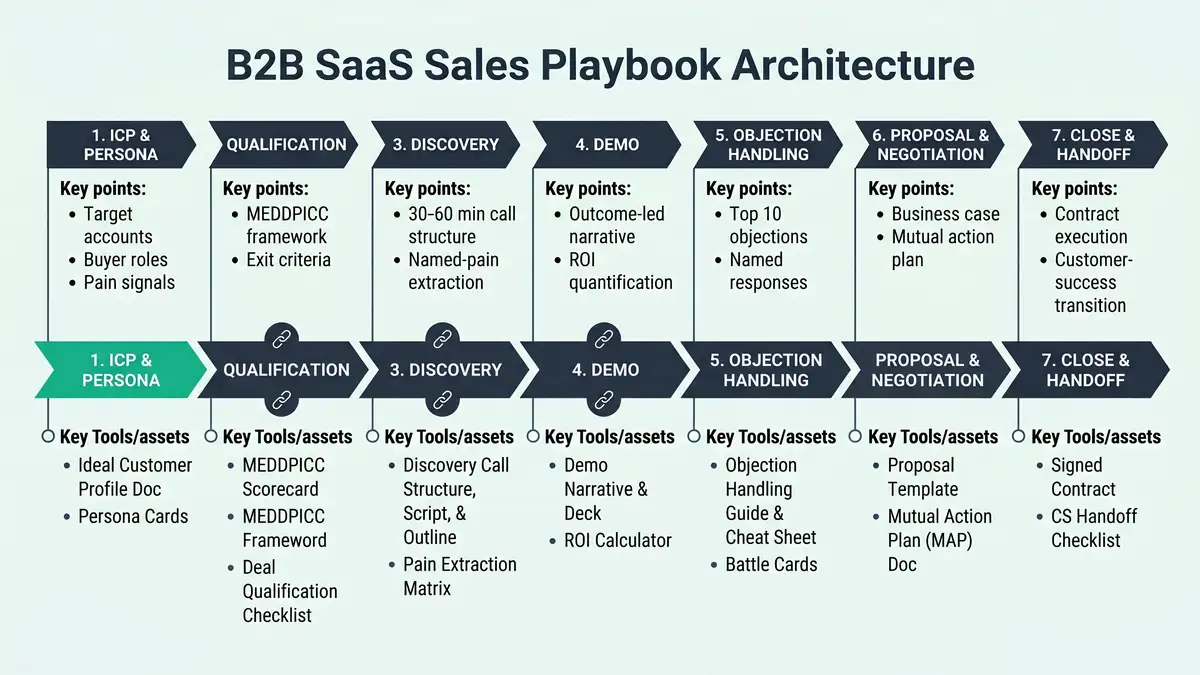
Every defensible 2026 SaaS sales playbook runs seven sections. Each section has a documented owner, an enforcement mechanism, and a quarterly refresh trigger. Skip a section and you re-introduce AE-specific intuition into the deal cycle.
ICP & persona — who do we sell to, who buys
Documented Ideal Customer Profile (firmographic + technographic + pain signals) and 4-6 buying-committee personas (economic buyer, champion, end-user, technical evaluator, legal/procurement). Each persona has named pain points, objections, channels, and decision criteria. Owner: marketing + sales leadership. Refresh: annually.
Qualification — MEDDPICC framework
The structured qualification model. MEDDPICC covers Metrics, Economic Buyer, Decision Criteria, Decision Process, Identified Pain, Champion, Competition, plus Paper Process for procurement. Each opportunity must score 7+ on MEDDPICC before progressing past Discovery. Owner: VP Sales. Refresh: quarterly recalibration with win/loss data. The MEDDPICC fields integrate with the broader lead scoring architecture so qualification is consistent from MQL handoff through closed-won.
Discovery — call structure and named-pain extraction
The 30-60 minute discovery call template with documented question sequence, MEDDPICC-aligned probing prompts, and named-pain extraction technique. Every AE runs the same call structure with the same depth requirements. Top-performing AEs' recorded calls become exemplars in the library. Owner: Head of Sales Enablement. Refresh: quarterly.
Demo — outcome-led narrative
The demo is not a feature tour. It is an outcome-led narrative anchored on the named pain extracted in discovery, with quantified ROI references and customer-outcome stories from similar ICP segments. Outcome-led demos convert at 40-55% to opportunity vs feature-led at 18-25%. Owner: Sales Engineering + Product Marketing. Refresh: per major release.
Objection handling — top 10 with named responses
Documented top-10 objection library: "too expensive," "we already use X," "send me information," "not the right time," "need to think about it," and the rest — see our deeper objection handling playbook for the response architecture. Each objection has 2-3 named responses tested against win/loss data. AEs memorise the library and practice in weekly role-plays. Owner: VP Sales. Refresh: quarterly with new patterns surfaced from call recordings.
Proposal & negotiation — business case + mutual action plan
Structured proposal template with executive summary, ROI calculator, business-case math, and Mutual Action Plan (MAP) covering the buyer's internal procurement journey. The MAP collapses validation-stage friction by making procurement steps visible to both sides. Owner: Deal Desk + AE. Refresh: quarterly.
Close & handoff — contract execution + customer success transition
Final-stage protocols: redline negotiation framework, contract execution sequence, kickoff scheduling, and structured handoff to Customer Success including all deal context, pain points, success criteria, and stakeholder map. Bad handoffs cause 25-40% of churn risk in year-one accounts. Owner: AE + CSM. Refresh: quarterly.
Methodology selection: MEDDPICC vs Challenger vs SPIN vs Sandler

The 2026 methodology decision is not "pick one and run it forever" — it's "stack the right methods at each playbook section." Salesmotion's 2026 methodology comparison documents nine active frameworks; for mid-market $10M-$40M ARR B2B SaaS the dominant pattern is a hybrid:
MEDDPICC for qualification. The dominant 2026 qualification framework. MEDDIC and its expanded MEDDPICC variant win for mid-market and enterprise complexity — the structured qualification fields force AEs to extract specifics from buyers (named economic buyer, dollarised pain, decision criteria) rather than coast on optimism. Best for: $25k+ ACV deals, 5+ buying-committee deals, 60+ day cycles.
Challenger or Command-of-the-Message for discovery and demo. Challenger's "teach-tailor-take-control" approach and Command-of-the-Message's outcome-led narrative both work; pick the one your team can execute consistently. Both replace feature-driven demos with insight-driven conversations that elevate AE positioning from order-taker to trusted advisor.
SPIN for discovery question structure. SPIN (Situation, Problem, Implication, Need-payoff) provides the question architecture that makes discovery calls extract named pain instead of surface-level "what are your goals?" Layer SPIN inside MEDDPICC for question discipline.
| Methodology | Best for stage | Best for ACV | Strength | Watch-out |
| MEDDIC / MEDDPICC | Qualification | $25k+ ACV | Structured rigor, exec alignment | Heavy lift for SMB cycles |
| Challenger | Discovery + Demo | $50k+ ACV | Insight-led positioning | Requires senior AE skill |
| Command of the Message | Demo + Proposal | $25k+ ACV | Outcome-led narrative | Training-intensive rollout |
| SPIN | Discovery questions | Any ACV | Question discipline | Standalone is too narrow |
| Sandler | Whole cycle | $5k-$50k ACV | Disqualification rigor | Less fit for enterprise |
Source: Salesmotion — 9 Popular Sales Methodologies 2026; SPOTIO — B2B Qualification Frameworks; Eagr — Methodologies Compared
For Sarah Chen at $10M-$40M ARR with $25k-$75k ACV deals: hybrid MEDDPICC (qualification) + Command-of-the-Message (discovery/demo) + SPIN (question structure inside discovery). Pair with the deeper sales pipeline management framework that operationalises the methodology at deal-stage level, and the marketing qualified lead handoff that feeds qualified opportunities into the playbook.
Discovery call architecture: the highest-leverage section

The discovery call is the single highest-leverage section in the playbook — it determines whether the rest of the cycle has a chance of converting. Top-quartile B2B SaaS programmes treat the 30-60 minute discovery call as the most important hour in the deal. The 2026 discovery call structure runs five blocks:
Block 1 — Set the stage (2-3 min)
Introductions, agenda confirmation, time check, expectation-setting. AE confirms what success looks like for this conversation. Buyer has the option to redirect. Establishes credibility through preparation evidence.
Block 2 — Current state and named pain (15-20 min)
SPIN-style situation and problem questions extract the buyer's current state, the specific pain points, and the cost of staying with the status quo. AE listens and reflects, never pitches. Named-pain extraction means the buyer articulates the dollarised cost of the problem in their own words. Without named pain, the deal won't progress.
Block 3 — Implications and ideal future (10-15 min)
Implication and need-payoff questions surface the cost of inaction and paint the buyer's ideal future state. The buyer connects the dots between current pain and future value. AE asks "what would change if this problem was solved?" rather than presenting features.
Block 4 — MEDDPICC qualification (10-15 min)
Direct qualification questions: who is the economic buyer; what's the decision criteria and process; what's the timing; who else is involved; what's the competition; what's the procurement process. Buyer experiences this as collaborative scoping rather than interrogation when sequenced properly.
Block 5 — Confirmed next step (5-10 min)
Recap, mutual action plan draft, scheduled next step before the call ends. "Next step is a 45-min demo with you and your CTO on Thursday at 2pm — confirmed?" If next step isn't booked on the call, the deal slips into stage-stuck pattern. Top-quartile AEs book next step on 80%+ of discovery calls.
The five failure modes that kill playbook programmes
Failure mode 1: Document-only playbook with no enforcement
The playbook lives as a 60-page Google Doc nobody reads after onboarding week. AEs revert to intuition within 30 days. The fix is enforcement: weekly call coaching reviews against playbook standards, MEDDPICC scoring required on every opportunity in CRM, AE adoption tracked as a managed metric.
Failure mode 2: Static playbook that never refreshes
The 2024 playbook running unchanged in 2026 has stale objection responses, outdated competitive positioning, and disconnected ICP definitions. Quarterly refresh is non-negotiable: pull last 90 days of win/loss data, surface new objection patterns from call recordings, update sections accordingly. Without refresh cadence, the playbook decays 20-30% relevance per year.
Failure mode 3: Playbook without methodology
Documenting "how we do discovery" without anchoring on a methodology produces 5-7 different AE styles within the same team. MEDDPICC + Command-of-the-Message provides the spine; without it, the playbook becomes a collection of templates rather than a system.
Failure mode 4: No call coaching cadence
Playbooks live or die in weekly call coaching. Top-quartile programmes review 2-3 calls per AE per week against playbook standards. Bottom-quartile programmes never coach calls and watch the playbook erode within a quarter. Conversation intelligence platforms (Gong, Chorus) compress the coaching workflow 60-70%.
Failure mode 5: Founder dependency in the playbook
The playbook relies on founder presence in deal reviews to make the framework work. AEs become unable to execute autonomously. The fix: design every section to work without the founder — including objection handling for the founder-specific objections that arise when the founder isn't there. The goal is a playbook that runs the team without the founder, not a playbook that augments the founder.
The AE coaching cadence: weekly, monthly, quarterly

The playbook only earns its cost when wired into a coaching cadence. Three nested loops drive playbook adoption: weekly 1:1 + call coaching, monthly playbook review + skill calibration, quarterly playbook refresh + win/loss analysis.
Weekly cadence (60 minutes per AE). 30-min 1:1 covering pipeline review, deal-blocker discussion, and skill development. 30-min call review using Gong/Chorus to inspect 1-2 recordings against playbook standards: did the AE follow the discovery structure? Were MEDDPICC fields completed? Was named pain extracted? Were the right objections handled? Was next step booked?
Monthly cadence (90 minutes team-wide). Playbook review session: surface 1-2 patterns from the past month's calls — new objections, missed opportunities, repeating mistakes. Update the playbook with named responses. Calibrate skill development across the team. Sales manager identifies bottleneck skills; CRO approves coaching capacity reallocation.
Quarterly cadence (half-day off-site). Pull 90 days of closed-won and closed-lost deal data. Identify wins driven by playbook execution vs misses driven by playbook gaps. Refresh sections accordingly. Update objection library with new patterns. Recalibrate ICP/persona definitions if competitive landscape shifted. Ship the v.next playbook with documented changelog.
How AI agents change the playbook in 2026

AI agent integration in sales playbooks is now production-grade across three layers. Conversation intelligence agents (Gong's Engage, Chorus AI Coach) auto-score every call against playbook standards in real time, flag deals where MEDDPICC fields are missing, and surface objection patterns at team scale. Real-time deal coaching agents (Trellus, Otter Pulse, Kona AI) prompt AEs mid-call with playbook-aligned suggestions when the conversation drifts off-structure. AI-powered prep agents generate persona-specific call briefs from CRM data 30 seconds before the call, replacing 20-minute manual prep cycles. The deeper integration pattern is documented in our AI agent for sales playbook. 54% of sellers already use AI agents; 9 in 10 plan to by 2027.
The economics: traditional playbook programmes require 0.5-1.0 FTE in sales enablement for a 12-AE team plus 4-6 hours per AE per week of manual coaching. AI-augmented playbooks drop the FTE to 0.25 and reclaim 2-3 hours per AE per week — translating to $100k-$200k of recovered selling capacity for a 12-AE team. Pair with broader agentic workflows for compounding RevOps leverage.
The infrastructure spine: tooling, governance, ownership
Tooling stack. Minimal viable stack for $10M-$40M ARR mid-market: CRM with MEDDPICC fields (HubSpot Sales Hub, Salesforce Sales Cloud), conversation intelligence (Gong or Chorus), enablement platform (Highspot, Showpad, or Notion), AI deal coach (Trellus, Otter Pulse, or built-in CRM AI). Total annual cost: $40k-$120k for 12 AEs. The tooling matters less than the discipline; mid-market teams that buy enterprise tooling without enforcement discipline see playbook adoption stuck below 40%.
Governance. CRO owns the playbook strategy. Head of Sales Enablement (full-time at 12+ AE scale) maintains the living document, runs the coaching cadence, and ships quarterly refreshes. AEs contribute objection patterns and call exemplars; sales managers enforce adoption via 1:1 call reviews. Without single ownership, the playbook decays into a disconnected document set.
Reporting cadence. AE-level: real-time MEDDPICC completion dashboard. Manager-level: weekly playbook adherence scorecard. CRO-level: monthly team-wide adoption rate, win-rate by AE tenure, ramp-time tracking. C-suite: quarterly playbook ROI review tied directly to SaaS customer acquisition cost reduction and quota attainment lift.
Want a diagnostic on whether your sales playbook is actually executing without you?
Book a Growth Mapping CallThe 90-day rollout playbook
For a $10M-$40M ARR mid-market SaaS installing playbook discipline from a chaotic state, the 90-day sequence:
Days 1-30: Audit, document, methodology decision
Audit current state: AE quota attainment by tenure, win rate by stage, ramp-time benchmark, current ICP/persona docs. Document the v1.0 playbook covering all seven sections in Notion or Highspot. Anchor the methodology decision: MEDDPICC + Command-of-the-Message + SPIN. Train the team on MEDDPICC qualification. Add MEDDPICC fields to CRM. Target deliverable: signed-off playbook v1.0 + CRM instrumentation + methodology training complete.
Days 31-60: Install coaching cadence + AI augmentation
Launch weekly 1:1 + call coaching cadence with Gong or Chorus. Run weekly objection-handling role-plays. Pilot AI deal coach (Trellus or equivalent) with top 3-4 AEs. Capture call exemplars from top performers as living-library assets. Switch primary AE-management metric from quota attainment alone to playbook-adherence + quota attainment combined. Target: 80%+ MEDDPICC completion across active opportunities.
Days 61-90: First quarterly refresh + measure lift
Run the first quarterly playbook refresh: pull 90-day win/loss data, surface objection patterns, update sections, ship v1.1. Measure ramp-time on AEs hired in the last 6 months. Compare team-wide quota attainment to baseline. Document the refresh playbook so the team can run autonomously. Target: 8-15pp quota attainment lift, 30-40% ramp time compression on new hires, MEDDPICC adoption above 90%.
Architect a SaaS sales playbook your team can execute without you
peppereffect installs the seven-section playbook architecture for $10M-$40M ARR B2B SaaS leaders ready to escape AE-dependent revenue. We deploy the MEDDPICC + Command-of-the-Message methodology hybrid, the discovery-call structure, the AI-augmented coaching layer, and the quarterly refresh cadence that turns playbooks from static documents into living operating systems your sales team executes autonomously.
Book a Growth Mapping CallFrequently asked questions
What is a SaaS sales playbook?
A SaaS sales playbook is the documented operating system for how a sales team finds, qualifies, runs, closes, and hands off deals — covering ICP/persona, qualification methodology, discovery structure, demo design, objection handling, proposal/negotiation, and close/handoff. The 2026 architecture is a living document anchored on MEDDPICC + Command-of-the-Message + SPIN, enforced through weekly call coaching, refreshed quarterly with win/loss data.
What's the best sales methodology for B2B SaaS in 2026?
For mid-market $10M-$40M ARR B2B SaaS with $25k-$75k ACV: hybrid MEDDPICC (qualification) + Command-of-the-Message (discovery/demo) + SPIN (question structure). MEDDPICC dominates qualification at mid-market scale because the structured fields force AE discipline. Pure Challenger requires senior AE skill; pure Sandler is better for SMB cycles.
How long does it take to build a SaaS sales playbook?
v1.0 documentation: 30 days for a focused programme. Initial team training and CRM instrumentation: another 30 days. First measurable lift in quota attainment and ramp time: 60-90 days. Mature multi-quarter refresh discipline: 12-18 months. Static one-time playbooks decay 20-30% relevance per year; living playbooks compound team performance.
What's a good quota attainment rate for B2B SaaS?
Median 50-65% across mid-market B2B SaaS. Top-quartile playbook-standardised teams hit 75-85%. Top-decile reach 90%+. The gap between median and top-quartile is almost entirely playbook discipline, AE coaching cadence, and methodology adherence — not lead quality differences.
How long should AE ramp time take?
Heroic-individual-AE models: 6-9 months for new hires to hit full quota. Playbook-standardised teams: 3-4 months. The compression comes from documented frameworks, exemplar call libraries, structured coaching, and AI-augmented onboarding. AE ramp time is one of the highest-leverage metrics — every month of compression is one month of additional revenue per hire.
What sales tools should I use for the playbook?
Minimal viable stack for $10M-$40M ARR: CRM with MEDDPICC fields (HubSpot/Salesforce), conversation intelligence (Gong/Chorus), enablement platform (Highspot/Showpad/Notion), AI deal coach (Trellus/Otter Pulse). Total cost: $40k-$120k/year for 12 AEs. Tooling matters less than discipline — mid-market teams that buy enterprise tools without enforcement see adoption stuck below 40%.
How often should the playbook be refreshed?
Quarterly minimum: pull 90 days of win/loss data, surface objection patterns from call recordings, update sections, ship v.next with documented changelog. Annual full rebuild: revisit ICP/persona definitions, methodology adherence, tooling stack. Static playbooks decay; living playbooks compound team performance over multiple quarters. SaaS onboarding flow design retention measurement architecture product-led growth vs sales-led growth moving upmarket without losing velocity hiring your first VP of Sales go-to-market strategy framework sales cycle compression framework
Resources
- Salesmotion — 9 Popular Sales Methodologies 2026
- Salesforce — State of Sales Report 2026
- Salesforce — 40 Sales Statistics 2026
- Atlassian — MEDDIC Sales Methodology
- SPOTIO — B2B Qualification Frameworks
- Eagr — Methodologies Compared
- AskElephant — Best Methodology for the AI Age
- Autobound — State of AI Sales Prospecting 2026
- Futurum — AI Agents Center Stage 2026
- IBM — State of Salesforce 2025-2026
- Averi — 2026 B2B SaaS Marketing Playbook
- Arcade — SaaS Marketing Strategy 2026
- GoConsensus — Sales & Marketing AI Prompts 2026