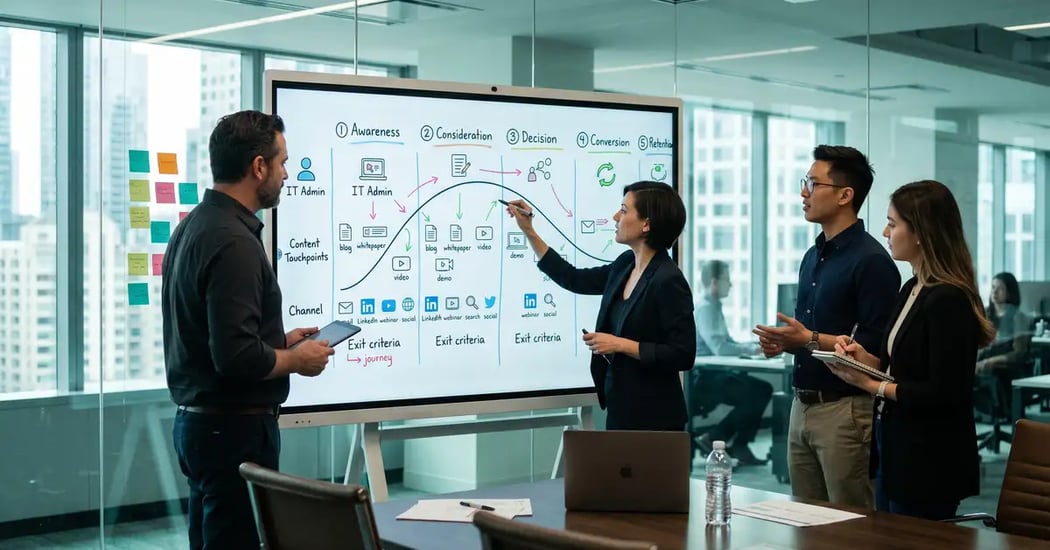

B2B buyer journey mapping in 2026 is the architectural blueprint that aligns content, sales motion, and conversion infrastructure to how customers actually buy — not how marketing teams wish they bought. Sarah Chen-style mid-market SaaS founders run "buyer journey" as a slide in last year's planning deck, miss the architectural truth that 70-80% of the journey now happens in the dark funnel before sales contact, and watch demo-request quality collapse because the content programme is mapping to a journey that ended in 2018. The fix is architectural: map five buyer stages with explicit exit criteria, document the five-to-fifteen-person buying committee with role-specific content, integrate the dark-funnel research surfaces (peer reviews, ChatGPT, podcasts, communities), and switch the planning anchor from "marketing campaigns" to "buyer-stage content alignment." This playbook walks the 2026 architecture, the buying committee complexity, the dark-funnel content strategy, and a 90-day rollout that lifts content-to-pipeline conversion 25-40%.
The peppereffect view
B2B buyer journey mapping is not a marketing artefact — it is the architectural backbone of content strategy, sales motion, and conversion design. Map five stages with explicit exit criteria, document the buying committee with role-specific content, integrate dark-funnel research surfaces, and reverse-engineer the journey from CRM win-data plus customer interviews. The journey map dictates the content calendar, not the other way around.
What B2B buyer journey mapping actually is in 2026
B2B buyer journey mapping is the discipline of documenting how a buying committee progresses from problem recognition through purchase decision and into expansion — including the channels they use, the content they consume, the questions they ask, and the stakeholders involved at each stage. The 2018 version was a linear five-step funnel ending at "customer." The 2026 version is a multi-stakeholder, multi-channel, mostly-dark-funnel architecture where buyers complete 70-80% of their journey on platforms you don't own and can't fully measure.
The architectural rewrite follows three structural shifts. First, the buying committee multiplied. Mid-market B2B SaaS deals now involve 5-15 stakeholders with distinct roles — economic buyer, champion, end-user, IT/security, legal, finance — each consuming different content at different stages. Second, the dark funnel dominated. B2B buyers now research vendors inside ChatGPT, Microsoft Word, and Gmail before ever visiting a vendor website — completely invisible to traditional analytics. Third, the journey collapsed into Gartner's six "buying jobs." Gartner's six-job framework — Problem Identification, Solution Exploration, Requirements Building, Supplier Selection, Validation, Consensus Creation — replaces the linear funnel with non-linear job loops.
The compounding effect: programmes that map journey + buying committee + dark-funnel surfaces lift content-to-pipeline conversion 25-40% within 12 months. Programmes still running 2018-era single-persona linear funnels see content engagement metrics decay 20-30% year-over-year as buyer behaviour shifts faster than the maps update. The journey map is the foundation that informs the broader B2B demand generation strategy and feeds directly into the B2B conversion rate optimization programme.
The "single persona" trap
Mapping the journey for one persona (the economic buyer or the champion) and ignoring the rest of the committee produces content that 60-80% of the buying group never sees or reads. End-users research differently than VPs, IT/security cares about different content than finance, and the deal stalls when any committee member's questions go unanswered. Map the committee, not just the persona.
The five-stage 2026 B2B buyer journey
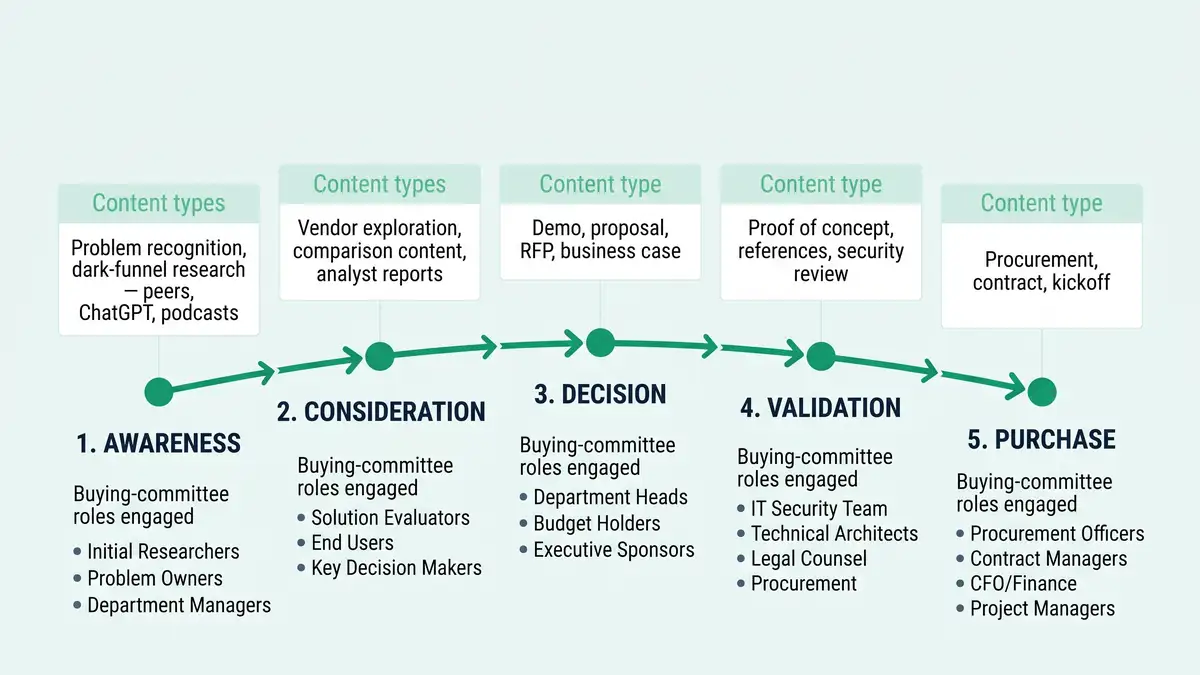
Every defensible 2026 B2B journey map has five stages with explicit exit criteria, primary buying-committee role engaged, and the content type that earns advancement to the next stage.
Awareness — problem recognition
The buyer realises they have a problem. Research happens almost entirely in the dark funnel: peer conversations, ChatGPT queries, podcast listens, LinkedIn scrolling, analyst reports. Champion or end-user typically initiates. Median time-in-stage: 14-30 days. Exit criteria: problem articulated internally, initial vendor names captured. Content alignment: thought leadership, category-defining frameworks, podcast appearances, AI-citable content.
Consideration — vendor exploration
The buyer evaluates 3-7 potential vendors. Research mixes dark-funnel and direct: G2 reviews, comparison content, vendor websites, first analyst calls. Buying committee expands to 3-5 stakeholders. Median time-in-stage: 21-45 days. Exit criteria: shortlist of 2-3 vendors, internal alignment on requirements. Content alignment: comparison guides, category vs vendor positioning, customer case studies, technical deep-dives.
Decision — vendor selection
The buyer narrows to a primary vendor. First sales contact typically happens here. Demo, proposal, RFP responses, business case construction. Buying committee at full strength: 5-15 stakeholders including economic buyer, champion, end-users, IT/security, legal, finance. Median time-in-stage: 21-45 days. Exit criteria: verbal selection, internal champion-led socialisation. Content alignment: tailored demos, ROI calculators, customer references by role, security documentation. The MQL→SQL handoff that triggers this stage is documented in our marketing qualified lead framework.
Validation — proof and risk reduction
The buyer pressure-tests the selection. POC, technical reviews, security audits, reference calls, contract redlines. The make-or-break stage where deals slip or stall. Median time-in-stage: 14-45 days. Exit criteria: technical approval, security sign-off, redlines resolved, internal consensus. Content alignment: implementation guides, security/compliance docs, case studies by ICP, mutual action plans. Pair the validation-stage tracking with our sales pipeline management playbook to close the deal-velocity loop.
Purchase — procurement and onboarding
Contract executed, kickoff scheduled, onboarding begins. The journey continues into expansion. Median time-in-stage: 7-21 days. Exit criteria: signed contract, kickoff meeting completed, primary stakeholders onboarded. Content alignment: onboarding documentation, customer success collateral, role-specific training, expansion content for adjacent stakeholders.
The 2026 buying committee: six roles, six buying jobs

The 2026 mid-market B2B SaaS buying committee runs 5-15 people across six recurring roles. Each role consumes different content, asks different questions, and applies different decision criteria. Intent Amplify's six-stage buying process aligns with Gartner's job framework: Problem Identification, Information Search, Evaluation, Justification, Purchase Completion, Consensus Building.
The six recurring roles in mid-market B2B SaaS deals: economic buyer (CFO/COO/CEO — final budget authority), champion (the internal advocate driving the deal), end-users (the team who'll actually use the product), technical evaluator (IT/security/architecture), legal/procurement (contract terms and risk), peer reference network (the unofficial advisors the champion consults). Each has stage-specific content needs.
| Role | Primary stage | Content needs | Decision criteria |
| Economic buyer | Decision/Validation | ROI calculator, business case, peer-CFO testimonials | Financial impact, payback period, risk |
| Champion | All stages | Strategic narratives, internal-pitch decks, executive summaries | Strategic fit, internal influence, career risk |
| End-users | Awareness/Consideration | Product demos, workflow examples, peer reviews | Daily-use experience, time savings, learning curve |
| Technical evaluator | Validation | Technical docs, security/compliance, integration guides | Architecture fit, security posture, scalability |
| Legal/procurement | Validation/Purchase | Contract templates, MSA examples, risk documentation | Contractual risk, vendor stability, compliance |
| Peer reference network | All stages (informal) | Customer case studies, peer testimonials, community content | Reputational risk, social proof, peer endorsement |
Source: Prospeo — B2B Decision Making 2026; Intent Amplify — B2B Buying Process; Intentsify — B2B Buying Groups Evolving
The strategic implication: any content programme that addresses fewer than four of these roles is leaving 40-60% of buying-committee influence unaddressed. Pair the role-specific content map with our deeper account-based marketing playbook for the architecture that orchestrates against the full committee.
The dark funnel: where 70-80% of the journey actually happens

The single biggest 2026 buyer-journey-mapping challenge is the dark funnel — research happening on platforms you don't own and can't fully measure. Peer reviews on G2 and TrustRadius. ChatGPT queries and Perplexity research. B2B buyers now research vendors inside Microsoft Word, Gmail, and AI tools. LinkedIn posts viewed and shared. Podcast episodes consumed during commutes. Sales-team-to-sales-team Slack conversations. None of it shows up in your analytics; all of it shapes the journey.
The fix is not better tracking — it's stacking three measurement layers that capture different slices of the dark funnel:
- Self-reported attribution. A "How did you first hear about us?" field on demo-request forms. Crude but powerful — captures awareness signals 10-20% of standard attribution misses entirely.
- AI-search visibility. Track citations in ChatGPT, Perplexity, Claude responses. LLMs reshape B2B brand discovery — being citable is the 2026 equivalent of being SEO-rankable.
- Branded-search MMM. When podcast or thought-leadership investment rises and branded search lifts 4-12 weeks later, MMM detects the relationship even though no individual click was tracked.
The discipline ties to the wider inbound marketing for SaaS playbook and our B2B marketing attribution framework — programmes that ignore the dark funnel systematically under-credit the channels driving 30-50% of qualified pipeline.
How to actually map the journey: research methodology

Buyer journey maps built from internal opinion produce fiction. Buyer journey maps built from disciplined research produce revenue. The 2026 methodology runs three research streams in parallel:
Customer interviews (qualitative). 8-12 interviews with recent customers and lost prospects. 60-90 minute conversations covering: How did you recognise the problem? What did you research? Who else was involved? What content actually mattered? What nearly killed the deal? Lost-deal interviews are equally important — sometimes more — than won-deal interviews. Document exact phrasing and consumption channels for each stage.
CRM win-data analysis (quantitative). Pull 12 months of closed-won and closed-lost deals. Reverse-engineer the journey from first-touch through opportunity creation. Document: median touches per deal, channel distribution by stage, content asset engagement before stage transitions, time-in-stage by ICP segment. The data validates or contradicts the qualitative findings.
Dark-funnel reconciliation. Layer self-reported attribution, AI-citation tracking, and branded-search trend analysis over the qualitative + quantitative findings. Identify the channels and content driving stages 1-2 (awareness, consideration) that traditional analytics misses. Cross-reference with peer-review platforms (G2, TrustRadius) for the validation-stage signals.
The output: a single living document — typically a Miro/Lucidchart map — that documents stage definitions, exit criteria, role-specific content needs, channel allocation, and time-in-stage benchmarks for each ICP segment. Refresh quarterly with new interviews; rebuild annually with full research cycle.
The five failure modes that kill journey mapping programmes
Failure mode 1: Single-persona, single-journey thinking
Mapping for one persona (typically the economic buyer or champion) misses 60-80% of buying-committee influence. Mid-market B2B SaaS deals run 5-15 stakeholders; map at least 4-5 distinct roles with stage-specific content needs. Single-persona maps produce content that talks past most of the committee.
Failure mode 2: Linear funnel where the journey is non-linear
Modern B2B buyers loop between Gartner's six buying jobs in non-linear sequences — they revisit Problem Identification mid-Validation, jump from Consideration straight to Validation when a peer recommends a vendor, return to Solution Exploration after RFP responses underwhelm. Linear-funnel content programmes produce content for transitions that don't happen sequentially.
Failure mode 3: Ignoring the dark funnel
If your journey map shows "lead capture" as the entry point, you've documented the visible 20% and ignored the invisible 80%. The 2026 journey starts in peer conversations and ChatGPT queries — long before the form fill. Map the dark-funnel surfaces explicitly even though they're harder to measure.
Failure mode 4: Internal-opinion mapping without research
Maps built from a marketing brainstorm produce a confident-sounding fiction. Real maps require 8-12 customer/prospect interviews, CRM win-data analysis, and dark-funnel reconciliation. The research takes 4-6 weeks; without it, the map is wrong in ways nobody can detect until the content programme underperforms for two quarters.
Failure mode 5: Static maps that never refresh
Maps built in Q1 2024 don't survive 2026 buyer behaviour shifts. AI-search adoption, dark-funnel growth, and buying-committee expansion change buyer journeys faster than annual marketing planning cycles. Refresh interview-based research quarterly; rebuild fully every 12 months. Static maps decay 20-30% relevance per year.
Aligning content to the journey: the content map

The journey map only earns its cost when it dictates the content calendar. The 2026 content-to-journey alignment runs four content tiers:
- Awareness-stage content. Category-defining frameworks, benchmark research, podcast appearances, AI-citable thought leadership, peer-community participation. Goal: be discoverable in dark-funnel research surfaces. Volume: 30-40% of programme.
- Consideration-stage content. Comparison guides, vendor positioning, customer case studies by ICP segment, technical deep-dives, analyst report summaries. Goal: earn shortlist inclusion. Volume: 25-30%.
- Decision-stage content. Tailored demos, ROI calculators, customer references by role, security documentation, business-case templates. Goal: support the champion's internal sale. Volume: 20-25%.
- Validation/Purchase-stage content. Implementation guides, security/compliance documents, mutual action plans, onboarding collateral, role-specific training. Goal: reduce risk perception, smooth procurement. Volume: 10-15%.
Most mid-market B2B SaaS programmes over-produce awareness content (60%+ of output) and under-produce decision and validation content (5-10%). Re-balancing toward the 30/25/25/15 distribution typically lifts content-to-pipeline conversion 20-35% without producing more content total. The discipline ties into the broader B2B content strategy framework and pairs with B2B lead nurturing for stage-specific re-engagement.
How AI changes journey mapping in 2026
AI integration in buyer journey mapping is now production-grade across two layers. AI-driven research analysis (Otter.ai, Grain, Sembly for interview transcription; ChatGPT/Claude for theme extraction) compresses qualitative analysis from 4-6 weeks to 1-2 weeks. AI-powered journey insights (HubSpot Breeze, Salesforce Agentforce) surface stage-transition patterns from CRM and engagement data automatically. Generative AI in content enables persona-specific content variants at scale — but only when the underlying journey map is sound.
The economics: traditional journey mapping projects cost $30k-$80k in research consulting plus 0.5-1.0 FTE marketing time. AI-augmented journey mapping drops the consulting cost 40-60% and the FTE time to 0.25 — but only when the journey map exists as a maintained living document, not a one-off project. Pair with broader agentic workflows for compounding research and content-production leverage.
Want a diagnostic on whether your buyer journey map is driving content decisions?
Book a Growth Mapping CallThe infrastructure spine: tooling, governance, refresh cadence
Tooling stack. Mapping platform: Miro or Lucidchart for the visual map; Aha! Journey Maps for product-team integration. Research: Grain or Otter.ai for interview transcription; Notion or Confluence for documentation. CRM analysis: HubSpot/Salesforce for win-data analysis; Dreamdata or Cometly for journey-touch attribution. Total annual cost for mid-market: $5k-$20k.
Governance. Head of Marketing or Head of Demand Generation owns the journey map. Marketing, sales, and customer success contribute insights; one programme manager maintains the living document. Without a single owner, the map decays into a slide-deck artefact that nobody references.
Refresh cadence. Quarterly: 2-3 fresh customer interviews, CRM data refresh, identification of changed patterns. Annual: full rebuild — 8-12 interviews, dark-funnel reconciliation, role-specific content map update. Every 18 months: ICP review and segment-specific journey variant addition.
The 90-day rollout playbook
For a $10M-$40M ARR mid-market SaaS installing buyer journey mapping discipline from a chaotic state, the 90-day sequence:
Days 1-30: Research, document, validate
Run 8-12 customer/prospect interviews (recent won, recent lost, recent stalled). Pull 12 months of CRM win-data and analyse touch patterns. Layer dark-funnel signals (self-report, AI-citation tracking, branded search). Build the v1.0 map in Miro/Lucidchart with five stages, six committee roles, and explicit exit criteria. Target deliverable: signed-off journey map document.
Days 31-60: Audit content, identify gaps, prioritise production
Audit existing content against the journey map: which stage and committee role is each asset serving? Identify the gaps — typically Decision and Validation stages are under-produced. Rebalance the content calendar toward the 30/25/25/15 distribution. Brief the writing team on role-specific content requirements. Target: 90-day content production plan aligned to the journey.
Days 61-90: Ship aligned content, measure, recalibrate
Produce 8-12 new content assets aligned to identified gaps. Implement self-reported attribution on demo-request forms. Set up AI-citation tracking. Run the first quarterly map-refresh interview cycle (2-3 customers). Document the maintenance cadence so the team can run it autonomously. Target: 25-40% lift in content-to-pipeline conversion within two quarters.
Architect a buyer journey map that drives content decisions
peppereffect installs the buyer journey mapping architecture for $10M-$40M ARR B2B SaaS leaders ready to stop producing content for journeys that ended in 2018. We deploy the five-stage architecture, the buying-committee documentation, the dark-funnel reconciliation, and the AI-augmented research engine that turns journey mapping from a marketing slide into the strategic backbone of content, sales, and conversion.
Book a Growth Mapping CallFrequently asked questions
What is B2B buyer journey mapping?
B2B buyer journey mapping is the discipline of documenting how a buying committee progresses from problem recognition through purchase and into expansion — including channels used, content consumed, questions asked, and stakeholders involved at each stage. The 2026 architecture combines five stages, six committee roles, dark-funnel research surfaces, and quarterly refresh cycles built on customer interviews + CRM win-data + dark-funnel reconciliation.
How long is a typical B2B buyer journey?
Median B2B SaaS buyer journeys run 90-180 days end-to-end for mid-market deals ($10k-$50k ACV). Enterprise deals ($100k+ ACV) extend to 180-365 days. Within that window, 70-80% of the journey happens before sales contact — entirely in the dark funnel of peer conversations, ChatGPT queries, podcast listens, and analyst reports.
How big is a B2B buying committee?
Mid-market B2B SaaS deals involve 5-15 stakeholders organised across six recurring roles: economic buyer, champion, end-users, technical evaluator, legal/procurement, and peer reference network. Each role has stage-specific content needs and decision criteria. Content programmes that address fewer than 4-5 roles leave 40-60% of buying-committee influence unaddressed.
What are the stages of a B2B buyer journey?
Five stages in 2026: Awareness (problem recognition, mostly dark-funnel research), Consideration (vendor exploration, 3-7 vendor shortlist), Decision (vendor selection, demo + proposal + RFP), Validation (proof and risk reduction, POC + security audit + reference calls), Purchase (procurement and onboarding). Each stage has explicit exit criteria and primary committee role engaged.
What's the dark funnel and why does it matter?
The dark funnel is research happening on platforms vendors don't own — peer reviews, ChatGPT queries, podcast listens, LinkedIn scrolling, community discussions. It accounts for 70-80% of the modern B2B buyer journey but is invisible to traditional analytics. Programmes that ignore the dark funnel systematically under-credit the channels driving 30-50% of qualified pipeline and over-fund last-touch channels.
How do I research the buyer journey?
Three research streams in parallel: 8-12 customer/prospect interviews (qualitative), 12 months of CRM win-data analysis (quantitative), and dark-funnel reconciliation (self-reported attribution + AI-citation tracking + branded-search MMM). Internal-opinion mapping without research produces confident-sounding fiction that decays content programme performance for two quarters before anyone detects the cause.
How often should I refresh the journey map?
Quarterly refresh: 2-3 fresh customer interviews, CRM data update, change-pattern identification. Annual rebuild: 8-12 interviews, dark-funnel reconciliation, role-specific content map update. Every 18 months: ICP review and segment-specific journey variant addition. Static maps decay 20-30% relevance per year as buyer behaviour shifts faster than annual planning cycles.
Resources
- Intentsify — How B2B Buying Groups Are Evolving
- Prospeo — B2B Decision Making 2026
- Intent Amplify — B2B Buying Process
- JTN Group — Evolution of the B2B Buyer Journey
- Charlotte Observer — B2B Buyers Move Research Inside AI Tools
- Informatics — LLMs Reshaping B2B Brand Discovery
- ABM Agency — 2026 ABM B2B Guide
- Altitude Marketing — Generative AI in B2B Content
- Directive Consulting — 25 Best GEO Agencies 2026
- B2B Marketing Brief — Marketing Readiness 2026
- CyberOptik — 25 Best B2B Websites 2026
- Deeto — Mapping B2B Buyer Journey
- Norvell Jefferson — Top 25 B2B Marketing Agencies 2026
- MarketJoy — ChatGPT Prompts B2B Lead Generation
- Docket — ChatGPT Prompts for Content Marketing