

B2B marketing attribution in 2026 is the boardroom argument every $10M-$40M ARR SaaS CEO has at least quarterly: which channels actually drive pipeline, which are coasting on last-touch credit, and which are invisible to the dashboard but doing the heavy lifting. The legacy answer — last-touch attribution showing direct, branded search, and demo-form fills as the only revenue drivers — is a measurement artefact, not the truth. The 2026 answer is a deliberate combination of multi-touch attribution, marketing mix modelling, and incrementality testing, sized to the maturity of your data infrastructure and ICP precision. This playbook walks the six attribution models that matter, the post-cookie data spine, and a 90-day rollout that gets you from "we have no idea what's working" to channel-level budget decisions you can defend.
The peppereffect view
B2B marketing attribution is not a single model — it is a measurement stack. Run W-shaped multi-touch attribution as the operational layer, marketing mix modelling as the strategic layer, incrementality testing as the validation layer, and self-reported attribution as the dark-funnel safety net. The right model is the one that drives correct budget decisions; the wrong model is whichever single one you trust blindly.
What B2B marketing attribution actually is in 2026
B2B marketing attribution is the discipline of assigning revenue credit to the marketing touchpoints that influenced a deal — across channels, time, and stakeholders inside a buying committee. The 2018 version was last-touch in Google Analytics, attributing every closed deal to the channel that delivered the form fill. The 2026 version is a multi-method stack accounting for 90-180 day sales cycles, 5-15 person buying committees, dark-funnel research that never touches your site, and the post-cookie data environment where third-party identity resolution has collapsed.
Three structural shifts have rewritten the discipline. First, the dark funnel grew. 70-80% of the B2B buyer journey now happens before the first form fill — peer reviews, ChatGPT queries, podcast listens, LinkedIn scrolling. Click-based attribution misses all of it. Second, cookie-based MTA broke. Third-party cookie deprecation, Apple Mail Privacy Protection, and tracking-prevention frameworks now leave 35-50% of touchpoints unattributable to the underlying account. Third, MMM came back. Marketing mix modelling — pre-cookie methodology that fell out of favour in 2010 — is enjoying a second life because it doesn't depend on individual identity resolution.
The compounding effect: multi-touch attribution alone misreads 20-40% of channel ROI in modern B2B environments. Companies still optimising budget on single-touch dashboards systematically over-fund bottom-funnel channels (paid search, retargeting) and under-fund brand-and-awareness channels (podcasts, thought leadership, organic social) that compound over 90-180 day cycles. The same dynamic shows up in our B2B demand generation strategy framework, where the 60/40 brand-activation split is consistently misread by single-touch attribution.
The "attribution is dead" trap
Some 2024-2025 marketing leaders concluded attribution was dead and fell back on AE intuition or self-reported attribution alone. Both are wrong. Attribution is not dead — single-method attribution is. Companies that abandoned attribution entirely now run on AE gut feel and miss 25-40% of pipeline-driving channels. The 2026 fix is method stacking: MTA + MMM + incrementality + self-report, weighted by use case.
The six attribution models — when each one wins
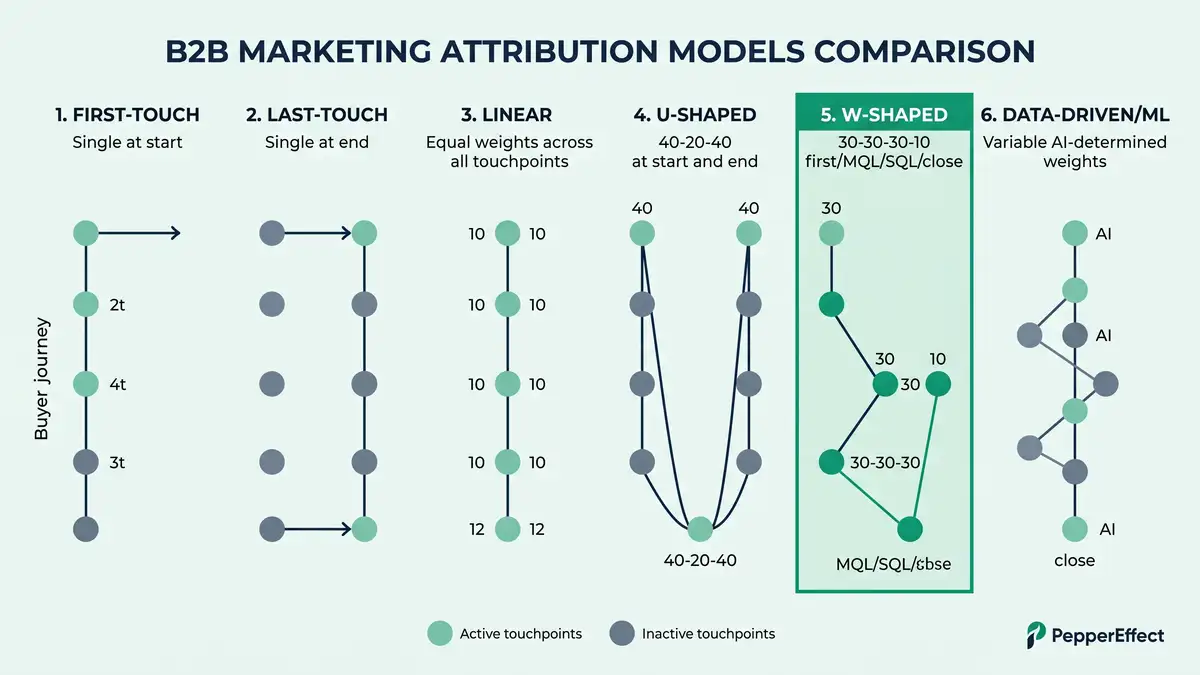
Every defensible attribution architecture combines models — but each model has a job. The 2026 model decision is not "which one" but "which combination at what stage."
First-touch attribution
100% credit to the first touchpoint. Best for: top-of-funnel channel evaluation (which channel introduces accounts to the brand). Worst for: budget allocation decisions on bottom-funnel channels. Use case: measuring brand-and-awareness ROI, podcast attribution, content-led discovery.
Last-touch attribution
100% credit to the closing touchpoint. Best for: bottom-funnel conversion-driver evaluation. Worst for: anything else — it systematically over-credits paid search, retargeting, and direct/branded traffic. Use case: tactical landing-page CRO and bottom-funnel ad performance.
Linear attribution
Equal credit across all touchpoints. Best for: simple multi-touch reporting when you don't trust any model's weights. Worst for: revealing which stages drive disproportionate impact. Use case: starting point before you have enough data for U/W/data-driven models.
U-shaped (position-based) attribution
40% to first touch, 40% to lead-creation touch, 20% distributed across middle. Best for: lead-generation focused programmes. Worst for: long sales cycles where post-MQL touches matter. Use case: simpler B2B SaaS with sub-60-day sales cycles.
W-shaped attribution (recommended for mid-market B2B SaaS)
30% to first touch, 30% to MQL conversion, 30% to opportunity creation, 10% distributed across middle. Best for: 90-180 day B2B sales cycles where four key stage transitions matter. Worst for: short-cycle PLG or transactional motions. Use case: $10M-$40M ARR mid-market B2B SaaS — the most defensible operational MTA model. Pair with our lead scoring framework so MQL/SQL transitions are accurately stamped.
Data-driven attribution (ML-based)
ML-determined weights using historical conversion data. Best for: enterprise programmes with 5,000+ closed deals/year and clean data infrastructure. Worst for: mid-market with <500 closed deals annually (insufficient training data) or sparse touchpoint instrumentation. Use case: enterprise SaaS at $100M+ ARR with mature data warehouse.
Multi-Touch Attribution vs Marketing Mix Modelling: when to use each

The 2026 strategic decision is not "MTA or MMM" — it's "MTA for which decisions, MMM for which other decisions." Multi-touch attribution operates at the deal level, requires identity resolution across touchpoints, and answers "which touchpoints inside this deal mattered?" Marketing mix modelling operates at aggregate spend level, doesn't require individual identity, and answers "what's the marginal ROI of $1 more on each channel?"
For a $10M-$40M ARR mid-market SaaS, MTA wins on tactical channel optimisation inside a quarter (W-shaped is the operational backbone). MMM wins on annual budget reallocation decisions across channel categories — paid search vs LinkedIn vs podcast vs thought leadership. Incrementality testing validates both: hold-outs prove which channels actually drive deals vs which channels just claim credit for deals that would have closed anyway.
| Method | Granularity | Identity required | Best decision | Cost |
| Multi-Touch Attribution (MTA) | Deal-level | Yes (cross-touchpoint) | Tactical channel optimisation | $25K-$60K/year platform |
| Marketing Mix Modelling (MMM) | Aggregate spend | No | Annual budget allocation | $30K-$120K/year platform |
| Incrementality testing | Channel-level holdouts | Partial | Validating channel impact | $5K-$25K + opportunity cost |
| Self-reported attribution | Account-level | No | Dark funnel detection | $0 (form field) |
Source: Improvado — 12 Best Multi-Touch Attribution Solutions 2026; Cometly — Best Attribution Model for SaaS 2026
The dark funnel: the 70-80% of buying that never touches your site

The single biggest 2026 attribution challenge is the dark funnel — research that happens on platforms you don't own and can't track. Peer reviews on G2 and TrustRadius. ChatGPT queries about your category. LinkedIn posts viewed and shared. Podcast episodes consumed during commutes. Sales-team-to-sales-team Slack conversations. None of it shows up in your analytics platform; all of it influences buying decisions.
The fix is not better tracking — it's stacking three measurement layers that each capture a slice of the dark funnel:
- Self-reported attribution. A "How did you first hear about us?" field on demo-request and pricing-page forms. Crude but powerful — captures category awareness 10-20% of MTA misses entirely. Top-quartile B2B SaaS programmes use self-report as the primary dark-funnel signal and reconcile against MTA quarterly.
- Brand-search MMM. Track branded search volume against media spend. When podcast or thought-leadership investment rises and branded search lifts 4-12 weeks later, MMM detects the relationship even though no individual click was tracked.
- ICP-account intent data. Bombora, G2 buyer intent, 6sense — third-party signals showing target accounts researching your category. The dark-funnel proxy that bridges anonymous research and account-level engagement.
The discipline ties to the wider inbound marketing for SaaS playbook: programmes optimising for measurable channels alone systematically under-fund the dark-funnel channels that drive 30-50% of qualified pipeline. For account-level attribution where the buying committee matters more than the individual lead, see our account-based marketing playbook.
The 2026 attribution platform stack

For mid-market B2B SaaS at $10M-$40M ARR, the 2026 attribution stack runs three platform layers. CRM-native attribution (HubSpot, Salesforce) covers W-shaped MTA for the operational layer at zero incremental cost — sufficient for 70%+ of mid-market needs if your data hygiene is clean. Specialised MTA platforms (Bizible/6sense, Dreamdata, Cometly, SegmentStream) layer in account-level multi-touch attribution with intent-data integration. MMM platforms (Improvado, Pecan, Recast) run quarterly mix modelling for annual budget allocation.
The build-vs-buy decision matters. Build CRM-native MTA in HubSpot/Salesforce when your data team is small and your sales cycle stays under 120 days — the same CRM that runs CRM automation and routing logic. Buy a specialised MTA platform when sales cycles exceed 120 days, buying committees exceed 5 stakeholders, and you need account-level rollup. Buy MMM when annual marketing spend exceeds $1M and you have 18+ months of clean spend-by-channel data.
Data infrastructure prerequisites. No attribution platform compensates for broken data plumbing. Before any platform decision, audit: UTM hygiene (every campaign tagged consistently), CRM event tracking (every form fill, content download, email click logged with attribution stamps), CDP or identity resolution layer (single account view across touchpoints), and a position model documented in writing (W-shaped, U-shaped, or data-driven). Pair with our marketing automation platform selection guide for the orchestration layer.
The five failure modes that kill attribution programmes
Failure mode 1: Single-method attribution
"We have MTA" or "we use last-touch" as the entire programme. Single-method attribution misreads 20-40% of channel ROI in modern B2B environments. The fix: stack MTA (operational) + MMM (strategic) + incrementality (validation) + self-report (dark funnel) and reconcile quarterly.
Failure mode 2: Over-attributing bottom-funnel channels
Last-touch attribution credits paid search, retargeting, and direct traffic for deals that 75-90% of buyer journey was driven by upstream brand and awareness channels. Marketing teams cut podcast budget, double down on Google Ads, and watch CAC creep up 25-40% over four quarters. Switching to W-shaped attribution corrects the imbalance.
Failure mode 3: Ignoring the dark funnel
If your attribution dashboard says 60%+ of revenue comes from "direct" or "branded search," you're not seeing 70-80% of the buyer journey — you're seeing the reflection of brand investment landing in your bottom-funnel channels. Layer self-reported attribution and MMM on branded search to reveal the real story.
Failure mode 4: No incrementality validation
MTA without holdout testing reports correlation, not causation. Channels that claim 30% of attribution credit may drive only 10% of incremental revenue (the rest would have closed anyway). Run quarterly geo-holdouts or matched-market tests on top-3 channels to validate which are causal vs correlational.
Failure mode 5: Attribution divorced from budget decisions
Attribution data sits in a dashboard nobody references when the annual budget is set. The CMO walks into the board meeting with last year's gut-feel allocation. Attribution earns its cost only when it directly drives quarterly budget reallocation — minimum 15-30% of channel spend should shift annually based on attribution-driven decisions.
How AI changes attribution economics in 2026

AI integration in attribution is now production-grade across three layers. ML-based MTA (data-driven attribution in HubSpot/Salesforce, Dreamdata's automated MTA) replaces hand-tuned position weights with model-derived weights — but still requires 500+ closed deals annually for stable training. Automated MMM (Pecan, Recast) compresses what was a 6-12 week analyst project into a 2-4 week automated pipeline, making MMM accessible to mid-market budgets that previously couldn't justify it. AI-driven incrementality testing automates holdout group selection and statistical significance calculations that previously required dedicated data-science teams.
The economics: traditional MTA + MMM + incrementality stack costs $80K-$200K/year for a $10M-$40M ARR mid-market team in platform fees plus 0.5-1.0 FTE in analytics support. AI-augmented stack drops the FTE to 0.25 and tightens the budget-decision cycle from annual to quarterly. The compounding effect — quicker, more confident budget reallocation — typically delivers 12-18% CAC efficiency improvement in year one. Pair with broader agentic workflows for compounding RevOps leverage.
The infrastructure spine: identity resolution, ICP-fit, governance
Identity resolution. Post-cookie, attribution depends on first-party identity resolution — connecting form fills, email clicks, product activity, and account-level events to a single account record. CDPs (Segment, RudderStack, mParticle) own this layer. Without it, MTA accuracy degrades 35-50% as touchpoints fragment across anonymous and identified states. The 2026 first-party data spine is mandatory infrastructure, not optional tooling.
ICP-fit gating. Attribution should track fit-qualified pipeline, not all pipeline. A channel that drives 1,000 leads from out-of-ICP accounts is producing zero pipeline value, regardless of attribution credit. Layer ICP firmographic gating before any attribution calculation — see our marketing qualified lead definition for the four-component fit framework.
Governance and reporting cadence. RevOps owns the attribution model, marketing executes against it, sales validates closed-deal data quality. Quarterly recalibration: pull last 90 days of attribution data, segment by ICP and channel, identify drift, adjust position weights or model selection. Annual budget allocation: reconcile MTA + MMM + incrementality findings into a single budget proposal with documented rationale. Without governance, attribution becomes a data-team curiosity instead of a budget-defending discipline that ties directly to SaaS customer acquisition cost reduction.
Want a diagnostic on where your attribution programme is misreading channel ROI?
Book a Growth Mapping CallThe 90-day rollout playbook
For a $10M-$40M ARR mid-market SaaS rebuilding attribution from a single-method legacy state, the 90-day sequence:
Days 1-30: Audit, instrument, choose models
Audit current attribution: which model is operational, what data is captured, where the gaps are (UTM hygiene, CRM event tracking, identity resolution). Add self-reported attribution to demo and pricing-page forms within week 1. Pick W-shaped as the operational MTA model. Document data infrastructure gaps and prioritise CDP-or-equivalent identity layer if missing. Target deliverable: attribution architecture document signed off by CMO + CRO + RevOps.
Days 31-60: Deploy MTA, instrument MMM, run first incrementality test
Deploy W-shaped MTA in CRM (HubSpot/Salesforce) or specialised platform (Dreamdata, Cometly, Bizible). Pull 18 months of historical spend-by-channel data for MMM baseline. Run first incrementality test on top-3 highest-spend channels (geo-holdout or matched-market). Build the dark-funnel reconciliation dashboard cross-referencing self-report against MTA. Target: W-shaped MTA producing weekly channel reports.
Days 61-90: Reconcile, recommend, recalibrate
At day 75, run the first attribution reconciliation review: MTA + MMM + incrementality + self-report data overlaid for the same period. Identify divergences. Build the channel-budget recommendation deck with attribution-driven rationale. Present to CFO/CEO for the next quarter's budget allocation. Document the quarterly recalibration playbook. Target: 15-30% of channel spend reallocated based on reconciled attribution data.
Architect a B2B attribution stack that drives correct budget decisions
peppereffect installs the multi-method attribution stack for $10M-$40M ARR B2B SaaS leaders ready to stop guessing about channel ROI. We deploy the W-shaped MTA operational layer, the MMM strategic layer, the incrementality validation layer, and the dark-funnel reconciliation that turns attribution from a dashboard nobody trusts into the budget-defending discipline your board expects.
Book a Growth Mapping CallFrequently asked questions
What is B2B marketing attribution?
B2B marketing attribution is the discipline of assigning revenue credit to marketing touchpoints that influenced a deal — across channels, time, and stakeholders inside a buying committee. The 2026 architecture is a multi-method stack: multi-touch attribution at the deal level, marketing mix modelling at aggregate spend level, incrementality testing for causal validation, and self-reported attribution for dark-funnel detection.
What's the best attribution model for B2B SaaS?
For $10M-$40M ARR mid-market B2B SaaS with 90-180 day sales cycles, W-shaped attribution is the most defensible operational MTA model. It allocates 30% to first touch, 30% to MQL conversion, 30% to opportunity creation, and 10% across middle touches — accurately reflecting which stage transitions matter most in B2B buying journeys. Layer MMM on top for annual budget allocation and incrementality tests for causal validation.
What's the difference between MTA and MMM?
MTA (Multi-Touch Attribution) operates at the deal level, requires identity resolution across touchpoints, and answers "which touchpoints inside this deal mattered?" MMM (Marketing Mix Modelling) operates at aggregate spend level, doesn't require individual identity, and answers "what's the marginal ROI of $1 more on each channel?" Both are required for full B2B attribution coverage in 2026.
Is multi-touch attribution dead in 2026?
No. Cookie-based MTA is degraded — third-party cookie deprecation, Apple Mail Privacy Protection, and tracking-prevention frameworks leave 35-50% of touchpoints unattributable. But first-party MTA running on identity-resolved CRM data, paired with MMM and incrementality testing, remains the operational backbone of B2B attribution. The fix is method stacking, not method abandonment.
How does the dark funnel affect attribution?
The dark funnel — research happening on platforms you don't own (peer reviews, ChatGPT, LinkedIn, podcasts) — accounts for 70-80% of the modern B2B buyer journey. Click-based attribution misses all of it. The 2026 fix is layering self-reported attribution, branded-search MMM, and ICP-account intent data to capture the dark-funnel signal that MTA alone cannot see.
How long does it take to implement B2B attribution?
The 90-day rollout: 30 days to audit, instrument, and pick models; 30 days to deploy W-shaped MTA, instrument MMM baseline, and run the first incrementality test; 30 days to reconcile findings and recommend budget reallocation. Quarterly recalibration cadence after launch. Full programme maturity (multi-method, validated, board-defensible) takes 12-18 months.
What attribution platforms work for mid-market B2B SaaS?
For $10M-$40M ARR, three layers: CRM-native MTA (HubSpot, Salesforce — covers 70%+ of needs), specialised MTA platforms (Bizible/6sense, Dreamdata, Cometly, SegmentStream — for account-level multi-touch with intent integration), and MMM platforms (Improvado, Pecan, Recast — for annual budget mix). Build CRM-native if sales cycles stay under 120 days; buy specialised when cycles exceed 120 days or buying committees exceed 5 stakeholders. conversion rate optimization playbook
Resources
- Marketing Managed — 2026 B2B Marketing Trends Predictions
- Improvado — Multi-Touch Attribution in 2026: B2B Guide
- Improvado — 12 Best Multi-Touch Attribution Solutions 2026
- Directive Consulting — 2026 B2B SaaS Marketing Blueprint
- Cognism — 12 B2B Marketing Trends Predictions 2026
- Cometly — Best Attribution Model for SaaS 2026
- Cometly — Revenue Attribution For B2B SaaS 2026
- Heeet — First-Touch vs Multi-Touch Attribution 2026
- SegmentStream — 10 Best Multi-Touch Attribution Software 2026
- Vehnta — 2026 B2B SaaS Marketing Strategies
- Omnibound — B2B SaaS Marketing 2026 Strategy Funnel
- 1827 Marketing — 2026 B2B Marketing Transformation Roadmap
- Factors AI — SaaS Marketing Strategy 2026 Playbook
- Headley Media — 80+ B2B Marketing Phrases 2026
- Fatgraphs — B2B SaaS Marketing Complete Guide 2026