

B2B demand generation is not a campaign budget line. It is the production system that engineers predictable pipeline 6-12 months into the future — by building the awareness, education, and category presence that creates in-market demand the rest of your funnel can capture. The 95-5 rule from the Ehrenberg-Bass Institute settles the strategic case: only 5% of B2B buyers are in-market at any moment, and demand gen exists to win the 95% before they enter the buying window. The mid-market B2B SaaS companies treating demand gen as "another marketing channel" are quietly losing the future-pipeline race to competitors who treat it as the operating system.
This article installs the framework: the four-phase production system (Audience → Authority → Activation → Attribution), the channel mix and budget allocation, the content-engine architecture, the agentic AI layer compressing time-to-pipeline, the 2024-2026 benchmarks, the five common failure modes, and the 90-day rollout. Built for the Sarah Chen whose CMO has been authorised to reallocate 20-40% of marketing budget toward demand gen — and whose board needs the playbook her team will actually execute, not another deck on "why demand gen matters."
What "Predictable Pipeline" Actually Requires
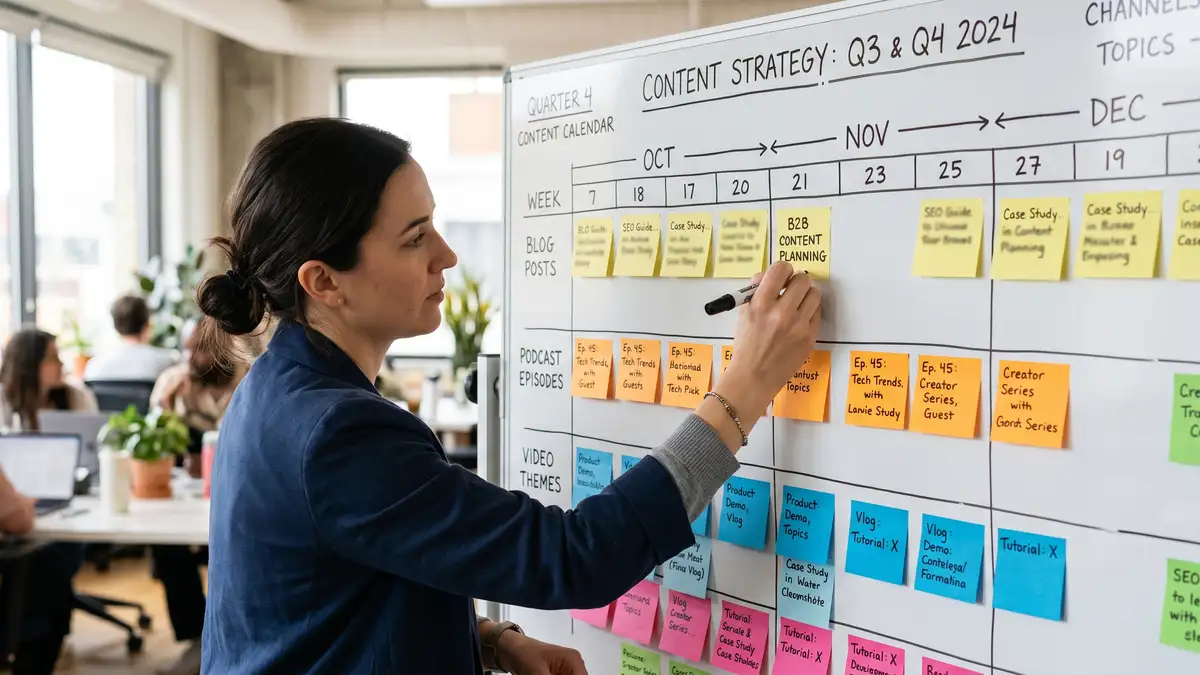
Predictable pipeline is the engineered output of a production system, not the lucky byproduct of campaigns. The same architectural rigour you applied to expansion revenue and your SaaS financial model applies here: production systems compound, campaigns decay. It requires three architectural commitments most mid-market SaaS companies are unwilling to make: a 6-9 month investment horizon before measurable pipeline impact, an owned-media-first budget allocation rather than paid-channel dependency, and an organisational discipline that measures demand-gen success in share-of-voice and pipeline velocity 12 months out — not MQLs this quarter.
The companies hitting top-quartile pipeline contribution from demand-gen-driven inbound (50%+ of total pipeline) share a deterministic pattern: they run the same four-phase architecture, they refuse to gate the demand-creation content layer, and they treat their podcast, video, and executive thought-leadership cadence as a non-negotiable production schedule. Your demand gen vs lead gen disambiguation sets the strategic frame; this article installs the operating system.
The Production-System Test
If your demand-gen output drops the moment your CMO is on holiday, you do not have a system — you have a person. Predictable pipeline requires a content-production cadence that runs whether or not any single individual is in the office, with measurement that tracks compounding output rather than discrete campaigns.
Want to see your own CAC against peer benchmarks? Run the CAC Diagnostic for your true CAC, the 30 to 50% reduction agentic deployment delivers, and a board-ready PDF in 60 seconds.
Run the CAC DiagnosticThe Four-Phase Demand-Gen Architecture
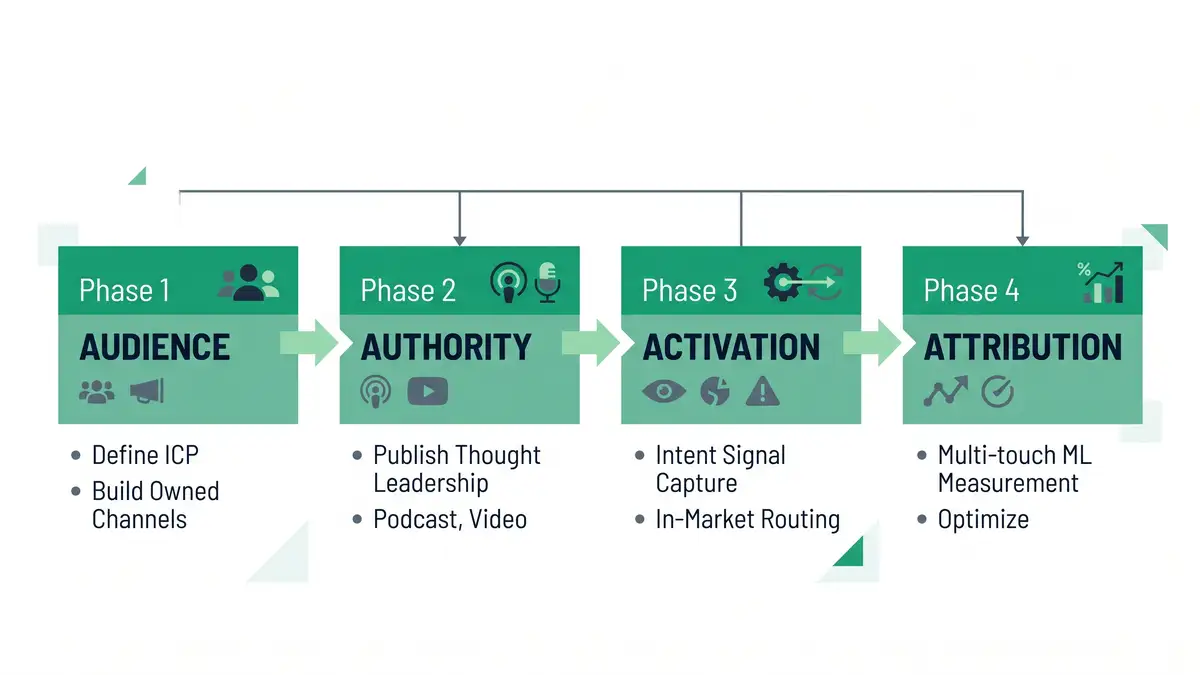
The framework stacks horizontally — each phase feeds the next, and skipping any phase produces an unbalanced system. The most common breakage is companies launching at Phase 2 (publishing content) without doing Phase 1 (defining the audience and owned channels), and then wondering why content engagement plateaus.
Phase 1: Audience — Define the ICP and Build Owned Channels
Define the four-vector ICP (firmographic + technographic + intentographic + behavioural). Stand up the owned-media infrastructure: newsletter, podcast feed, YouTube channel, executive LinkedIn profiles, blog. Audience-build is the most-skipped, most-leveraged phase — it is the only phase that compounds. Cite Lets Nara's 2026 B2B demand-gen framework.
Phase 2: Authority — Publish Thought Leadership at Production Cadence
2-4 high-quality pieces per week across 3-5 channels. Long-form blog (ungated), weekly podcast (1-2 episodes), 2-4 LinkedIn videos, 1-2 executive thought-leadership posts. The output cadence is the system; below 2 pieces per week you are publishing, not producing. Innovative Group's 2026 framework documents the cadence threshold for compounding pipeline.
Phase 3: Activation — Capture In-Market Signal
Intent-data infrastructure (Bombora, 6sense, Demandbase) bridges demand to lead. The moment a target account enters the in-market state — defined by content-engagement velocity, research patterns, peer-Slack mentions — the agentic SDR layer fires personalised outreach within hours. Autobound's 2026 intent-data provider analysis documents the bridge layer.
Phase 4: Attribution — Measure What Demand Gen Actually Did
Multi-touch ML attribution beats last-click for demand gen (last-click systematically credits the lead-gen capture and ignores the touches that built the in-market signal). Track share-of-voice, branded search volume, dark-social mentions, content-cited revenue, and pipeline velocity at the 6-12 month horizon. DigitalScouts' MTA guide lays out the measurement stack.
The 60/40 Brand-Activation Budget Split (and Why Most Get It Wrong)
The Binet & Field B2B Effectiveness Code, codified by the LinkedIn B2B Institute, established the optimal split: 60% on long-term brand-building (demand gen), 40% on short-term activation (lead gen). Top-quartile B2B SaaS companies validated against pipeline outcome run between 50/50 and 60/40 demand/lead. Most mid-market B2B SaaS in 2026 still runs closer to 80/20 lead-gen-heavy — exactly inverse to the empirical optimum, leaving 6-12 months of compounding demand-creation pipeline on the table.
| Allocation | 2026 Mid-Market Norm | Top-Quartile Performance |
| Owned media (content, podcast, video, executive brand) | 15-25% | 50-60% |
| Earned media (PR, partnerships, speaker slots, podcasts) | 5-10% | 20-30% |
| Paid (LinkedIn, programmatic, sponsorship) | 50-65% | 15-25% |
| Lead-gen activation (paid search, gated assets, retargeting) | 15-25% | 10-20% |
Sources: Cognism Mid-Market B2B Strategies 2026, Dreamdata LinkedIn Ads Benchmarks 2026, Innovative Group 2026 Demand Gen Strategy.
The reason most mid-market companies stay trapped at 80/20 lead-gen-heavy is short-term measurability: lead gen produces an MQL count for next month's board deck; demand gen produces compounding pipeline-velocity 6-12 months out that no last-click attribution model credits. The fix is shifting marketing's primary KPI from raw MQL count to qualified accounts, share-of-voice, and pipeline velocity at the 12-month horizon — the same architectural shift documented by your ABM implementation guide applied to budget governance.
The Content-Engine Architecture

The content engine is not "we publish a blog post each week." The content engine is a multi-format production system that produces 8-15 atomic content units per week, each derived from a single high-leverage source asset, distributed across owned channels, and indexed for both search and AI citation. The engine has a deliberate asset-tier architecture: a single weekly podcast episode becomes the raw material for 1 long-form blog post, 4-6 LinkedIn video clips, 1 newsletter feature, 2-3 X/Twitter threads, and 1 YouTube long-form video. One source asset produces 10-15 outputs.
| Asset Tier | Cadence | Production Cost | Distribution Channels |
| Source: Podcast / Long-form video | 1-2/week | 4-6 hrs production | Apple, Spotify, YouTube, owned site |
| Derivative: Long-form blog | 1-2/week | 2-3 hrs editing + AEO | Blog, LinkedIn, newsletter |
| Derivative: LinkedIn video clips | 4-6/week | 30 min/clip | Founder + brand LinkedIn |
| Derivative: Executive thought leadership | 2-4 posts/week | 30-45 min/post | Founder + key exec LinkedIn |
| Derivative: Newsletter | 1/week | 1 hr | Owned email list |
Sources: Innovative Group Demand Gen Strategy 2026, Ryesing B2B Demand Generation Strategies 2026, The B2B Playbook LinkedIn Thought Leader Ads.
The economic case for the content engine is the cost-per-derivative collapse. The 6 hours invested in a podcast recording yields 10-15 atomic outputs across 5 channels — a per-output cost of 30-45 minutes. A traditional "publish one blog post per week" content team produces one output per 4-6 hours of work, a 10-15x lower throughput at identical headcount. Ryesing's 2026 demand-gen analysis documents the production-leverage shift.
Diagnose whether your content team is publishing or producing — and where the 10x leverage is hiding in your existing assets.
Book a Demand-Gen Diagnostic CallThe Agentic AI Layer for Demand Gen

Agentic AI in 2026 is collapsing three previously labour-intensive demand-gen workflows: content variant generation at scale, dark-social monitoring and engagement, and intent-signal-triggered routing. AI tools (Clay, 11x.ai, Default, Salesforce Einstein, 6sense AI Writer) generate 5-10 platform-tailored variants from a single source asset, monitor branded mentions across Slack communities and podcasts, and trigger personalised outreach within hours of in-market signal rather than the historic 5-10 day lag.
The structural implication for mid-market SaaS: the historical content-team headcount required to run a top-quartile demand-gen program (8-12 people) compresses to 3-5 with proper agentic AI orchestration. The savings reallocate into more source-asset production (more podcast episodes, more original research, more executive video) — which is the only thing that ultimately differentiates one company's content engine from another's. Your agentic workflow orchestration layer plus sales automation spine, wired into your CRM automation infrastructure, is the operational frame for compressing time-to-pipeline.
Five Failure Modes That Compound Silently
Failure 1 — Demand-Gen Team Measured on Lead Targets
If the demand-gen team's quarterly review is "how many leads did your podcast generate?" the team will either kill the podcast or warp it into a lead-capture vehicle. The correct demand-gen KPIs are share-of-voice, branded search volume, dark-social mentions, and pipeline-velocity 6-12 months out. Mismatched KPIs produce mismatched output.
Failure 2 — Gating the Demand-Creation Content Layer
Putting thought-leadership content behind a form converts the small in-market percentage and silences the 95% who would have shared, cited, and amplified the work. Demand-gen content must be ungated. Lead-gen content (whitepapers tied to specific in-market triggers, calculators, comparison guides) earns a gate. Mixing the two destroys both.
Failure 3 — No Podcast / Video Infrastructure
Companies running text-only demand gen in 2026 are competing with one hand tied. Audio and video are the dominant attention formats and the channels where executive trust forms. The B2B Playbook documents a $50K → $185K MRR trajectory built on LinkedIn thought-leader ads alone — a video-led activation tier that text-only programs cannot replicate.
Failure 4 — No Executive Brand Layer
Founder-led demand gen consistently outperforms corporate-page content 3-5x on engagement. If your CEO and CRO are not posting weekly on LinkedIn, you are forfeiting the highest-leverage demand-gen channel available. Founder-brand outperforms corporate-brand because trust forms with people, not logos — and the algorithmic distribution rewards individual posts over company pages.
Failure 5 — No Continuity Beyond 90 Days
Companies that "do demand gen for 90 days" produce no demand-gen ROI. The 6-9 month investment horizon is non-negotiable; companies that pivot in month 4 because they "didn't see results" are diagnosing the wrong failure mode. The fix is committing to a 12-month minimum rollout window before evaluating effectiveness, and locking the budget at the CEO level so quarterly board pressure cannot truncate it.
The 90-Day Demand-Gen Operating System Rollout

| Days | Focus | Outcome |
| 1-30 | Audience phase: ICP definition, owned-channel infrastructure (newsletter, podcast feed, YouTube channel, exec LinkedIn profiles), measurement baseline (share-of-voice, branded search, MQL-to-pipeline) | Production infrastructure live; measurement baseline locked |
| 31-60 | Authority phase: weekly podcast cadence launched, 2-4 LinkedIn videos/week from CEO, 1-2 long-form blog posts/week, executive thought leadership routine established | Content production cadence at 8-12 atomic units/week |
| 61-90 | Activation + Attribution: intent-data layer (Bombora/6sense) deployed, in-market signal triggers wired to agentic SDR sequences, multi-touch attribution dashboard live, 6-12 month pipeline-velocity baseline locked | End-to-end system operational; first measurable in-market signals captured |
Sources: Directive Consulting Complete Guide to B2B Demand Gen, Lets Nara B2B Demand Generation Framework, Innovative Group 2026 Strategy.
By month 6, branded search volume should be measurably up; by month 9, share-of-voice in your category should be measurably up; by month 12, pipeline contribution from demand-gen-driven inbound should hit 30-40% (with the trajectory toward 50%+ at month 18). Companies running disciplined execution against this timeline routinely see CAC compression alongside the pipeline lift — because demand-gen-driven inbound converts at materially higher rates and lower cost than paid-channel-only acquisition.
Bottom Line
B2B demand generation is a production system, not a campaign. The 95-5 rule makes the strategic case: you must win the 95% out-of-market or compete with every competitor for the same 5% in-market. The 60/40 brand-activation budget split makes the allocation case. The four-phase architecture (Audience → Authority → Activation → Attribution) is the operating system. The five failure modes (lead-target KPIs, gated demand content, no podcast/video, no executive brand, no continuity beyond 90 days) compound silently until pipeline conversion stalls and CAC inflates. Agentic AI in 2026 compresses the headcount required to run top-quartile demand gen by 50-60%, reallocating savings into more source-asset production. The CEO's job is not to fund demand gen as a quarterly experiment. It is to install it as the production system that compounds 6-12 months out — and to lock the budget so quarterly board pressure cannot truncate the system before it produces its compounding return.
Install the Demand-Gen Operating System
peppereffect runs the 90-day demand-gen rollout for $10M-$40M ARR B2B SaaS — Audience-phase ICP and owned-channel infrastructure, Authority-phase content production engine (podcast, video, executive thought leadership), Activation-phase intent-data layer with agentic orchestration, Attribution-phase multi-touch ML measurement. Architectural, not advisory. Outcome target: 30-40% pipeline contribution from demand-gen-driven inbound at month 12, 50%+ at month 18.
Book Your Growth Mapping CallSee the Demand Gen vs Lead Gen disambiguation →
Frequently Asked Questions
What is B2B demand generation?
B2B demand generation is the production system that creates and sustains awareness, education, and category presence so that future B2B buyers eventually consider you when they enter the in-market state. It runs on a 6-24 month time horizon, produces outputs measured in branded search volume, share of voice, and pipeline velocity 6-12 months forward — not MQL count this quarter. The work is podcasts, video, organic social, ungated long-form content, executive thought leadership, owned audience, and category-defining events.
What's the difference between B2B demand gen and B2B lead gen?
Demand gen creates the future market — building mental availability with the 95% of buyers not yet in-market per the Ehrenberg-Bass 95-5 rule. Lead gen captures the 5% who are in-market today. Demand gen runs on a 6-24 month horizon; lead gen runs on a 0-90 day horizon. Both are necessary; neither substitutes for the other. The architectural distinction is documented at length in the demand gen vs lead gen disambiguation.
How long does B2B demand generation take to show results?
Sustained demand-gen investment requires 6-9 months to move the needle on pipeline. By month 6, branded search volume should be measurably up; by month 9, share of voice in your category; by month 12, pipeline contribution from demand-gen-driven inbound should hit 30-40%. Companies that pivot in month 4 because they "didn't see results" are diagnosing the wrong failure mode — the 6-9 month minimum is non-negotiable.
What's the optimal B2B demand-gen budget allocation?
The Binet & Field B2B Effectiveness Code, codified in the LinkedIn B2B Institute's research, sets the optimal split at 60% brand-building (demand gen) and 40% sales activation (lead gen). For owned/earned/paid mix specifically: top-quartile B2B SaaS runs 50-60% owned media, 20-30% earned, 15-25% paid. Most mid-market B2B SaaS runs 15-25% owned and 50-65% paid — exactly inverse to the empirical optimum.
How many content pieces should a B2B demand-gen team produce per week?
2-4 high-quality pieces per week across 3-5 channels. Top-performing programs run a multi-format production system that produces 8-15 atomic content units per week, each derived from a single source asset (typically a podcast episode or executive video). Below 2 pieces per week, you are publishing, not producing — and the system will not compound.
What is the dark funnel and why does it matter for demand gen?
The dark funnel is the portion of the B2B buying journey that happens in unattributed channels — Slack groups, peer communities, podcasts, dark-social shares, executive networks. Forrester research consistently shows 70%+ of the buying journey completes before the first sales contact, much of it in dark social. Demand-gen's job is to be present in those channels; lead-gen attribution cannot see them, which is why MTA models that credit demand-creating touches outperform last-click.
Can agentic AI replace a demand-gen team?
No — agentic AI compresses the headcount required for top-quartile demand gen by 50-60% (from 8-12 people to 3-5), but the source-asset production (podcast hosting, executive video, original research) still requires humans. The savings reallocate into more source-asset production, which is the only thing that ultimately differentiates one company's content engine from another's. AI is the compression layer, not the substitute. qualified-lead routing logic multi-touch attribution architecture conversion-stage CRO architecture demand generation vs lead generation account-based marketing playbook B2B SaaS marketing budget allocation
Resources
- Ehrenberg-Bass / Marketing Science — 95-5 Rule
- Ryesing — B2B Demand Generation Strategies 2026
- Innovative Group — B2B Demand Generation Strategy 2026
- Lets Nara — B2B Demand Generation Framework
- Directive Consulting — Complete Guide to B2B Demand Gen Strategy
- Dreamdata — LinkedIn Ads 2026 Benchmarks Report
- The B2B Playbook — LinkedIn Thought Leader Ads
- Cognism — 12 Proven B2B Marketing Strategies Mid-Market 2026
- Forrester — Digital Natives Rewriting B2B Buying
- Similarweb — B2B Dark Funnel 2026
- Autobound — Intent Data Providers 2026
- Corporate Visions — B2B Buying Behaviour 2026
- DigitalScouts — Multi-Touch Attribution in B2B
- 2X Marketing — MQL vs ABX
- FullFunnel — Long-Cycle Playbooks
- The B2B Playbook — Demand Generation Strategy 2026
- Demand Gen Report — B2BMX 2026 GTM Tracks
- Account Insight — 21 B2B Marketing Trends 2026