

Inbound marketing for SaaS in 2026 is no longer a blog with a few gated PDFs and a hopeful nurture sequence. The buyers you want — Sarah Chen-style mid-market CEOs running $10M-$40M ARR companies — now complete 70-80% of their evaluation in the dark funnel before they ever fill in a form, and 75% explicitly prefer a rep-free experience during early-stage research. The Master Growth Architect treats inbound as a four-phase precision engine: attract on Google AND inside ChatGPT, convert anonymous traffic into known accounts, nurture with intent-driven sequences, and delight customers into repeat-revenue and referral. This playbook details the architecture, the benchmarks, and a 90-day rollout that decouples pipeline growth from headcount.
The peppereffect view
Inbound marketing for SaaS is the architecture that converts demand created in the dark funnel into self-serve qualified pipeline — without expanding the SDR team. The system is four phases (Attract, Convert, Nurture, Delight), three measurement layers (visitor, lead, account), and one non-negotiable infrastructure spine (AEO/GEO + first-party data + lifecycle automation). Build the engine; do not curate fragments.
What inbound marketing for SaaS actually means in 2026
The original definition — create educational content, rank on Google, capture leads, nurture to MQL — is necessary but no longer sufficient. Three structural shifts have permanently rewritten the playbook for B2B SaaS.
The buying journey moved offline. Forrester research shows 75% of B2B buyers prefer a rep-free experience during early-stage research, and prospects now complete 70-80% of their evaluation entirely in the dark funnel — peer reviews, analyst reports, ChatGPT queries, competitor pricing pages — before your sales team is invited in. Your homepage no longer owns the first impression; the LLMs do.
AI search has fractured discovery. ChatGPT now commands 77% of all AI-driven referral traffic and 17.6% of global digital queries, while Google AI Overviews appear in roughly 50% of search results and intercept around 60% of clicks on informational queries. Inside that fracture, only five brands typically capture ~80% of AI responses in any given category — winner-take-most economics that punish late entrants brutally.
The funnel collapsed into a flywheel. The HubSpot-popularised flywheel model — Attract, Convert, Nurture, Delight — replaces linear funnel thinking with a momentum model where customer delight becomes the primary growth lever. Flywheel companies drive 24% faster revenue growth and 3x higher conversion rates than companies still optimising for top-of-funnel volume.
The "build it and they will come" trap
Mid-market SaaS leaders running 2018-era inbound — high-volume blog content, ungated downloads, no AEO infrastructure, MQL volume as the only KPI — are now seeing organic traffic decline 20-40% year-over-year. Inbound has not died; the architecture beneath it has been rewritten. The companies seeing 702% organic ROI are running 2026-grade systems, not legacy content factories.
Want to see your own CAC against peer benchmarks? Run the CAC Diagnostic for your true CAC, the 30 to 50% reduction agentic deployment delivers, and a board-ready PDF in 60 seconds.
Run the CAC DiagnosticInbound vs outbound for B2B SaaS: when each one wins
Both channels matter. The architectural mistake is treating them as substitutes rather than complements. Hybrid GTM motions consistently outperform single-channel strategies because they capture demand at different points in the buying journey: outbound creates awareness inside specific target accounts, inbound captures latent intent and earns mental availability across the full ICP universe.
| Dimension | Inbound (Attract & Capture) | Outbound (Initiate & Provoke) |
| Cost per lead | 61% lower than outbound average | $50-$150 per qualified meeting |
| Time to compound | 6-12 months before pipeline lift | 4-8 weeks to first meetings |
| Buyer fit | Self-directed researchers, mid-market | Strategic accounts, enterprise |
| Scaling lever | Content + SEO/AEO + CRO | SDR headcount + agentic AI agents |
| Best ICP signal | Search intent + content engagement | Account fit + timing triggers |
Source: Altior — Inbound or Outbound; Oliver Munro — SaaS Marketing Statistics 2026
For mid-market SaaS at $10M-$40M ARR with growth ambitions of $50M ARR without proportional headcount scaling, inbound is the leverage layer. Read the deeper comparison in our analysis of demand generation vs lead generation and the wider B2B demand generation strategy playbook for how the two motions architect together. Outbound is reserved for tier-1 accounts where personalisation depth justifies cost-per-touch — see our outbound sales strategy guide and the broader account-based marketing playbook for the surgical motion.
The four-phase inbound architecture
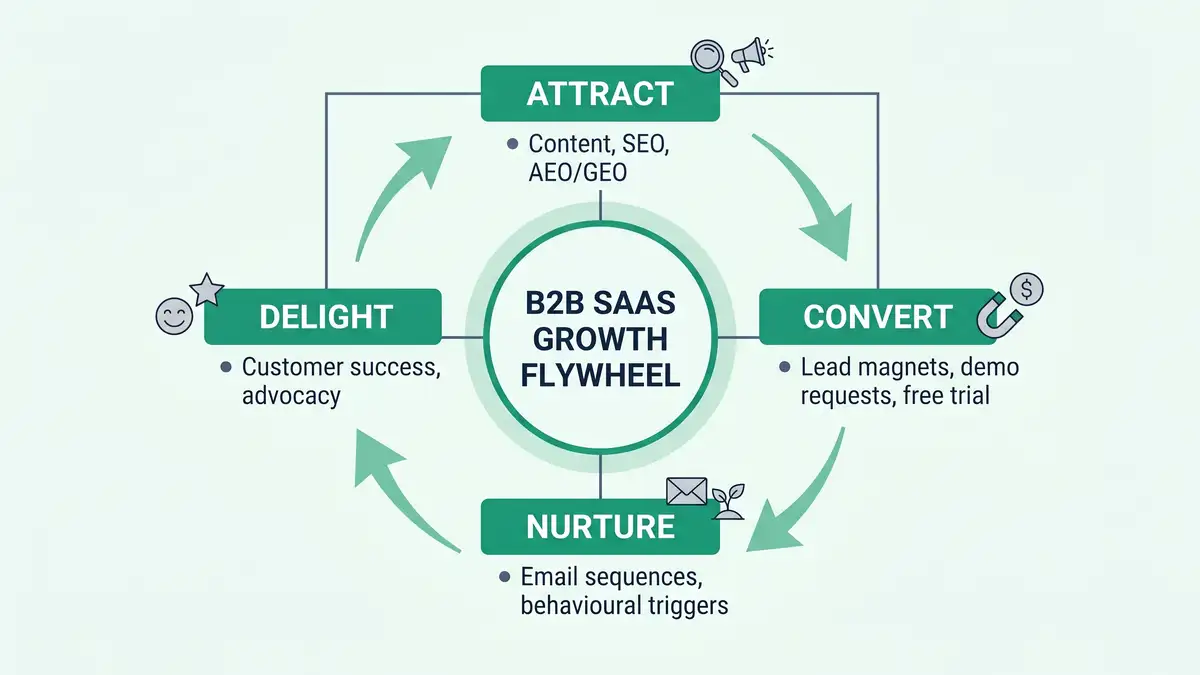
The four phases — Attract, Convert, Nurture, Delight — replace the linear funnel with a momentum loop. Each phase has its own accountability metric, its own infrastructure requirement, and its own failure mode.
Phase 1: Attract — earn presence in every research surface

Attract is the discovery layer. In 2026 it spans three surfaces: Google search (still the largest single source of B2B research traffic), AI answer engines (ChatGPT, Perplexity, Claude, Google AI Overviews), and platform communities (LinkedIn, Reddit, niche Slack groups, podcasts). The mechanic that wins all three is the same: topic cluster architecture — one pillar page anchoring 8-15 cluster posts that interlink semantically, signalling topical authority to both classical search and large language models.
Topic clusters are not a tactic; they are infrastructure. Companies running tight cluster architecture see organic traffic compound 35-60% faster than companies running disconnected blog libraries. Pair the cluster with deliberate AEO and GEO optimisation — schema markup, FAQ schema, semantic chunking, brand mention density across third-party sources — and you create the conditions for ChatGPT to cite you when prospects ask their pre-evaluation questions. The full mechanic is documented in our answer engine optimization strategy playbook.
Phase 2: Convert — turn anonymous traffic into known accounts
Conversion is where the median B2B SaaS site bleeds the most demand. The median visitor-to-lead conversion rate is just 2.35%, while top-decile sites convert at 11.45% — a 5x performance gap that is almost entirely engineering, not luck. Our B2B landing page optimization framework dissects exactly where mid-market SaaS sites leak. The four levers that close the gap:
High-utility lead magnets, not gated PDFs
Interactive ROI calculators, benchmark reports, and self-assessment tools convert at 18-35% landing-page conversion rates — versus 2-5% for traditional ebooks. High-value gated assets remain the highest-ROI conversion mechanism in B2B; what changed is that the asset must do meaningful work, not summarise five blog posts.
Landing pages built around one decision
Every conversion page should answer one question and request one action. B2B SaaS pages that strip extraneous navigation and embed social proof above the fold see 22-40% lift in form completion. Mobile-first design is non-optional; 53% of B2B research traffic now starts on mobile devices.
Demo and trial paths designed by ICP
Demo conversion rates median around 36%, but only 8-12% of trial signups become paying customers without lifecycle intervention. Top quartile demo programmes route requests instantly via async scheduling, qualify with progressive profiling, and assign by AE territory. Free-trial paths win when product activation gates fire within the first session.
Conversion rate optimisation as a discipline
Treat CRO as a quarterly programme with hypothesis logs, test queues, and statistical rigour — not as ad-hoc tinkering. Top-decile SaaS sites run 6-12 controlled experiments per quarter and document a 1.5-3x lift in form-fill rate within two quarters of disciplined operation.

Phase 3: Nurture — convert leads into accounts ready to buy
Nurture is where most SaaS marketing teams collapse. They build lead magnets, capture emails, then route everything into a "newsletter" that converts at 0.3% to opportunity. Disciplined nurture programmes drive 50% more sales-ready leads at 33% lower cost per lead — the difference is segmentation depth and trigger logic.
The 2026 nurture stack runs three sequence types in parallel: educational sequences (top-of-funnel content, 6-12 emails over 30-45 days) for early-stage researchers; solution sequences (product-anchored content, 4-7 emails over 14-21 days) for prospects who downloaded comparison or evaluation assets; and activation sequences (in-product behavioural triggers, 3-5 emails over 7-14 days) for trial users and product-led signups. Layer behavioural intent signals — content engagement scoring, reverse-IP identification, third-party intent data — to fire personalised paths inside each sequence type.
For the deeper architecture pattern see our B2B lead nurturing and marketing automation platform playbooks. Pair both with behavioral email triggers — the non-negotiable is that every nurture email must include exactly one CTA. Multi-CTA emails reduce click-through by 38-52% relative to single-CTA equivalents.
| Sequence type | Trigger | Length | Target conversion |
| Educational | Top-of-funnel asset download | 6-12 emails / 30-45 days | 4-8% to MQL |
| Solution | Comparison, pricing, evaluation page visit | 4-7 emails / 14-21 days | 12-18% to demo request |
| Activation | Trial signup or PLG behavioural milestone | 3-5 emails / 7-14 days | 20-35% to paid conversion |
| Re-engagement | Dormant 60-90 days | 3-4 emails / 10-14 days | 8-15% reactivation |
Source: Reform — Nurture Campaign Analytics Guide; Insider One — Email Marketing Benchmarks 2026
Phase 4: Delight — make customers your strongest acquisition channel

Delight is the phase legacy inbound treats as an afterthought and modern flywheels treat as the primary growth lever. SaaS companies in the top quartile of net revenue retention generate 40-60% of new ARR from existing accounts via expansion, upsell, and referral. The infrastructure: tight onboarding sequences, in-product engagement scoring, customer-led case-study production, and ambassador/referral programmes wired into the CRM.
The compounding effect is what makes the flywheel mathematically superior to the funnel. Every delighted customer becomes a referral source (median referral close rate is 3-5x cold inbound), a case-study contributor (case-study pages convert at 4-9% to demo request), and an organic distribution channel inside their own LinkedIn networks. This is where peppereffect's autonomous fulfillment systems compound: clean onboarding turns customers into evangelists faster, and evangelists do top-of-funnel work the marketing team would otherwise pay for. For the wider mechanic, see how the Freedom Machine philosophy turns customer success into the largest single source of net new ARR.
The five failure modes that kill SaaS inbound programmes
Every underperforming inbound engine we audit fails on one of five structural patterns. None of them are new. All of them are fixable in 60-90 days.
Failure mode 1: Volume content over intent content
Publishing two blog posts a week against keywords with no commercial intent produces traffic that never converts. The fix: keyword research that maps every commissioned post to a known buyer-stage query — informational, comparative, or commercial — and an editorial calendar that protects 60% of capacity for commercial-intent content.
Failure mode 2: No AEO/GEO infrastructure
If your content is not architected for AI answer engines — schema markup, semantic chunking, brand citation density, FAQ density — you are invisible to 17.6% of global queries already and the share is rising. AEO and GEO are infrastructure layers, not optional add-ons.
Failure mode 3: Weak lead magnet library
One ebook from 2022 and a pricing page does not constitute a conversion engine. Top-quartile SaaS sites maintain 12-25 active lead magnets segmented by ICP, role, and buyer stage — and refresh the top 6 quarterly based on performance data.
Failure mode 4: Broken nurture sequences
"Newsletter + occasional product update" is not a nurture programme. Without segmented sequences, behavioural triggers, and lifecycle stage progression, captured leads decay at 8-12% per month and never produce pipeline contribution.
Failure mode 5: MQL volume as the primary KPI
Companies still measuring MQL volume as the headline marketing metric run 30-50% below revenue benchmarks of companies measuring qualified-account pipeline contribution. Switching the accountability metric from MQL to SQL pipeline value is the single most impactful upgrade most marketing leaders can make in a quarter — and it directly compounds on top of SaaS customer acquisition cost reduction.
The infrastructure spine: what runs underneath all four phases

The four phases sit on top of three infrastructure layers that determine whether the engine compounds or stalls.
Search infrastructure. Technical SEO foundations — Core Web Vitals at green, schema markup on every commercial page, internal linking architecture that compounds authority — are baseline. Sites failing Core Web Vitals see 15-30% lower organic conversion rates regardless of ranking position. Layer AEO/GEO optimisation on top: FAQ schema, How-To schema, brand-entity reinforcement across third-party publications, and structured citation strategies that train LLMs to surface your content.
Data infrastructure. First-party data is now the only durable foundation. With third-party cookie deprecation and rising privacy regulation, customer data platforms (CDPs), reverse-IP identification, and consent-based behavioural tracking become non-optional. The data spine feeds segmentation, personalisation, scoring, and attribution — all of which collapse without clean first-party identity resolution.
Lifecycle automation. Marketing automation platforms (HubSpot, Marketo, Customer.io) handle the orchestration. The discriminator between mediocre and top-quartile programmes is not the platform; it is the depth of the automation logic. Multi-trigger workflows, behavioural scoring, lead routing, and SLA-bound sales handoffs are what turn captured leads into qualified pipeline at predictable velocity.
Brand and activation: the 60/40 split that compounds
Binet & Field's research across $30B of B2B marketing spend established that the optimal long-term mix is roughly 60% brand-building (broad reach, future buyers) and 40% sales activation (precise targeting, in-market buyers). Most SaaS marketing teams allocate 90% to activation and wonder why CAC keeps rising.
The Ehrenberg-Bass 95-5 rule clarifies why: at any given moment, only 5% of your ICP is in-market for your category. The 95% who are out-of-market today still need to remember you exist when they enter the buying window — which happens on a 12-36 month cycle for most SaaS categories. Brand-building is the discipline that earns mental availability across that 95%; activation captures the 5%. Neither replaces the other.
The practical translation for inbound: 60% of content investment goes into pillar/thought-leadership content, podcast appearances, founder-led LinkedIn presence, and category-defining points of view. 40% goes into bottom-of-funnel comparison pages, ROI calculators, demo paths, and lifecycle nurture. Most inbound teams flip this ratio and starve their own future pipeline.
Want a diagnostic on where your inbound architecture is leaking demand?
Book a Growth Mapping CallThe 2026 measurement model: from MQL volume to pipeline contribution
Marketing-qualified lead volume — the metric that defined inbound for fifteen years — has officially become a vanity number. Companies measuring marketing on MQL volume run 30-50% below the revenue performance of companies that have shifted accountability to SQL conversion and pipeline contribution. The 2026 measurement model runs three layers in parallel.
| Layer | Primary metrics | Purpose |
| Awareness | Branded search volume, share of voice, LLM citation share | Mental availability across the 95% out-of-market |
| Engagement | Visitor-to-lead %, content engagement score, multi-session sessions | Capture velocity inside the 5% in-market |
| Pipeline | SQL conversion %, pipeline $ generated, win rate by source | Revenue accountability and CAC efficiency |
Source: Geisheker — Is the MQL Dead?; SaaSHero — 2026 B2B SaaS Conversion Benchmarks
The shift in measurement also shifts incentive. When marketing is paid on MQLs, content gets engineered for low-friction form fills. When marketing is paid on pipeline contribution, content gets engineered for buyer fit and intent depth. Same investment, fundamentally different output.
The 90-day rollout playbook
For a $10M-$40M ARR mid-market SaaS rebuilding inbound from a legacy state, the first 90 days are about installing infrastructure and proving early conversion lift, not chasing traffic volume. The sequence:
Days 1-30: Audit, instrument, and pick the cluster
Audit current inbound performance: visitor-to-lead %, MQL-to-SQL %, organic traffic by intent class, AEO citation rate. Instrument first-party data — CDP or equivalent identity resolution. Pick one topic cluster with high commercial intent and 4-8 cluster posts already published. Refresh the pillar page and clean internal linking. Target: ship 2 high-utility lead magnets, fix Core Web Vitals to green, deploy schema markup site-wide.
Days 31-60: Build the conversion and nurture spine
Rebuild three highest-traffic landing pages around single decisions; embed lead magnets at the right buyer stage. Deploy three nurture sequences (educational, solution, activation) with behavioural triggers. Switch primary KPI from MQL volume to SQL pipeline contribution. Target: 2x visitor-to-lead conversion on the rebuilt pages, 25%+ open rate across nurture sequences.
Days 61-90: Layer AEO/GEO and start delight
Deploy AEO/GEO optimisation on the top 20 commercial pages: FAQ schema, semantic chunking, branded entity reinforcement across third-party publications. Launch a customer-led case-study programme with quarterly cadence. Start a referral programme wired into the CRM. Target: first AI citation tracking baseline established, 1-3 case studies live, 10-15% of new pipeline attributed to referral by quarter-end.
Architect your inbound engine the right way
peppereffect installs the four-phase inbound architecture for $10M-$40M ARR B2B SaaS leaders ready to decouple pipeline growth from headcount. We deploy the topic clusters, AEO/GEO infrastructure, lifecycle automation, and measurement model that turns content into qualified pipeline.
Book a Growth Mapping CallFrequently asked questions
What is inbound marketing for SaaS?
Inbound marketing for SaaS is the architecture for attracting prospects through content, search, and AI answer engines, converting them into known accounts via lead magnets and landing pages, nurturing them through behavioural and lifecycle sequences, and delighting customers into expansion and referral. The 2026 distinction is that inbound now runs across three discovery surfaces (Google, AI engines, communities) and measures contribution to SQL pipeline rather than MQL volume.
Is inbound marketing dead in 2026?
No. Volume-based content factories are dead. Architected inbound — running tight topic clusters, AEO/GEO infrastructure, intent-driven nurture, and pipeline-contribution measurement — drives 702% organic ROI and 61% lower cost per lead than outbound. The narrative about inbound's death comes from companies running 2018-era inbound and watching it fail in the 2026 search environment.
How long does inbound marketing take to work for SaaS?
First conversion lift on existing content: 30-60 days from CRO and lead magnet investment. Compounding organic traffic from new content: 6-12 months from publication. AEO/GEO citation share: 60-120 days from infrastructure deployment. Top-quartile programmes show ROI inside two quarters; bottom-quartile programmes never compound because they skip infrastructure.
What is the best inbound marketing KPI for B2B SaaS?
Pipeline contribution by source — measured as SQL pipeline value generated by inbound channels divided by inbound marketing spend. This replaces MQL volume as the primary KPI and aligns marketing accountability with revenue, not activity. Secondary metrics: visitor-to-lead %, lead-to-SQL %, time-to-pipeline by content cluster.
How does AI search change inbound marketing?
AI search has fractured discovery. ChatGPT now drives 77% of AI-referral traffic and intercepts 17.6% of global queries. Inbound that is not architected for AI answer engines — schema, semantic chunking, brand citation density, structured FAQ — becomes invisible to a fast-rising share of pre-evaluation research traffic. AEO and GEO are infrastructure, not tactics.
What's the right budget split between brand and activation in SaaS inbound?
Roughly 60/40 brand-to-activation, per Binet & Field's research. Most SaaS teams allocate 90/10 toward activation and wonder why CAC keeps rising. The 60% brand investment earns mental availability across the 95% of ICP that's out-of-market at any moment; the 40% activation captures the 5% in-market today. Neither replaces the other.
Should I gate my best content?
Yes — for high-utility assets (interactive tools, benchmark reports, ROI calculators), gating drives 18-35% landing-page conversion. Top-of-funnel educational content should remain ungated for SEO and AEO benefit. The 2026 mistake is gating low-value PDFs that nobody opens; the 2026 winner is gating high-utility tools and using ungated cluster content to drive the traffic. attribution model for SaaS seven-step CRO programme dark-funnel buyer research hybrid GTM motion architecture
Resources
- Altior — Inbound or Outbound: The Modern B2B SaaS Growth Playbook
- TransFunnel — Flywheel Model Explained
- 3Thinkrs — AEO and GEO Search Hacks for Tech Brands
- Flipbooker — Lead Magnets That Convert (2026 Guide)
- RevenueHero — State of Demo Conversion Rates 2025
- Insider One — Email Marketing Benchmarks 2026
- Geisheker — Is the MQL Dead?
- Digital Applied — Conversion Rate Benchmarks 2026
- SaaSHero — 2026 B2B SaaS Conversion Rate Benchmarks
- GrowthSpree — MQL to SQL Conversion Rate Benchmarks B2B SaaS 2026
- ZeroClick Labs — 2026 AI SEO Statistics
- Geisheker — Dark Funnel & Dark Social 2026
- Oliver Munro — 60+ SaaS Marketing Statistics & Benchmarks for 2026
- Reform — Nurture Campaign Analytics Guide
- Pansofic — Core Web Vitals Guide 2026
- Genesys Growth — Designing B2B SaaS Homepages 2026