

Outbound sales is not dead in 2026. Volume-and-spray outbound is dead. The companies still running cold lists with templated sequences are watching open rates collapse to 12-18% and reply rates to 1-2%. Meanwhile the operators who rebuilt the architecture — intent-data targeting, agentic AI augmentation, multi-channel orchestration, AE-aligned SDR pods — are booking 20-30+ qualified meetings per SDR per month at $30-$80 cost-per-meeting, generating 30-50% of total pipeline from outbound at $0.15-$0.35 cost-per-pipeline-dollar. That is the most efficient channel in their GTM mix.
This article installs the system: the four-layer architecture (Targeting → Sequencing → Personalisation → Iteration), the agentic AI economics that compress SDR headcount 40-60%, the multi-channel sequence playbook that outperforms email-only by 30-50%, the 2026 deliverability requirements that have made domain warming non-optional, the five failure modes that account for 80% of outbound program collapse, and the 90-day rollout playbook. Built for the Sarah Chen whose CRO is asking whether to scale SDRs or replace them with AI — and who needs the answer to be neither, but both, in the right architecture.
The 2026 Performance Baseline: What Working Outbound Actually Looks Like

The numbers separate working from broken. A cold outbound sequence targeting a warm, intent-qualified list with 10-12 multi-channel touches over 4 weeks should produce: 30-40% email open rate, 6-12% reply rate, 1.5-3% meeting-booked rate, and 7-15 meetings per SDR per month with human execution — climbing to 20-30+ with agentic AI augmentation. Below those numbers, you have a structural problem, not a market problem (Bridge Group SDR Benchmarks, Lavender Cold Email Benchmarks).
The baseline that actually matters: intent-triggered outbound converts 3-5x higher than cold-list prospecting. That single architectural decision — filtering targets by buying-signal data rather than blasting your TAM — separates the 0.5-1.5% meeting-booked rate (cold list) from the 3-5% rate (intent-qualified). Everything else in the system stacks on that foundation. Get targeting right; the channel mix, personalisation, and sequencing compound. Get targeting wrong; no amount of activity rescues the program.
The Targeting Test
If your SDR team is being measured on dials-per-day or emails-sent-per-day rather than meetings booked from intent-qualified accounts, you are running activity, not architecture. The fix is upstream of the SDR — in the list. Without intent-data filtering, no SDR achieves top-quartile output regardless of effort.
The Four-Layer Outbound Architecture
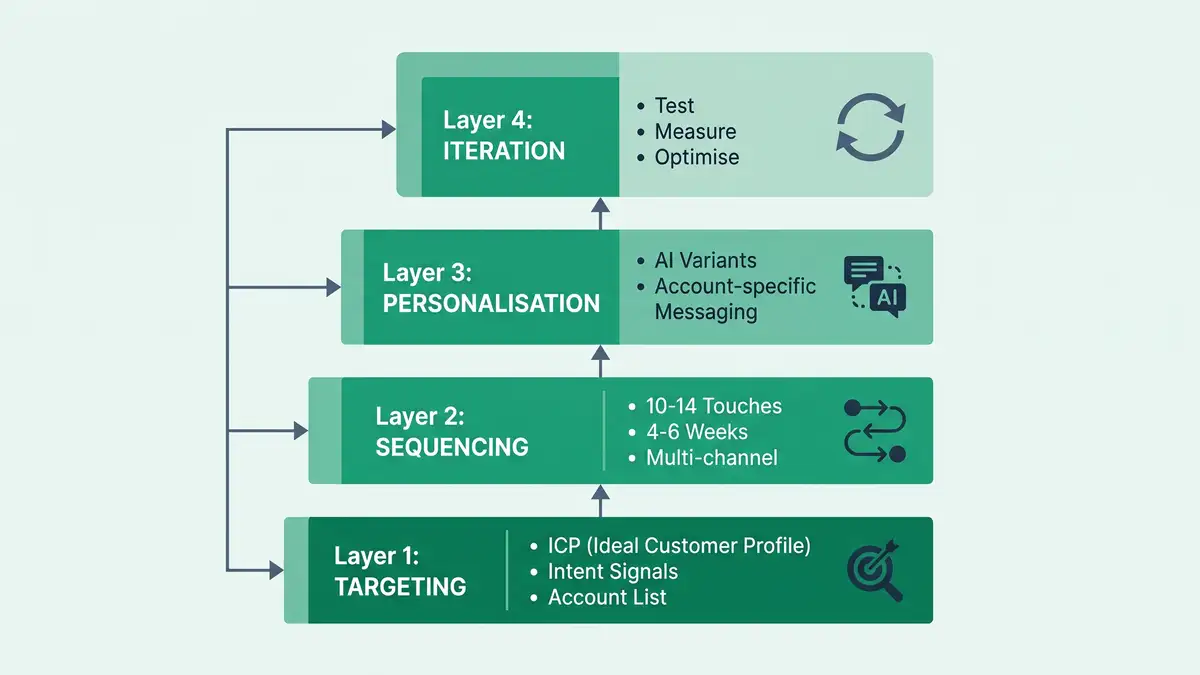
The architecture stacks vertically. Each layer is a prerequisite for the layer above. Skipping any layer collapses the system.
Layer 1: Targeting — Intent Data Is Non-Negotiable
Define the four-vector ICP (firmographic + technographic + intentographic + behavioural). Integrate Bombora, 6sense, or Cognism intent signals into target list construction. Filter aggressively: company size, industry, decision-maker role, buying-signal threshold. Top-quartile outbound runs on lists where 60-80% of accounts show active intent — not 100% of TAM. The same logic that drives your ABM architecture applies here at higher volume.
Layer 2: Sequencing — 10-14 Touches Over 4-6 Weeks
Standardised cadence: emails on touches 1, 3, 6, 9, 12; LinkedIn on 2, 4, 7, 10; phone on 5, 8, 11; video at touch 6 or 10 as mid-sequence refresh. Outreach's Sales Execution Report data shows email-only sequences cap at 0.8-1.5% meeting rate, while orchestrated multi-channel sequences hit 3-5% on intent-qualified lists.
Layer 3: Personalisation — AI-Augmented at Scale
Agentic AI (Clay, Lavender, Default Labs, 11x.ai) compresses personalisation from 10 minutes per prospect to 1-2 minutes while delivering 30-50% reply-rate lift. The architecture: AI generates the first draft personalised to intent signal + account data; SDR reviews and ships. Volume scales 3-5x without sacrificing per-prospect relevance.
Layer 4: Iteration — Weekly A/B Discipline
Sequences deployed in January running unchanged through December lose 15-25% open rate per quarter to sender fatigue and algorithm drift. Top performers run continuous A/B tests — subject line, email length, CTA, sender name, channel mix — with 1 new test per week. Companies that iterate routinely produce 5-10% month-over-month meeting-booked-rate improvements; companies that don't decay.
The Multi-Channel Sequence Playbook

| Channel | Median Open/Connect | Top-Quartile Reply Rate | Best Sequence Position |
| Cold Email (intent-triggered, AI-personalised) | 30-40% open | 6-12% | Touches 1, 3, 6, 9, 12 |
| LinkedIn Connection + Direct Message | 35-45% acceptance | 10-18% | Touches 2, 4, 7, 10 |
| Phone (warm-list dialling) | 18-25% connect | 15-25% meeting from conversation | Touches 5, 8, 11 |
| Video Prospecting (Loom, Vidyard) | 50-65% open | 12-20% | Touches 6, 10 (mid-sequence) |
| LinkedIn InMail (Sales Navigator) | 50-60% open | 15-25% | Executive/C-suite outreach |
Sources: Outreach Sales Execution Report, Sendspark Multi-Channel Outreach Guide, Cognism Phone Prospecting Benchmarks, Lavender Cold Email Benchmarks, Cognism LinkedIn Prospecting Best Practices.
The economic case for multi-channel is the compounding effect. Email-only sequences cap at 0.8-1.5% meeting-booked rate. Email + LinkedIn yields 1.5-2.5%. Email + LinkedIn + phone yields 2-3.5%. Email + LinkedIn + phone + video yields 3-5% on warm intent-qualified lists. Each channel addition lifts conversion 30-50% — not because the channels are independently more effective, but because the orchestrated touch pattern matches how B2B buyers actually evaluate vendors in 2026 (Salesmotion 2026 Cold Outreach Playbook).
Agentic AI Economics: The SDR Cost Inflection

2026 is the inflection point where agentic AI SDRs become economically dominant for narrow, high-volume tasks. The cost-per-qualified-meeting math:
| SDR Type | Monthly Cost (Loaded) | Cost-Per-Meeting | Meetings/Month |
| Human SDR (median, $60K + 35% benefits) | $8,750 | $150-$250 | 8-12 |
| Human SDR (top-quartile, $75K + 40%) | $10,500 | $80-$120 | 15-20 |
| Agentic AI SDR (Default, 11x.ai, Clay) | $2,000-$3,000 | $30-$80 | 30-50 |
| Hybrid (1 human SDR + 2 AI agents) | $13,750 | $45-$90 | 45-70 |
Sources: Bridge Group SDR Metrics & Comp Report, Salesso Outbound SDR Statistics, Gradient Works SDR Benchmarks.
The structural shift is not "AI replaces SDRs." It is task reallocation. AI agents excel at list building, intent filtering, email personalisation at scale, LinkedIn first-message automation, data enrichment, and meeting-scheduling. AI agents fail at complex discovery conversations, objection handling, trust-building on first calls, and account-strategy navigation. The 2026 model: human SDRs focus on phone conversations, complex discovery, and decision-maker relationship-building; AI agents handle everything else. Result: 40-60% fewer human SDRs needed per revenue dollar with measurably higher conversion. Your agentic workflow orchestration plus sales automation spine is the operational frame.
Diagnose whether your SDR team is producing 20+ meetings per SDR or capped at 8-12 — and where the agentic AI compression is hiding.
Book an Outbound Diagnostic CallEmail Deliverability: The 2026 Compliance Reality
Gmail and Microsoft Outlook now enforce strict authentication. As of Q4 2025, 89% of mail from non-compliant domains is rejected or delivered to spam. The infrastructure requirements are no longer best-practice — they are a precondition for inbox placement (Smartlead DMARC Compliance Guide).
| Requirement | Threshold | Consequence of Failure |
| Dedicated sender domain | sales.company.com (separate from corporate) | Reputation damage to corporate domain |
| SPF / DKIM / DMARC alignment | DMARC p=quarantine minimum | 89% of non-compliant mail rejected |
| Domain warming protocol | 50-100/day → 1,000-3,000/day over 21-28 days | Cold-start sender flagged as spam |
| Spam complaint rate | <0.3% (Gmail/Outlook threshold) | Account suspension |
| Bounce rate | <3% (clean list) | Sender reputation decay |
| Open rate floor | 15% by week 1, 25%+ by week 4 | Engagement-based downranking |
Sources: Smartlead Domain Warming Guide, Callbox 2026 Cloud Outreach Report.
The compliance environment has tightened in parallel: GDPR, CAN-SPAM, CASL, CCPA, Virginia VCDPA, and Texas TDPSA all impose specific obligations on cold outbound. Penalties range from $43,280 per CAN-SPAM violation to €20M or 4% of global revenue under GDPR. A 2-4 hour legal review of templates, list-sourcing practices, and opt-out flows is non-optional.
Five Failure Modes That Account for 80% of Outbound Collapse

Failure 1 — Volume Over Personalisation
SDRs tasked with 150+ dials/day or 500+ emails/day; management measures dials, not meetings. Result: open rates collapse to 12-18%, reply rates drop to 1-2%, and 40-60% annual SDR turnover. Fix: cap at 100-150 emails/day and 30-50 dials/day per SDR; measure meetings booked, not activity. Reinvest the volume into intent filtering and personalisation.
Failure 2 — No Intent Data ("Calling the Universe")
Outbound from purchased lists with zero filtering targets 50-60% of accounts not in active buying window. Pipeline contribution stalls at 5-10%; cost-per-pipeline-dollar inflates 3-5x vs intent-driven outbound. Fix: deploy Bombora, 6sense, or Cognism intent signals as the gating layer for list construction.
Failure 3 — SDR-AE Misalignment
SDRs measure success by meetings booked; AEs ignore or reschedule 30-50% of SDR-sourced meetings due to lack of context or qualification. Pipeline conversion drops to 5-10%; SDR-AE relationship deteriorates. Fix: AE-aligned SDR pods (1 SDR per 2-3 AEs), shared meeting-quality SLA, weekly SDR-AE sync with feedback grading.
Failure 4 — Single-Channel Reliance
Email-only sequences cap at 0.8-1.5% meeting-booked rate; competitors using multi-channel outreach book 2-3x more meetings from identical lists. Fix: add LinkedIn (touches 2, 4, 7, 10), phone (touches 5, 8, 11), video (touches 6 or 10) to the email backbone — orchestrated, not abandoned.
Failure 5 — No Continuous Iteration
Sequences deployed in January running unchanged through December lose 15-25% open rate per quarter to sender fatigue and algorithm drift. Fix: weekly performance review, 1 new A/B test per week, monthly channel mix review, quarterly persona expansion. 5-10% month-over-month improvement is the disciplined-iteration baseline.
The 90-Day Outbound System Rollout
| Days | Focus | Outcome |
| 1-7 | Diagnostic + architecture: audit current outbound, define ICP, source initial 2,000-3,000-account list, integrate intent platform, sign tool stack | Outbound roadmap locked, target list sourced, tools signed |
| 8-30 | Build + pilot: write 3-4 sequence variants per persona, configure sender domain, warm domain (50→3,000 emails/day over 21-28 days), pilot 500 accounts, deploy first agentic AI agent, onboard SDRs | 15-20 meetings booked from pilot cohort, baseline metrics established |
| 31-60 | Scale + optimise: expand to 1,500-2,000 accounts, launch A/B tests (1 per week), add phone + LinkedIn + video orchestration, formalise SDR-AE handoff SLA, train AI personalisation models | 50-100 meetings/month, multi-channel operational, A/B winners deployed |
| 61-90 | Operationalise: scale to 3,000-4,000 accounts, document playbooks, plan team scale (2→3-4 SDRs + 2 AI agents by Q2), forecast revenue impact | 100-150 meetings/month, $4M-$6M Q2 pipeline forecast, system locked |
Sources: Prospeo Outreach Sequences Guide 2026, Outreach Sales Execution Report, Salesmotion 2026 Playbook.
By month 12, a $15M-$25M ARR mid-market B2B SaaS company executing this rollout should generate $8M-$12M in outbound pipeline contribution — 30-50% of total pipeline at $0.15-$0.35 cost-per-pipeline-dollar. The economics depend on disciplined intent filtering and multi-channel orchestration; companies that skip layers default to the volume-over-personalisation trap and produce a fraction of the output. The pipeline economics ripple into CAC compression and the SaaS financial model board-grade narrative.
Outbound Team Structure: AE-Aligned Pods + Agentic AI
The centralised SDR pool model is obsolete. Top performers use AE-aligned pods of 1 SDR + 1-2 AI agents serving 2-3 AEs. Each pod owns a specific ICP segment (enterprise / mid-market / SMB). Pod leaders own QA and coaching. Compensation: SDR base $45K-$55K + 20-30% variable; AI agent cost $2,000-$3,500/month per agent shared across pod. Total cost for a $15M-$25M ARR outbound team running 100-130 meetings/month: 3 SDRs + 3 AI agents + 5 AEs at $3.5M-$5M monthly pipeline output (Gradient Works SDR Benchmarks).
The handoff to the conversion layer matters: the meetings booked feed your expansion revenue machine post-close, and the CRM automation spine ensures every signal-to-meeting-to-pipeline event is tracked and attributed. Outbound that produces meetings the AE team rejects is outbound that has not earned its budget.
Bottom Line
Outbound is not dead in 2026. It is transformed. The four-layer architecture (Targeting → Sequencing → Personalisation → Iteration) is the operating system. Intent-data filtering moves cold-list 0.5% conversion to 3-5%. Multi-channel orchestration lifts email-only by 30-50%. Agentic AI compresses cost-per-meeting by 60-70% while lifting throughput. AE-aligned SDR pods replace centralised SDR pools. The 2026 deliverability bar (DMARC enforcement, domain warming, sender reputation) has made the infrastructure layer non-optional. The five failure modes (volume-over-personalisation, no intent data, SDR-AE misalignment, single-channel reliance, no iteration) account for 80% of underperforming programs. The CEO's job is not to ask whether to scale SDRs or replace them with AI. It is to install the architecture that makes both work — and to refuse to fund any outbound motion that has not earned its position in the system.
Install the Outbound Operating System
peppereffect runs the 90-day outbound rollout for $10M-$40M ARR B2B SaaS — intent-data targeting, multi-channel sequence playbook, agentic AI augmentation, AE-aligned SDR pod design, deliverability infrastructure, and the measurement spine wired to your CRM. Architectural, not advisory. Outcome target: 100-150 qualified meetings/month by month 3, $0.15-$0.35 cost-per-pipeline-dollar, 30-50% of new pipeline from outbound by month 12.
Book Your Growth Mapping CallSee the B2B Demand Generation Strategy framework →
Frequently Asked Questions
What is outbound sales strategy?
Outbound sales strategy is the architecture for proactive, seller-initiated B2B revenue motion — identifying high-fit target accounts, sequencing multi-channel outreach (email, LinkedIn, phone, video) over 4-6 weeks, personalising messaging to specific buying signals, and converting in-market accounts into qualified pipeline. The 2026 distinction is intent-data-triggered outbound (3-5% meeting rate) vs cold-list outbound (0.5-1.5% rate); the operating system around the latter is dead, the former is alive.
Is outbound sales dead in 2026?
No. Volume-and-spray outbound is dead. Intent-triggered, agentic-AI-augmented, multi-channel outbound is alive and the most cost-efficient channel in many B2B SaaS GTM mixes ($0.15-$0.35 cost-per-pipeline-dollar). The narrative about "outbound's death" comes from companies running the 2018 architecture — purchased lists, email-only, no intent data, volume-first SDRs — and watching it fail in the 2026 deliverability environment.
How many meetings should an SDR book per month?
Median: 8-12 meetings/month. Top-quartile (with multi-channel sequences and agentic AI augmentation): 20-30+ meetings/month. Below 8 meetings/month indicates structural issues: weak ICP filtering, no intent data, single-channel reliance, or domain deliverability problems. Above 20 typically requires intent-data targeting and agentic AI compression of low-value tasks.
How many touches should an outbound sequence have?
Top-performing sequences run 10-14 touches over 4-6 weeks across multiple channels: email (5-6 touches), LinkedIn (3-4), phone (2-3), video (1-2). 90% of meetings booked occur within the first 4-8 touches on intent-qualified segments; later touches sustain awareness for future buying cycles. Below 8 touches typically under-converts; above 14 dilutes per-touch quality.
Should I build SDRs in-house or outsource them?
For a $10M-$40M ARR mid-market B2B SaaS, build in-house with agentic AI augmentation. The 2026 economics favour 2-3 in-house SDRs + 1-2 AI agents over outsourced SDR teams, which typically deliver 40-60% lower meeting-quality rates and miss the AE-aligned pod architecture that drives top-quartile pipeline conversion. Outsourced SDR works only at very early stage (sub-$5M ARR) when in-house capacity isn't justified.
How does agentic AI change outbound sales economics?
Agentic AI compresses cost-per-qualified-meeting from $150-$400 (human SDR) to $30-$80 (AI agent). The 2026 hybrid model — 1 human SDR + 1-2 AI agents — produces 45-70 meetings/month at $45-$90 cost-per-meeting, a 50-100% productivity gain over human-only SDRs at lower total cost. AI handles list building, personalisation at scale, LinkedIn first-message automation, and meeting scheduling; humans focus on phone conversations, discovery, and account strategy.
What's a good cold email open rate in 2026?
25-35% with proper deliverability infrastructure (dedicated domain, DMARC alignment, domain warming) and AI-personalised copy. 35-45% with intent-triggered targeting layered on top. Below 20% indicates structural problems: poor sender reputation, broken authentication, list quality decay, or inadequate personalisation. Gmail and Outlook enforcement of DMARC since Q4 2025 has made domain warming and authentication non-optional preconditions for inbox placement.
Resources
- Bridge Group — Sales Development Metrics & Comp Report
- TamToTarget — How Many Meetings Should an SDR Book (2026)
- Gradient Works — Benchmarks for SDR/BDR Metrics
- Prospeo — SDR Activity Metrics That Matter (2026)
- Touchstone BPO — Appointment Setting Conversion Rates 2026
- Salesso — Outbound SDR Statistics 2025
- Callbox — 2026 Cloud Outreach Benchmark Report
- Martal — 2026 Sales Statistics: Cold Outreach Pipeline Funnel
- Outreach — Sales Execution Report
- Outreach — Insights Sequence Performance Report
- Salesmotion — Cold Outreach 2026 Playbook
- Prospeo — Outreach Sequences in 2026
- Sendspark — Multi-Channel Outreach Strategy
- Apollo.io — Email Benchmarks
- Cognism — LinkedIn Prospecting Best Practices
- Cognism — Phone Prospecting Benchmarks
- Smartlead — Domain Warming & DMARC Best Practices
- Lavender AI — Cold Email Benchmarks
- Forrester — Digital Natives Rewriting B2B Buying