

The marketing qualified lead is not dead — but the 2018 MQL definition is. Sarah Chen-style mid-market SaaS CEOs are still routing leads to AEs based on a whitepaper download from six months ago, watching sales reject 55-75% on first glance, and listening to RevOps argue with marketing about why pipeline contribution is collapsing. The fix is architectural: redefine MQL as a four-component qualified-account routing decision (fit + engagement + intent + stage), wire it into a sales-marketing SLA both teams sign off on quarterly, and switch the headline KPI from MQL volume to SQL pipeline contribution. This playbook walks the 2026 MQL architecture, the SLA framework, and a 90-day rollout that lifts sales acceptance 25-35 percentage points.
The peppereffect view
The marketing qualified lead is the routing logic between marketing demand and sales capacity — not a content-engagement vanity score. Architect it as four converging signals (fit, engagement, intent, stage), gate it on account-level fit, recalibrate quarterly via the sales-marketing SLA, and measure success on SQL pipeline contribution, never MQL volume.
What a marketing qualified lead actually is in 2026
A marketing qualified lead is a contact (or, in account-based motions, an account) that has demonstrated sufficient fit, engagement, intent, and buying stage to be routed to sales for qualification. The 2018 version of MQL was a content-engagement score — three whitepaper downloads, two pricing-page visits, one webinar attendance. The 2026 version is a multi-signal qualified-account routing decision that gates on firmographic fit before any engagement counts, weights third-party intent at 20-30% of the composite, and decays automatically when engagement stops compounding.
The architectural rewrite follows three structural shifts. First, sales acceptance collapsed. 60% of sales teams now disagree with marketing's MQL criteria, driving 55-75% MQL rejection rates and 30-50% revenue underperformance versus aligned teams. Second, intent data became table stakes. First-party engagement plus third-party intent (Bombora, G2, 6sense, Demandbase) drives 2.1-2.7x higher MQL→opportunity conversion than engagement-only models. Third, the conversation moved to accounts. The MQA (marketing qualified account) framework, which gates account-level fit before individual engagement counts, generates 3-5x larger pipeline values than legacy lead-based MQL in mid-market and enterprise.
Healthy MQL→SQL conversion sits at 20-40% in 2026 with strict qualification. B2B SaaS specifically averages 32-40%, with top-quartile programmes hitting 50%+ — the gap between median and top-quartile is almost entirely MQL definition discipline, not lead quality.
The "MQL is dead" misread
The "MQL is dead" narrative of 2020-2023 was correct about content-engagement-only definitions. It was wrong about the underlying concept. Modern MQL frameworks have absorbed the criticism by gating on account-level fit, layering intent data, and switching the accountability metric from MQL volume to SQL pipeline contribution. Companies that abandoned MQL altogether without replacing it now run on AE intuition and miss 30-40% of qualified pipeline.
The four-component MQL definition
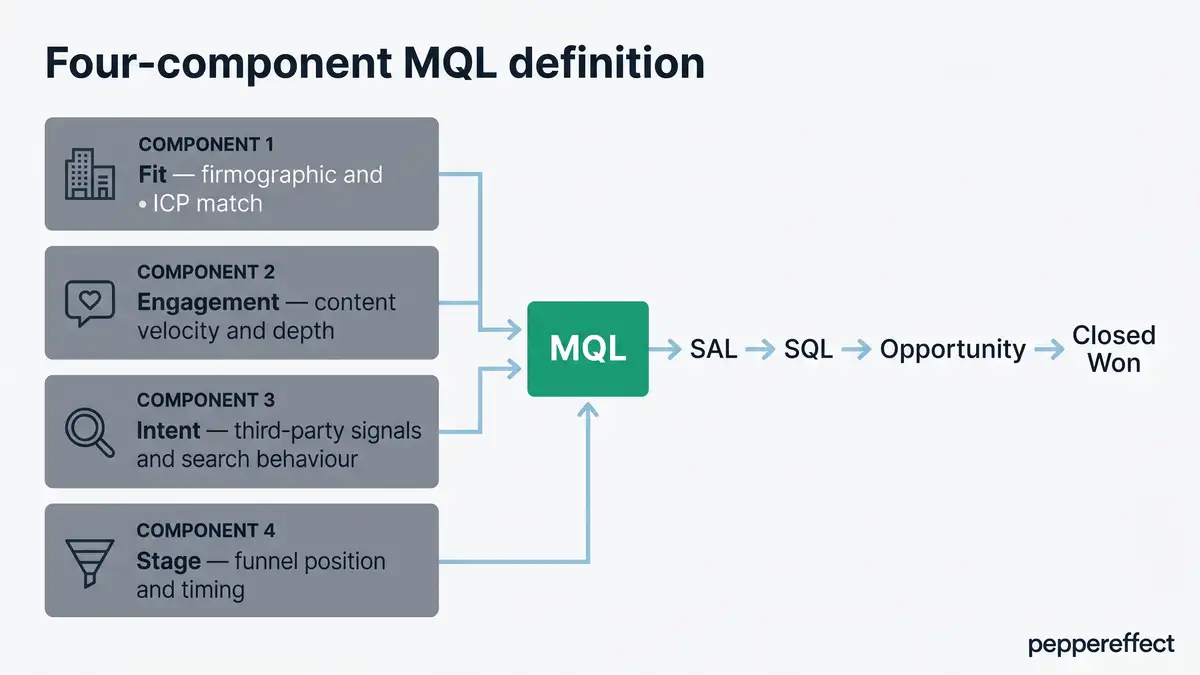
Every defensible 2026 MQL definition runs four signal components in parallel. A lead must clear all four gates simultaneously to qualify — single-component definitions (engagement-only is the worst offender) correlate with sales acceptance rates below 30%.
Fit — firmographic and ICP match
Industry, ARR band, employee count, geography, role, seniority. The non-negotiable starting gate. Without fit gating, marketing routes "VP at $50M company" leads to AEs whose ICP is $5M-$25M ARR — guaranteed rejection. Pull firmographics via Clearbit/ZoomInfo on form submit; never trust self-reported form fields alone. Weight: 25-30% of composite, but binary at the gate (fail = no MQL regardless of other signals).
Engagement — depth and velocity
Content engagement depth (multi-asset, multi-session), email click patterns, page visits to commercial-intent pages (pricing, comparison, case studies), webinar attendance, product activity in PLG motions. Velocity matters more than volume — three sessions in 14 days beats fifteen sessions across nine months. Weight: 30-40% of composite.
Intent — third-party and search behaviour
Bombora topic surges, G2 buyer intent, 6sense account intent, ZoomInfo/Demandbase intent feeds, branded search behaviour. The signal that converts ABM motion from "spray to target list" into "engage when buying window opens." Modern B2B intent data providers now cover most categories. Weight: 20-30% of composite.
Stage — funnel position and timing
Where in the buying journey is this lead? Awareness, evaluation, decision, expansion. Engagement with pricing pages signals decision stage; engagement with category-education content signals awareness. Pair with explicit signals — demo requests, sales conversations, RFP downloads — to confirm. Weight: 10-20% of composite. Fails if clearly out of buying window.
MQL vs MQA: when to qualify the lead vs the account

The 2026 architectural decision is whether to qualify at the lead level (MQL) or the account level (MQA). For SMB-targeting B2B SaaS with single decision-makers and short sales cycles, lead-level MQL still works. For mid-market and enterprise SaaS targeting 5-15 person buying committees with 90+ day cycles, MQA is mandatory — qualifying individual leads in isolation produces fragmented signals while the actual buying decision happens at the account level.
The hybrid pattern wins for $10M-$40M ARR mid-market SaaS targeting 100-500 employee accounts. Run MQA at the account level for tier-1 ABM accounts (100-200 strategic accounts) and lead-level MQL for everything else. Both feed the same handoff workflow but use different qualification logic. The deeper architecture is documented in our account-based marketing playbook.
| Qualification model | Best for | Sales acceptance | Pipeline value lift |
| Lead-only MQL (legacy) | SMB, single-decision motion | 25-35% | Baseline |
| Lead-level MQL with fit gate | SMB-mid-market hybrid | 40-55% | +30-50% |
| Account-level MQA | Mid-market and enterprise ABM | 55-70% | +200-400% |
| Hybrid MQL + MQA | $10M-$40M ARR with tier-1 accounts | 50-65% | +150-300% on tier-1 |
Source: Hypha Dev — HubSpot ABM Engine; Directive — Modern ABM Strategy 2026
The sales-marketing SLA: the document that makes MQL real

The single highest-ROI MQL upgrade most marketing leaders can ship is rewriting the sales-marketing SLA. Without a documented agreement on what qualifies, who owns each input, and how rejections feed back, MQL definitions decay 30-40% within six months and sales builds shadow scoring in spreadsheets the central programme never sees.
The 2026 SLA includes seven non-negotiable components:
| SLA component | What it specifies |
| 1. MQL definition | The four-component composite, weights, threshold scores, and disqualifiers |
| 2. SAL definition (Sales Accepted Lead) | Sales' acceptance criteria — what they will work, what they reject and why |
| 3. SQL definition (Sales Qualified Lead) | BANT/MEDDIC/MEDDPICC criteria for full sales qualification |
| 4. Handoff timing | SLA: marketing routes within 5 minutes; sales contacts within 30 minutes |
| 5. Rejection-loop process | How sales rejects an MQL, with reason codes; how marketing reroutes or recycles |
| 6. Volume commitments | Marketing's MQL volume target by AE, by segment, monthly |
| 7. Recalibration cadence | Quarterly review with both teams in the room, full annual rebuild |
Source: peppereffect SLA framework; Geisheker — Is the MQL Dead?; Martal — B2B Sales Statistics 2026
Organisations with formal quarterly MQL definition reviews and SLA recalibration report 40-50% reductions in sales-marketing disputes and 15-22% improvement in MQL→SQL conversion. The recalibration is not optional governance; it is the single discipline that determines whether the MQL programme survives year two. Pair it with the deeper measurement model in our lead scoring playbook.
The 2026 MQL→SQL benchmark you should be hitting

The full-funnel benchmarks converge on stable patterns once MQL is wired correctly. Prospeo's 2026 dataset and SaaSHero's benchmarks agree on the central numbers.
| Funnel stage | B2B SaaS median | Top quartile | Top decile |
| Lead → MQL | 15-25% | 30-40% | 45%+ |
| MQL → SAL (sales accepted) | 25-45% | 55-70% | 75%+ |
| MQL → SQL | 13-32% | 40-50% | 55%+ |
| SQL → Opportunity | 42-48% | 55%+ | 65%+ |
| Opportunity → Closed Won | 20-30% | 35-45% | 50%+ |
Source: Prospeo — Lead Conversion Rate Benchmarks 2026; SaaSHero — 2026 SaaS Conversion Benchmarks; Oliver Munro — SaaS Marketing Statistics 2026
If your MQL→SAL is below 30%, sales is rejecting most of what you ship — fix the fit gate first, the engagement threshold second. If your MQL→SQL is below 13%, the entire definition needs a rebuild. If you're seeing high MQL→SQL but collapsing volume, you've over-tightened thresholds and need to widen the engagement layer. The corrective discipline ties to SaaS customer acquisition cost efficiency and the wider B2B demand generation strategy framework.
The five failure modes that kill MQL programmes
Failure mode 1: Engagement-only definition
"Three asset downloads in 30 days = MQL" without firmographic gating produces 25-35% sales acceptance. Most rejected leads aren't bad people — they're wrong-fit accounts whose engagement was about category education, not buying. Add the fit gate as the binary first filter.
Failure mode 2: No SLA or stale SLA
"We have an MQL definition" is not an SLA. The SLA documents seven components: MQL definition, SAL definition, SQL definition, handoff timing, rejection-loop process, volume commitments, and recalibration cadence. Without it, sales and marketing argue about what qualifies — every quarter — without resolution. RevOps owns the SLA; marketing and sales sign off jointly.
Failure mode 3: MQL volume as primary KPI
When marketing is paid on MQL volume, content gets engineered for low-friction form fills — exactly the wrong incentive. Switch the primary KPI to SQL pipeline contribution and watch the same team produce 30-50% lower MQL volume but 2-3x higher pipeline impact. The metric is the strategy.
Failure mode 4: No rejection-loop process
When sales rejects an MQL, where does it go? In bottom-quartile programmes — into a black hole. In top-quartile programmes — back to nurture with an explicit reason code, automatic re-qualification timer, and feedback to the scoring model. Without the loop, every rejection is wasted demand. Pair with our B2B lead nurturing framework for the recycle motion.
Failure mode 5: Set-and-forget thresholds
MQL thresholds calibrated against 2024 buyer behaviour don't survive 2026. Quarterly recalibration is mandatory: pull last 90 days of MQL→SAL→SQL→Closed Won data, segment by score tier and signal source, identify drift, adjust thresholds. Annual reviews retire unused signals and add new ones. Bottom-quartile programmes never recalibrate.
How AI and agentic systems change MQL economics

Agentic AI is rewriting the MQL operating model. Traditional rule-based MQL scoring requires manual rule maintenance; predictive ML models require quarterly retraining cycles; agentic systems re-score continuously as new signals arrive — autonomously adjusting thresholds, flagging model drift, and re-routing accounts whose intent surfaces shift mid-cycle.
Three production-ready 2026 use cases compound the most: autonomous re-ranking when third-party intent fires (route hot accounts within minutes, not the next quarterly review); dynamic threshold adjustment based on rolling 90-day win/loss data; behavioural anomaly detection that flags accounts whose engagement pattern matches your top 5% closed-won historical cohort. The deeper mechanic is documented in our agentic workflows playbook and our AI agent for sales guide.
The economics: traditional rule-based MQL scoring costs $10K-$15K/year in maintenance for a mid-market team; predictive ML adds $30K-$60K in MLOps; agentic re-scoring layered on top adds $15K-$30K but reclaims 6-10 hours per AE per week of manual triage and lifts SAL by 18-30 percentage points. For a 12-AE team, that's $250K-$400K of recovered selling capacity plus higher conversion — comfortable 5-10x year-one payback.
The infrastructure spine: RevOps ownership and tooling
RevOps owns the MQL definition. Organisations assigning MQL definition authority to Revenue Operations (not marketing or sales alone) report 60% fewer definition revisions and 35% faster time-to-productivity for new SDRs. The reason is simple: marketing optimises for MQL volume, sales optimises for SAL quality, and only RevOps optimises for end-to-end pipeline contribution. Without RevOps ownership, the definition gets pulled in two directions and never stabilises.
The tooling stack. CRM-native MQL scoring (HubSpot AI predictive, Salesforce Einstein, Marketo) covers 70%+ of $10M-$40M ARR mid-market needs. Layer specialised tools (6sense, Demandbase, Apollo) for intent data and ABM accounts — see our marketing automation platform comparison. Specialised lead-qualification platforms earn their cost only when integrated into the broader RevOps stack.
Attribution. Multi-touch attribution at the MQL level requires UTM hygiene, event tracking integrated with the CRM, and a position model (W-shaped or U-shaped for B2B). Without attribution, MQL programmes can't prove pipeline contribution and lose budget priority.
Want a diagnostic on where your MQL definition is leaking pipeline?
Book a Growth Mapping CallThe 90-day rollout playbook
For a $10M-$40M ARR mid-market SaaS rebuilding MQL from a legacy state, the 90-day sequence:
Days 1-30: Audit, align, define
Audit current MQL performance: MQL→SAL rate, MQL→SQL rate, AE rejection reason codes, signal coverage. Run the sales-marketing SLA workshop with both teams in the room. Map the four components (fit, engagement, intent, stage) to your specific ICP. Decide MQL vs MQA vs hybrid based on account-tier strategy. Switch primary KPI from MQL volume to SQL pipeline contribution. Target deliverable: signed SLA + MQL spec document, RevOps-owned.
Days 31-60: Build, integrate, train
Build the model in CRM (HubSpot AI predictive or Salesforce Einstein). Integrate first-party data (Clearbit/ZoomInfo enrichment, content engagement, product activity). Layer third-party intent (6sense or Bombora) for tier-1 ABM accounts. Train AEs on score tiers, routing logic, and rejection-loop process. Run model in shadow mode for 14 days — score everything, route nothing — to surface threshold issues before live.
Days 61-90: Launch, monitor, calibrate
Flip routing live with weekly conversion review for first 30 days. Track AE acceptance rate (target: 55%+ on A/B-grade leads). At day 75, run the first quarterly recalibration: pull conversion data, identify drift, adjust thresholds. Document the recalibration playbook so the team can run it autonomously by quarter two. Target: MQL→SAL conversion lift of 20-30 percentage points by day 90.
Architect an MQL definition that actually drives pipeline
peppereffect installs the four-component MQL architecture for $10M-$40M ARR B2B SaaS leaders ready to decouple MQL volume from SQL pipeline contribution. We deploy the sales-marketing SLA, the lead-vs-account qualification model, the intent data integration, and the recalibration cadence that turns MQL from vanity metric into revenue-aligned routing logic.
Book a Growth Mapping CallFrequently asked questions
What is a marketing qualified lead?
A marketing qualified lead is a contact (or account) that has demonstrated sufficient fit, engagement, intent, and buying stage to be routed to sales for qualification. Modern 2026 MQL definitions require simultaneous evaluation of four components — fit (firmographic/ICP match), engagement (content velocity and depth), intent (third-party signals like Bombora or 6sense), and stage (funnel position) — feeding into either a maintained rule engine or a predictive ML model with RevOps governance.
Is the MQL dead in 2026?
No. The 2018 engagement-only MQL definition is dead. The modern MQL — gated on account-level fit, layered with intent data, governed by a sales-marketing SLA, and measured on SQL pipeline contribution — is more important than ever. Companies that abandoned MQL altogether without replacing it run on AE intuition and miss 30-40% of qualified pipeline.
What's a good MQL to SQL conversion rate?
B2B SaaS median sits at 13-32%; top-quartile programmes hit 40-50%; top-decile reach 55%+. The gap between median and top-quartile is almost entirely MQL definition discipline and sales-marketing SLA quality, not lead source differences. Below 13% indicates the MQL definition is engagement-only or missing the fit gate.
What's the difference between MQL, SAL, and SQL?
MQL (Marketing Qualified Lead) = marketing's qualification before handoff. SAL (Sales Accepted Lead) = sales agrees to work the lead. SQL (Sales Qualified Lead) = sales has qualified using BANT/MEDDIC and confirmed buying readiness. Each transition is a gate; MQL→SAL averages 25-45% acceptance, SAL→SQL averages 50-70%.
What signals should an MQL definition use?
Four components: fit (firmographic, role, ICP match — 25-30% weight, binary gate), engagement (depth and velocity — 30-40%), intent (third-party signals like Bombora, G2, 6sense — 20-30%), and stage (funnel position and timing — 10-20%). Engagement velocity matters more than volume; intent without behavioural confirmation is noise.
Should I use MQL or MQA?
For SMB-targeting B2B SaaS with single decision-makers, MQL still works. For mid-market and enterprise SaaS targeting 5-15 person buying committees, MQA is mandatory — qualifying individuals in isolation produces fragmented signals while the actual decision happens at the account level. For $10M-$40M ARR mid-market, run a hybrid: MQA for tier-1 ABM accounts (100-200 strategic accounts), lead-level MQL for everything else.
How often should I recalibrate the MQL definition?
Quarterly minimum, with a full annual rebuild. Models that don't recalibrate decay 30-40% accuracy within six months. Top-quartile programmes pull 90-day MQL→SAL→SQL→Closed Won data each quarter, segment by score tier and signal, identify drift, and adjust thresholds. Annual reviews retire unused signals and add new ones. attribution model decision matrix six-stage pipeline architecture buying committee mapping MEDDPICC sales playbook
Resources
- Oliver Munro — 60+ SaaS Marketing Statistics & Benchmarks 2026
- Monday.com — MQL vs SQL Difference Explained 2026
- Directive Consulting — Modern ABM Strategy 2026
- Martal — B2B Sales Statistics 2026
- Understory — MQL to SQL Conversion B2B SaaS Benchmarks
- Demandbase — Measuring ROI of Intent-Based Marketing
- SaaSHero — 2026 B2B SaaS Conversion Benchmarks
- Hypha Dev — HubSpot ABM Engine: MQA Replaces MQL
- Headley Media — 80+ B2B Marketing Phrases 2026
- Prospeo — Lead Conversion Rate Benchmarks 2026
- Geisheker — Is the MQL Dead?
- Cognism — 15 Best B2B Intent Data Providers 2026
- ALM Corp — 25 Best Lead Generation Tools 2025-2026
- Only-B2B — High-Converting ABM Funnel 2026