

B2B email marketing strategy in 2026 is the highest-ROI channel in your stack — $36-$45 returned for every $1 spent — and the one most B2B SaaS marketing teams squander on weekly newsletters that nobody opens, drip sequences that never re-segment, and "lifecycle automation" that fires a single welcome email and goes silent. The fix is architectural: replace newsletter-as-broadcast with a five-stage lifecycle engine, anchor every email to a behavioural trigger, and engineer deliverability infrastructure (DMARC, BIMI, dedicated domain) so your messages actually land in the inbox. This playbook walks the 2026 architecture, the deliverability spine, and a 90-day rollout that lifts email-attributed pipeline 25-40%.
The peppereffect view
B2B email marketing strategy is not a content cadence — it is the orchestration layer connecting marketing demand to sales pipeline. Architect five lifecycle stages (welcome, educational, solution, activation, retention/win-back), wire each stage to behavioural triggers, anchor measurement to click-to-conversion not opens, and engineer deliverability as infrastructure. Newsletter-as-strategy died with Apple Mail Privacy Protection.
Why B2B email is still the highest-ROI channel in 2026
Email marketing returns $36-$42 per dollar invested in 2026 — a 3,600-4,200% ROI that has actually widened since 2024 as AI-driven personalisation matured. Sender's 2026 benchmarks show technology and software companies achieve 3,600% returns; nearly one in five companies (19%) hit 7,000% ROI or higher — roughly $70 returned per $1 spent. By comparison, Google Ads returns approximately $2 per dollar invested, paid social $1.75, and display ads $1.35.
The economics compound at scale. Digital Applied's 2026 dataset shows automated email sequences outperform broadcast campaigns by 320% on revenue per recipient and reduce CAC by 18-32% relative to paid acquisition. For a $10M-$40M ARR mid-market SaaS, a properly architected email programme typically attributes 22-35% of pipeline contribution — second only to organic search and ahead of paid acquisition combined. The mechanic compounds inside our wider inbound marketing for SaaS playbook and the broader B2B lead nurturing architecture.
The trap is that nearly half of B2B SaaS programmes still operate the 2019 architecture: weekly newsletter sent to one undifferentiated list, no lifecycle segmentation, no behavioural triggers, opens treated as the primary KPI. Dotdigital's 2026 engagement research documents the gap: programmes that orchestrate emails by lifecycle stage and behavioural trigger generate 2-3x the conversion of broadcast-equivalent volume.
Apple Mail Privacy Protection killed the open rate
Since 2021 (and now intensified in 2026), Apple Mail Privacy Protection auto-fetches images on Apple devices regardless of whether the user opened the email — inflating open rates to 50-70% on Apple-heavy lists. With over 53% of opens now coming from Apple devices, the open rate has become a vanity metric. Anchor measurement to click-to-open rate, click-through rate, and downstream conversion. Programmes still optimising for open rate are calibrating against noise.
The five-stage lifecycle architecture
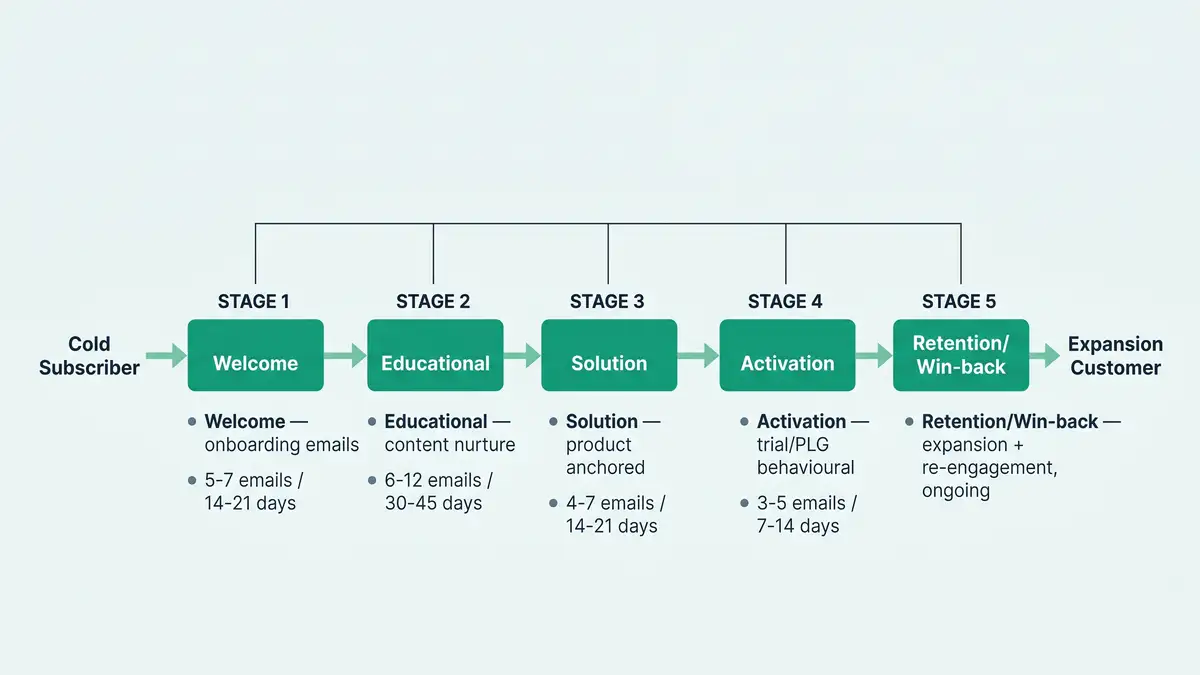
Every defensible 2026 email programme runs five lifecycle stages in parallel, with subscribers flowing between them based on behavioural signals — not calendar cadence.
Welcome — onboard new subscribers in 14-21 days
Five to seven emails sent across the first 14-21 days after subscription. Goal: establish category authority, segment by ICP and pain point, and qualify intent. Welcome sequences drive 50-86% higher open rates than promotional emails and account for 30%+ of full-funnel email-attributed revenue when properly architected.
Educational — content nurture across 30-45 days
Six to twelve emails delivering frameworks, benchmarks, and category education. Top-of-funnel content paired with light commercial signals. Segmented by persona and pain point, not by industry alone. Measured on click-to-conversion to MQL, not opens.
Solution — product-anchored across 14-21 days
Four to seven emails for prospects who downloaded comparison or evaluation assets, viewed pricing pages, or matched solution-stage scoring criteria. Specific use cases, ROI calculators, customer outcome data. Target conversion: 12-18% to demo request.
Activation — trial and PLG behavioural across 7-14 days
Three to five emails triggered by in-product behaviour — trial signup, feature activation milestones, dormant trial alerts. Behavioural sequences in PLG contexts hit 20-35% paid conversion vs 8-12% on time-based-only sequences. Pair activation emails with deeper behavioural email triggers so each in-product event fires the next-best message automatically.
Retention and win-back — ongoing
Customer-side: NPS triggers, expansion-opportunity content, advocacy nudges. Lapsed-side: win-back sequences for dormant 60-90+ days. Win-back sequences achieve 8-15% reactivation; the alternative is paying paid-acquisition CAC again to win back accounts you already had.
The deliverability spine: DMARC, DKIM, SPF, BIMI
Since the February 2024 Google/Yahoo bulk sender requirements went into force, email deliverability infrastructure stopped being an IT detail and became table-stakes for any B2B sender at scale. Programmes without proper authentication see 25-45% lower inbox placement in 2026 versus authenticated senders — meaning nearly half your sends never reach the inbox at all.
The non-negotiable infrastructure: SPF (authorises sending IPs), DKIM (cryptographically signs each message), DMARC (policy enforcement; the alignment requirement that gates Google/Yahoo bulk delivery), and BIMI (verified logo display in inbox, requires DMARC at p=quarantine or stricter). Programmes running all four see 10-15% higher open rates from logo trust signals alone.
Dedicated sending domain. Marketing emails should never go from your primary corporate domain — use a dedicated subdomain (send.yourdomain.com or mail.yourdomain.com) that can be warmed independently and isolated from transactional and one-to-one sales mail. Cold outbound goes from a separate domain entirely (yourdomain.co or similar) to prevent reputation damage flowing into the marketing domain — see our cold email outreach playbook for the cold-side architecture.
Domain warming. New domains require 4-8 weeks of gradual volume ramp-up — start at 50/day, double weekly, never exceed engagement-rate thresholds. Domain warming is the most-skipped step in B2B email infrastructure and the leading cause of newly-deployed programmes seeing inbox placement collapse below 50% in week one.
| Authentication layer | Purpose | 2026 status |
| SPF | Authorise sending IPs | Required — 100% adoption |
| DKIM | Cryptographic signing | Required — 100% adoption |
| DMARC (p=none) | Reporting only | Insufficient — Google/Yahoo require p=quarantine+ |
| DMARC (p=quarantine/reject) | Policy enforcement | Required for >5K sends/day |
| BIMI + VMC | Verified logo display | Recommended — 10-15% open lift |
| One-click unsubscribe (RFC 8058) | Inbox compliance | Required — Google/Yahoo enforced |
Source: PowerDMARC — Google/Yahoo Email Authentication 2026; Warmy — Deliverability & GDPR Guide 2026
Segmentation depth: from one-list-to-rule-them-all to dynamic cohorts

Top-quartile B2B SaaS programmes maintain 20-40+ active segments simultaneously; median programmes run 3-5. The performance gap is enormous: deeply segmented programmes achieve 2.5-4x click-through and 1.8-2.6x conversion versus broadcast equivalents.
The 2026 segmentation layers compound:
| Segmentation layer | Examples | Impact on CTR |
| Firmographic | Industry, ARR band, employee count, region | +15-25% |
| Persona/role | CEO/founder, VP Sales, Marketing Ops, RevOps | +20-35% |
| Lifecycle stage | Cold, MQL, SQL, customer, expansion | +30-50% |
| Engagement velocity | Hot (3+ engagements / 14d), warm, cold, dormant | +40-65% |
| Behavioural intent | Pricing-page visitors, comparison-asset downloaders | +60-90% |
| AI-personalised content | Dynamic blocks based on engagement history | +25-40% |
Source: Prospeo — B2B Email Segmentation 2026; Insider One — Email Personalization 2026
The segmentation strategy that wins for $10M-$40M ARR is not "segment everything"; it is "segment the top 20% of engaged accounts by behavioural intent and persona, broadcast-segment the rest by lifecycle stage." Over-segmentation produces operational complexity without proportional return — under-segmentation produces 2024-grade open rates against a 2026 buyer.
The five failure modes that kill email programmes
Failure mode 1: Newsletter-as-strategy
One weekly newsletter sent to an undifferentiated list converts at 0.3-0.6% to MQL. The fix is replacing the newsletter with the five-stage lifecycle architecture. The newsletter still has a place — as one segment of one stage — but it is never the entire programme.
Failure mode 2: Open-rate as primary KPI
With 53%+ of opens unreliable due to Apple Mail Privacy Protection, optimising for open rate is calibrating against noise. Anchor measurement to click-to-open rate, click-through rate, and email-attributed pipeline contribution. Top-quartile B2B programmes hit 2-4% CTR and 0.5-1.2% click-to-meeting.
Failure mode 3: Skipped deliverability infrastructure
No DMARC enforcement, no domain warming, marketing email leaving the primary corporate domain. Programmes ignoring the 2024 Google/Yahoo requirements see 25-45% lower inbox placement in 2026. The infrastructure is not optional — it is the precondition for any send to convert.
Failure mode 4: No behavioural triggers
Time-based drip sequences sending the same nurture content to every subscriber regardless of in-product behaviour or content engagement. Behavioural-triggered emails outperform time-based equivalents by 2-3x on click-through and 50% on conversion. Without triggers, "marketing automation" is just slow broadcast.
Failure mode 5: Set-and-forget sequences
Sequences launched in 2024 still running in 2026 against subject-line patterns now flagged as spam, content references that no longer apply, and segmentation logic that excludes ICP shifts. Top-quartile programmes review every active sequence quarterly: subject lines, copy, segmentation, conversion data. Bottom-quartile programmes never review and watch performance decay 25-40% over six months.
How AI rewrote email economics in 2026

AI integration in B2B email marketing is now production-grade across three layers. Content generation via tools like Lavender, Smartlead, Apollo, and Claude/GPT-based custom workflows compresses email production time 60-75% and lifts conversion 22-31% through real-time personalisation scoring. Send-time optimisation using ML models that predict per-recipient engagement windows lifts CTR 18-26%. Behavioural anomaly detection flags accounts whose engagement pattern matches historical closed-won cohorts — the same predictive layer described in our lead scoring playbook.
The economics shift cleanly. A traditional B2B email team running 4-8 sequences with manual content production costs $80K-$140K/year in tooling and headcount. The same team augmented with AI content generation, send-time optimisation, and behavioural triggers produces 3-4x the active sequence count at 1.4x the cost — recovering 200-400 hours of marketing operations capacity per quarter.
The discriminator: AI augments lifecycle architecture, it doesn't replace it. Teams that deploy AI email tools without rebuilding their lifecycle architecture see modest 8-15% lifts; teams that pair AI with the five-stage architecture see 60-120% lifts. Pair email AI with broader agentic workflows for compounding leverage.
The infrastructure spine: platform, attribution, compliance

Platform selection. For $10M-$40M ARR mid-market B2B SaaS, the 2026 platform decision is HubSpot, Marketo, or Customer.io for primary lifecycle marketing, layered with Apollo or Smartlead for outbound and SendGrid/Postmark for transactional. HubSpot's 2026 maturity covers 70%+ of mid-market needs natively; specialised tools earn their cost only when integrated into the broader RevOps stack — see our marketing automation platform comparison.
Attribution. Multi-touch attribution at the email level requires UTM hygiene, click-event tracking integrated with the CRM, and a clear position model (W-shaped or U-shaped for B2B). Email-attributed pipeline contribution for top-quartile mid-market SaaS sits at 22-35%; if your dashboard shows under 10%, attribution is broken — not the channel. The discipline ties directly to SaaS customer acquisition cost reduction and the broader SaaS lead generation measurement model.
Compliance. GDPR, CAN-SPAM, CASL, and CCPA all apply differentially. The 2026 minimum: documented consent for every subscriber, one-click RFC 8058 unsubscribe header, physical address in every send, and explicit opt-in for any marketing send to EU addresses. Cold outbound has additional rules — see our cold email deliverability playbook.
Want a diagnostic on where your email programme is leaking pipeline?
Book a Growth Mapping CallThe 90-day rollout playbook
For a $10M-$40M ARR mid-market SaaS rebuilding email from a legacy newsletter state, the 90-day sequence:
Days 1-30: Audit, fix infrastructure, segment
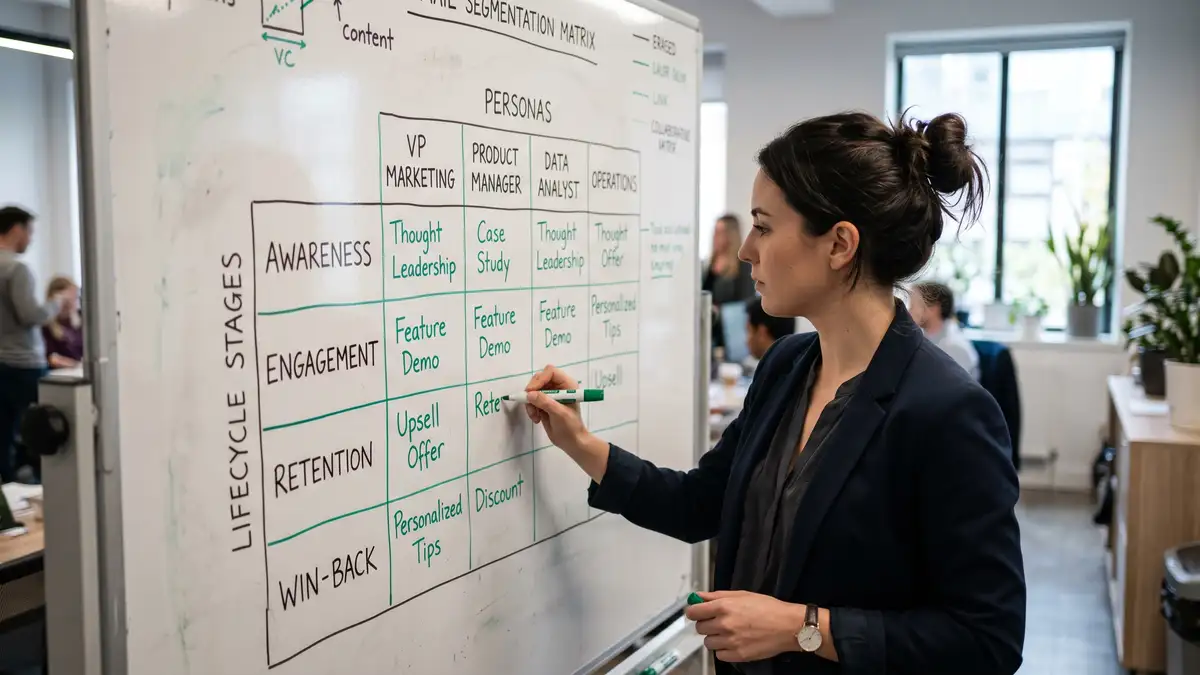
Audit current programme: deliverability (DMARC enforcement, BIMI, dedicated domain), engagement metrics (CTR not open rate), attribution (email-attributed pipeline %), sequence inventory. Fix authentication infrastructure first — if DMARC is at p=none, move to p=quarantine within 30 days. Build the foundational segmentation matrix (firmographic × persona × lifecycle stage). Document the five-stage lifecycle map. Target deliverable: deliverability score above 95% inbox placement.
Days 31-60: Rebuild welcome and educational sequences
Replace the legacy newsletter with the five-stage architecture starting with welcome and educational. Build behavioural triggers (content engagement scoring, page visits, form submissions) feeding into segment promotions. Layer AI content generation for personalisation at scale. Switch primary KPI from open rate to click-to-conversion. Target: 2x CTR on welcome sequence, 25%+ open-to-click on educational.
Days 61-90: Layer solution, activation, retention; calibrate
Deploy solution sequence (pricing-page-triggered) and activation sequence (PLG behavioural). Launch first win-back campaign for 60-90 day dormant subscribers. Set up email-attributed pipeline dashboard with W-shaped attribution. Document the quarterly recalibration playbook. Target: 25-40% lift in email-attributed pipeline by day 90, 8-15% reactivation rate on win-back.
Architect a B2B email programme that compounds revenue
peppereffect installs the five-stage email lifecycle architecture for $10M-$40M ARR B2B SaaS leaders ready to decouple pipeline growth from headcount. We deploy the deliverability infrastructure, the behavioural triggers, the AI content layer, and the attribution model that turns email from a vanity-metric channel into 22-35% of pipeline contribution.
Book a Growth Mapping CallFrequently asked questions
What is B2B email marketing strategy?
B2B email marketing strategy is the architecture for orchestrating email across the full prospect-to-customer lifecycle — welcome, educational, solution, activation, and retention/win-back stages — wired to behavioural triggers and segmented by firmographic, persona, lifecycle stage, and engagement velocity. The 2026 distinction is that strategy now includes deliverability infrastructure (DMARC, BIMI), AI-driven personalisation, and click-to-conversion measurement instead of open rates.
What's the ROI of B2B email marketing in 2026?
Email marketing returns $36-$45 per dollar invested in 2026, a 3,600-4,500% ROI. Technology and software companies achieve approximately 3,600% returns. Nearly 19% of companies hit 7,000%+ ROI through automated lifecycle sequences. By comparison, Google Ads returns $2 per $1, paid social $1.75, and display ads $1.35.
Why are open rates unreliable in 2026?
Apple Mail Privacy Protection auto-fetches images on Apple devices regardless of whether the user actually opened the email. With 53%+ of opens now coming from Apple devices, the open rate has become a vanity metric. Top-quartile B2B programmes anchor measurement to click-to-open rate, click-through rate, and email-attributed pipeline contribution.
What are the 2026 B2B email marketing benchmarks?
Median B2B click-through rate: 1.5-2.2%. Top-quartile: 3.5-4.5%. Median click-to-open rate: 8-12%. Top-quartile: 18-25%. Median email-attributed pipeline contribution: 8-15%. Top-quartile: 22-35%. Win-back reactivation: 8-15%. Welcome-sequence revenue share: 30%+ of email-attributed pipeline when properly architected.
How often should I send B2B marketing emails?
For active prospects in nurture: weekly to bi-weekly across the educational stage. For solution-stage prospects: 2-3 emails per week with behavioural triggers. For customers: bi-weekly value-driven emails plus expansion-trigger sequences. For dormant subscribers: monthly re-engagement only. Frequency should be governed by engagement velocity — hot prospects can absorb 3x the cadence of cold subscribers without unsubscribe spike.
What email authentication do I need in 2026?
SPF, DKIM, and DMARC at p=quarantine or stricter are required for any sender exceeding 5,000 sends per day to Gmail or Yahoo (per the February 2024 bulk sender requirements). BIMI with a verified mark certificate is recommended — it produces 10-15% open lift through verified logo display. Without proper authentication, inbox placement drops 25-45%.
Should I use plain text or HTML emails?
Both have a place. Plain-text or lightweight-HTML emails consistently outperform heavily designed templates on B2B click-through by 15-30% — they look like one-to-one outreach rather than broadcast marketing. Heavy HTML still wins for product launches, customer newsletters, and case-study features. The 2026 best practice: lightweight HTML for nurture, plain text for sales-aligned sequences, designed HTML reserved for high-impact moments.
Resources
- Sender — Marketing ROI Statistics 2025-2026
- Designmodo — Email Marketing Benchmarks by Industry 2026
- Dotdigital — Email Engagement in 2026
- Digital Applied — Email Deliverability Benchmarks 2026
- Insider One — Email Personalization Best Practices 2026
- Attn Agency — Behavioral Triggers and AI-Driven Customer Journey 2026
- Prospeo — Best AI Email Writing Tools 2026
- Prospeo — B2B Email Segmentation 2026
- Digital Applied — Email Marketing Statistics 2026
- Digital Applied — Marketing Automation Platform Comparison 2026
- PowerDMARC — Google/Yahoo Email Authentication 2026
- Flowium — Winback Email That Converts 2026
- Oliver Munro — 60+ SaaS Marketing Statistics & Benchmarks 2026
- Warmy — Email Deliverability & GDPR Compliance Guide 2026
- Litmus — Top Email Marketing Trends 2026
- Clearout — Email Warmup Checklist 2026
- Red Sift — BIMI in 2026
- Cometly — Revenue Attribution For B2B SaaS 2026