

What Is Cold Email Outreach?
Cold email outreach is the practice of sending targeted, unsolicited emails to prospects who have no prior relationship with your business — with the goal of starting a sales conversation. Unlike spam, strategic cold email targets specific decision-makers with personalized messages relevant to their role, industry, and pain points. According to Instantly's 2026 benchmark data, well-executed B2B cold email campaigns deliver $36–$45 return for every $1 invested — making it the highest-ROI outbound channel available outbound lead generation strategy to growth-stage companies. cold email automation
The channel has evolved significantly. Where early cold email meant mass-blasting generic templates to purchased lists, the 2026 landscape demands precision: authenticated sending infrastructure, verified lead data, segment-specific messaging, and multi-channel coordination. Average reply rates sit at 3.43%, but top-performing campaigns consistently achieve 5–10%+ reply rates through disciplined execution of the fundamentals covered in this guide. The difference between average and elite isn't luck — it's systematic infrastructure applied to every stage of the outreach engine.
For B2B founders and revenue leaders targeting $10M–$50M ARR, cold email outreach represents the most scalable path to pipeline generation without proportional headcount growth. This guide covers the complete system — from technical infrastructure through AI-powered personalization — so you can architect an outreach engine that compounds.
What you'll learn in this guide:
- How to build authenticated sending infrastructure that reaches inboxes, not spam folders
- The email copy structure and subject line formulas that drive 5–10%+ reply rates
- Follow-up sequencing that captures the 42% of replies most campaigns miss
- Multi-channel orchestration combining email, LinkedIn, and phone for 30–287% response increases
- Legal compliance frameworks for CAN-SPAM, GDPR, and CASL — including penalty thresholds
- AI automation strategies that reduce prospect research from 20 minutes to 2 minutes
Key Takeaway
Cold email outreach in 2026 is a precision-engineered system, not a volume game. The companies generating $36–$45 per $1 invested are the ones treating outreach as infrastructure — with authenticated domains, verified data, segment-specific messaging, and strategic follow-up sequences that capture the 42% of replies most teams leave on the table.

Does Cold Email Outreach Still Work in 2026?
Yes — but the rules have fundamentally changed. The spray-and-pray era is over. Practitioners who persist with generic templates sent to purchased lists face diminishing returns and escalating deliverability challenges. Meanwhile, organizations investing in AI-powered infrastructure, deep audience segmentation, and authentic personalization continue to generate substantial pipeline.
The data confirms this split. Sendr.ai's 2026 analysis shows personalized subject lines generate 50% higher open rates compared to generic alternatives. Personalized calls-to-action deliver 202% better conversion rates. And campaigns using segment-specific messaging — where a VP of Marketing receives fundamentally different positioning than a VP of Sales — consistently outperform one-size-fits-all approaches by significant margins.

One critical shift: open rates are no longer reliable metrics. Apple Mail Privacy Protection now accounts for 46% of email clients, automatically opening emails to prevent tracking. According to Expandi.io, this artificial inflation makes open rates meaningless as a performance indicator. Elite teams now track reply rates, meeting booking rates, and pipeline conversion as primary KPIs — metrics that reflect genuine engagement rather than automated behavior.
The competitive advantage flows to organizations that combine rigorous technical execution with authentic strategic personalization. Research from Boomerang found that emails written at a 3rd-grade reading level — short words, short sentences, simple structure — achieve 36% higher response rates than complex copy. Busy executives reward clarity. Your cold email isn't competing against other cold emails — it's competing against every message in your prospect's inbox.
| Metric | Average Performance | Top Performer | Key Driver |
| Reply Rate | 1–3% | 5–10%+ | Personalization + segmentation |
| Open Rate | 40–60% (unreliable) | N/A (Apple MPP) | Deprioritize as metric |
| Meeting Booking Rate | 10–15% of replies | 25–30% of replies | CTA design + response speed |
| Cost Per Meeting | $50–$150 | Under $5 | Infrastructure + automation |
Sources: Instantly 2026, Sendr.ai 2026, Expandi.io 2026
How Do You Build Cold Email Infrastructure That Delivers?
Technical infrastructure determines whether your cold emails reach inboxes or spam folders — everything else depends on this foundation. Before writing a single email, you need authenticated sending domains, warmed-up mailboxes, and verified lead data. Skip this step and even perfectly crafted copy will never be seen.
Email authentication requires three DNS records working in concert: SPF (Sender Policy Framework) authorizes which servers can send email from your domain, DKIM (DomainKeys Identified Mail) adds a cryptographic signature verifying the email hasn't been tampered with, and DMARC (Domain-based Message Authentication) tells receiving servers what to do with unauthenticated email. According to Mailtrap's 2025 analysis, all three are now mandatory for inbox placement — not optional best practices.
Set Up Dedicated Outreach Domains
Create separate sending domains (e.g., outreach.yourcompany.com) to protect your primary business domain's reputation. Configure SPF, DKIM, and DMARC records correctly for each. Distribute volume across 10–25 authenticated domains for campaigns exceeding 5,000 daily sends.
Warm Up Sending Mailboxes
Run a 14–30 day warm-up protocol before any cold campaign launch. Ramp volume gradually while maintaining high engagement signals from warm contacts. Maintain consistent daily volumes — erratic patterns (500 Monday, 1,000 Friday) trigger ISP abuse detection.
Source and Verify Lead Data
Acquire leads from reputable B2B databases (Apollo, Hunter, ZoomInfo) — not scraped lists. Run comprehensive email verification: format check, MX record validation, SMTP verification, and catch-all detection. Maintain bounce rates below 2%. Remove role-based addresses (info@, support@, sales@) that generate inconsistent engagement.
Standardize and Deduplicate
Lowercase all email addresses, trim spaces, standardize job titles, and deduplicate across campaigns. This deceptively simple step prevents errors compounding across thousands of records — deduplication typically reduces list size by 5–15% while preventing far greater reputational damage from duplicate contact.
Avoid This Mistake
Never concentrate all sending volume on a single domain and inbox. Distributing 5,000+ daily emails across multiple authenticated domains and 100+ sending inboxes prevents overloading any single domain and distributes reputation risk. One domain blacklisting shouldn't collapse your entire outreach operation — build redundancy into your lead generation infrastructure.
What Makes a Cold Email Actually Convert?
The highest-leverage tactical element in cold email is the subject line — it determines open rate, which gates all downstream engagement. EmailTooltester's 2026 research found that full visibility across all email clients requires staying within 33 characters, but subject lines between 36–70 characters achieve optimal response rates. The practical rule: put your primary message in the first 33 characters, then extend if needed.

Subject lines that perform: personalized benefit statements ("Sarah, 30% faster sales cycles?"), competitive intelligence framing ("How TechCorp gained 40% market share"), and question-based approaches generating curiosity ("Ready for your best quarter?"). Subject lines that fail: all-caps formatting, excessive punctuation, promotional language, and false urgency. According to Sopro.io, 32% of recipients immediately delete emails with shocking or alarmist subject lines.
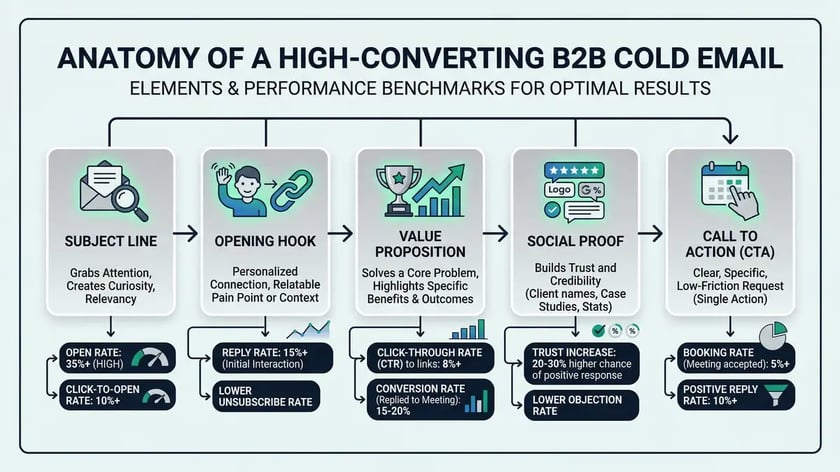
For the email body, Instantly's data confirms the sweet spot is 50–125 words. Shorter risks appearing incomplete; longer faces declining engagement at every additional sentence. Structure the body around a clear value hypothesis: why you're contacting this person specifically, what you believe is relevant to them, and what specific outcome you propose. Single-CTA emails outperform multi-CTA emails because cognitive load reduces response rates. Interest-based CTAs ("Would you be open to exploring this?") generate 30% reply rates — double the rate of specific or open-ended alternatives.
One counterintuitive finding: including a friendly opener like "Hope this finds you well" actually generates 24% more meetings than emails without such openings, according to Gong research — suggesting conventional wisdom against pleasantries may overstate the case. The deeper principle: authenticity matters more than rigid formula. Include one line of social proof — a customer testimonial, case study reference, or relevant credential — and you meaningfully improve trust and response rates, particularly in competitive categories.
| Email Element | Optimal Range | Impact |
| Subject line length | 33–70 characters | Full visibility + optimal response |
| Body word count | 50–125 words | Highest engagement window |
| Reading level | 3rd grade (simple) | 36% higher response rate |
| CTAs per email | 1 (interest-based) | 30% reply rate |
| Personalization | Subject + opening line | 50% higher opens, 202% better CTAs |
Sources: EmailTooltester 2026, Instantly 2026, Sendr.ai 2026
Key Takeaway
Cold email conversion is driven by three levers: subject line relevance (33–70 chars), body brevity (50–125 words), and single interest-based CTAs (30% reply rate). The common thread across all high-performing campaigns is specificity coupled with relevance — not volume, not urgency tactics, not clever tricks.

How Should You Structure Follow-Up Sequences?
Follow-up sequences aren't an afterthought — they're where 42% of your total replies originate. Instantly's analysis of billions of email interactions found that while 58% of replies come from the initial cold email, the remaining 42% arrive through follow-ups. HubSpot research confirms that 80% of sales require at least five follow-ups, yet most practitioners stop after one or two attempts — creating a self-fulfilling prophecy where campaigns appear to perform poorly because they lack persistence.
The ideal sequence spans 4–7 emails with progressively increasing intervals. A proven cadence: Day 1 (initial email), Day 4 (first follow-up with fresh angle), Day 9 (new value proposition), Day 16 (social proof or case study), Day 23 (final follow-up with low-friction CTA). Beyond 7 emails, engagement declines substantially while unsubscribe and spam complaint rates increase. Timing within the day matters too — Braze's 2026 research shows morning hours (8–12 PM) and mid-afternoon (2–4 PM) in the recipient's time zone outperform late afternoon and evening sends.
The fundamental error in follow-up sequencing is repeating the same message. Each follow-up should function as a standalone email that works independently. Vary your approach: first follow-up introduces social proof, second takes a question-based approach around a specific pain point, third shifts angle entirely with an alternative use case, fourth offers a low-friction next step like a brief discovery call. This maps directly to how lead nurturing sequences build progressive engagement across multiple touchpoints.
| Sequence Position | Timing | Content Strategy | Reply Contribution |
| Email 1 (Initial) | Day 1 | Value hypothesis + interest-based CTA | 58% of total replies |
| Email 2 | Day 4 | Social proof or case study | ~15% |
| Email 3 | Day 9 | Question-based (pain point) | ~12% |
| Email 4 | Day 16 | Alternative angle or use case | ~10% |
| Email 5 | Day 23 | Low-friction CTA (breakup email) | ~5% |
Sources: Instantly 2026, HubSpot 2025
Ready to architect a cold email outreach engine that generates pipeline on autopilot? Explore our Lead Generation infrastructure.
Book Your Growth Mapping CallHow Does Multi-Channel Outreach Amplify Cold Email Results?
Combining cold email with LinkedIn and phone outreach increases total response rates by 30–287%, according to SuperSend's 2026 benchmarks. Cold email delivers 1–2% average reply rates at high volume (50–100+ emails daily per resource), while LinkedIn outreach delivers 10%+ reply rates at lower volume due to platform connection limits. The channels are complementary, not competing.
The strategic integration sequences channels to build progressive familiarity: Day 1 cold email, Day 3 LinkedIn connection request, Day 5 first email follow-up, Day 7 engage with prospect's LinkedIn posts, Day 10 second email follow-up. Each channel uses a different mechanism, so the cumulative visibility doesn't register as spam. For high-value enterprise accounts worth $32,000+ annual recurring revenue, combining email and phone touchpoints can accelerate deal velocity by up to 5 weeks.
Research from Clearbit reveals the optimal multi-threading approach: reaching out to 2–4 people at the same company yields the highest response rate of 7.8%, whereas contacting 5–10 people drops response rates to 2.5%. Target complementary roles — VP Sales and VP Marketing, for example — without excessive contact that triggers spam responses. This multi-threaded, multi-channel approach transforms cold outreach from a single-touch gamble into a systematic sales automation engine.
What Are the Legal Requirements for B2B Cold Email?
Legal compliance isn't optional — CAN-SPAM violations carry penalties of $53,088 per email, and GDPR non-compliance can cost up to €20 million or 4% of global revenue. The good news: B2B cold email is legal in most jurisdictions when executed correctly. The bad news: many practitioners unknowingly violate requirements that carry material penalties.
The CAN-SPAM Act (US) operates on an opt-out model — you may email prospects without prior consent provided you include accurate sender identification, non-deceptive subject lines, clear commercial identification, a legitimate physical mailing address, a prominent unsubscribe mechanism, and honor opt-out requests within 10 business days. GDPR (EU/UK) operates differently, requiring affirmative legal basis — typically "legitimate interest" for B2B contacts, meaning documented justification that your business interest in contacting the prospect balances against their privacy expectations.
Canada's CASL is the strictest regime globally, requiring express or implied consent before sending commercial messages, with penalties up to CAD $10 million per violation. Implied consent carries expiration dates — generally 24 months after last interaction. The practical recommendation: adopt GDPR compliance as your global baseline standard. This simplifies operations, protects against the harshest penalties across all jurisdictions, and signals professionalism to prospects. Integrate compliance into your CRM automation workflows so opt-out processing and data handling happen systematically.
| Regulation | Jurisdiction | Consent Model | Max Penalty |
| CAN-SPAM | United States | Opt-out (no prior consent needed) | $53,088 per email |
| GDPR | EU / UK | Legitimate interest (B2B) or consent | €20M or 4% global revenue |
| CASL | Canada | Express or implied consent required | CAD $10M per violation |
| Spam Act 2003 | Australia | Express or inferred consent | AUD $1.38M per violation |
Sources: Mailtrap 2025, Scrap.io 2026, GDPR.eu
How Does AI Transform Cold Email Outreach?
AI has compressed prospect research from 20 minutes to 2 minutes per lead — a 10× efficiency gain that fundamentally changes the unit economics of cold outreach. According to Outreach's 2026 benchmark report, 80% of elite cold email teams now use AI for research and sequencing work, compared to only 45% of average performers. The gap between AI-enabled and AI-absent teams is widening every quarter.
Advanced AI SDR tools — including Ava by Artisan, Agent Frank, and Saleshandy's AI Sequence CoPilot — now handle autonomous prospecting: lead research, email composition, follow-up sequencing, and meeting scheduling. These tools implement advanced segmentation, surface engagement triggers, and adapt messaging based on response patterns using sentiment analysis. The business case: what previously required a full-time SDR working 8 hours daily can now be handled by agentic AI workflows, with human effort redirected toward qualified lead nurturing and high-value conversations.
However, over-reliance on AI without strategic guidance produces technically sound emails lacking genuine relevance. AI tends toward safe, middle-ground messaging unless trained on high-performing exemplars. And prospects increasingly detect AI-generated copy, which damages credibility. The winning approach: use AI as a force multiplier for human strategy — 54% of high-performing sales teams now use AI for email composition while maintaining human oversight on positioning, offer design, and relationship building. That's the difference between AI automation and AI replacement.
Key Takeaway
AI transforms cold email economics by compressing research time 10× and enabling personalization at scale — but the competitive advantage belongs to teams that combine machine efficiency with human strategic judgment. Elite performers use AI for research, list building, and initial sequencing, then apply human oversight for positioning, tone, and relationship management. Neither alone achieves what the combination delivers.
Frequently Asked Questions
What is cold email outreach and how does it differ from spam?
Cold email outreach targets specific decision-makers with personalized messages relevant to their role and industry. Spam is unsolicited bulk messaging sent indiscriminately. The legal distinction matters: cold email is legal under CAN-SPAM when it includes accurate sender identification, a physical address, and a functioning unsubscribe mechanism. Strategic cold email typically generates 3–10% reply rates because it addresses genuine business pain points, whereas spam generates near-zero engagement and damages sender reputation. The key differentiator is targeted lead generation with personalization versus volume without relevance.
Does cold email outreach still work in 2026?
Yes — for practitioners who execute with discipline. Cold email delivers $36–$45 ROI per $1 spent, making it the highest-return outbound channel. However, the bar has risen: authenticated infrastructure (SPF/DKIM/DMARC), verified lead data, segment-specific messaging, and strategic follow-up sequences are now table stakes. Average reply rates sit at 3.43%, but top performers consistently achieve 5–10%+ through personalization, optimal timing, and multi-channel integration. The channel rewards precision over volume.
How do you write an effective B2B cold email?
Keep it between 50–125 words with a single interest-based CTA. Subject lines should place the core message within 33 characters for full device visibility. Open with relevance — either personalized context or social proof — not generic pleasantries. Structure the body around a clear value hypothesis: why you're contacting this specific person and what outcome you propose. Write at a 3rd-grade reading level (short words, short sentences) for 36% higher response rates. Include one line of social proof to build trust. Test 2–3 subject line variants per campaign on 100+ send batches.
How many follow-up emails should you send?
The optimal sequence spans 4–7 emails with progressively increasing intervals. Research shows 42% of total replies arrive through follow-ups, and 80% of sales require at least five contact attempts. Space emails 3–5 days apart initially, increasing to 7-day gaps for later follow-ups. Each email must introduce genuinely new value — a different angle, case study, or pain point — rather than repeating "just checking in." Beyond 7 emails, engagement declines while unsubscribe rates increase.
What tools do you need for cold email outreach?
The essential stack includes: a dedicated sending platform (Instantly, Saleshandy, or Lemlist) for sequence management and analytics; a B2B data provider (Apollo, Hunter, or ZoomInfo) for verified lead sourcing; an email verification tool (ListMath or Hunter) maintaining bounce rates below 2%; a CRM system for pipeline tracking; and an AI research tool for prospect intelligence. For campaigns exceeding 5,000 daily sends, add domain management infrastructure distributing volume across 10–25 authenticated sending domains.
Is cold email legal under GDPR?
B2B cold email is permissible under GDPR using the "legitimate interest" legal basis — meaning your business interest in contacting a prospect balances against their privacy expectations. This requires documented justification and immediate compliance with opt-out requests. Critical distinction: GDPR classifies freelancers and self-employed individuals as consumers requiring explicit opt-in consent, even if they use business email addresses. Penalties for non-compliance reach €20 million or 4% of global revenue. The safest approach: adopt GDPR compliance as your global baseline standard regardless of recipient geography.
What reply rate should you expect from cold email?
Industry average reply rates sit at 1–3% for standard campaigns and 3.43% overall. Top-performing campaigns achieve 5–10%+ through disciplined execution. Rates vary significantly by vertical: legal services averages 10%, healthcare 4–6%, financial services 3–5%, and SaaS 1.9–3.5%. Benchmark against your industry peer group, not universal averages. More importantly, track reply-to-meeting conversion (typically 10–30% of replies) and cost per meeting — the metrics that connect directly to pipeline generation and revenue.
Architect Your Cold Email Outreach Engine
Stop sending emails into the void. peppereffect installs systematic outreach infrastructure — authenticated domains, verified data pipelines, AI-powered personalization, and multi-channel sequencing — that generates qualified pipeline without scaling headcount.
Book Your Growth Mapping CallResources
- Instantly — Cold Email Statistics and Benchmarks 2026
- Sendr.ai — Cold Email Personalization and Performance Data
- Outreach — AI Sales Development Benchmark Report 2026
- Mailtrap — Cold Email Laws and Compliance Guide
- Braze — Send Time Optimization Research 2026
- GDPR.eu — Official GDPR Regulation and Guidance
- Scrap.io — Global Cold Email Compliance Framework
- EmailTooltester — Subject Line Length and Performance Analysis
cold email vs. LinkedIn comparison
diagnostic engagement replacing cold outbound marketing email lifecycle architecture cold email deliverability architecture personalized email outreach at scale channel partner program