

The Content Paradox: Why Most B2B Content Fails to Generate Revenue
Seventy-four percent of B2B marketers report that content marketing generates more leads than any other channel. Yet the average B2B website converts B2B website design at just 1–2% — according to 2026 conversion benchmarks. That's not a volume problem. It's an architecture problem. optimizing content for AI answer engines SEO content marketing SEO copywriting framework
Most B2B companies produce content. Few build content systems. The difference: a blog post is an asset. A content system is an engine — one that compounds traffic, captures demand demand-gen production framework dual-funnel demand and lead generation, nurtures prospects, and converts revenue while you sleep.
700%+
3-Year Content ROI
First Page Sage, 2025
67%
B2B Buyer Journey
Completed before sales contact
3×
Pipeline From Content
vs paid channels alone
This guide maps the architecture. You'll learn:
- Why tactic-led content fails — and what system-driven content strategy looks like
- How to build a pillar-cluster architecture that dominates search
- The role of AI in scaling content production without sacrificing quality
- Distribution automation that turns every piece into a multi-channel asset
- ROI measurement frameworks that connect content to pipeline
- How Generative Engine Optimization (GEO) is reshaping B2B content strategy
What Is a B2B Content Strategy?
The Bottom Line
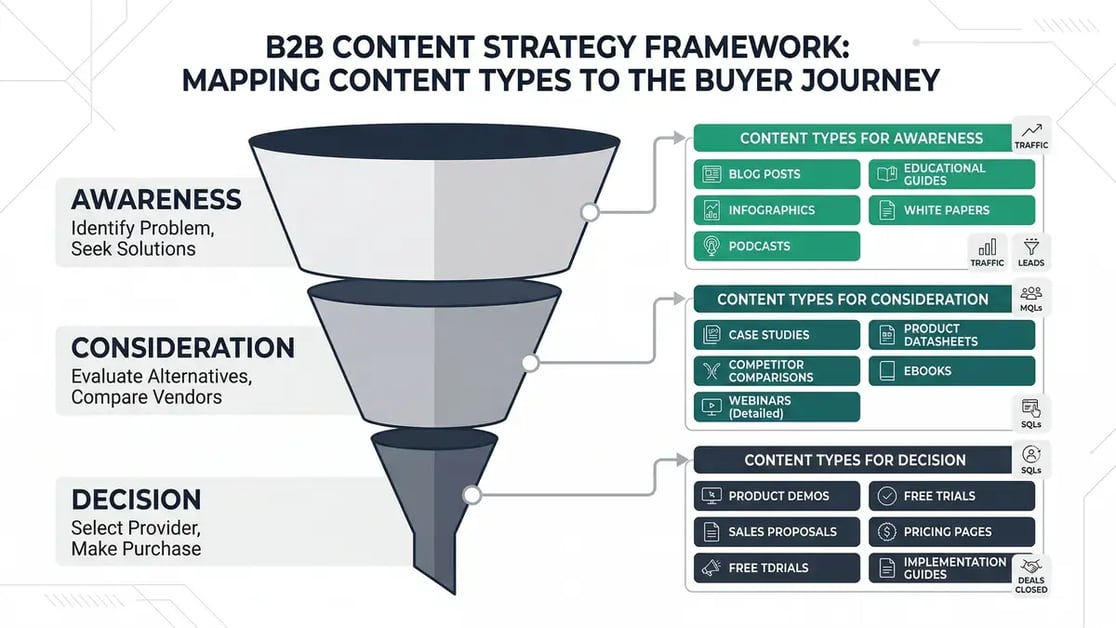
B2B content strategy is not a publishing schedule — it is pipeline architecture. Companies that deploy systematic content operations generate 3× more pipeline than those relying on paid channels alone, because each piece of optimised content compounds traffic and leads indefinitely.
A B2B content strategy is the systematic architecture of information assets designed to attract, educate, and convert business buyers. It's distinct from content marketing (the execution) and content creation (the production). Strategy is the blueprint — the structural decisions about what to create, for whom, through which channels, and tied to which revenue outcomes.
The best B2B content strategies operate as information engines: self-reinforcing systems where every article, guide, and resource strengthens the whole. Each piece builds topical authority, captures search demand, feeds the nurturing pipeline, and compounds over time.
Three structural components define a high-performance content strategy:
| Component | Function | Outcome |
| Pillar-Cluster Architecture | Organises content into topical hubs with interconnected subtopics | Search dominance and topical authority |
| Distribution Engine | Automates multi-channel delivery: email, social, syndication, paid | Maximum reach per content dollar |
| Measurement Framework | Connects content performance to pipeline metrics and revenue attribution | ROI visibility and continuous optimisation |
Without all three, you're producing content — not building infrastructure.
Why Tactic-Led Content Fails

Most B2B content operations are tactic-led: publish a blog post, share it on LinkedIn LinkedIn lead generation, hope someone reads it. The result is predictable — fragmented output, inconsistent quality, and zero compounding returns.
The Content Marketing Institute's 2026 B2B survey reveals the gap: only 12% of B2B marketers rate their content marketing as highly effective. The majority — 47% — describe it as merely "somewhat effective." That's a polite way of saying it underperforms.
Five structural failures explain the pattern:
- No topical architecture. Content topics are chosen reactively — based on sales requests, competitor activity, or keyword volume in isolation. There's no interconnected structure to build authority.
- Publishing without distribution. Content is created and abandoned. No automated email sequences, no social scheduling, no repurposing workflow. Each piece reaches a fraction of its potential audience.
- No measurement beyond vanity metrics. Pageviews and social shares look good in reports. They tell you nothing about pipeline impact. Without attribution to revenue, content investment is a faith-based exercise.
- Creator-dependent production. Output depends entirely on individual writers. When the writer is busy, content stops. There's no system, no process, no scalable production methodology.
- Ignoring the buyer journey. Every piece targets top-of-funnel awareness. Nobody builds the middle-funnel comparison content or bottom-funnel decision enablement that actually converts pipeline to revenue.
The alternative is architectural thinking — designing content as a system where every piece has a role, a connection, and a measurable contribution to growth.
Avoid This Mistake
Publishing content without a keyword research and topic cluster foundation. 90% of B2B blog content generates zero organic traffic because it targets keywords with no search demand or competes against established pages without differentiation. Research first, write second.
The Pillar-Cluster Architecture: How to Dominate Search
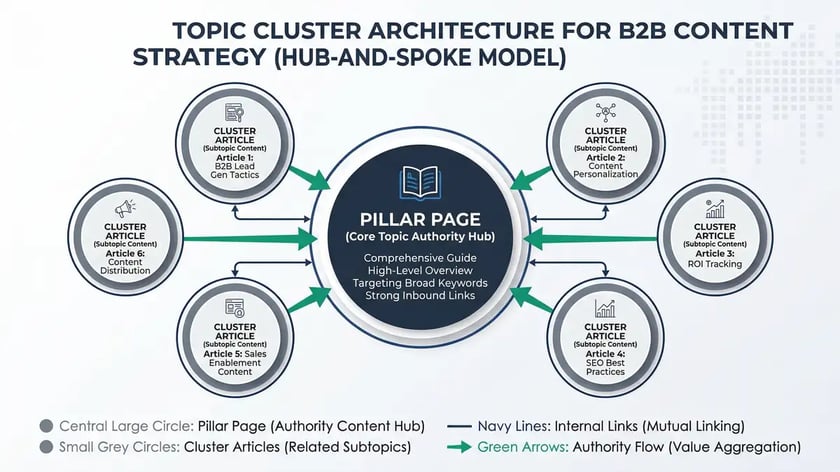
The pillar-cluster model is the structural foundation of a system-driven content strategy. It organises your content into topical hubs — each anchored by a comprehensive pillar page and surrounded by interconnected cluster articles.
How It Works
A pillar page is a comprehensive, authoritative resource on a broad topic — typically 2,500–5,000 words covering every major subtopic. Cluster articles go deeper on specific aspects of that topic. Every cluster article links back to the pillar, and the pillar links out to every cluster.
This architecture signals to search engines that your site has comprehensive topical authority. According to HubSpot's 2026 marketing research, blog posts remain among the top five highest-ROI content formats when structured within a pillar-cluster system.
Building Your Pillar-Cluster Map
Start with your four or five core service areas. Each becomes a pillar. For each pillar, identify 15–25 cluster topics using keyword research, customer questions, and sales objection data.
Example for a B2B AI consultancy:
| Pillar Topic | Cluster Topics (Examples) | Search Intent |
| Lead Generation | AI lead scoring, outbound automation, LinkedIn prospecting, lead qualification frameworks | Commercial / Informational |
| Sales Automation | CRM automation, proposal generation proposal automation software, pipeline management, sales enablement AI | Commercial / Navigational |
| Operations | Client onboarding, project management AI, workflow automation, document processing AI-powered workflow automation | Informational / Commercial |
| Marketing Infrastructure | Content strategy, SEO architecture, marketing automation, analytics dashboards | Informational / Commercial |
The internal linking structure is critical. Every cluster article links to its parent pillar. Every pillar links to every cluster. Cross-cluster links connect related topics across pillars. This creates a web of topical authority that search engines reward with higher rankings.
The Compounding Effect
A tactic-led content operation creates isolated assets. A pillar-cluster architecture creates a network effect: each new cluster article strengthens the pillar, which strengthens every other cluster in the group. Over 6–12 months, this compounds into search dominance for your entire topical domain.
Key Takeaway
The topic cluster model — pillar pages supported by cluster articles with strategic internal linking — signals topical authority to search engines and creates a content ecosystem where each new piece strengthens the ranking power of every other piece.
AI-Powered Content Production: The Human-Machine Framework
AI has transformed content production from a bottleneck into a scalable system. But the transformation isn't "AI writes everything" — it's "AI accelerates the machine; humans architect the strategy."
The CMI 2026 survey reports that 65% of B2B marketers have improved their creative capabilities through AI tools, with 58% reporting improved content quality. The key: they use AI as infrastructure, not as a replacement for strategic thinking.
Where AI Creates Leverage
- Research acceleration. AI synthesises industry reports, competitor content, and data sources in minutes — not days. Deep research that once took a content team a week now happens before the writer starts.
- Draft generation at scale. First drafts of cluster articles can be generated in hours, giving human editors a strong foundation to refine, fact-check, and inject expertise.
- SEO optimisation. AI analyses search intent, keyword density, and content structure in real time — ensuring every piece is architecturally sound before publication.
- Repurposing automation. One pillar article becomes 10 LinkedIn posts, 5 email sequences, 3 short-form videos, and 20 social snippets — programmatically.
Where Humans Remain Essential
- Strategic architecture. Deciding what to create, for whom, and why — this requires business context that AI doesn't have.
- Original insight. Proprietary data, client case studies, and expert perspectives differentiate your content from the AI-generated ocean.
- Brand voice and positioning. AI can mimic tone; it can't originate the strategic positioning that makes your content unmistakable.
- Quality control and fact-checking. Every AI-generated data point must be verified against primary sources. Accuracy is non-negotiable.
The organisations winning at content aren't choosing between AI and human expertise. They're building production systems where AI handles the 80% of production work that's systematic, and humans focus on the 20% that's strategic.
Ready to architect a content strategy that generates pipeline? See how peppereffect builds content engines for B2B founders.
View Marketing InfrastructureDistribution Automation: Making Every Piece Work Harder
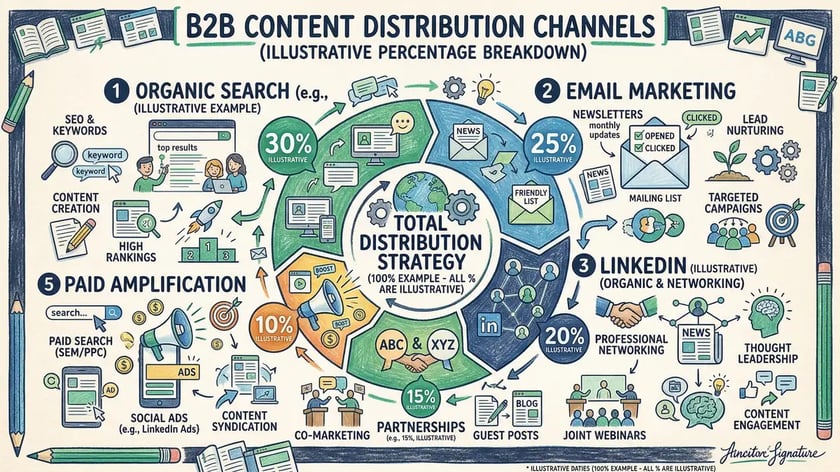
Publishing is not distribution. A content system without a distribution engine is a library nobody visits. The goal: every content asset reaches every relevant audience segment through every relevant channel — automatically.
The Multi-Channel Distribution Framework
For each content piece, automate distribution across five channels:
- Organic search (SEO). The pillar-cluster architecture handles this. Content is structured to capture search demand at every stage of the buyer journey.
- Email nurturing. Every new article triggers automated email sequences to relevant segments. A lead generation cluster article goes to prospects in the awareness stage. A case study goes to prospects evaluating solutions.
- Social amplification. Each article generates 5–10 social posts, scheduled across 2–4 weeks. Include different angles: a statistic, a question, a contrarian take, a key insight.
- Paid promotion. High-performing content gets budget behind it. Use engagement data to identify winners, then amplify through LinkedIn Sponsored Content or Google Ads for bottom-funnel pieces.
- Syndication and partnerships. Republish on industry platforms, partner newsletters, and professional communities where your buyers spend time.
The Repurposing Engine
One pillar article should generate at least 15–20 derivative assets. This isn't lazy recycling — it's strategic asset maximisation:
- Pillar article → Executive summary email
- Pillar article → 5 LinkedIn carousel posts
- Key statistics → Infographic
- FAQ section → Short-form video scripts
- Comparison table → Sales enablement one-pager
- Customer quotes → Testimonial graphics
The cost of production drops dramatically when your system extracts maximum value from every investment.
Key Takeaway
Measurement is not optional — it is the feedback loop that makes content strategy work. Track organic traffic growth, keyword rankings, cost per lead, and content conversion rate monthly to identify what's working and where to double down.
Generative Engine Optimization: The SEO Evolution
Traditional SEO is necessary but no longer sufficient. Generative Engine Optimization (GEO) — also called Answer Engine Optimization (AEO) — is the emerging discipline of optimising content for AI-powered search experiences: Google's AI Overviews, ChatGPT, Perplexity, and other LLM-driven discovery platforms.
The shift matters because buyer behaviour is changing. Instead of scanning ten blue links, executives increasingly ask AI assistants: "What's the best approach to B2B content strategy?" Your content needs to be the answer — not just a search result.
GEO-Ready Content Architecture
- Direct answers in content. Structure articles so that key questions are answered within the first 2–3 sentences of each section. AI systems extract concise, authoritative answers.
- Structured data (schema markup). Implement Article, FAQPage, and BreadcrumbList schemas on every piece. This gives AI systems structured context about your content.
- Cited statistics and sources. AI systems prefer content backed by verifiable data. Every claim should link to a primary source.
- Comprehensive topical coverage. GEO rewards depth. Pillar-cluster architecture naturally provides the comprehensive coverage that AI systems use to assess topical authority.
The organisations that architect for both SEO and GEO simultaneously will dominate the next generation of B2B discovery.
Measuring Content ROI: From Vanity Metrics to Revenue Attribution
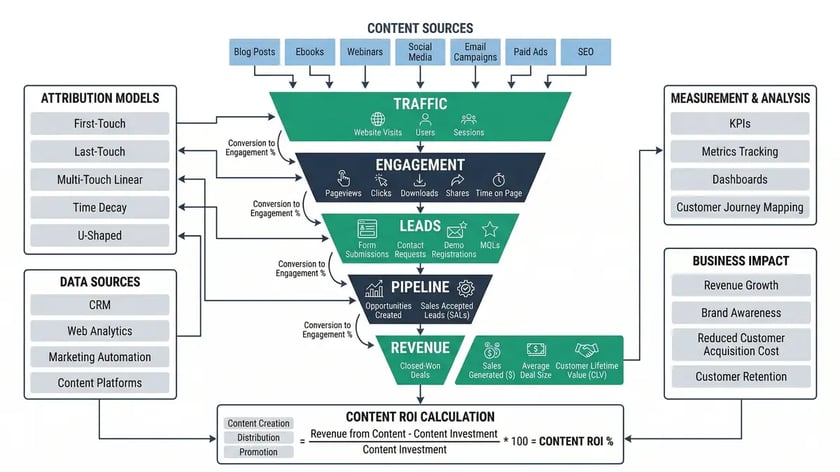
The measurement gap kills more content strategies than poor execution. Without clear attribution from content to pipeline to revenue, content marketing remains a cost centre — not an investment.
B2B deals average 62+ touchpoints across 6+ months with 7 decision-makers involved — which makes single-touch attribution meaningless for content measurement. — Coalition Technologies
The Three-Layer Measurement Framework
| Layer | Metrics | Purpose |
| Engagement | Organic traffic, time on page, scroll depth, social shares | Content quality validation |
| Conversion | Visitor-to-lead rate (2–5%), MQL generation, form submissions, content downloads | Demand capture effectiveness |
| Revenue | Content-influenced pipeline, content-attributed deals, customer acquisition cost customer acquisition cost playbook reduction | Business impact and ROI |
Most B2B teams stop at Layer 1. High-performers operate across all three, using multi-touch attribution models that credit content at every stage of the buyer journey — from first organic visit to closed deal.
Benchmarks That Matter
According to Unbounce's benchmark analysis of 41,000 landing pages, the median B2B conversion rate is 6.6% for optimised landing pages. For standard blog content, 2–5% visitor-to-lead is the target range. Top-performing content operations achieve MQL-to-SQL rates of 14–18% on qualified traffic.
The critical insight: conversion rate is a function of content quality, audience targeting, and journey stage alignment — not volume. Publishing more content doesn't improve conversion. Publishing the right content for the right audience at the right stage does.
Building Your Content Engine: The Implementation Roadmap
Strategy without execution is expensive advice. Here's the systematic approach to building a content engine that generates qualified pipeline 24/7:
Phase 1: Foundation (Weeks 1–4)
- Audit existing content — identify what performs, what's missing, and what should be retired
- Build your pillar-cluster map: 4–5 pillars, 15–25 clusters each
- Define buyer journey content requirements: awareness, consideration, decision
- Set up measurement infrastructure: analytics, attribution, CRM integration
Phase 2: Production System (Weeks 5–8)
- Establish your AI-human production workflow: research → draft → edit → publish
- Create content templates and style guides for consistency at scale
- Build editorial calendar with pillar-first publishing cadence
- Implement schema markup and technical SEO infrastructure
Phase 3: Distribution Engine (Weeks 9–12)
- Automate email nurturing sequences triggered by content consumption
- Build social amplification workflows: auto-scheduling, repurposing, engagement tracking
- Identify syndication partnerships and cross-promotion opportunities
- Set up paid amplification for high-performing content
Phase 4: Optimisation Loop (Ongoing)
- Monthly performance reviews: what's converting, what's ranking, what needs updating
- Quarterly content audits: refresh declining performers, retire underperformers
- Continuous keyword expansion: identify new cluster opportunities from search data
- A/B test CTAs, landing pages, and conversion paths
Frequently Asked Questions
How long does it take for a B2B content strategy to show results?
Expect 3–6 months for organic search traction and 6–12 months for compounding pipeline impact. The pillar-cluster architecture accelerates this — each new piece strengthens the entire network. Early wins come from email distribution and social amplification while search authority builds.
How much should a B2B company invest in content marketing?
High-growth B2B companies typically allocate 25–40% of their marketing budget to content. For a company spending $200k annually on marketing, that's $50–80k on content production, distribution, and tooling. The ROI compounds: content assets generate returns for years after creation, unlike paid advertising which stops when the budget does.
Can AI replace human content creators in B2B?
No. AI accelerates production and handles systematic work — research synthesis, draft generation, repurposing. But strategic positioning, original insight, brand voice, and quality control require human expertise. The winning model is AI-augmented production with human-led strategy.
What's the difference between SEO and GEO?
SEO optimises for search engine rankings — getting your content onto page one. GEO (Generative Engine Optimization) optimises for AI-powered answers — getting your content cited by ChatGPT, Google AI Overviews, and Perplexity. Both matter. The best B2B content strategies architect for both simultaneously through structured data, comprehensive coverage, and cited sources.
How do you measure content ROI with long B2B sales cycles?
Use multi-touch attribution that credits content at every stage of the buyer journey. Track first-touch (how they found you), multi-touch (which content they consumed), and last-touch (what triggered the conversion). Connect your content analytics to CRM pipeline data so you can trace a closed deal back to the articles that influenced it.
Should we gate our best content behind forms?
Gate selectively. Top-of-funnel educational content should be ungated to build organic traffic and topical authority. Gate high-value middle-funnel and bottom-funnel assets: detailed frameworks, benchmarking reports, ROI calculators, and implementation guides. The trade: access to premium content in exchange for contact information.
The Bottom Line: Content as Infrastructure
The gap between B2B companies that grow predictably and those that scramble for pipeline is infrastructure. A content strategy isn't a marketing tactic — it's business infrastructure that compounds over time.
The organisations winning now aren't producing more content. They're building content systems: pillar-cluster architectures that dominate search, AI-powered production engines that scale without proportional cost, distribution automation that reaches every buyer on every channel, and measurement frameworks that connect every article to revenue.
This is the shift from "content marketing" to "information engineering" — and it's the foundation of sustainable B2B growth in the AI era.
At peppereffect, we architect these systems. From lead generation to sales administration to marketing infrastructure — we install the content operating system that turns your expertise into a 24/7 revenue engine. Explore how we build it. answer engine optimization best practices inbound marketing flywheel lead scoring best practices B2B buyer journey mapping how much SEO actually costs
Resources
- Content Marketing Institute — B2B Content Marketing Trends: Insights for 2026
- HubSpot — 2025 Marketing Statistics, Trends & Data
- Unbounce — B2B Conversion Rate Optimization: 2025 Strategies
- Coalition Technologies — Must-Know B2B Marketing Statistics
They Ask, You Answer playbook LTV to CAC ratio benchmarks positioning framework