

What Is B2B Website Design — And Why Does It Matter More Than Ever?
B2B website design is the strategic architecture of a business-to-business website — not just visual aesthetics, but the entire conversion system that transforms anonymous visitors into qualified pipeline. In 2026, your website is no longer a digital brochure. It is the primary revenue infrastructure through which buyers research, evaluate, compare, and select vendors — often without ever speaking to a human.
The data is unambiguous. B2B buyers now complete 70–80% of their purchasing journey digitally before contacting sales, up from 57% just five years ago (Sopro). The average buying committee has expanded to 12 stakeholders, each consuming different content at different stages. And 61% of B2B buyers explicitly prefer a rep-free buying experience (Demand Gen Report). Your website must sell — autonomously, around the clock — or you lose to competitors whose websites do.
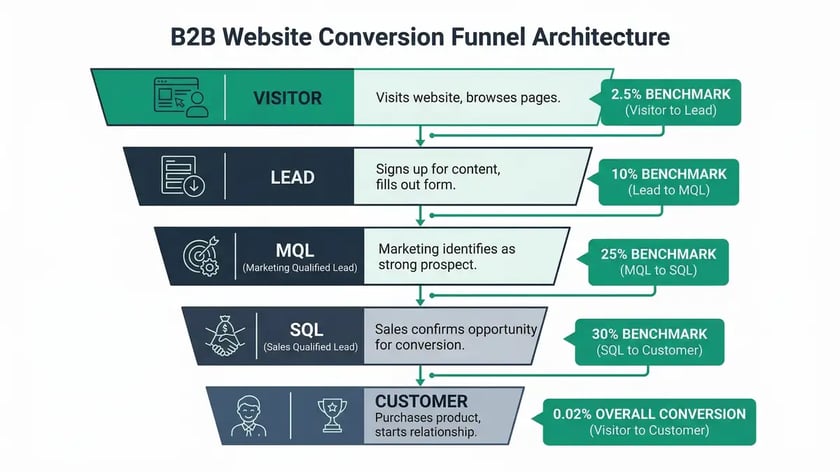
Yet the median B2B website conversion rate sits at just 2.9%, meaning 97 out of every 100 visitors leave without taking action (SERPSculpt). For SaaS companies, that number drops to 1.1%. The gap between median and top-quartile performance represents millions in lost pipeline — and the fix is not a redesign of colors and fonts. It is a fundamental rethinking of marketing infrastructure as a conversion-engineered system.
What you will learn in this guide:
- Why most B2B websites fail as revenue systems — and the conversion benchmarks that expose the gap
- How to architect your website around the self-directed B2B buyer journey
- The technical performance foundations (Core Web Vitals, mobile-first) that directly impact conversion
- AI-powered personalization and conversational strategies that deliver 40%+ conversion lift
- A step-by-step framework to transform your website from passive brochure to autonomous sales machine
- Platform selection guidance for B2B — HubSpot, Webflow, WordPress compared
- How to calculate redesign ROI and build the business case for strategic investment
Key Takeaway
B2B website design is not a creative exercise — it is conversion engineering. Every percentage point of conversion improvement reduces customer acquisition cost by 15–25% and compounds through higher search visibility and expanded AI-driven discovery. The organizations winning in 2026 treat their websites as core revenue infrastructure, not marketing collateral.

Why Do Most B2B Websites Fail as Revenue Systems?
The majority of B2B websites are built as digital brochures — organized around what the company wants to say, not what buyers need to decide. They feature generic "About Us" pages, undifferentiated service descriptions, and contact forms buried behind three clicks. This architecture ignores the fundamental reality of modern B2B purchasing: buyers are researching, comparing, and building internal consensus long before they ever reach your sales team.
Consider the conversion data by industry. Legal services — a high-complexity, relationship-driven B2B category — achieve 7.4% conversion rates. Financial services average 1.9%. IT and managed services sit at 1.5%. SaaS landing pages convert at just 1.1%. The variance is not random; it reflects differences in how effectively websites address buyer intent at each stage of the decision process. Traffic source matters equally: organic search converts at 2.7% (intent-driven), email at 2.4% (relationship-driven), while paid social drops below 1% (exploratory).
| Industry / Source | Conversion Rate | Implication |
| Legal Services (B2B) | 7.4% | High-trust, relationship-driven |
| All B2B Median | 2.9% | Baseline benchmark |
| Financial Services | 1.9% | Commodity perception drag |
| IT / Managed Services | 1.5% | Low-intent research traffic |
| SaaS Landing Pages | 1.1% | Highest optimization pressure |
| Organic Search | 2.7% | Strongest intent signal |
| Paid Social | <1.0% | Exploratory, low-intent traffic |
Source: SERPSculpt B2B Sales Conversion Rate Report 2025
The B2B bounce rate problem compounds this. Average B2B websites see bounce rates of 30–55%, with most visitors viewing only 2 pages per session before leaving. This means every page must efficiently move visitors toward conversion — there is no luxury of extended exploration. If your homepage does not immediately signal relevance, credibility, and a clear next step, you have lost the visitor within seconds. Effective B2B content strategy addresses this by organizing information around buyer questions, not company structure.
The Most Expensive Mistake in B2B Web Design
Organizing your website by internal department structure ("Products," "Services," "Company") instead of buyer journey stage ("Problem," "Solution," "Proof," "Next Step") is the single most common — and most costly — architectural error. It forces buyers to translate your internal language into their decision criteria, and most will not bother.
How Should B2B Website Architecture Map to the Buyer Journey?

High-performing B2B websites treat information architecture as a strategic discipline — organizing content around buyer decision stages, not company departments. The shift from "what we offer" to "what you need to decide" fundamentally changes how pages are structured, linked, and prioritized.
Effective B2B website architecture follows a clear conversion hierarchy. The homepage introduces the value proposition and directs visitors toward specific solution pages addressing distinct buyer segments. Solution pages demonstrate differentiation and address core buyer questions about functionality, outcomes, and fit. Supporting content — case studies, comparison pages, ROI calculators — builds the confidence necessary for committee-based decisions. This is the same B2B lead generation logic that applies across all channels: meet the buyer where they are, not where you wish they were.
Because B2B buying decisions involve multiple stakeholders with different priorities, effective architecture presents distinct content pathways for different personas. Engineering buyers prioritize technical specs and integration capabilities. Finance teams emphasize total cost of ownership and contract flexibility. Executives focus on strategic outcomes, competitive advantage, and implementation timelines. A single generic product page serves no constituency well. Multi-stakeholder segmentation — role-specific case studies, industry-vertical landing pages, use-case-specific proof points — is what separates websites that convert from websites that inform.
This multi-stakeholder approach connects directly to sales automation strategy. When your website qualifies and segments visitors by role, industry, and intent stage, your CRM automation system inherits pre-qualified leads with context — dramatically reducing sales cycle length and increasing close rates.
Key Takeaway
Custom-designed B2B websites achieve 20–40% higher conversion rates than template-based alternatives — and most of this improvement comes from conversion-focused architecture, not visual design. A £100,000 custom redesign improving conversion from 1.5% to 2.8% on 40,000 monthly visitors generates £4.16M incremental annual pipeline (UTSUBO).

What Technical Foundations Drive B2B Website Conversion?
Technical performance is not a nice-to-have polish — it is a direct revenue driver. Every 100-millisecond improvement in page load time boosts B2B website conversion rates by up to 7% (Magnet). Yet only 47% of websites currently pass Google's Core Web Vitals assessment, meaning the majority of B2B websites forfeit both ranking advantage and conversion performance through preventable technical deficiencies.
Core Web Vitals — Largest Contentful Paint (load speed), Interaction to Next Paint (responsiveness), and Cumulative Layout Shift (visual stability) — function as both search ranking signals and direct conversion levers. Companies optimizing these metrics report bounce rate reductions from 68% to 41% and form submission increases of 35%. Sites achieving "Good" scores receive preferential treatment in Google's search results, creating a compounding advantage: faster pages convert more visitors AND rank higher, driving more qualified traffic to a higher-converting experience.

Mobile optimization is no longer optional. Mobile devices account for 60–65% of global website traffic as of 2025, and Google's mobile-first indexing means the mobile version of your site determines your search rankings. Yet many B2B websites still treat mobile as an afterthought — compressing desktop layouts into smaller screens rather than designing mobile-first experiences with touch-friendly navigation, simplified forms, and fast-loading pages. This architectural failure means optimizing for only 35–40% of your traffic while neglecting the majority.
For organizations investing in SEO for B2B, these technical foundations are non-negotiable. Strong Core Web Vitals compound with content quality and link authority to create ranking advantages that template-based competitors simply cannot match.
| Performance Metric | Impact | Revenue Implication |
| 100ms load time improvement | +7% conversion rate | ~$70K annual uplift per $1M revenue |
| Core Web Vitals "Good" | 5–10 position ranking gain | Compounding organic traffic growth |
| Mobile-first architecture | Serves 60–65% of traffic | Prevents majority-audience neglect |
| Bounce rate optimization | 68% → 41% reduction | +35% form submissions |
Sources: Magnet Core Web Vitals Guide, Thrive Web Designs
How Does AI-Powered Personalization Transform B2B Website Performance?
AI-powered personalization increases B2B conversion rates by 40% compared to generic experiences — and personalized calls-to-action convert 202% better than generic versions (Genesys Growth). These are not incremental improvements; they represent a fundamental shift in how websites interact with visitors.
Personalization in B2B operates across three data layers. First-party behavioral data — page views, content consumption, time on site — reveals implicit intent signals. Firmographic enrichment — company size, industry, revenue range — enables contextual personalization reflecting buyer priorities. And third-party intent data reveals when organizations are actively investigating solutions, enabling proactive engagement through agentic workflows that trigger targeted content delivery without human intervention.
Progressive profiling — collecting visitor information gradually across multiple interactions rather than demanding everything upfront — delivers particularly strong results. Companies implementing progressive profiling report 42% higher form submissions, 61% more marketing-qualified leads, and 27% more sales-accepted opportunities compared to traditional forms (Reform.app). The mechanism is straightforward: initial interactions collect only name and email; subsequent touchpoints gather role, pain points, budget, and timeline as trust builds.
Ready to transform your website from passive brochure to autonomous sales machine?
Book Your Growth Mapping CallConversational AI takes this further. AI chatbots deliver 10–15% conversion rates compared to 1–3% for traditional contact forms — a 5–7x improvement (Oscar Chat). B2B companies deploying chatbots report a 54.8% increase in high-quality leads, with 41% of meetings booked outside business hours (Zoom). Critically, 59% of chatbot-generated opportunities come from non-high-intent pages like FAQ sections and About Us pages — meaning chatbots expand lead capture across your entire website, not just dedicated landing pages. This is AI workflow automation applied directly to the revenue-critical surface area of your digital presence.
How Do You Build a B2B Website That Sells Autonomously?
Transforming a brochure website into an autonomous sales machine requires systematic execution across five architectural layers. This is not a redesign project — it is the installation of a conversion operating system. Each layer builds on the previous, creating compounding returns that template-based approaches cannot replicate.
Conversion Architecture Audit
Map your current website against the buyer journey. Identify where visitors enter (traffic sources), where they drop off (exit pages), and where they convert (or fail to). Benchmark your conversion rate against industry medians. Calculate the revenue gap: if you are converting at 1.5% against a 2.9% median on 30,000 monthly visitors with $50K average deal value, you are leaving $2.52M in annual pipeline on the table.
Multi-Stakeholder Journey Mapping
Define content pathways for each persona in the buying committee. Create role-specific landing experiences, industry-vertical pages, and use-case demonstrations. Ensure every page answers a specific question a specific stakeholder asks at a specific decision stage. Connect these pathways to your lead nurturing sequences for seamless handoff.
Technical Performance Foundation
Achieve "Good" Core Web Vitals scores across all pages. Implement mobile-first architecture, CDN delivery, aggressive caching, and image optimization. Eliminate render-blocking resources and minimize JavaScript payload. Target sub-2-second page loads on mobile connections. This is non-negotiable infrastructure, not optional polish.
AI-Powered Engagement Layer
Deploy progressive profiling forms that collect data gradually. Implement conversational AI for 24/7 lead qualification. Add dynamic content personalization based on firmographic and behavioral data. Integrate website engagement data directly with your CRM for real-time lead scoring and sales automation triggers.
Measurement and Continuous Optimization
Establish 30–90 days of clean baseline data before any redesign. Define success KPIs tied to revenue: conversion lift, CAC reduction, sales cycle compression. Implement multi-touch attribution connecting website behavior to closed deals. Run continuous A/B testing on CTAs, form flows, and content pathways. This is not a project with an end date — it is an operating system that improves continuously.
| Investment Level | Typical Scope | Expected Conversion Lift | 3-Year TCO |
| Template / DIY | Pre-built theme, basic customization | 0–10% | $50K–$150K (hidden costs) |
| Mid-Market Custom | Custom architecture, CRM integration | 20–30% | $100K–$250K |
| Enterprise Architecture | Full conversion system, AI personalization | 30–50%+ | $200K–$500K |
Source: Websarc Custom Design vs Templates Analysis
Which Platform Should You Choose for B2B Website Architecture?
Platform selection fundamentally shapes your website's technical ceiling, marketing team autonomy, and long-term scalability. Three platforms dominate the B2B landscape, each with distinct trade-offs that align with different organizational priorities.
Webflow has emerged as the leading choice for performance-conscious B2B teams. It combines enterprise-grade design control with native CMS functionality, performance-optimized hosting, and marketing team autonomy — enabling content updates without developer intervention. Webflow sites typically achieve Lighthouse scores above 90 and page loads under 2 seconds. For teams prioritizing speed, design freedom, and independence from developer bottlenecks, Webflow is the strongest option.
WordPress powers 43% of websites globally and offers unmatched flexibility through its plugin ecosystem. However, this flexibility creates its weakness: plugin accumulation drives performance degradation, security vulnerabilities, and mounting technical debt. For B2B organizations already invested in WordPress with substantial existing content, migration cost may outweigh performance gains — but for new builds, the maintenance overhead makes WordPress increasingly difficult to justify.
HubSpot CMS integrates natively with HubSpot's CRM, marketing automation, and email platforms — creating seamless lead tracking and personalization for organizations already in the HubSpot ecosystem. Design flexibility is more constrained than Webflow, and pages often load slower. For teams prioritizing CRM-native automation and willing to accept design constraints, HubSpot CMS delivers strong content hub capabilities that compensate for its limitations.
The platform decision should follow — not precede — your architecture strategy. Define the conversion system you need, then select the platform that enables it most effectively. If your generative engine optimization and AEO strategy demands technical flexibility and performance, Webflow provides the strongest foundation. If CRM integration is the primary constraint, HubSpot CMS is the pragmatic choice.
Key Takeaway
Template websites incur $50,000–$150,000 in hidden costs over three years (plugin maintenance, developer fixes, lost conversions) while custom architectures generate 20–40% higher conversion rates and positive ROI within 1.3 months. The "cheap" option is usually the most expensive over any meaningful time horizon.
Frequently Asked Questions
What makes B2B website design different from B2C website design?
B2B website design serves buying committees of 6–12 stakeholders making high-value decisions over weeks or months, while B2C targets individual consumers making faster, lower-value purchases. This means B2B architecture must address multiple personas with different priorities — technical, financial, and strategic — across a longer decision timeline. Content depth, proof assets like case studies and ROI calculators, and progressive information disclosure are essential in B2B but rarely needed in B2C. Your B2B content strategy should reflect these fundamental differences in how buying decisions unfold.
How much does a B2B website redesign cost?
Template-based B2B websites start at $5,000–$15,000 upfront but accumulate $50,000–$150,000 in total cost over three years including plugin maintenance, developer fixes, and lost conversions. Custom B2B website architecture typically ranges from $50,000–$250,000 depending on complexity, personalization requirements, and CRM integration depth. The critical metric is not cost but ROI: a $100,000 custom redesign improving conversion from 1.5% to 2.8% generates approximately $4.16M in incremental annual pipeline, delivering 789% first-year return on investment.
How often should a B2B website be redesigned?
Full redesigns every 2–3 years are standard, but continuous optimization should happen monthly. The most effective approach is building a conversion-focused architecture that enables ongoing iteration — A/B testing CTAs, refining form flows, adding content pathways, improving page speed — without requiring complete rebuilds. Think of your website as an operating system that receives continuous updates, not a static asset that ages until replacement becomes unavoidable.
What is the most important metric for B2B website performance?
Conversion rate — specifically, visitor-to-qualified-lead conversion — is the single most important metric because it directly connects traffic investment to pipeline output. The median B2B conversion rate is 2.9%, but top performers reach 5–7%+. Every percentage point of improvement reduces customer acquisition cost by 15–25%. Secondary metrics include pages per session (engagement depth), bounce rate by traffic source (content-visitor alignment), and time-to-conversion (sales velocity indicator). Integrate these with your CRM automation for end-to-end revenue attribution.
How do Core Web Vitals affect B2B website conversions?
Core Web Vitals directly impact both search rankings and conversion rates. Every 100-millisecond improvement in page load time delivers up to 7% conversion lift. Only 47% of websites currently pass Google's Core Web Vitals assessment, meaning achieving "Good" scores provides meaningful competitive advantage. Companies optimizing these metrics report bounce rate reductions of 27 percentage points and form submission increases of 35%. For B2B sites with high average deal values, even marginal performance improvements translate to substantial revenue impact.
Should B2B websites use chatbots or traditional contact forms?
Both — but chatbots should be the primary engagement mechanism. AI chatbots deliver 10–15% conversion rates compared to 1–3% for traditional forms, capture leads across all pages (not just contact pages), and operate 24/7 with 41% of meetings booked outside business hours. Traditional forms remain useful for specific high-intent actions like demo requests or pricing inquiries where visitors have clear purchase intent. The best approach layers conversational AI across your entire site while maintaining streamlined forms on key conversion pages — and connecting both to your lead nurturing infrastructure.
What role does AI personalization play in B2B web design?
AI personalization is a conversion multiplier: it delivers 40% higher conversion rates and 202% improvement in CTA performance by matching content, offers, and messaging to individual visitor characteristics. Progressive profiling — collecting data gradually rather than demanding it upfront — generates 61% more marketing-qualified leads. For B2B organizations deploying agentic workflows, website personalization feeds real-time behavioral data into autonomous systems that trigger client onboarding, lead scoring, and sales engagement without manual intervention.
Stop Losing Pipeline to a Passive Brochure Website
peppereffect architects B2B websites as autonomous sales machines — engineered for conversion, powered by AI, and integrated with your growth infrastructure. We deploy the 4 Pillars methodology to install a website operating system that captures, qualifies, and converts without scaling headcount.
Book Your Growth Mapping CallResources
- SERPSculpt — B2B Sales Conversion Rate by Industry Report (2025)
- Sopro — B2B Buyer Statistics and Insights (2025)
- UTSUBO — How to Measure and Justify Website Redesign ROI (2025)
- Magnet — Understanding Google's Core Web Vitals (2025)
- Reform — Progressive Profiling vs Traditional Forms (2025)
- Websarc — Custom Design vs Templates for B2B (2025)
- Demand Gen Report — B2B Buyers Prefer Rep-Free Experience (Gartner, 2025)
- Oscar Chat — Contact Forms vs AI Chatbots Conversion Comparison (2025)