

What Is SEO for B2B Companies and Why Does It Require a Different Playbook?
B2B search engine a generative engine optimization service optimization is the systematic process of building organic search visibility for businesses that sell to other businesses — and it operates under fundamentally different rules than consumer SEO. While B2C optimization chases high-volume keywords with broad appeal, B2B SEO targets lower-volume queries where a single conversion can represent a five- or six-figure contract. The math is inverted: businesses earn an average of $22 in revenue for every $1 spent on SEO, yet most B2B companies still apply consumer-grade tactics to enterprise buying cycles that span 6 to 18 months with multiple decision-makers evaluating solutions independently.
The competitive landscape reinforces why a systems-first approach matters. Major publishers including Forbes, HubSpot, and Content Marketing Institute capture approximately 65% of top-3 positions for B2B keywords, leaving smaller publishers with less than 5% of that visibility share. Outranking these entrenched competitors requires specialized topical depth, not generic SEO playbooks. Meanwhile, answer engine optimization has emerged as a parallel channel — ChatGPT now accounts for 20% of search-related traffic worldwide, and AI referral traffic converts at 3.76%, roughly 216% higher than standard web traffic. The organizations winning in B2B SEO are those building infrastructure that works across Google, AI search engines, and the dark funnel simultaneously.
What you'll learn in this playbook:
- Why B2B SEO requires fundamentally different keyword strategy, content architecture, and measurement than B2C
- How to build pillar-cluster topic architectures that rank for 300% more keywords and earn AI citations
- The systems-first keyword research methodology that prioritizes commercial intent over raw volume
- Why ungated content generates 52% more organic traffic and how to structure the gated-vs-ungated decision
- How one B2B SaaS company grew organic pipeline to $820,000/month while cutting CAC by 78%
- The complete technical stack and implementation framework for building B2B SEO as growth infrastructure
Key Takeaway
B2B SEO is not a marketing tactic — it is growth infrastructure. Companies that treat it as a systems discipline achieve 748% ROI with 9-month payback periods, while those applying B2C playbooks to B2B buying cycles consistently underperform. The differentiator is architectural: pillar-cluster content networks, buyer-journey keyword mapping, and AI search optimization working as an integrated system.
How Does B2B SEO Differ from B2C Search Optimization?
The structural differences between B2B and B2C search behavior create cascading implications across every dimension of SEO strategy. A B2C keyword like "running shoes" might generate 200,000 monthly searches with relatively low individual transaction values. A B2B keyword like "enterprise workflow automation software" might receive only 500 monthly searches — yet each searcher represents a potential six-figure contract. This fundamental inversion means B2B SEO success is determined not by capturing the highest-volume keywords but by identifying terms where search intent aligns precisely with available solutions.

Decision-making structures reshape search behavior entirely. B2B buying decisions involve multiple stakeholders — procurement officials, technical evaluators, budget holders, and executive sponsors — each conducting independent research using different language. A CFO searching for marketing budget benchmarks and a VP of Marketing evaluating demand generation strategies represent distinct search intents requiring separate content. B2B transactions extend across 6 to 18 months with multiple research phases, making traditional last-click attribution meaningless. Buyers use industry-specific jargon, comparison queries, and problem-oriented searches, expecting content that demonstrates genuine expertise.
| Dimension | B2B SEO | B2C SEO |
| Search volume | Lower volume, higher value per click ($500-$100K+ deals) | High volume, lower individual transaction value |
| Decision-makers | 5-12 stakeholders researching independently | 1-2 individuals (personal/household) |
| Sales cycle | 6-18 months with multiple research phases | Days to weeks, impulse-driven |
| Keyword intent | Problem-oriented, jargon-heavy, comparison queries | Product-focused, brand-aware, price-sensitive |
| Content depth | Expert-level, methodology-driven, data-backed | Accessible, feature-focused, review-based |
| Top SERP DR average | 78 (high authority required) | 62 (more accessible entry) |
Sources: Backlinko B2B SEO Guide, Semrush B2B SEO Research
How Do You Build a Systems-First B2B Keyword Strategy?
Effective B2B keyword strategy inverts traditional consumer keyword research entirely. Rather than starting with search volume data, it begins with buyer journey mapping and deliberately prioritizes commercial intent over raw traffic numbers. A 50-volume keyword that converts to sales-qualified leads outperforms a 5,000-volume keyword that only attracts general interest blog readers — yet most B2B companies chase volume because they apply consumer-grade SEO methodology to enterprise buying cycles.
The process starts by mapping specific buyer journey stages for each target persona. Awareness-stage buyers have identified a problem but have not formulated a solution approach. Consideration-stage buyers understand available solution categories and are comparing approaches. Evaluation-stage buyers have narrowed to specific vendors. Decision-stage buyers are negotiating terms and planning implementation. Each stage generates distinct search patterns, and a complete B2B SEO strategy addresses all stages — though companies with resource constraints should prioritize middle- and bottom-of-funnel keywords first, as they drive revenue faster.
Pain point mapping translates real customer challenges into search queries. This requires direct input from sales teams who interact with buyers throughout their journeys. For niche B2B markets, success means dominating hundreds of low-volume, high-intent long-tail terms rather than competing for broad category keywords where publishers already hold 65% of top positions.
Map the Buyer Journey per Persona
Define awareness, consideration, evaluation, and decision stages for each ICP. Document what questions they ask, what language they use, and where they research at each stage. A CFO uses different search terms than a technical evaluator.
Extract Pain Points from Sales Conversations
Interview sales teams and account managers to identify the exact problems prospects describe. Translate these pain points into keyword queries — these typically have lower volume but significantly higher commercial intent than category terms.
Classify Keywords by Intent, Not Volume
Tag every keyword as informational, commercial, or transactional. Prioritize commercial and transactional terms for immediate content development. A 50-volume transactional keyword drives more pipeline than a 5,000-volume informational keyword.
Assess Competitive Feasibility
Check SERP composition and domain ratings for target keywords. Top 10 B2B keywords average DR 78 — identify realistic opportunities where your domain authority can compete within 3-6 months rather than chasing terms requiring years of authority building.
Avoid This Mistake
Do not prioritize keywords by search volume alone. In B2B markets, 70-80% of queries are non-branded and dominate awareness/consideration phases, while 20-30% are branded and peak during decision phases. Chasing high-volume informational keywords while neglecting lower-volume commercial terms is the single most common B2B SEO failure — it generates traffic that converts at fractions of a percent while pipeline-building opportunities go uncaptured.

What Technical Infrastructure Powers B2B SEO at Scale?
Building effective B2B SEO starts with establishing technical foundations that enable both search engine crawlability and AI system interpretation. Modern search requires optimization not just for Google's algorithms but explicit structuring for AI systems that extract, analyze, and cite your content when composing answers. Websites with strong topical authority rank for 300% more keywords and receive 47% more organic traffic than single-post competitors — and this multiplier operates because AI systems evaluate your entire content network as a whole, not page by page.
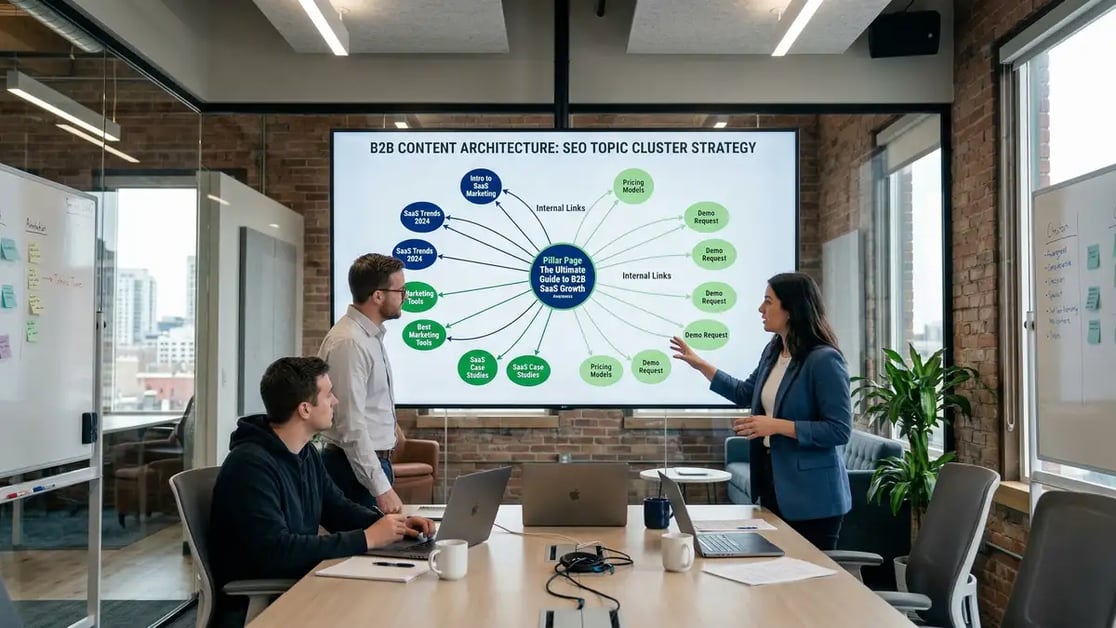
Topic clusters and pillar page architecture form the essential infrastructure. A pillar page with 10 to 15 well-linked cluster posts signals coherent topical authority, while a single strong post signals only a beginning. AI systems check for semantic coverage, internal linking patterns, content network coherence, and overall authority perception before deciding whether to cite your content. Pillar pages should define the core topic comprehensively, answer major questions a reader or AI system would have, and link clearly to every cluster post. Headers should be written as real questions — "How do I measure B2B demand generation ROI?" rather than "Demand Gen ROI Metrics" — because AI systems use these headers to infer topical relevance before reading content.
Schema markup provides structured data that both Google and AI systems use to understand business context. Essential implementations include Organization schema, Service schema, FAQ schema with direct answers, Article schema with authorship metadata, and BreadcrumbList schema. Pages implementing schema markup on topically authoritative sites show 73% greater effectiveness compared to isolated posts. Internal linking should use descriptive anchor text — "how topic clusters affect AI citations" rather than generic "click here" language.
| Technical Element | Target | Impact |
| Pillar-cluster architecture | 1 pillar + 10-15 cluster posts per topic | 300% more keywords, 47% more traffic |
| Schema markup (FAQ, Article, Org) | Every page with structured data | 73% greater effectiveness, 3x AI citation rate |
| Internal link depth | Any page within 3-4 clicks of homepage | Eliminates orphaned pages, improves crawlability |
| Core Web Vitals (LCP) | Under 2.5 seconds | Direct ranking factor + user experience |
| Core Web Vitals (INP) | Under 200 milliseconds | Interaction responsiveness signal |
| Core Web Vitals (CLS) | Under 0.1 | Visual stability signal |
Sources: Google Core Web Vitals, Backlinko B2B SEO Analysis
Ready to architect your B2B SEO infrastructure? Explore peppereffect's Marketing Infrastructure services for systems-first search optimization.
Book Your Growth Mapping CallWhy Does Content Strategy Separate B2B SEO Winners from Everyone Else?
Content strategy in B2B SEO requires aligning format, depth, and gating decisions with funnel stage and conversion objectives — and the traditional approach of gating all valuable content behind forms has proven increasingly counterproductive. Only 2% of B2B website visitors B2B website architecture fill out forms, meaning the remaining 98% leave without a trace if all valuable content sits behind a gate. Educational B2B blogs generate 52% more organic traffic than gated alternatives, and companies that switch from gated to ungated demand generation content report dramatic results — one company grew inbound pipeline from $2M to $13M while increasing close rates from 0.2% to nearly 20%.

The gating decision should be based on asset specificity and conversion stage. Proprietary research, interactive tools, and benchmark reports that genuinely justify form friction deserve gating. Foundational educational content, industry guides, and thought leadership articles should remain ungated to build search visibility and authority. This is not about giving everything away — it is about recognizing that visibility and authority build the demand that gating is supposed to capture. Strategic gating at evaluation and decision stages captures high-intent prospects while maintaining broad visibility for awareness-stage content.
Case studies represent the most effective consideration-stage content, with 78% of B2B decision-makers preferring them during evaluation. Their effectiveness lies in specificity — generic testimonials lack credibility, but case studies with concrete metrics (revenue impact, time saved, cost reduced, pipeline generated) demonstrate real-world results prospects can apply to their situations. Comparison and alternative content captures high-intent evaluation traffic: 59% of B2B buyers use software comparison websites during evaluation, making "X vs Y" articles critical demand capture assets. Pillar content hubs combining a comprehensive pillar page with 10-15 cluster articles rank 2.5x faster and drive 60% traffic uplift compared to standalone content pieces.
Key Takeaway
The gated-vs-ungated debate is settled by data: ungated educational content generates 52% more organic traffic and builds the authority that drives demand. Gate proprietary research and bottom-of-funnel tools — but keep thought leadership, guides, and educational content open to build search visibility. The compound returns from authority-building far outweigh the short-term lead capture from gating awareness-stage content.
How Do You Build Authority Through Strategic Link Acquisition?
Link building in B2B SEO differs materially from consumer-focused approaches because relevance and topical alignment trump volume completely. A single high-quality backlink from a recognized industry authority often outweighs dozens of low-relevance links. Ahrefs analysis of 1 billion pages confirms that the number of referring domains correlates with higher rankings more strongly than any other factor — but in B2B markets, the topical relevance of those domains matters even more than their raw authority scores.
Guest posting remains one of the most reliable methods, with more than 50% of marketers rating it their most effective link-building tactic. The critical distinction is targeting: submitting to trade publications and industry blogs your target buyers actually read generates both contextual backlinks and direct referral traffic from qualified audiences. Digital PR campaigns built around original research, company milestones, or expert commentary on emerging issues generate backlinks from high-authority news sites — more than 55% of digital PR campaigns secure 10 or more quality links per campaign.
Broken link building provides clear value to both parties — finding outdated content on authority sites, creating a superior replacement, then reaching out to sites linking to the broken resource. Directory listings in platforms like Better Business Bureau and industry-specific marketplaces provide efficient acquisition with buyer discovery benefits — B2B purchasers actively use directories to shortlist vendors.
| Link Building Method | Effectiveness | Best For |
| Guest posting (trade publications) | 50%+ marketers' top tactic | Contextual backlinks + referral traffic |
| Digital PR / original research | 55% secure 10+ quality links | High-authority news/industry links |
| Broken link building | High acceptance rate (value exchange) | Competitive content replacement |
| Industry directories (BBB, niche) | Credibility signal + buyer discovery | Local/industry authority building |
| Pillar content (linkable assets) | Compounds over time | Passive link acquisition at scale |
Sources: Ahrefs Link Building Research, Moz Link Building Guide
What Does Answer Engine Optimization Mean for B2B Search Strategy?
Answer Engine Optimization represents the fastest-growing B2B SEO discipline in 2026, driven by the unmistakable reality that AI systems now answer user questions directly — often without users ever visiting a website. Combined search engine and LLM usage has increased 26% worldwide, and the nature of visibility has fundamentally changed. Being cited in an AI-generated response creates brand awareness and drives traffic without requiring a traditional click, and AI users tend to be further along in evaluation when they do click through.
The process by which AI systems decide what to cite follows predictable patterns. They interpret user questions to understand intent and scope, search existing content for relevant answers, then compose responses citing sources that appear clear, specific, and trustworthy. Pages that surface complete responses early, supported by evidence, earn citations. Pages that bury responses or rely on vague claims lose them. This means AEO optimization requires putting answers first — not building narrative tension or burying conclusions. Headlines should match how users phrase questions, short paragraphs of 2-4 sentences make scanning easier, and direct answers must appear before explanations.
FAQ schema implementation becomes essential for AEO, explicitly marking question-answer pairs for AI extraction. Pages implementing FAQ schema appropriately see 3x higher citation frequency than pages without structured data. Freshness plays a measurable role — pages not refreshed quarterly are 3x more likely to lose AI citations compared to recently updated pages. Companies should monitor citation frequency, competitive citation share, and question coverage as direct AEO performance metrics using platforms like Profound, Geoptie, or Atomic AGI that track brand citations across ChatGPT, Perplexity, Claude, and Gemini.
Key Takeaway
AEO is not a replacement for traditional SEO — it is a force multiplier. The same content structured for Google rankings can simultaneously earn AI citations when optimized with question-based headers, direct answers first, FAQ schema markup, and quarterly freshness updates. Companies implementing both channels systematically capture disproportionate visibility before the market matures. 51% of B2B companies are increasing AEO investment while only 14% increase traditional SEO — the integrated approach captures both.
How Should B2B Companies Measure SEO Success Beyond Vanity Metrics?
Measuring B2B SEO success requires fundamentally different metrics than consumer-focused programs. Impressions, rankings, and organic sessions feel useful but rarely connect to business impact. Celebrating 50,000 monthly organic sessions that convert at 0.1% to opportunities reflects failed strategy — the same work optimized for quality over volume might generate 5,000 sessions but drive 2% conversion to opportunities, a 20x improvement in actual business value. The metrics that matter: organic-influenced pipeline, demo requests from organic pages, cost per organic lead, and revenue generated from organic traffic.
Attribution modeling represents the critical foundation. Last-click attribution — giving all credit to the final touchpoint before conversion — fundamentally misrepresents B2B customer journeys spanning 6-18 months with dozens of potential touchpoints. Multi-touch attribution distributes credit across the entire journey. Account-level attribution follows all interactions from individuals within target accounts, revealing how awareness campaigns, consideration content, and sales outreach work together. Pipeline-attributed ROI calculation assigns revenue from closed-won deals back to the marketing activities that influenced them.
Cost per organic lead directly compares channel efficiency — organic at $38 versus PPC at $285, with organic leads converting to SQLs at 31% versus 22% for PPC. Marketing cycle length determines realistic attribution windows: bootstrapped companies see 6-9 month payback, PE-backed companies 9-16 months, and VC-backed companies 12-24 months.
| Metric | What It Measures | Why It Matters for B2B |
| Organic-influenced pipeline | Revenue from deals where organic played any role | Reveals true channel contribution across long cycles |
| Cost per organic lead | Total SEO investment ÷ organic leads | $38 organic vs $285 PPC in benchmark case study |
| Demo-to-close rate by source | Conversion quality by acquisition channel | Organic: 31% vs PPC: 22% close rate |
| SEO share of voice | Your visibility ÷ total competitor visibility | Competitive positioning benchmark |
| Content decay rate | Pages losing rankings without refresh | Signals quarterly update priorities |
Sources: WebFX B2B SEO Case Study, HubSpot Marketing Statistics
Frequently Asked Questions
What is B2B SEO and how does it work?
B2B SEO is the process of optimizing a business website to rank in search engines for queries used by other businesses during their buying process. It works by building topical authority through pillar-cluster content architectures, targeting keywords aligned with buyer journey stages, implementing technical foundations like schema markup and Core Web Vitals, and earning authoritative backlinks from industry-relevant sources. Unlike B2C SEO, B2B optimization prioritizes commercial intent over search volume because a single conversion can represent a five- or six-figure deal. The content infrastructure must address multiple decision-makers researching independently across 6-18 month buying cycles.
How does B2B SEO differ from B2C SEO?
B2B SEO targets lower-volume, higher-value keywords where each searcher represents significant deal potential — the top 10 B2B keywords average domain rating 78 compared to 62 for B2C. B2B buying decisions involve 5-12 stakeholders researching independently using different language and priorities, while B2C typically involves 1-2 individuals. Sales cycles extend 6-18 months versus days or weeks. Content must demonstrate expert-level depth rather than broad accessibility. Measurement shifts from traffic volume to pipeline attribution, tracking how organic search influences revenue across the entire multi-touch customer journey rather than counting last-click conversions.
What does a B2B SEO strategy include?
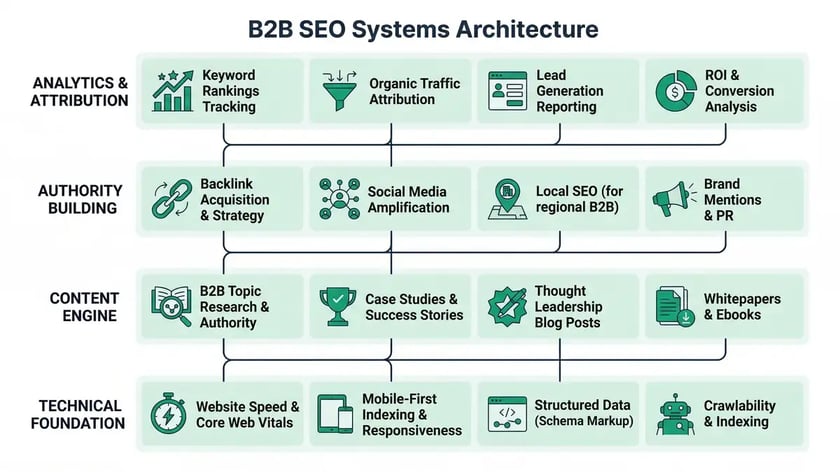
A complete B2B SEO strategy includes five integrated components: buyer journey keyword mapping (targeting queries across awareness, consideration, evaluation, and decision stages), pillar-cluster content architecture (comprehensive pillar pages supported by 10-15 cluster posts), technical SEO infrastructure (schema markup, Core Web Vitals, internal linking), strategic link acquisition (guest posting, digital PR, industry directories), and answer engine optimization (structuring content for AI citations). The strategy also requires appropriate budget allocation — growth-stage companies typically invest $3,000-$15,000/month depending on competitive intensity.
How long does B2B SEO take to show results?
B2B SEO typically shows initial results within 3-6 months for lower-competition keywords, with significant pipeline impact emerging at 6-12 months. Thought leadership SEO campaigns deliver 748% ROI with approximately a 9-month breakeven period. One benchmark case study showed 215% organic traffic growth and 180% more leads within 90 days — but full pipeline attribution took 6 months to materialize. Bootstrapped companies should expect 6-9 month payback periods, PE-backed companies 9-16 months, and VC-backed companies 12-24 months. The compound nature of SEO means returns accelerate over time as content authority and backlink profiles strengthen.
Is SEO worth the investment for B2B companies?
The data strongly supports B2B SEO investment. Businesses earn an average of $22 in revenue for every $1 spent on SEO, with B2B SaaS companies specifically seeing 702% ROI within 7 months. Organic leads convert to sales-qualified leads at 31% versus 22% for PPC, with 46% higher average contract values. One case study documented organic pipeline contribution reaching $820,000/month while reducing CAC by 78%. Unlike paid advertising that stops delivering when spend stops, SEO content assets continue driving traffic and leads indefinitely — creating compounding returns that make it the highest-ROI channel available to most B2B organizations.
How much should B2B companies spend on SEO?
B2B companies typically allocate 7.7% of total revenue to marketing, with SEO investment varying by stage and competitive intensity. Growth-stage SaaS companies ($1M-$10M ARR) typically spend $3,000-$15,000/month on SEO. Enterprise implementations often exceed $10,000/month. The average SEO project costs approximately $3,199/month over a year-long engagement. Budget allocation should prioritize commercial-intent content creation, technical infrastructure, and link acquisition — with measurement tied to pipeline contribution rather than traffic volume. Companies seeing the highest returns treat SEO as permanent infrastructure investment rather than time-limited campaign spend.
Deploy B2B SEO as Growth Infrastructure
peppereffect architects systems-first SEO infrastructure that compounds organic pipeline month over month. From pillar-cluster content networks to AI search optimization, we install the operating system for sustainable B2B growth — so you can decouple revenue from headcount.
Book Your Growth Mapping CallResources
- Backlinko — The Complete B2B SEO Guide
- Semrush — B2B SEO Strategy and Research
- Google — Core Web Vitals Documentation
- Ahrefs — Link Building Strategies for B2B
- WebFX — B2B SEO Case Study: 215% Traffic Growth
- HubSpot — B2B Marketing and SEO Statistics
- Moz — Link Building Fundamentals for B2B
HubSpot SEO tools and topic clusters
HubSpot SEO tools and topic clusters
GEO as a parallel search discipline technical AEO best practices for B2B
answer engine optimization partner
zero-click search measurement SaaS unit economics framework ai visibility