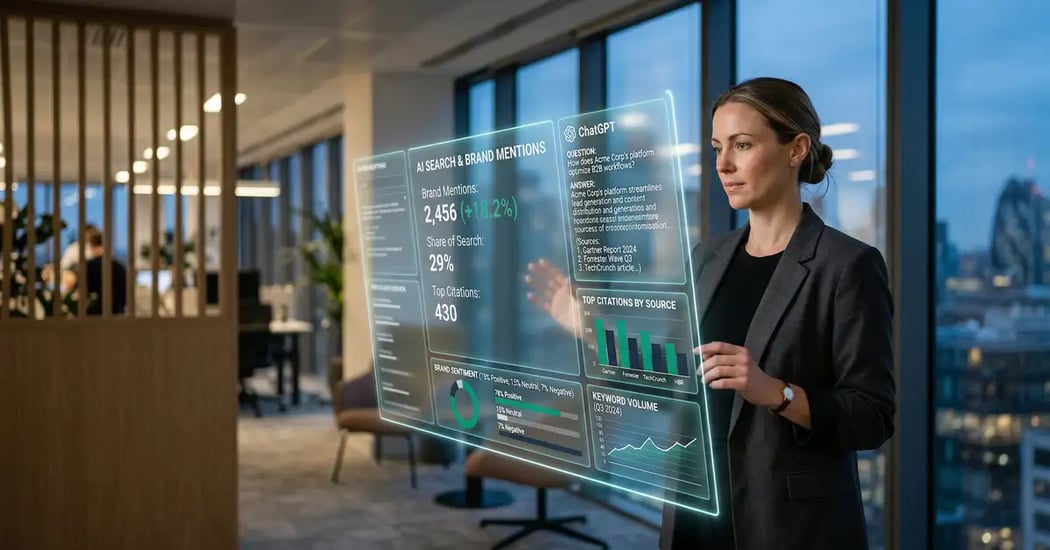

What are answer engine optimization services?
Answer engine optimization services are specialist consulting and implementation programmes that engineer a B2B brand's content, schema, entities and authority signals to be cited inside AI answer engines such as ChatGPT, Perplexity, Google AI Overviews, Gemini and Claude. Unlike traditional SEO — which optimises for blue-link rankings — AEO services optimise for citation share inside AI-generated answers, where 90 percent of B2B buyers now research vendors before ever visiting a website.
The category exists because the discovery interface has changed. Seer Interactive analysed millions of search results and found that organic click-through rates on AI Overview queries have collapsed from 1.76 percent to 0.61 percent — a 61 percent decline. Define Media Group's portfolio of 64 sites recorded a 42 percent fall in organic clicks since AI Overviews expanded in May 2025, with no recovery. The traffic that built classic SEO is being absorbed by AI synthesis layers.
That is why a credible AEO services partner does not just rebrand SEO. They architect an AI-ready marketing infrastructure across content, schema, crawler access, entity disambiguation and earned media — and they measure outcomes in citation share, not keyword rank.
What you'll learn in this guide:
- The six core deliverables every credible AEO services partner must provide
- How AI engines actually select citations — and what that means for your scope of work
- 2025–2026 AEO services pricing benchmarks across audit, mid-market and enterprise tiers
- Twelve red flags that signal a weak or rebranded AEO provider
- The measurement framework (citation share, sentiment, AI referral) that replaces keyword rank tracking
- A six-step evaluation framework to compare and select an AEO partner
Key Takeaway
Answer engine optimization services exist because 50 percent of B2B buyers now begin vendor research inside an AI chatbot, not Google. A credible AEO partner installs durable authority infrastructure — entity clarity, schema, earned media, citation tracking — rather than re-skinning SEO tactics under a new acronym.
Why answer engine optimization matters in 2026
The economic case for AEO services is no longer theoretical. McKinsey estimates that approximately 50 percent of consumers already use AI-powered search engines intentionally, rising to 75 percent by 2028, with USD 750 billion in annual US revenue redirected through AI-powered discovery. For B2B specifically, the shift is even sharper: ChatGPT is preferred by 47 percent of B2B buyers — three times the next competing LLM — and conversions from AI recommendations run 436 percent higher than traditional organic.
SparkToro's 2024 zero-click study confirms the structural backdrop: 58.5 percent of US Google searches and 59.7 percent of EU searches now end with zero clicks. The battle for discovery has moved upstream of the website. Brands that fail to engineer AI citation presence become invisible at the precise moment purchasing intent crystallises.
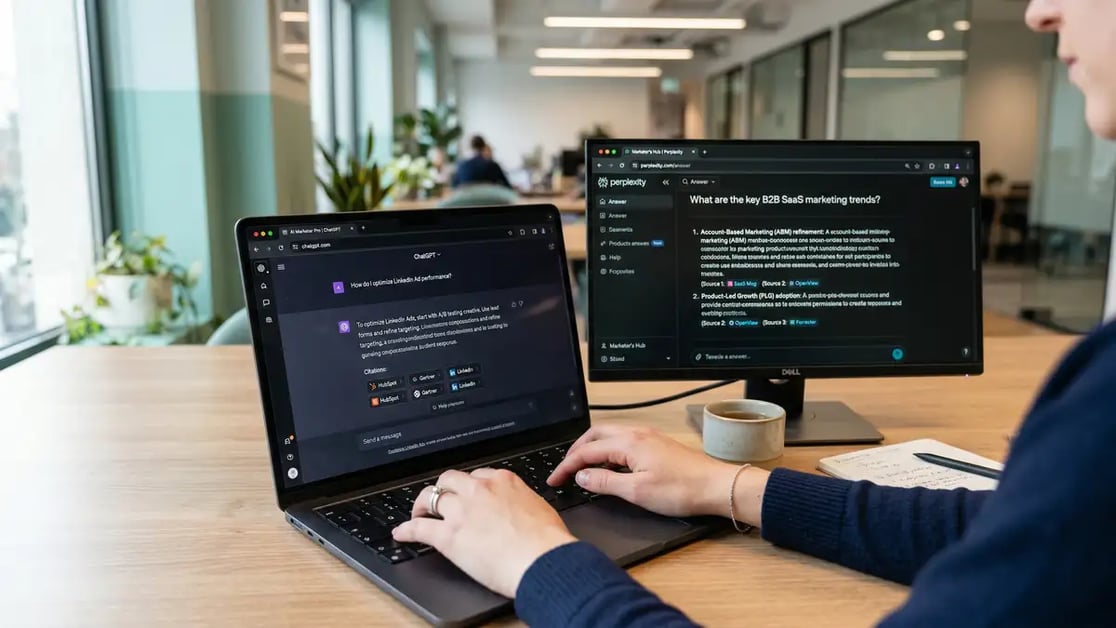
How do AI engines actually select citations?
Answer engine optimization services only work if they map to how AI systems retrieve and rank sources. Modern LLMs use Retrieval-Augmented Generation (RAG) — a two-stage pipeline introduced in Lewis et al.'s 2020 RAG paper. First, a retrieval system fetches candidate documents using semantic similarity. Second, the language model evaluates retrieved passages for factual density, authority and relevance before deciding whether to cite them.
This matters because pages compete at sub-document granularity. GetPassionFruit's analysis of LLM search behaviour documents that GPT-5.4 follows a two-phase pattern: domain-restricted brand-site queries first, then validation against third-party review platforms. The result: GPT-5.4 cites brand websites 56 percent of the time, while GPT-5.3 cited them only 8 percent. Architecture changes shift the optimisation surface — and a credible AEO partner tracks these shifts continuously.
Different platforms apply different selection logic. Zapier's analysis of ChatGPT source selection shows the model prioritises multiple precise keywords inside documents, recency, authority signals, trustworthiness assessment and perspective diversity. Perplexity, by contrast, runs a three-layer machine-learning reranker that structurally favours earned media from Tier-1 publications — and applies a 30-day freshness decay that penalises stale content.
| AI Engine | Primary Selection Signal | Implication for AEO Scope |
| ChatGPT (GPT-5.x) | Domain authority + brand-site retrieval | Optimise own domain depth and entity clarity |
| Perplexity | Tier-1 earned media + 30-day freshness | Continuous PR + monthly content refreshes |
| Google AI Overviews | Schema + traditional rankings + structured data | Schema hygiene + foundational SEO |
| Gemini | Knowledge Graph + Wikidata entity validation | Brand SERP + sameAs schema linking |
| Claude | Tables, statistics, structured guides | Data-rich content with clear hierarchy |
Sources: Zapier ChatGPT source selection analysis, AuthorityTech Perplexity algorithm study, GetPassionFruit LLM search analysis

Crucially, traditional SEO performance has near-zero predictive power over AI citations. ZipTie.dev's analysis documents that the correlation between website traffic and AI citation behaviour is r²=0.05 — meaning 95 percent of citation behaviour is unexplained by traffic. Sites with zero organic traffic can receive 900+ AI citations, while sites with millions of monthly visits can be invisible inside ChatGPT. This is why AEO services must be architected as a distinct discipline, not bundled as a SEO add-on. Any provider claiming "we already do this as part of SEO" is operating on the wrong correlation model.
What does a credible AEO services partner actually deliver?
Genuine answer engine optimization services operate across six tightly interlocked layers. Skip any one and the engine misfires. 51Blocks' analysis of winning AEO packages codifies these six elements as the baseline standard.
Strategic Discovery & AI Visibility Audit
Baseline citation share across ChatGPT, Perplexity, Gemini, Google AI Overviews and Claude on 50–100 priority prompts. Identify gaps in structured data, missing entities, weak internal linking, broken crawler access and content not yet engineered for AI extraction.
Content Architecture & Re-Engineering
Restructure existing pages and produce new ones using extraction-friendly formats. Listicles account for 35.6 percent of all AI citations, and 44.2 percent of citations come from the first 30 percent of a page — so front-loaded answers and H2/H3 hierarchy are mandatory.
Schema, Structured Data & Entity Disambiguation
Implement Article, FAQPage, HowTo, Organization and Product schema, plus sameAs linking to Wikidata. Schema is not a silver bullet — ZipTie's testing shows it carries roughly 10 percent weight in ChatGPT citation evaluation — but it functions as the last-mile optimiser on top of strong domain authority.
Crawler Access & robots.txt Configuration
Audit and configure GPTBot, OAI-SearchBot, ChatGPT-User, PerplexityBot and ClaudeBot, Claude-User and Claude-SearchBot access. AlmCorp's research finds OAI-SearchBot is blocked by 49 percent of sites — a self-inflicted invisibility penalty.
Authority & Earned Media Infrastructure
Engineer Tier-1 publication placements, Wikipedia presence, analyst citations and review-platform listings. 7.8 percent of ChatGPT citations originate from Wikipedia, and 84 percent of AI responses about business topics cite it — making Wikipedia the gold standard authority surface.
Citation Tracking, Reporting & Continuous Optimisation
Monthly citation share, sentiment, AI referral traffic and competitor co-mention reporting using tools like Profound, Athena Citation Engine, Otterly.AI or Peec AI. Authority is inferred through repetition over time — which is why AEO must run as a continuous programme, not a campaign.
Key Takeaway
If a prospective AEO services partner cannot articulate all six layers — and demonstrate dedicated tooling and expertise in each — they are selling rebranded SEO. The six layers are interdependent: schema without authority underperforms, authority without crawler access underperforms, content without entity clarity underperforms.
How much do answer engine optimization services cost in 2026?
Pricing reflects technical complexity and the AI-specific expertise required. Eagles Media Enterprises' 2025 pricing study documents three tiers across the AEO services market.
| Tier | Monthly Retainer | Best For | Typical Scope |
| Audit & Strategy | $1,000 – $2,500 (one-off) | Diagnostic engagement | Baseline + roadmap, no execution |
| Small / Specialist | $799 – $2,000 / month | Single-vertical SMBs | Schema, content tweaks, basic tracking |
| Mid-Market | $2,000 – $8,000 / month | $5–50M revenue B2B | Full 6-layer programme, monthly reporting |
| Enterprise | $10,000 – $50,000+ / month | Multi-product, multi-region brands | Earned media, Wikipedia, custom tracking |
Sources: Eagles Media Enterprises 2025 GEO/AEO pricing study, Moosend best AEO agencies analysis
The defining variable is not headline price but scope-to-deliverable ratio. A USD 5,000/month retainer that delivers all six layers and produces monthly citation share reporting is dramatically more valuable than a USD 12,000/month engagement that simply re-skins traditional SEO. The published case data supports the investment case: The Search Initiative documented a 2,300 percent traffic lift from AI search platforms for one B2B industrial products client following a comprehensive six-layer AEO programme.
Need a benchmark of where your brand currently appears across ChatGPT, Perplexity and Google AI Overviews? Book a peppereffect AEO diagnostic — we baseline your citation share, identify your six-layer gaps and quantify the lift available in 90 days.
Book Your AEO DiagnosticTwelve red flags when evaluating an AEO services partner
The market is flooded with providers reframing existing SEO retainers as "AEO". The following twelve red flags separate genuine answer engine optimization services from rebranded packages.
Avoid Any Provider That…
1. Cannot show you actual ChatGPT, Perplexity and Google AI Overviews citation reports for current clients. 2. Treats AEO as "SEO with FAQPage schema added". 3. Has no defined approach to crawler access and robots.txt configuration. 4. Cannot name a citation tracking tool they actually use (Profound, Athena, Otterly, Peec). 5. Promises "AI keyword rankings" — citations are probabilistic, not deterministic. 6. Has no entity disambiguation methodology. 7. Does not include earned media or Wikipedia work in scope. 8. Reports on traffic alone with no citation share metric. 9. Sells AEO as a one-off project rather than a continuous programme. 10. Cannot explain RAG, fan-out queries or freshness decay. 11. Has no documented case study of citation lift on a comparable brand. 12. Charges enterprise prices for SMB scope.
The most damaging failure pattern is treating AEO as a finite campaign. KDGsWorks' research on AEO failures documents that authority is inferred through repetition over time — when reinforcement stops, uncertainty rises and citations decay. LLM Listed's failure-mode analysis reinforces this: brands that win consistent citation share are those running AEO as continuous infrastructure, not project bursts.
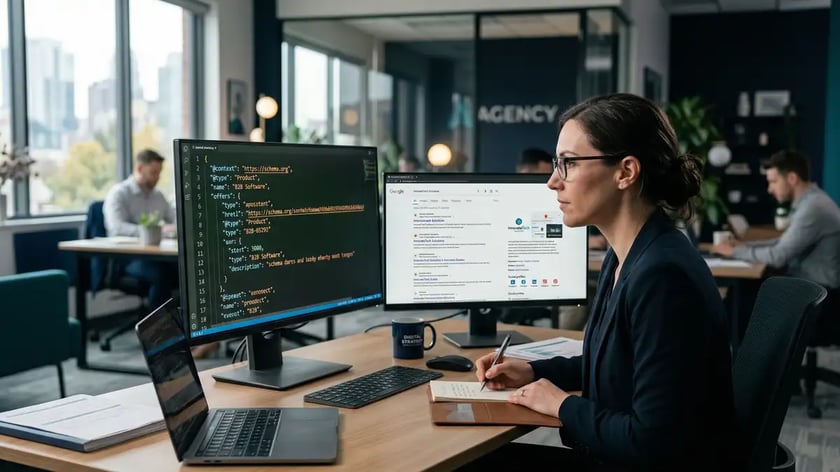
How is AEO performance measured?
Traditional SEO measurement relies on deterministic keyword positions. Answer engine optimization services must instead measure probabilistic citation behaviour across responses that vary each time the same query executes. This requires a different metrics stack — and any partner that reports only on traffic and rankings is measuring the wrong thing.

Five core metrics define the AEO scorecard. Citation Frequency tracks how often your brand appears in AI responses across a defined prompt set, replacing keyword rank as the primary visibility signal. AI Share of Voice measures your citation rate against named competitors on the same prompts. Citation Sentiment evaluates whether mentions are positive, neutral or negative. AI Referral Traffic captures click-throughs in GA4 from ChatGPT, Perplexity and other AI sources. Competitor Co-Mentions reveal which brands appear alongside yours in AI responses, exposing market segmentation. The toolset for this is mature: Profound monitors visibility across ten AI engines, Athena Citation Engine predicts citation likelihood from ML training on millions of AI responses, and Otterly.AI and Peec AI provide platform-level citation analytics.
Key Takeaway
Demand a monthly report covering all five metrics. If your AEO partner cannot produce a citation share trend line — "we held 18 percent share of voice on 50 priority prompts in March, up from 9 percent in January" — they are not running answer engine optimization. They are running SEO with a new label.
How do you select the right AEO services partner?
Use a six-step evaluation to compare prospective providers. First, demand baseline citation share data on your own brand from at least two prompt sets. A serious partner will run this diagnostic before pitching scope. Second, verify the six-layer service architecture — discovery, content, schema, crawler access, authority and tracking — is fully covered, not partially. Third, ask which citation tracking tool they actually license and ask to see redacted client reports. Fourth, validate they understand RAG, fan-out queries and freshness decay in plain language; if they fumble the technical foundation, they cannot architect against it.
Fifth, check pricing-to-scope ratio. A USD 4,000/month engagement that produces all six layers plus monthly reporting outperforms an USD 8,000/month rebranded SEO retainer every time. Sixth, insist on a 90-day pilot with measurable citation-share targets. The reasonable benchmark is a 30–60 percent citation lift on priority prompts within six months — this aligns with documented industry case studies and gives you a contractual exit if performance does not materialise. peppereffect uses this exact framework on every AI marketing engagement we run.
Frequently Asked Questions
What is the difference between SEO, AEO and GEO?
SEO optimises for blue-link rankings on traditional search engines. AEO (Answer Engine Optimization) focuses specifically on being cited inside AI answer engines like ChatGPT, Perplexity and Google AI Overviews. GEO (Generative Engine Optimization) is the broader discipline covering technical infrastructure, authority signals and content engineering for all generative AI platforms. Yext's definitional framework places AI search as the environment, AI SEO as the practice, and visibility as the outcome — with AEO and GEO sitting inside that hierarchy. In practice, most credible providers now bundle all three under a single integrated search visibility programme.
How long do answer engine optimization services take to show results?
Genuine AI citation lift typically begins appearing within 60–90 days of a comprehensive six-layer programme launch, with material share-of-voice gains by month four to six. The Search Initiative's documented B2B case study showed a 2,300 percent AI search traffic lift over a multi-month engagement, but the underlying mechanism is gradual: AI systems infer authority through repeated reinforcement, freshness signals and cross-platform validation. Anyone promising 30-day citation transformation is misrepresenting how RAG and freshness decay actually work. Plan AEO as a 12-month minimum commitment.
How do I know if my brand is currently being cited by AI engines?
Run twenty representative buyer prompts across ChatGPT, Perplexity, Google AI Overviews and Gemini and record the brand mentions and citation links. Tools like Profound, Athena Citation Engine, Otterly.AI and Peec AI automate this at scale, monitoring hundreds of prompts across multiple engines. The free baseline test: ask each AI engine "What are the best [your category] companies for [your ICP]?" and check whether your brand appears, in what position, and with what surrounding context. Most B2B brands without AEO investment appear in zero to two of those prompts — which is why marketing infrastructure work has become urgent.
Do answer engine optimization services replace traditional SEO?
No — they augment it. ChatGPT, Google AI Overviews and Gemini still factor traditional ranking signals, schema and domain authority into their citation choices, so a strong SEO foundation remains valuable. However, the correlation between SEO performance and AI citations is r²=0.05, meaning 95 percent of citation behaviour is unexplained by SEO metrics. The rational architecture is to maintain SEO as foundational infrastructure while running AEO as a distinct discipline with its own scope, tooling, KPIs and continuous reinforcement cycle.
What schema markup is most important for AEO?
Article, FAQPage, HowTo, Organization and Product schemas correlate most strongly with AI citation patterns, alongside sameAs schema linking to Wikidata for entity disambiguation. ZipTie.dev's testing found schema carries approximately 10 percent weight in ChatGPT citation evaluation — meaningful but secondary to domain authority. Implementation quality matters more than schema volume: a single well-implemented FAQPage with question-based content outperforms five poorly nested schemas. Combine schema with consistent entity naming across headers, title tags and body copy to maximise extraction confidence.
What is the minimum budget for credible AEO services?
The realistic minimum for a six-layer AEO programme that produces measurable citation share gains is USD 2,000–4,000 per month for a 12-month commitment. Below that range, partners cannot fund the citation tracking tool licences, content engineering hours and earned media outreach required. Diagnostic-only audit engagements start at USD 1,000–2,500 as one-off projects and are a sensible first step before committing to a retainer. Enterprise programmes covering multi-product, multi-region brands typically run USD 10,000–50,000 monthly.
Why should peppereffect handle our AEO services rather than our existing SEO agency?
Most SEO agencies have rebranded existing retainers as "AEO" without rebuilding their methodology, tooling or measurement stack. peppereffect engineers AEO as a distinct discipline inside our four-pillar growth architecture: deterministic six-layer execution, continuous citation share reporting, integrated lead generation systems, and an explicit "Freedom Machine" mandate to decouple your growth from headcount. Where traditional agencies sell hours, we install autonomous infrastructure.
Architect Your AI Citation Engine
peppereffect installs deterministic answer engine optimization services across all six layers — discovery, content, schema, crawler access, authority and tracking — engineered for measurable citation share gains across ChatGPT, Perplexity, Google AI Overviews, Gemini and Claude. Stop renting blue-link visibility. Own your AI citation share.
Book Your AEO Strategy CallResources
- McKinsey — The new front door to the internet: Winning in the age of AI search
- Superprompt — 90% of B2B Buyers Use ChatGPT in Purchasing Research (2025 Study)
- Search Engine Land — Google AI Overviews drive drop in organic and paid CTR
- SparkToro — 2024 Zero-Click Search Study
- Ahrefs — What triggers AI Overviews? Analysis of 146M SERPs
- ZipTie.dev — How AI Search Tracking Actually Works
- Bradlee Bartlett — What Content Formats Get Cited by AI
- Eagles Media Enterprises — How Much Do GEO/AEO Agencies Charge in 2025