

What Is Schema Markup for AI Citation and Why Does It Matter in 2026?
Schema markup for AI citation is structured data (JSON-LD) that tells generative engines — ChatGPT, Google AI Overviews, Gemini, Perplexity, Claude — exactly what entities, claims, authors, and relationships a page represents, so the engine can confidently cite it inside an AI-generated answer. It is not the same as traditional schema for rich snippets. The objective has shifted from earning a blue-link enhancement to being selected as a named source inside a zero-click answer that the buyer never leaves.
The economic rationale is now unambiguous. Seer Interactive's September 2025 study found organic click-through rate dropped 61% (from 1.76% to 0.61%) for queries that surface AI Overviews, while paid CTR collapsed 68%. BrightEdge's March 2026 data shows AI Overviews now appear on 48% of all tracked queries, up 58% year-over-year. The corridor between searching and buying is being colonised by AI summaries, and the brands cited inside those summaries are the brands that exist.
Schema markup is the most underused lever B2B companies have to influence that citation decision. KEO Marketing research based on Schema.org data found B2B sites with comprehensive structured data see 34% higher citation rates than equivalent sites without it. This guide deploys the full technical architecture — not generic "add FAQ schema" advice.
What you'll learn in this guide:
- How AI engines actually parse and use schema during citation selection
- Which schema types drive B2B citation (and which are obsolete theatre)
- How to architect a JSON-LD
@graphthat disambiguates your brand as an entity - The full citation pipeline — from crawl to ingestion to retrieval to cited answer
- Vertical-specific schema playbooks for SaaS, consulting, and executive search
- The implementation mistakes that trigger Google manual actions and destroy AI trust
Key Takeaway
Schema markup has evolved from a rich-result tactic into entity infrastructure for the generative web. The engines that now mediate 48% of search queries — and handle 900M weekly ChatGPT users plus surging Gemini referrals — depend on structured data to identify who is authoritative on what. For B2B companies competing in zero-click environments, answer engine optimization without a schema architecture is a broken strategy.

How Do AI Engines Use Schema to Select and Cite Sources?
AI engines do not cite randomly. Each one runs a multi-stage retrieval process where structured data shapes four specific decisions: whether the content is ingestible, whether entities are disambiguable, whether claims are attributable, and whether the source is trustworthy enough to name. Getting schema right influences all four — which is why citation rates correlate with markup quality even when ranking positions don't.
The retrieval mechanics differ across platforms. BrightEdge's one-year AIO analysis shows only 17% overlap between AI Overview citations and the organic top 10. Ahrefs confirms the divergence: just 38% of AI Overview citations now pull from top-10 pages, down from 76% a year earlier. Ranking alone no longer guarantees citation. Schema-defined entity clarity is increasingly the deciding factor.
The January 2026 shift to Gemini 3 as the default AIO model accelerated this decoupling. Gemini 3 uses deeper semantic understanding that rewards pages with clean entity-to-claim mapping in their markup — exactly what a well-structured @graph delivers.
| AI Engine | Primary Retrieval Mechanism | How Schema Influences Citation |
| Google AI Overviews (Gemini 3) | Fan-out query expansion + knowledge graph lookup | Organization + Person + Article schema define entity authority signals |
| ChatGPT (GPT-5 + live browsing) | Retrieval-augmented generation across indexed web | Clean JSON-LD enables claim extraction and attribution |
| Perplexity | Sub-document chunking (~26,000 snippets/query) | Speakable + FAQPage schema surface citable fragments faster |
| Claude (via web search) | Contextual retrieval with semantic chunking | Article + author schema support source credibility weighting |
| Gemini (direct app) | Native Google Knowledge Graph + live retrieval | sameAs links to Wikidata anchor your entity in Google's graph |
Sources: BrightEdge AIO Analysis, ALM Corp Perplexity Retrieval Study, Search Engine Journal on Gemini 3
The operational implication is deterministic: your schema must function as a machine-readable dossier of who you are, what you know, and what you have claimed. Not a checklist of rich-result types. Entity clarity is what wins citations in generative engine optimization — and it is what your competitors without a schema architect are failing to deliver.
Which Schema Types Drive AI Citation for B2B Sites?
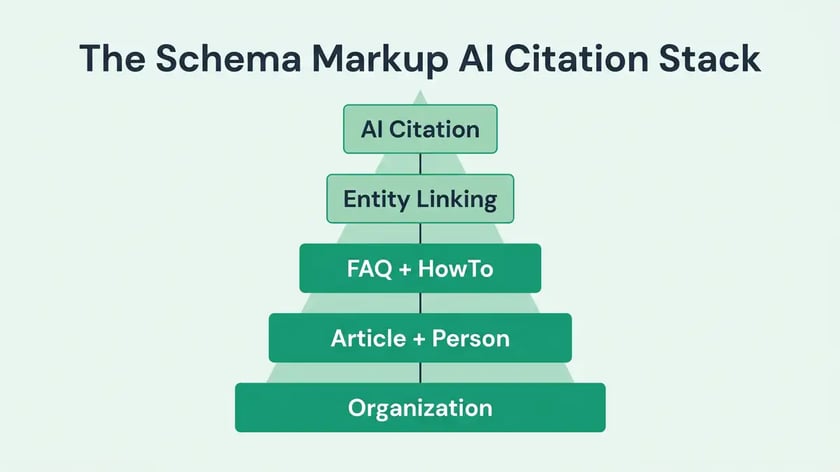
Most B2B implementations suffer from the same failure: they deploy two or three schema types Assess your AEO readiness before implementing. (usually FAQPage and Article), skip the foundational entity layer, and wonder why citation rates stagnate. The correct architecture deploys a five-tier schema stack, with each tier solving a distinct machine-comprehension problem.
The tiers compound. A page with Article schema but no Organization or Person schema is a claim without a source. A page with both but no sameAs links is an entity without disambiguation. A page with all three but no @graph is three disconnected assertions instead of one integrated knowledge object. Schema App's quarterly business review data shows customers deploying the full stack see measurable CTR lifts when rich results are awarded — confirming that completeness, not just presence, drives performance.
| Tier | Schema Types | What It Establishes | B2B Priority |
| 1. Entity Foundation | Organization, Person, WebSite | Who your brand is, who your authors are, what the site represents | Critical — always deploy |
| 2. Content Context | Article, BlogPosting, WebPage, BreadcrumbList | What each page is, who wrote it, where it sits in the hierarchy | Critical — always deploy |
| 3. Answer Surfaces | FAQPage, HowTo, Speakable | Machine-extractable Q&A, procedures, and voice-ready fragments | Deploy where content genuinely matches |
| 4. Commercial Layer | Service, Product, SoftwareApplication, Offer | What you sell, pricing, specifications, and applicability | Critical for service/SaaS pages |
| 5. Trust Signals | Review, AggregateRating, Event, VideoObject | Proof, social validation, multimedia context | Deploy when assets exist |
Sources: Schema App 2026 Analysis, LLMRefs LLM SEO Guide, Stackmatix Structured Data AI Search Guide
Key Takeaway
Deploying only answer surfaces (FAQ, HowTo) without the entity foundation is the most common B2B schema mistake. It produces short-term rich-result wins and long-term AI invisibility. Architect the stack in tier order: entities first, context second, answer surfaces third. HubSpot SEO implementations often skip tier 1 entirely — a fixable architectural gap.
How Do You Architect a JSON-LD @graph That AI Engines Parse Cleanly?

The @graph pattern is the single most under-deployed technique in B2B schema. It allows you to declare multiple related entities in one script block, explicitly linked by stable @id URIs. Instead of fragmented markup that AI engines must reconcile, you deliver a unified knowledge object. AISO Hub's 2026 implementation guide is explicit: define key entities, give them stable @id values, link them with about/mentions/sameAs, and implement JSON-LD across the entire site — not page by page in isolation.
The deployment sequence matters. Build the Organization entity once, at https://peppereffect.com/#organization, and reference it from every Article, Service, and WebPage object. Define each author Person entity once, at https://peppereffect.com/#person-peter-vogel, and reuse that @id in every BlogPosting they author. This is how Google's Search Central guidance signals real entity authority: consistency of identifier, not repetition of name string.
The five implementation steps below are the deterministic build order we deploy for B2B clients. Skip any step and the graph becomes ambiguous — which is functionally equivalent to not having schema at all.
Declare the Organization with sameAs disambiguation
Publish one Organization object at /#organization with name, url, logo (ImageObject), sameAs linking to LinkedIn, Wikidata, Crunchbase, X, YouTube, and any industry registry. Add knowsAbout listing your topical authority domains. This becomes the anchor every other entity references.
Declare Person entities for every author
Each author gets their own object at /#person-[slug] with name, url (author page), jobTitle, worksFor (pointing to the Organization @id), and sameAs to LinkedIn and any publication bylines. Add knowsAbout for their expertise areas — this strengthens E-E-A-T signals AI engines now weight heavily.
Wrap each page in a WebPage + primary entity
The WebPage object declares @id, url, isPartOf (pointing to the WebSite), and breadcrumb. For blog posts, add an Article or BlogPosting object with author (Person @id), publisher (Organization @id), mainEntityOfPage (WebPage @id), plus headline, image, datePublished, dateModified, and keywords.
Add answer-surface schema where content honestly matches
FAQPage only where you have a real Q&A section. HowTo only where the content is an ordered procedure. Speakable for content you want voice assistants to read. Mismatched answer-surface schema is the fastest path to a Google manual action and citation suppression across Perplexity and ChatGPT.
Assemble into one @graph per page and validate
Combine all entity objects into a single "@graph": [...] array inside one <script type="application/ld+json"> block. Run through Google's Rich Results Test and Schema.org Validator before deployment. Monitor Search Console's Enhancements report weekly for errors and warnings.
Every peppereffect client implementation deploys this exact five-tier schema architecture as part of our AI SEO Agency engagement — installed once, maintained autonomously.
Review Search Visibility SystemsWhat Is the Citation Pipeline — From Markup to AI Answer?

The path from a JSON-LD object on your page to a cited source inside an AI Overview is not one step. It is a four-stage pipeline — and every stage has specific schema requirements that determine whether your page survives or gets filtered out. Understanding the pipeline is what separates B2B brands that get consistently cited from those who publish schema and wonder why nothing changes.
Stage one is crawl and parse. Googlebot, GPTBot, PerplexityBot, and ClaudeBot fetch your page, extract the JSON-LD, and validate it against Schema.org definitions. Malformed markup fails silently. Google's Rich Results Test is your baseline validator, but production readiness requires zero errors and zero warnings — a warning is just an error that hasn't been penalised yet.
Stage two is entity resolution. The engine matches your Organization @id against its knowledge graph using sameAs links. Clean resolution (your markup's Organization maps cleanly to a single Wikidata entity) drives citation confidence. Ambiguous resolution (multiple competing entities with similar names) suppresses it. Stage three is claim extraction — the engine identifies specific factual assertions in your content and pairs them with the authoring Person entity and the publishing Organization. Stage four is retrieval and attribution: when a user query matches extracted claims, the engine surfaces your content as a source, using the entity metadata to generate the citation.

Which Schema Mistakes Actively Hurt AI Visibility?
Bad schema is worse than no schema. Google's March 2026 core update explicitly targeted structured-data abuse patterns, and sites caught in the pattern lost rich-result eligibility across multiple content types. The December 2025 core update affected 40-60% of sites — with mismatched schema among the documented signal causes. The governance implication: treat schema as production code with formal validation gates, not as an optional enhancement your content team adds ad hoc.
Avoid These Five Schema Mistakes
1. FAQPage schema on pages without a real FAQ section — guarantees manual action risk. 2. Review or AggregateRating markup for reviews you wrote yourself — explicit policy violation. 3. Using root domain URLs in sameAs when the specific entity URL exists — breaks entity resolution. 4. Declaring Organization on every page instead of referencing one @id — dilutes the entity signal. 5. Mixing Microdata, RDFa, and JSON-LD on the same page — produces parsing conflicts. Run SEO for B2B companies implementations through formal validation gates before every deployment.
How Should B2B Companies Implement Schema by Vertical?
The five-tier stack is the foundation — but vertical context determines which Tier 4 (commercial) and Tier 5 (trust) objects drive actual citation. Each of peppereffect's three target verticals has a distinct schema playbook. Deploying the wrong one is not merely suboptimal; it actively signals to AI engines that your site is not what it claims to be.
| Vertical | Priority Schema Types | Citation Strategy |
| B2B SaaS (mid-market) | SoftwareApplication, Product, Offer, Service, Article, FAQPage, HowTo, Review | Product schema on every feature page, SoftwareApplication on pricing, HowTo on docs — drives ChatGPT and Gemini product-comparison citations |
| High-Ticket Consulting / Coaching | Service, Organization, Person (authors + leaders), Course, Event, VideoObject, FAQPage | Person schema is disproportionately important — AI engines cite named expertise over brand-level claims in coaching content |
| Executive Search / Recruiting | Organization, ProfessionalService, Service, Person, Event, Article, JobPosting (where applicable) | ProfessionalService + sameAs to industry registries builds citation authority for "best executive search firm for X" queries |
Sources: Atak Interactive B2B Schema Guide, LLMRefs 2026 LLM SEO Guide, RankBrain SaaS SEO Playbook
For SaaS teams, the schema architecture must mirror the product taxonomy — every feature page, pricing tier, and integration gets its own SoftwareApplication or Offer object, linked via @id. For AI for SaaS implementations, this becomes the machine-readable surface that lets ChatGPT and Gemini compare your product against competitors when a buyer runs a comparison query. For consultants and coaches building a Freedom Machine, the Person + Service pairing is the citation unit — the AI needs to name you, not just your business.
Key Takeaway
Schema architecture is vertical-specific. SaaS citation requires a SoftwareApplication-anchored graph. Consulting citation requires a Person-anchored graph. Executive search automation citation requires a ProfessionalService-anchored graph with deep sameAs coverage. Deploy the wrong anchor and AI engines categorise your site against the wrong peer set — which is worse than being invisible.
Frequently Asked Questions
Does schema markup actually improve AI citation rates?
Yes, with nuance. Schema.org-based research cited by KEO Marketing shows B2B sites with comprehensive structured data see 34% higher citation rates. However, Search Engine Land's analysis notes a December 2024 Search/Atlas study found no correlation between raw schema coverage and citation rates. The reconciliation: quality of schema (full entity graph, clean sameAs, matched content) drives citation, while quantity of schema types alone does not. Architect the stack correctly and the lift is measurable.
Is JSON-LD still the best format for AI search in 2026?
Yes. JSON-LD remains Google's preferred format, and all major AI engines (ChatGPT, Gemini, Perplexity, Claude) parse it natively. Microdata and RDFa are legacy formats that introduce parsing complexity and offer no citation advantage. Use JSON-LD exclusively, consolidate entities inside a single @graph, and avoid mixing formats on the same page — parsing conflicts cause silent schema failures that validation tools don't always catch.
How is schema different for AEO versus traditional SEO?
Traditional SEO schema optimises for rich results — FAQ dropdowns, review stars, HowTo carousels — that enhance a blue-link listing. Answer engine optimization schema optimises for citation inside AI-generated answers, where the click may never happen. The shift requires prioritising entity schema (Organization, Person) over surface schema (FAQ, Review), building stable @id URIs, and linking extensively with sameAs to establish entity authority in machine knowledge graphs.
What is the role of sameAs in AI citation?
sameAs is the single highest-leverage property for AI citation. It tells engines that your Organization or Person entity is identical to the entities at the linked URLs — typically Wikidata, Wikipedia, LinkedIn, Crunchbase, official registries, and verified social profiles. Clean sameAs resolution lets the engine attach your entity to its existing knowledge graph node, which dramatically increases the probability of citation. Missing or ambiguous sameAs creates entity fragmentation — the AI equivalent of being nobody in particular.
Should I implement Speakable schema for voice AI?
Yes, if your content has sections that work as spoken answers. Speakable schema marks paragraphs or headlines suitable for voice-first AI assistants — Alexa, Google Assistant, Siri — to read aloud. As Wellows' 2026 AI Overviews research documents, voice and multimodal queries are rapidly growing share of overall search. Mark short, self-contained answer paragraphs (one to three sentences) with speakable cssSelector references. Do not mark entire articles; that defeats the purpose.
Does llms.txt help with AI citation the way schema does?
No — not yet. ALM Corp's January 2026 analysis of 844,473 sites with llms.txt files found no measurable correlation between having the file and AI visibility. Schema markup, in contrast, has documented citation effects. Deploy schema first, treat llms.txt as an optional future-hedge rather than a citation driver. Revisit llms.txt adoption data quarterly — the landscape may change, but as of Q2 2026 the ROI gap is substantial.
How do I monitor schema performance after deployment?
Three layers. First, Google Search Console's Enhancements report surfaces schema errors and warnings weekly — address every warning. Second, rich-result impressions and clicks in the Performance report show which schema types are driving visibility. Third, AI-citation tracking tools (including native platforms like Conductor and BrightEdge plus emerging specialists) monitor whether your entity is being named inside ChatGPT, Gemini, and Perplexity answers. For coaching business automation and consulting use cases, citation presence often matters more than click volume.
Install a Schema Architecture That Wins AI Citations
peppereffect architects full five-tier JSON-LD schema systems for B2B SaaS, consulting, and executive search companies — deployed once, validated against every major AI engine, and monitored autonomously. Decouple your growth from the collapsing click economy with the exact infrastructure that makes your brand citable by default.
Book a Growth Mapping CallOr start with the GEO guide → the schema check in our publishing standard
Resources
- Seer Interactive / Dataslayer — 61% organic CTR drop for AIO queries (Sept 2025 study)
- BrightEdge — AI Overviews at the One-Year Mark: Presence, Size, and Citation Patterns
- Ahrefs — 38% of AI Overview Citations Pull From The Top 10 (down from 76%)
- Search Engine Land — How Schema Markup Fits Into AI Search Without the Hype
- KEO Marketing — Query Fan-Out B2B SEO Strategy and Schema.org Citation Research
- Schema App — What 2025 Revealed About AI Search and the Future of Schema Markup
- Search Engine Journal — Google AI Overviews Now Powered by Gemini 3
- AISO Hub — Schema Markup Knowledge Graph 2026 Guide with Templates