

Your buyers are asking ChatGPT, Perplexity, and Google's AI Overviews which vendors to consider, and the AI is answering with a shortlist. If your brand is not on it, you are not in the deal. That is the problem a GEO agency exists to solve. Generative engine optimization, or GEO, is the discipline of making your brand the one AI systems cite, compare, and recommend. This guide explains what GEO services actually include, how they differ from SEO and AEO, the evidence that they work, what they cost, and how to choose a GEO agency without getting sold "SEO with AI keywords."
A GEO agency makes your brand citable inside AI answer engines like ChatGPT, Google AI Overviews, Perplexity, Gemini, and Claude. The work has four parts: technical readiness so AI crawlers can read you, answer-first content rich in statistics and citations, off-site authority like reviews and earned media, and Share-of-Model measurement. It matters because 68 percent of Google searches now end without a click and 95 percent of B2B buyers plan to use generative AI in a future purchase. The Princeton GEO study found citations and statistics lift AI visibility by 30 to 40 percent, yet 26 percent of brands have zero mentions in AI Overviews. GEO is how you stop being invisible.
This is a commercial decision, so it is treated commercially: what you get, what it costs, and what good looks like. Every figure is sourced.
What does a GEO agency actually do?
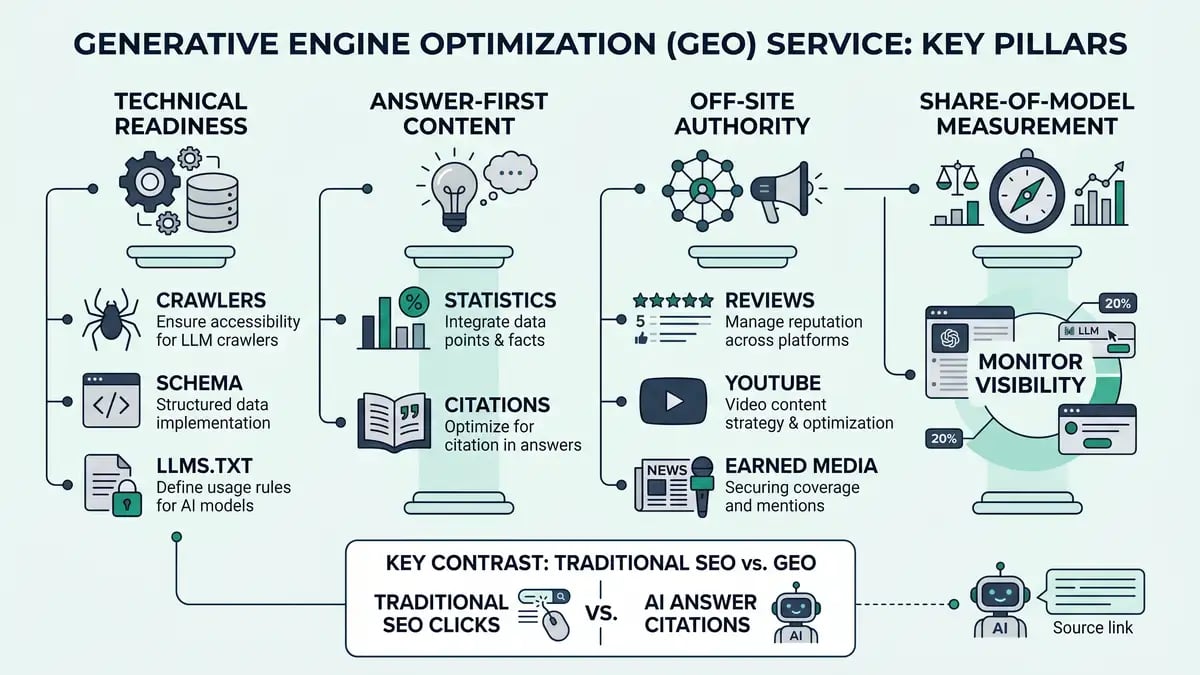
A real GEO engagement is built around four interlocking workstreams, not a single tactic. Get any one wrong and the AI engines route around you.

Technical readiness ensures AI crawlers like GPTBot, ClaudeBot, Google-Extended, and Perplexity's bots can access, render, and interpret your content. In practice that means configuring robots.txt and llms.txt, fixing server-side rendering on JavaScript-heavy pages, and applying schema (PageCrawl). Content architecture restructures pages into answer-first sections with clear entity definitions, statistics, and citations that models can chunk and quote. Off-site authority builds earned media, reviews on G2 and Capterra, and presence on Reddit, YouTube, and LinkedIn, because AI systems overwhelmingly favour third-party authoritative sources over brand-owned content (arXiv GEO study). And AI-specific measurement tracks your Share of Model and citation presence across engines.
Those last two are where most agencies fall short, so they deserve their own emphasis. The earned-media bias is the single most counterintuitive fact in GEO, and the measurement layer is what separates a real program from guesswork. We go deeper on the citation mechanics in our guide to how LLMs decide what to cite, and on tracking in our explainer on Share of Model. For the underlying discipline, our complete guide to generative engine optimization covers the concepts a services engagement is built on.
| Workstream | What it covers | Why it matters |
| Technical readiness | Crawler access, llms.txt, schema, rendering | If AI cannot read you, you cannot be cited |
| Content architecture | Answer-first, entities, statistics, citations | Makes content quotable and authoritative to models |
| Off-site authority | Reviews, earned media, Reddit, YouTube | AI favours third-party sources over your own pages |
| AI-specific measurement | Share of Model, citation tracking per engine | The only way to prove visibility is improving |
Sources: arXiv GEO study, PageCrawl, Share of Model.
The takeaway
GEO is not one deliverable. A credible agency runs all four workstreams together: it cannot just rewrite your pages, because AI engines weigh your off-site reputation more heavily than your own site, and it cannot improve what it does not measure. If a proposal skips off-site authority or Share-of-Model tracking, it is not a GEO program.
GEO vs SEO vs AEO: what you are actually buying
The three acronyms get used interchangeably, and that confusion is how buyers overpay for the wrong thing. Traditional SEO optimises for ranked lists and organic clicks: keywords, on-page work, and link authority to climb the results page (Ahrefs). AEO, answer engine optimization, is narrower: it targets a brand's presence in a single platform's answer box, such as Google's AI Overviews. GEO is the broadest of the three. It treats generative engines as a multi-platform ecosystem and focuses on citation selection and model perception, influencing which brands get chosen and recommended across ChatGPT, Perplexity, Gemini, Claude, and AI Overviews at once.

The practical difference is what gets measured and optimised. SEO chases rankings, AEO chases a snippet on one platform, and GEO chases your share of the answer across every engine your buyers use. That is why GEO is not, as the cynics put it, "SEO with AI keywords." It is a distinct set of tasks aimed at how large language models perceive and cite your brand. Our breakdown of AEO versus SEO unpacks the mechanics, and our piece on LLM SEO covers what changes when machines, not people, read your site.
None of this means classic SEO is dead. Google's AI Overviews frequently draw from high-ranking pages, so strong technical SEO still feeds AI visibility. GEO is additive: the rankings earn you a seat in the AI Overview, and GEO earns you the citation across the other engines. A good agency builds on your SEO foundation rather than discarding it.
Want to know if AI engines are citing you right now?
Request an AI visibility auditWhy GEO matters now: the search shift in numbers
The demand for GEO is not hype, it is a measurable change in how discovery works. Zero-click search has reached 68.01 percent of Google queries in early 2026, up from 60.45 percent in 2024, and AI Overviews now appear in more than 20 percent of searches while cutting click-through by nearly 60 percent when present (SparkToro). The "result" of a search is increasingly an answer, not a click, which means brands now compete to be cited inside the answer rather than just to rank for it.

For B2B specifically, the stakes are higher. Forrester found that 95 percent of B2B buyers plan to use generative AI in at least one area of a future purchase, and over half say generative AI led them to consider more or different vendors (Forrester). Because the engines present a short list rather than dozens of links, being absent from that list means exclusion from consideration even if your traditional SEO is excellent. BrightEdge found 68 percent of marketers are already changing strategy in response to AI search, with 45 percent going multi-platform (BrightEdge).
The quality signal is the part most teams miss. AI search visitors click 75 percent less but convert 23 times better than traditional organic visitors, because the AI pre-qualifies intent before sending anyone through (Ahrefs). Fewer, hotter prospects is exactly the trade a B2B firm wants. Yet 26 percent of brands have zero mentions in AI Overviews, which is the cost of doing nothing. This is the same pipeline leak we documented for the SaaS vertical in AI visibility for B2B SaaS.
Does GEO actually work? The evidence
GEO has more experimental backing than most marketing disciplines. The Princeton GEO study tested specific content changes and measured their effect on visibility inside generative answers. Adding citations from reliable sources, incorporating credible quotations, and including relevant statistics each improved a source's position-adjusted word count by 30 to 40 percent and its subjective impression score by 15 to 30 percent (Princeton GEO study). Even stylistic changes like improving fluency lifted visibility 15 to 30 percent. Overall, GEO techniques raised visibility by up to 40 percent across diverse queries, and a live test on Perplexity showed gains of up to 37 percent.
The lesson is that the highest-leverage GEO moves are also the cheapest: cite your sources, quote credible authorities, and anchor claims in statistics. That is a content-architecture change, not a six-figure rebuild. A good agency operationalises it at scale and measures the result, which is the discipline behind avoiding the reasons AI projects fail: scope it to a measurable outcome, not a vague "do AI."
The measurement red flag
If a GEO agency cannot tell you how it will measure your Share of Model before and after, walk away. Visibility inside AI answers is trackable across engines, and an agency that does not baseline your citation share is selling activity, not outcomes. Demand a measurement plan in the proposal, not a promise.
What a GEO agency costs and how to choose one
GEO retainers commonly start around 4,000 USD a month at the affordable end and scale with the number of engines tracked and the volume of off-site authority work required (Minuttia). GEO is usually a separate retainer from classic SEO even at the same firm, because the scope is genuinely different: llms.txt configuration, AI referrer monitoring, hallucinated-URL management, and Share-of-Model tracking are not SEO tasks (WebFX). Budget for the measurement and off-site work, not just content.
Use these five checks to separate a real GEO agency from a rebranded SEO shop.
They start with an AI visibility audit
A credible engagement begins by measuring how often and how prominently AI engines cite you today, and how they currently answer your category questions. No baseline means no way to prove progress.
They measure Share of Model across multiple engines
Tracking one platform is AEO, not GEO. Ask exactly which engines they monitor and how they quantify citation frequency and prominence over time.
They build off-site authority, not just your pages
Because AI systems favour third-party sources, an agency that only optimises your own site is ignoring the biggest lever. Look for earned media, reviews, and community strategy in the plan.
They treat GEO as distinct from SEO
If the pitch is "SEO with AI keywords," it is the wrong agency. GEO has its own tasks, its own metrics, and its own deliverables. Make them articulate the difference.
They tie the work to a business outcome
Citation share is the leading indicator; the lagging indicator is qualified pipeline from AI-referred buyers who convert at far higher rates. A good agency connects the two.
Done right, GEO is one of the highest-leverage marketing investments a B2B firm can make in 2026: it puts you inside the answer at the exact moment a buyer asks an AI which vendor to choose. If you want the full discipline behind it, our guide to getting cited by ChatGPT and Perplexity covers the tactics in depth.
Find out if AI is recommending you, or your competitor
peppereffect is a Master Growth Architect that installs generative engine optimization as a measured system: AI visibility audit, Share-of-Model tracking, off-site authority, and the content architecture that makes you the answer. Book a Growth Mapping Call and we will show you where your brand stands in the AI answers your buyers are already reading.
Book your Growth Mapping CallFrequently asked questions
What is a GEO agency?
A GEO agency provides generative engine optimization services that make your brand citable inside AI answer engines like ChatGPT, Google AI Overviews, Perplexity, Gemini, and Claude. The work spans technical readiness so AI crawlers can read you, answer-first content with statistics and citations, off-site authority like reviews and earned media, and Share-of-Model measurement.
How is GEO different from SEO and AEO?
SEO optimises for ranked lists and organic clicks. AEO optimises a brand's presence in a single platform's answer box, like Google AI Overviews. GEO is broader: it treats generative engines as a multi-platform ecosystem and focuses on citation selection and model perception across ChatGPT, Perplexity, Gemini, and others. It is not SEO with AI keywords.
Does GEO actually work?
Yes. The Princeton GEO study found adding citations, quotations, and statistics improved visibility in generative answers by 30 to 40 percent, with up to 40 percent overall and up to 37 percent in a live Perplexity test. These are minimal content changes with large effects, which is why citations and statistics are core GEO levers.
How much does a GEO agency cost?
GEO retainers commonly start around 4,000 USD a month at the affordable end and scale with scope, engines tracked, and off-site authority work. GEO is usually a separate retainer from classic SEO because it involves distinct tasks like llms.txt configuration, AI referrer monitoring, and Share-of-Model tracking.
How do I choose a GEO agency?
Choose one that runs an AI visibility audit, maps how AI engines answer your category today, measures Share of Model across multiple engines, and builds off-site authority rather than only optimising your pages. Red flags include treating GEO as SEO with AI keywords and no multi-engine measurement.
Does traditional SEO still matter for GEO?
Yes. AI Overviews often draw from high-ranking pages, so strong technical SEO and content foundations still feed AI visibility. GEO is additive: classic SEO earns the rankings AI Overviews pull from, while GEO adds the citations, statistics, and off-site presence generative engines weigh across platforms. Our guide to AI search engine optimization shows how they work together.
Agencies and consultancies get named in AI answers far less often than the software vendors they work alongside. The five-layer playbook for service firms sets out the pass thresholds that close that gap.
Resources
- arXiv: Generative Engine Optimization, How to Dominate AI Search (2025)
- Princeton: GEO, Generative Engine Optimization study
- SparkToro: zero-click search in 2026
- Forrester: AI-powered search in B2B marketing
- Ahrefs: AI SEO statistics 2025
- BrightEdge: 68% of marketers embracing the AI search shift
- Similarweb: the impact of generative AI on publishers
- Minuttia: best GEO agencies and pricing 2026
- WebFX: how much GEO costs in 2026
- PageCrawl: llms.txt and AI crawler monitoring