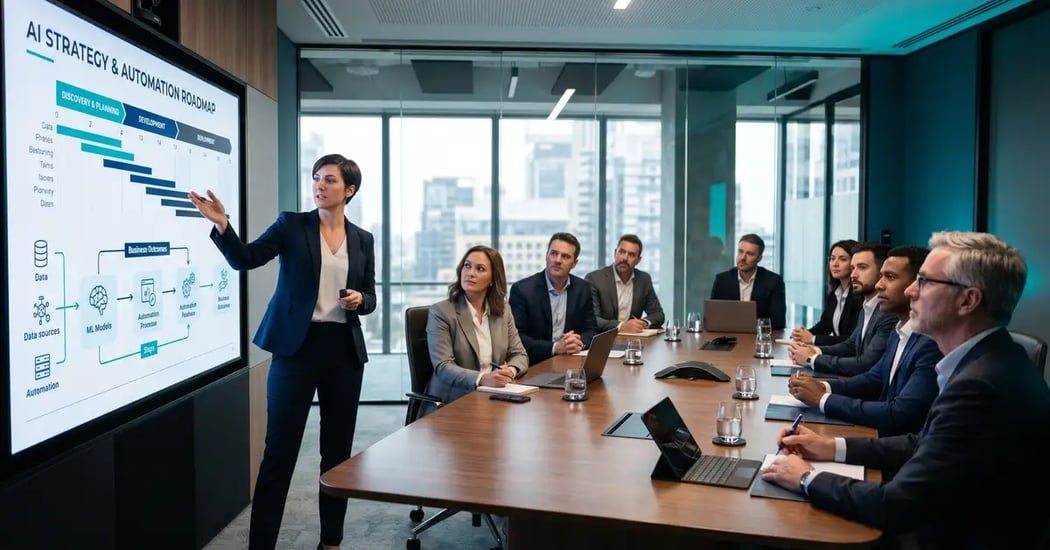

The AI consultant has moved from a niche technical specialist to a central strategic lever for B2B organisations trying to scale artificial intelligence in 2026. Enterprises are confronting three forces at once: a rapid rise in AI adoption, a persistent skills gap, and brutally high failure rates for internal AI initiatives. The result is a structural surge in demand for external advisers who can turn scattered experiments into production systems that actually pay back.
This guide gives founders and executives a commercially grounded view of what AI consultants do, why demand is climbing, what they cost, when to hire one versus building in-house or using an automation agency, and how to choose without getting burned. Every figure here is sourced from recent research houses, market analysts, and job-market data.
What an AI consultant actually does in 2026
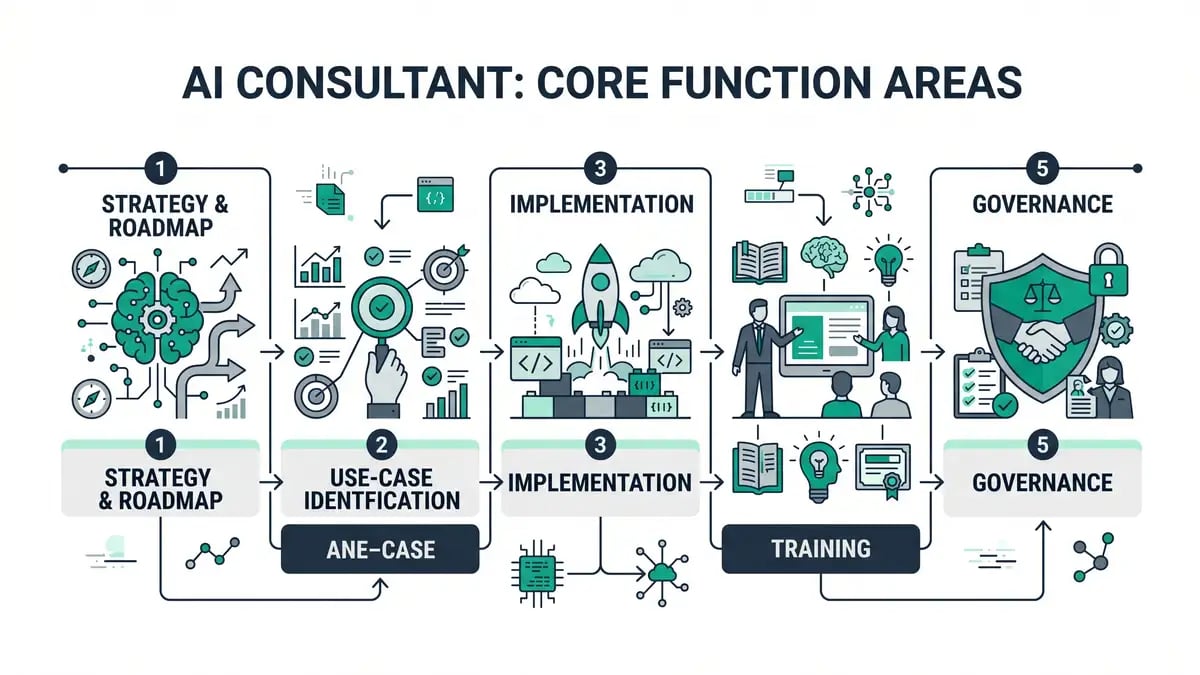
An AI consultant is an external professional who advises organisations on how to design, implement, and scale AI solutions. The defining shift in 2026 is that the role now combines strategy, technology, and change management rather than being confined to model-building. CIO's overview of AI consulting describes consultants as sparring partners and interfaces between departments, responsible for identifying, evaluating, and profitably implementing AI scenarios across a spectrum that runs from process automation and chatbots to complex deep-learning analytics.

The major professional services firms frame it the same way. PwC's AI services practice packages AI-readiness assessments, real-world simulations, organisational change management, and training, positioning consulting at the intersection of technology deployment and enterprise transformation. Deloitte's State of AI in the Enterprise research treats successful adoption as a scaling challenge requiring new operating models, workforce strategies, and governance. So picture a hybrid of strategy consultant, solutions architect, and transformation adviser, not a narrow machine-learning engineer.
Across industries, the core service is AI strategy and roadmap design tied directly to business outcomes. The work usually starts with requirement analysis and feasibility studies, then produces a prioritised portfolio of use cases ranked by expected impact, feasibility, and alignment with data and infrastructure constraints. Increasingly, that strategy includes decisions about agentic workflows and automation, not just predictive models. A strong consultant articulates a clear line of sight from AI strategy to measurable outcomes and presents a concrete roadmap, not a list of tools.
Key takeaway
In 2026 the AI consultant is a translator between business and technology. The deliverable is not a model, it is a prioritised roadmap with measurable outcomes, a data and governance plan, and a path to internal capability. If a prospective adviser leads with tools rather than outcomes, that is a warning sign.
Three types of provider, and which one you need
Buyers conflate three distinct provider types. Knowing the difference saves both budget and months of misalignment.
Individual or boutique consultants sell their time and expertise directly, focusing on strategy, architecture, and high-level design, often with hands-on build work in smaller engagements. They frequently act as fractional AI leaders or interim heads of AI for startups, providing ongoing advisory while coaching internal teams. Their differentiators are depth, flexibility, and close collaboration with the founder's team. Their constraint is capacity.
AI consulting agencies, including large firms like Deloitte and PwC, operate with multidisciplinary teams and standardised methodologies spanning strategy, data engineering, model development, change management, and governance. They handle complex transformations backed by global delivery capacity, but engagements are more expensive and more formal, with defined phases and extensive documentation.
Automation build partners focus on building and integrating specific AI-powered automations such as support chatbots, workflow bots, or monitoring systems. They are ideal when you have a clear use case and want a system built quickly. The trade-off is that they may not provide holistic strategy, roadmap, or governance. This is the territory of a focused AI automation agency that ships working systems rather than slide decks.

See consultants as the architects and guides of the AI journey, agencies as full-service transformation partners, and automation partners as specialist builders. The right choice depends on the complexity of your needs, your internal capabilities, and your budget. Many companies discover they need a sequence of all three.
Why demand for AI consultants is surging
Four converging forces explain the spike in demand, and each one maps to a specific reason organisations reach outside.
Adoption is outrunning maturity. Deloitte's enterprise research finds worker access to AI rose 50 percent in 2025, with the number of companies running at least 40 percent of AI projects in production projected to double within six months. IDC's "Time for the AI Pivot" white paper reports generative AI adoption jumping from roughly 55 percent of organisations in 2023 to 75 percent in 2024. Yet McKinsey's 2025 workplace report notes that almost all companies invest in AI but only about 1 percent believe they have reached maturity, with the biggest barrier being organisational and capability constraints, not technology.
The skills gap is real and slow to close. Deloitte reports insufficient worker skills as the single biggest barrier to integrating AI into workflows, above technological maturity or budget. In response, 53 percent of organisations are educating the broader workforce, 48 percent are designing upskilling strategies, and 36 percent are hiring specialised talent. All of those take time, leaving immediate gaps that external consultants fill.

Failure rates are punishing. Resource Data, citing MIT and Gartner, reports that roughly 95 percent of enterprise AI initiatives fail, and contrasts the practices of the successful 5 percent: robust data foundations, tight alignment between use cases and outcomes, and disciplined deployment. Dynatrace cites a failure rate around 85 percent, attributing it to poor data quality, lack of relevant data, and organisational challenges. The numbers vary by methodology, but they consistently show that failure stems from data, process, and governance, not algorithms.
Agentic AI is a new design problem. Deloitte's 2026 technology trends report on agentic AI predicts that by 2028, 15 percent of day-to-day work decisions will be made autonomously through agentic systems, up from essentially none in 2024. That raises questions few organisations have answered internally: how to structure workflows around agents, where to place human oversight, and how to allocate decision rights. Understanding the shift from rules to autonomy is exactly why teams study intelligent automation before they build.
What AI consulting costs
Pricing is opaque because few firms publish rate cards. The most reliable starting point is salary data, which anchors everything downstream.
Glassdoor reports average total pay of approximately 178,957 USD per year for machine-learning consultants in the US. Indeed's listings show senior AI and ML architect roles reaching up to 248,000 USD plus bonuses, with junior roles around 25 to 35 USD per hour and expert consultants at 60 to 80 USD per hour in employment contexts. Tredence's analysis of AI consultant roles describes the same profile: advanced degrees and deep cross-domain experience, implying comparable compensation for in-house hires.
| Engagement type | Typical pricing | Best for |
| Independent senior consultant (hourly) | $150 to $300/hr ($1,200 to $2,400/day) | Strategy, architecture, fractional AI leadership |
| Boutique firm (blended day rate) | $1,200 to $1,500/day | Readiness assessments, roadmap, pilot builds |
| AI readiness and strategy assessment | Low five figures and up | Early-stage direction setting |
| Single use-case design and build | Mid to high five figures per use case | Support bots, forecasting models |
| Enterprise operating model and governance | Six to seven figures | Large, multi-year transformations |
| Retainer (ongoing advisory) | A few thousand to tens of thousands/month | Scale-ups needing fractional AI expertise |
Sources: Glassdoor, Indeed, Deloitte, Alice Labs. Consulting rates derived from salary economics; figures are indicative.
The mechanics are straightforward. An in-house consultant earning 180,000 USD equates to roughly 900 USD per working day across 200 working days. Once overheads, non-billable time, and margin are added, consulting day rates often land at two to three times that, which is why senior independent rates cluster around 1,800 to 2,700 USD per day. Large firms add brand and team premiums on top.
Budget the full cost, not just the fee
A strategy and roadmap engagement may cost 50,000 to 150,000 USD in fees, but implementation often requires significantly more in data engineering, model deployment, and training. Account for internal staff time and follow-on build work. A good consultant designs projects that deliver quick wins while laying foundations for scale, which is part of the value, but the consulting fee is rarely the whole bill.
When to hire a consultant, build in-house, or use an automation agency
The decision turns on scope, speed, strategic importance, and internal readiness. Use this sequence to place yourself.
Assess your stage and readiness
Early stage with scattered pilots and thin internal expertise points to a consultant who can define vision, identify high-impact use cases, and create a roadmap without forcing multiple senior hires up front.
Judge whether AI is core or peripheral
If AI will be central to your business model with continuous innovation, build in-house for control and long-term cost efficiency. Deloitte reports about 36 percent of organisations are already hiring specialised talent to drive AI initiatives.
Check whether the use case is well scoped
A specific, well-defined need such as a support chatbot or an automated workflow favours an automation agency built for rapid delivery. A consultant can still help evaluate vendors and define requirements first.
Sequence the engagement
The strongest pattern is hybrid: a consultant runs the readiness assessment and roadmap, automation partners or internal teams build specific solutions, and the consultant shifts to oversight as internal capability grows.
| Option | Cost profile | Speed | Control | Best for |
| AI consultant / boutique | High per-hour, no fixed senior salary | Fast onboarding, reuses prior methods | Moderate; risk of dependency without upskilling | Strategy, roadmap, early implementation |
| Build in-house | Fixed salaries; cheaper over time if continuous | Slow ramp; competitive recruiting | Highest; deep domain and institutional memory | AI core to the business model |
| Automation agency | License plus project fees | Fastest for defined use cases | Limited; possible vendor lock-in | Specific, well-scoped builds |
Synthesis of Deloitte, PwC, and Dynatrace.
Each path carries distinct trade-offs. Consultants can be onboarded quickly and bring patterns from prior engagements, but per-unit time costs exceed employee salaries and over-reliance creates dependency unless capability-building is baked in. Building in-house offers control and institutional memory but suffers long ramp-up and competitive recruiting. Automation agencies offer speed through ready-made solutions, but control may be limited and governance must be managed carefully. The practical answer for most B2B founders is to start with a consultant to set direction, then build or buy execution, often combining business process automation services with internal ownership over time.

Not sure whether you need strategy, a build, or both?
Book a Growth Mapping CallThe ROI of good AI consulting
Return shows up in three places: productivity, time-to-value, and risk reduction. Deloitte's enterprise research is the clearest recent evidence. Improving productivity and efficiency tops the list of realised benefits, reported by 66 percent of organisations. Beyond that, 53 percent report improved insights and decision-making, 40 percent report cost reductions, 38 percent report enhanced customer relationships, and 20 percent report improved products and increased innovation.
The risk-reduction case is just as strong. Because the large majority of AI projects fail on data readiness, misaligned use cases, and weak organisational support, consultants who run upfront feasibility studies, align initiatives to business processes, design robust data pipelines, and set measurable success criteria materially improve the odds. McKinsey's State of AI research found that the companies capturing outsized value concentrate on a small number of high-impact use cases, align AI with business strategy, and invest in capability, which is precisely the discipline a good consultant enforces. If you want to pressure-test the numbers before committing, work through the AI ROI math for B2B.
The advantage no longer lies in adopting AI per se but in doing so faster and more effectively than competitors. Consultants compress learning curves and prioritise the use cases with the highest immediate impact.
The least visible but most durable outcome is internal capability. McKinsey stresses that the biggest barriers to scaling AI are cultural and organisational, not technical: siloed data, weak cross-functional collaboration, and limited leadership understanding. Consultants who facilitate cross-departmental workshops, build AI literacy among non-technical staff, and embed AI into core planning can catalyse the cultural shift that sustains value. In a landscape where tools evolve monthly, that capability may outlast any specific model.
How to choose an AI consultant, and the red flags to avoid
Alice Labs' framework on choosing an AI consultant emphasises track record, domain expertise, project approach, and cultural fit. Demand case studies with measurable outcomes and a clear methodology covering requirement analysis, roadmap design, implementation, and change management. CIO's description of the role stresses both hard skills (programming, data analysis, statistics) and soft skills (structured thinking, communication, project and change management, ethical awareness), so probe how a consultant works with non-technical stakeholders, not just their model expertise.
Ask prospective consultants to walk you through four areas: how they prioritise use cases and link them to outcomes; how they handle data readiness, quality, and governance; what their plan is for change management and AI literacy; and how they address bias, privacy, compliance, and agentic control. Vague answers in any of these are a signal to keep looking.
Watch for three red flags. A tool-first, outcome-second approach, where the consultant promotes a specific platform without engaging your objectives and data realities. Vagueness about deliverables and measurement, given that high failure rates make explicit success criteria non-negotiable. And neglect of change management and skills, which Deloitte's research identifies as the primary barrier to adoption. Consultants who treat AI as a purely technical deployment tend to deliver systems nobody uses. The same discipline applies whether you are commissioning a strategy or evaluating AI automation tools to build it.
Market outlook: will AI replace consultants?
The AI consulting market sits inside a much larger AI services ecosystem. Zion Market Research identifies Europe, with strong UK contribution, as the second-largest regional market for AI consulting, while North America remains the largest given the density of technology firms and early adopters. Demand concentrates in financial services, healthcare, manufacturing, retail, and telecommunications, where data-rich operations and regulatory complexity make AI both attractive and hard.
As for the existential question, the evidence points to reshaping rather than replacement. BCG estimates 50 to 55 percent of US jobs will be reshaped by AI within two to three years, meaning tasks change but most roles persist. McKinsey's work on agents and skill partnerships suggests agents and robots could perform 60 to 70 percent of today's global work hours in technical automation scenarios, but with new collaborations emerging rather than wholesale replacement. AI already drafts reports, summarises interviews, models scenarios, and processes datasets, raising consultant productivity. What it cannot do is define vision, negotiate risk-versus-innovation trade-offs, design governance, or manage organisational politics. Even Gartner's projection that generative AI will collapse the entry-level cybersecurity skills gap by 2028 comes alongside rising demand for senior judgement on AI risk and governance.
The likely future is AI-augmented consulting and agent orchestration: a smaller share of time on analysis and drafting, a larger share on strategy, governance, and the human work of change. For a deeper view of the autonomous systems consultants increasingly design, see how teams build AI agent workflow automation and deploy no-code AI agents across the customer lifecycle.
Stop renting strategy. Install the operating system.
peppereffect architects AI operating systems that decouple your revenue from headcount: logic-gated workflows and autonomous agents across lead generation, sales administration, operations, and marketing. Not a slide deck. A working machine.
Book Your Growth Mapping CallFrequently asked questions
What does an AI consultant do? An AI consultant is an external adviser who helps an organisation design, implement, and scale AI. The role combines strategy, technology, and change management: defining a vision and roadmap, translating business problems into prioritised use cases, assessing data readiness, selecting and integrating models and agentic systems, and managing the organisational change needed to capture value while controlling risk. In practice it is closer to a hybrid of strategy consultant, solutions architect, and transformation adviser than a narrow machine-learning engineer.
How much does an AI consultant cost? Pricing varies by seniority and firm type. Glassdoor reports average total pay around 178,957 USD per year for machine-learning consultants in the US, and Indeed lists senior AI roles up to 248,000 USD. Independent senior consultants commonly charge 150 to 300 USD per hour, equivalent to day rates near 1,200 to 2,400 USD. Strategy assessments often start in the low five figures, use-case builds run mid to high five figures, and enterprise programmes from large firms can reach six or seven figures.
When should I hire an AI consultant instead of building in-house? Hire a consultant when you are early stage with scattered pilots, lack internal expertise, and need fast structure without committing to multiple senior hires. Build in-house when AI is core to your business model and you expect continuous innovation. Use an automation agency when you have a specific, well-scoped use case and need rapid build over strategy. Many organisations combine all three in a phased approach.
Why is demand for AI consultants growing so fast? Four forces converge: accelerating adoption (IDC found generative AI rose from roughly 55 percent of organisations in 2023 to 75 percent in 2024), a persistent skills gap (Deloitte cites insufficient worker skills as the biggest barrier), high failure rates (MIT data via Resource Data estimates around 95 percent of initiatives fail), and the rise of agentic AI creating new governance questions, with Deloitte predicting 15 percent of day-to-day decisions made autonomously by 2028.
What is the ROI of hiring an AI consultant? Return comes from productivity gains, faster time-to-value, and reduced project risk. Deloitte finds 66 percent of organisations report productivity and efficiency gains, 53 percent improved decision-making, and 40 percent cost reductions. Given high failure rates, good consultants reduce risk through feasibility studies, outcome alignment, data pipeline design, and measurable success criteria, while building internal capability to reduce dependency over time.
Will AI replace consultants? AI will reshape consulting more than eliminate it. BCG estimates 50 to 55 percent of US jobs will be reshaped within two to three years, meaning tasks change but most roles persist. AI raises productivity by handling drafting, summarisation, and analysis, but strategic work such as defining vision, designing governance, and managing organisational politics remains difficult to automate, shifting demand toward higher-judgement advisory and agent orchestration.
Resources
- Deloitte, State of AI in the Enterprise
- McKinsey, Superagency in the Workplace
- McKinsey, The State of AI in 2023
- McKinsey Global Institute, Agents, Robots and Us
- IDC, Time for the AI Pivot
- BCG, AI Will Reshape More Jobs Than It Replaces
- Deloitte, Agentic AI Strategy (Tech Trends 2026)
- Resource Data, AI Success Starts With Data
- Dynatrace, Why AI Projects Fail
- CIO, What Does an AI Consultant Actually Do
- PwC, AI Services
- Alice Labs, How to Choose an AI Consultant
- Tredence, AI Consultant Jobs
- Glassdoor, Machine Learning Consultant Salary
- Indeed, AI Consultant Jobs
- Zion Market Research, AI Consulting Market
- Gartner via Security World Market, Gen AI and the Cyber Skills Gap