

Search "AI automation tools" and you get a wall of listicles ranking 50 products with no logic and no opinion. That is not a buying guide, it is noise. This is the version a B2B operator actually needs: the categories that matter, the leading tools in each, how their pricing behaves at your volume, and the one shift, agentic AI, that changes which tools are worth betting on in 2026. By the end you will know which kind of tool you need and how to choose without getting sold.
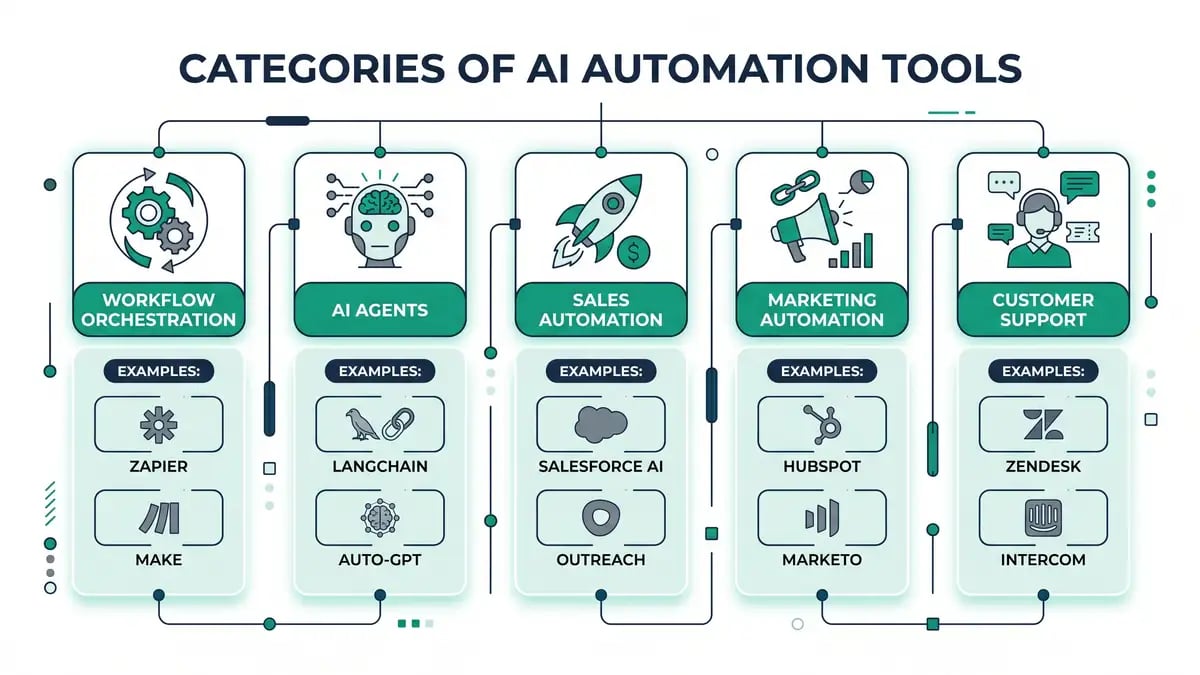
AI automation tools fall into six categories: workflow orchestration (n8n, Make, Zapier), AI agent builders (n8n, Make, OpenAI, Copilot Studio), sales automation (Clay, Apollo, HubSpot), marketing automation (HubSpot, Jasper), customer support (Zendesk AI, Intercom Fin), and enterprise RPA (UiPath, Automation Anywhere). The decisive factor is rarely features, it is the pricing model: per-task billing explodes on multi-step work, while per-execution and usage-based models stay flat. The bigger shift is agentic AI: Gartner expects 33 percent of enterprise apps to feature it by 2028, up from under 1 percent in 2024. Choose tools that can grow into agents, not just rules.
This is a category-by-category buyer's guide, not a ranking. Every figure is sourced.
What counts as an AI automation tool in 2026
An AI automation tool is software that uses artificial intelligence to run a business process with little or no human input. The line that matters is the one between deterministic automation and AI automation. Traditional automation and RPA follow fixed rules: if this, then that. AI automation adds judgement, handles unstructured data like emails and documents, and increasingly operates as agents that plan and execute multi-step work. Gartner expects 33 percent of enterprise applications to feature agentic AI by 2028, up from less than 1 percent in 2024 (Gartner via PagerDuty). That is the inflection point shaping every tool decision this year. For the underlying distinction, see our guide to agentic workflows.
The market reflects the momentum. The workflow automation market alone is forecast to grow from 26.01 billion USD in 2026 to 40.77 billion USD by 2031, a compound annual growth rate of 9.41 percent (Mordor Intelligence), while the generative AI in automation segment is growing at 17.1 percent a year (The Business Research Company). The six categories below are where that spend goes.
Workflow orchestration tools: the backbone
Orchestration platforms connect your apps and run multi-step automations, and they are the foundation most B2B automation is built on. The three leaders differ most in how they bill. Zapier is the no-code default with the largest connector library, priced per task from a free 100-task tier up to around 69 USD a month (Zapier). Make uses a usage-based, per-operation model (Make). n8n bills per full workflow execution regardless of step count and can be self-hosted, which keeps cost flat as workflows get complex (n8n).

That billing difference is the single most important thing to understand before you commit, because it decides your cost ceiling. A 10-step workflow on a per-task model consumes 10 chargeable units per run; on a per-execution model it is one. We break the math down in our n8n vs Zapier comparison and our n8n pricing guide. If you are weighing the platforms directly, start with what n8n is and the real n8n use cases teams run in production.
The takeaway
Pick your orchestration layer on pricing model, not connector count. If your workflows are simple and low-volume, Zapier's per-task model and huge library win on speed. If they are multi-step or high-volume, n8n's per-execution model and self-hosting win on cost as you scale. This one choice compounds across every automation you build on top of it.
AI agent builders: the fastest-growing category
Agent builders are where the agentic shift becomes real. Instead of firing a workflow once per trigger, these tools let you configure autonomous or semi-autonomous agents that plan, decide, and act across multiple steps. n8n and Make both ship native AI agent capabilities on top of their orchestration engines, OpenAI offers agent tooling on a usage-based per-token model (OpenAI), and Microsoft Copilot Studio targets the Microsoft stack. The appetite is near universal: S&P Global found 58 percent of firms are identifying opportunities to implement agents and another 40 percent are open to exploring them (S&P Global).
The caveat is governance. Deloitte notes that while agentic AI is expected to have high impact across support, supply chain, and R&D, oversight is lagging adoption (Deloitte). The practical answer is human-in-the-loop approval on anything that touches a customer or moves money. Our guides to n8n AI agents and no-code AI agents show how to build them with guardrails.
Not sure which tools your stack actually needs?
Get an AI automation tool auditSales, marketing, and support automation tools

Beyond the horizontal platforms, function-specific tools embed AI into a workflow your team already runs. In sales, Clay and Apollo lead on enrichment and prospecting while HubSpot folds AI across the CRM, and these typically price per seat or per organisation, scaling with contact database size and sequence volume. In marketing, HubSpot and Jasper handle campaigns and content, often on per-seat or per-output pricing. In customer support, Zendesk AI runs roughly 19 to 55 USD per agent per month (Zendesk) and Intercom Fin charges per resolution, a model that ties cost directly to deflected tickets.
These tools deliver value fast because the use case is pre-built, but they create a hidden trap: a sprawl of disconnected point tools that each automate one silo. The real leverage comes from connecting them, which is exactly the job of the orchestration layer above and of CRM automation done properly. A point tool automates a task; an orchestrated system automates a process end to end.
Enterprise RPA and how pricing models compare

At the enterprise end, RPA platforms like UiPath and Automation Anywhere automate high-volume, structured processes and are increasingly bolting on AI for unstructured inputs, typically priced per seat plus usage (UiPath). They are powerful but heavy, and often overkill for mid-market teams that a modern orchestration platform can serve at a fraction of the cost. The deeper point is that across every category, the pricing model, not the logo, determines your cost at scale.
Five models dominate, and matching them to your usage pattern is the core budgeting decision.
| Pricing model | Example tools | Best when |
| Per task | Zapier | Simple, low-volume, few-step automations |
| Per execution | n8n | Multi-step or high-volume workflows |
| Usage / per operation | Make | Variable volume, moderate complexity |
| Per seat | Zendesk AI, HubSpot | Fixed team using a tool daily |
| Per token / per resolution | OpenAI, Intercom Fin | AI calls or outcomes you can meter to value |
Sources: Zapier, n8n, Make, Zendesk, OpenAI.
How to choose your AI automation tools

Tool choice is necessary but not sufficient. S&P Global found the share of companies abandoning most of their AI initiatives before production has surged from 17 percent to 42 percent, and the failures trace to data and governance, not the platform (Informatica). Use these four steps to choose well and avoid joining that statistic.
Start from the process, not the tool
Name the specific, high-frequency process you want to automate first, then pick the category that owns it. Buying a tool before you know the workflow is how shelfware happens.
Model the pricing at your real volume
Estimate runs per month and steps per run, then compare per-task, per-execution, and usage-based costs. The cheapest tool at 100 runs is often the most expensive at 10,000.
Check the agent and data-control ceiling
Can the tool grow from rules into agents, and can it keep data on infrastructure you control if you need that? Buying a tool that caps out at simple rules means re-platforming in a year.
Fix data and ownership before you scale
Clean inputs, clear owner, and human-in-the-loop approval on sensitive actions. This is what separates the 58 percent who deploy agents successfully from the 42 percent who abandon them.
The shelfware trap
The most common failure is buying tools before defining processes, then watching them go unused. With 42 percent of companies now abandoning most AI initiatives before production, the constraint is never tool availability. Pick one narrow, high-frequency workflow, model its cost on the right pricing tier, ship it, prove the ROI, then expand. A working automation beats a full toolbox every time.
The tools are commodities; the system is the moat. Choosing the right stack, wiring it to your real data, and sequencing automations so they compound is where the return actually comes from. That is the work a build partner does, and where an AI automation agency earns its fee, measured in genuine automation ROI rather than another subscription. The same systems discipline underpins our AI workflow automation framework.
Stop collecting tools. Start building the system.
peppereffect is a Master Growth Architect that selects, integrates, and operates AI automation tools as one system, matched to your processes, your volume, and your data rules. We pick the tools that win on your numbers, wire them together, and add the guardrails that keep them running. Book a Growth Mapping Call and we will map the highest-leverage automations and the exact stack to run them.
Book your Growth Mapping CallFrequently asked questions
What are AI automation tools?
AI automation tools are software that uses artificial intelligence to run business processes with little or no human input. They span workflow orchestration (n8n, Make, Zapier), AI agent builders, sales and marketing automation, customer support automation, and RPA. The difference from traditional automation is that AI tools handle judgement and unstructured data, and increasingly act as agents that plan and execute multi-step tasks rather than following fixed rules.
What are the best AI automation tools for B2B in 2026?
It depends on the job. For workflow orchestration, n8n, Make, and Zapier. For AI agents, n8n, Make, OpenAI's agent tools, and Microsoft Copilot Studio. For sales, Clay, Apollo, and HubSpot. For marketing, HubSpot and Jasper. For support, Zendesk AI and Intercom Fin. For enterprise RPA, UiPath and Automation Anywhere. Choose by category and by how the pricing model behaves at your volume.
How much do AI automation tools cost?
Pricing follows a few models: per-task (Zapier, from a free 100-task tier to about 69 USD a month), per-execution (n8n), usage-based or per-operation (Make), per-seat (Zendesk AI, roughly 19 to 55 USD per agent per month), and usage-based per token (OpenAI and other LLM APIs). The model matters more than the sticker price, because per-task costs balloon on multi-step workflows while per-execution and usage-based models stay flatter at scale.
What is the difference between AI automation and traditional automation?
Traditional automation and RPA follow fixed, deterministic rules. AI automation adds judgement, handles unstructured data, and increasingly uses agentic AI, autonomous systems that plan multi-step workflows, make decisions, and act with minimal supervision. Gartner expects 33 percent of enterprise applications to feature agentic AI by 2028, up from less than 1 percent in 2024.
Do you need to code to use AI automation tools?
No. Most workflow and agent platforms, including n8n, Make, and Zapier, offer visual no-code builders and ready-made templates, so non-technical teams can build automations. Technical teams can optionally use code nodes, APIs, and custom integrations for advanced logic. The right choice depends on whether you need speed and simplicity or deep customization and control.
Why do AI automation projects fail?
Usually not because of the tool. S&P Global found the share of companies abandoning most of their AI initiatives before production rose from 17 percent to 42 percent, and failure traces to poor data quality, weak governance, and unclear scope rather than the platform. Tool choice is necessary but not sufficient: pair it with clean data, clear ownership, and a narrow, measurable first use case.
Resources
- Mordor Intelligence: Workflow Automation Market
- The Business Research Company: Generative AI in Automation Market
- Gartner: Top Strategic Technology Trends 2025, Agentic AI
- S&P Global: AI adoption with mixed outcomes
- Deloitte: State of AI in the Enterprise
- Informatica: Why most AI projects fail
- Zapier: Pricing
- n8n: Pricing
- Make: Pricing
- Zendesk: Pricing
- UiPath: Pricing
- OpenAI: API Pricing