

What Is an AI SEO Agency?
An AI SEO agency is a search marketing firm that deploys artificial intelligence, machine learning, and agentic workflows to optimize your visibility across both traditional search engines and generative search platforms like Google AI Overviews, ChatGPT, Perplexity, and Claude. Unlike traditional SEO agencies that rely on manual keyword research, content calendars, and periodic audits, an AI SEO agency architects autonomous systems that continuously analyze, optimize, and adapt your search presence at machine speed.
The distinction matters because search itself has fundamentally changed. AI Overviews now appear on 48% of tracked Google queries as of February 2026 — up from 31% just twelve months earlier, according to Search Engine Land's analysis of Seer Interactive data. The global SEO services market has reached $83.98 billion in 2026, per Mordor Intelligence, but the fastest-growing segment is generative engine optimization — projected to reach $7.3 billion by 2031 from $886 million in 2024, a 34% CAGR according to SEOmator's AI SEO statistics report.
For B2B companies, the shift is even more urgent. 94% of B2B buyers now use large language models during their purchase journey, per 6sense and Forrester's 2025 research. If your content isn't engineered for AI citation, you're invisible to the majority of your buyers before they ever reach a search engine results page.
What you'll learn in this article:
- Why generative search is dismantling the traditional SEO playbook — and what replaces it
- The specific services an AI SEO agency delivers that a traditional agency cannot
- How GEO (Generative Engine Optimization) differs from conventional SEO techniques
- ROI benchmarks and cost structures for AI-driven SEO engagements
- How B2B buyers use AI search — and why your content strategy must adapt
- A five-step framework for evaluating whether an AI SEO agency is right for your business
Key Takeaway
An AI SEO agency doesn't just optimize for Google rankings — it architects your visibility across every platform where buyers research solutions, from AI Overviews to ChatGPT to Perplexity. With 94% of B2B buyers using LLMs in their purchase journey, the question isn't whether to invest in AI-driven search optimization — it's how fast you can deploy it.

Why Is Generative Search Disrupting Traditional SEO?
The core disruption is simple: AI Overviews answer the query before users reach your website. Seer Interactive's September 2025 study — analyzing 3,119 informational queries across 42 organizations spanning 25.1 million organic impressions — found that organic CTR plummeted 61% when AI Overviews appeared, dropping from 1.76% to 0.61%, as reported by Seer Interactive. Paid CTR crashed even harder — down 68%.
The impact compounds with zero-click behavior. According to Click-Vision's analysis of Semrush data, 58.5% of US searches and 59.7% of EU searches already conclude without a click. When AI Overviews trigger, Deep Marketing reports that zero-click rate surges to 83%. Meanwhile, Similarweb data shows zero-click searches grew from 56% to 69% since AI Overviews launched.
But here's the critical nuance that separates AI SEO agencies from traditional ones: being cited in AI Overviews reverses the damage. Brands that appear as sources within AI Overviews earn 35% more organic clicks and 91% more paid clicks than those that don't, per the same Search Engine Land analysis. Traditional SEO agencies optimize for position one. An AI SEO agency optimizes for citation — a fundamentally different engineering challenge that requires different AI workflow automation capabilities.
| Metric | Without AI Overviews | With AI Overviews | Change |
| Organic CTR | 1.76% | 0.61% | -61% |
| Paid CTR | 19.7% | 6.34% | -68% |
| Zero-click rate | ~60% | 83% | +38% |
| CTR for cited brands | Baseline | +35% organic | +91% paid |
Sources: Seer Interactive — AIO Impact on Google CTR, Search Engine Land
What Does an AI SEO Agency Actually Do?

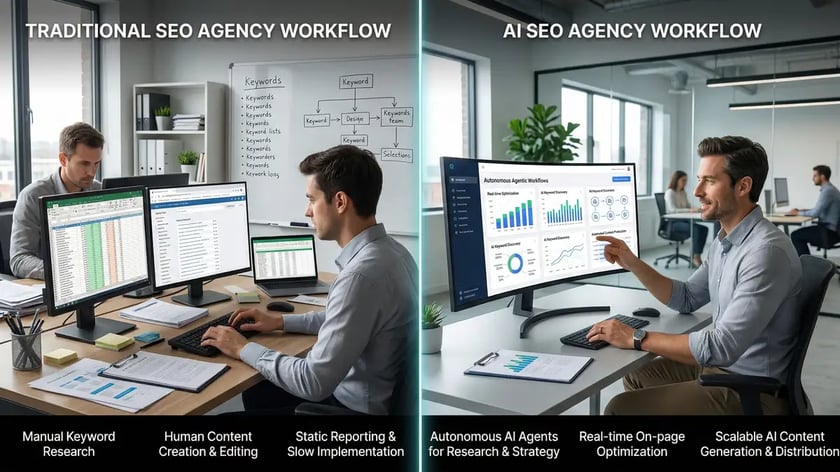
An AI SEO agency replaces manual, labor-intensive SEO processes with autonomous systems that execute at scale. Where a traditional agency assigns a strategist to manually research 50 keywords per month, an AI SEO agency deploys agentic workflows that analyze thousands of keyword opportunities, predict ranking shifts, and generate optimized content in days rather than weeks. According to SEOmator's comparison study, AI tools reduce keyword research time by 80% and enhance content optimization efficiency by 30%.
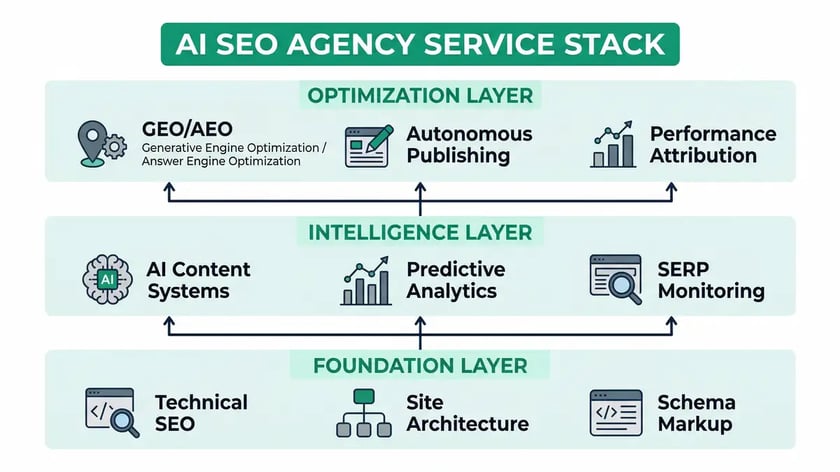
The service stack of an AI SEO agency typically spans three integrated layers. The foundation layer covers technical SEO, site architecture, and schema markup — automated through crawl intelligence and anomaly detection. The intelligence layer deploys AI content systems, predictive analytics, and real-time SERP monitoring using AI agency infrastructure. The optimization layer — the differentiator — handles GEO/AEO optimization, autonomous publishing, and performance attribution across generative search platforms.
This isn't about bolting ChatGPT onto an existing agency workflow. 86% of SEO professionals have integrated AI into their strategy, per DemandSage's 2026 analysis, but most use AI for individual tasks — research (72.9%), writing (43.2%), editing (36.8%). An AI SEO agency builds the complete automation infrastructure that connects these capabilities into a single operating system.
| Capability | Traditional SEO Agency | AI SEO Agency |
| Keyword research | Manual, 50-100 keywords/month | AI-powered, 1,000+ with intent clustering |
| Content production | 2-4 week cycles, writer-dependent | 3-7 day cycles, AI-assisted with human review |
| Technical audits | Quarterly manual crawls | Continuous automated monitoring |
| Generative search (GEO/AEO) | Not offered or bolted on | Core capability, citation-first architecture |
| Competitive intelligence | Monthly reports | Real-time dashboards with predictive alerts |
| Performance attribution | Rankings and traffic | AI citations, brand mentions, multi-platform visibility |
Sources: SEOmator — AI-Powered SEO vs Traditional Methods, DemandSage — AI SEO Statistics 2026
How Does GEO Differ from Traditional SEO?
Generative Engine Optimization (GEO) is the practice of structuring content so AI systems cite it when answering user queries. The term originates from the Princeton and Georgia Tech research paper published at KDD 2024, which tested optimization strategies across 10,000 queries. The key finding: including citations, statistics, and quotations from authoritative sources can boost visibility in generative engines by over 40% across diverse query types.
Where traditional SEO focuses on backlink profiles, keyword density, and page speed, GEO prioritizes structured data, factual density, and citation-worthiness. An AI SEO agency implements SEO copywriting frameworks specifically engineered for AI extraction — content that answers the query with verifiable data, attributes claims to named sources, and uses the schema markup that generative engines parse most effectively.
The competitive advantage is structural. According to Search Engine Land's 2026 GEO guide, AI engines strongly favor earned media — authoritative third-party sources — over brand-owned content. This means the SEO playbook inverts: instead of optimizing your own pages to rank first, you optimize your content to be cited by AI systems that billions of users now consult. An AI SEO agency architects this entire citation ecosystem using B2B content strategy frameworks designed for the generative era.
Key Takeaway
GEO doesn't replace traditional SEO — it adds a new optimization layer that most agencies aren't equipped to deliver. The Princeton research shows that factual specificity and citation density drive 40%+ visibility improvements in generative engines. If your agency isn't measuring AI citations alongside rankings, you're optimizing for yesterday's search architecture.
| GEO Technique | Impact on AI Visibility | Traditional SEO Equivalent |
| Statistics and data points | +40% visibility boost | Keyword optimization |
| Named source citations | High AI extraction priority | Backlink building |
| Structured data / schema markup | Machine-readable content signals | On-page meta tags |
| Topical authority clustering | Entity-level recognition | Internal linking |
| Freshness and update frequency | Recency signal for AI models | Content refresh cadence |
Sources: Aggarwal et al. — GEO: Generative Engine Optimization (KDD 2024)
What Results Can You Expect from AI-Driven SEO?
AI-driven SEO strategies achieve a 14.6% conversion rate — compared to 1.7% from traditional SEO methods, per SEOmator's 2026 data comparison. That 8.6x improvement reflects the compounding effect of better targeting, faster optimization cycles, and content engineered for high-intent queries surfaced by AI platforms like Perplexity, which RankScience reports converts 7x better than Google search traffic because its users are purpose-built researchers.
Cost structures have evolved accordingly. Stridec's 2026 pricing analysis shows AI SEO services in the US typically range from $2,000 to $15,000 per month — 20-40% higher than traditional SEO retainers — because the work demands deeper semantic structuring, advanced schema implementation, and content engineered for AI citation. However, the ROI justifies the premium: companies investing in AI-driven SEO report revenue increases of 3-15% with sales ROI uplift between 10-20%. 82% of enterprise SEO specialists plan to increase their AI investments, per DemandSage.
| Metric | Traditional SEO | AI SEO |
| Monthly retainer | $2,500-$10,000 | $2,000-$15,000 |
| Conversion rate | 1.7% | 14.6% |
| Content production speed | 2-4 weeks per article | 3-7 days per article |
| Keyword research time | 40-60 hours/month | 8-12 hours/month (-80%) |
| Revenue impact | Varies widely | 3-15% increase documented |
Sources: Stridec — AI SEO Pricing in 2026, SEOmator
Avoid This Mistake
The most expensive error B2B companies make is treating AI SEO as a bolt-on to their existing agency relationship. Adding a ChatGPT subscription to a traditional SEO workflow doesn't make it an AI SEO strategy. True AI-driven search optimization requires rearchitecting your content production, schema infrastructure, and measurement framework from the ground up — which is why choosing the right AI marketing agency is a structural decision, not a vendor swap.
Ready to deploy an AI-driven marketing infrastructure that dominates both traditional and generative search?
Book Your Growth Mapping CallHow Are B2B Buyers Using AI Search?
The B2B buying journey now begins in AI platforms, not Google. According to Procurement Magazine's analysis, 73% of B2B buyers use AI tools like ChatGPT and Perplexity in their research process. RankScience reports that nearly 9 out of 10 B2B software buyers use AI platforms for vendor research, per G2 Reach data. Gartner projects that search engine use will fall 25% by 2026 as AI chatbots become the preferred research method, with 90% of B2B buying intermediated by AI agents by 2028.
This shift demands a fundamental rethinking of B2B content strategy. When buyers ask Claude "What are the best AI SEO agencies for B2B SaaS?" or prompt Perplexity with "Compare AI-driven SEO services for mid-market companies," your content must be structured to surface as a cited authority — not just rank on page one of Google. The companies deploying AI for SaaS growth understand this: traditional search visibility is necessary but no longer sufficient.
The evaluation framework below reflects how sophisticated B2B buyers now select an AI SEO agency:
Audit Your AI Visibility Baseline
Before engaging any AI SEO agency, query your brand and core topics across ChatGPT, Perplexity, Google AI Overviews, and Claude. Document where you appear as a cited source — and where competitors do. This baseline reveals your AI citation gap.
Evaluate GEO Capability, Not Just SEO Track Record
Ask prospective agencies to show GEO-specific results: AI Overview citations gained, Perplexity source appearances, ChatGPT recommendation frequency. Traditional ranking screenshots are insufficient evidence of generative search competence.
Assess the Technology Stack
An AI SEO agency should operate with agentic workflows, autonomous content production systems, real-time competitive intelligence, and schema markup automation. Ask about their AI orchestration layer — tools alone don't create systemic leverage.
Demand Multi-Platform Attribution
Insist on measurement across all search surfaces: Google organic, AI Overviews, ChatGPT citations, Perplexity references, and Claude mentions. Single-channel reporting misses 50%+ of your buyer discovery touchpoints.
Verify the Content Architecture Approach
The right AI SEO agency builds topical authority clusters, not isolated blog posts. Look for structured content ecosystems with internal linking maps, entity-level optimization, and schema implementations that maximize both Google rankings and AI extraction probability.
Key Takeaway
B2B search has bifurcated: buyers use AI platforms for discovery and Google for validation. An effective AI SEO agency optimizes for both channels simultaneously. With 73% of B2B buyers already using AI tools for research and Gartner projecting 25% decline in traditional search engine use by 2026, the window to establish AI search visibility is closing fast.
Frequently Asked Questions
What is SEO for AI called?
SEO for AI is called Generative Engine Optimization (GEO) or Answer Engine Optimization (AEO). GEO focuses on structuring content to be cited by AI-generated responses from platforms like Google AI Overviews, ChatGPT, Perplexity, and Claude. The term was formalized by Princeton and Georgia Tech researchers in their KDD 2024 paper, which demonstrated that citation-optimized content achieves 40%+ visibility improvements in generative search results. An AI SEO agency implements both GEO and traditional SEO as integrated disciplines.
How do you rank in AI search?
Ranking in AI search requires a fundamentally different approach than traditional SEO. AI systems prioritize content that includes verifiable statistics, named source citations, structured data markup, and comprehensive topical coverage. The Princeton GEO study found that factual specificity and data density are the strongest signals. Practical steps include implementing FAQ schema, creating original research content, building topical authority clusters, and ensuring your content directly answers the queries B2B buyers ask AI assistants.
Is an AI SEO agency more expensive than a traditional agency?
AI SEO services typically cost 20-40% more than traditional SEO retainers, ranging from $2,000 to $15,000 per month depending on scope and competition level, per Stridec's pricing analysis. The premium reflects deeper technical requirements — semantic structuring, schema automation, and multi-platform optimization. However, AI-driven SEO achieves a 14.6% conversion rate versus 1.7% for traditional methods, making the cost-per-acquisition substantially lower despite higher retainers.
What percentage of searches now trigger AI Overviews?
As of February 2026, 48% of tracked Google queries display AI Overviews, up from 31% in February 2025. AI Overviews now reach 1.5 billion users monthly across 200+ countries. The expansion has been uneven across industries — ALM Corp reports a 58% surge across nine major verticals. For B2B informational queries, the prevalence is even higher, which is why AI automation agencies are experiencing accelerating demand.
How do B2B buyers use AI for purchase research?
94% of B2B buyers now use large language models during their purchase journey, according to 6sense and Forrester 2025 research. They query ChatGPT for vendor comparisons, use Perplexity for technical evaluations, and consult Google AI Overviews for market overviews. Perplexity users convert 7x better than Google searchers because the platform is purpose-built for research workflows. This makes AI citation optimization — not just search ranking — the primary driver of B2B pipeline generation in the generative era.
What is the difference between GEO and traditional SEO?
Traditional SEO optimizes for position in search engine results pages — backlinks, keyword placement, page speed, and domain authority drive rankings. GEO optimizes for citation in AI-generated responses — factual density, structured data, source attribution, and entity authority drive inclusion. Both matter, but they require different strategies. A comprehensive AI SEO agency integrates both disciplines into a single marketing infrastructure that captures visibility across traditional and generative search simultaneously.
Deploy the AI SEO Infrastructure Your B2B Business Needs
peppereffect architects AI-powered search visibility systems that dominate both Google rankings and generative engine citations — decoupling your pipeline from manual SEO execution and building autonomous discovery infrastructure that scales without headcount.
Book Your Growth Mapping CallResources
- Seer Interactive — AIO Impact on Google CTR: September 2025 Update
- Aggarwal et al. — GEO: Generative Engine Optimization (Princeton/Georgia Tech, KDD 2024)
- Search Engine Land — Google AI Overviews Drive 61% Drop in Organic CTR
- LeadScale — AI Search and AI Agents in B2B Buying
- SEOmator — AI-Powered SEO vs Traditional Methods: 2026 Data Comparison
- DemandSage — 61 AI SEO Statistics 2026: Growth and Adoption Rates
- RankScience — B2B Buyers Research on Perplexity, Not Google
what is generative engine optimization
understanding generative engine optimization
the new search visibility landscape
growth architecture partner selection criteria
generative engine optimization strategy SEO pricing benchmarks zero-click search diagnose a sudden traffic drop