

Why SEO Copywriting Is the Highest-ROI Skill in B2B Marketing
Every piece of content your company publishes either compounds or decays. SEO copywriting — the discipline of writing content optimized for both search engines and human readers — determines which category your content falls into. Companies that deploy systematic SEO content writing report 700%+ ROI over three years, while those publishing without optimization watch their content disappear into Google's indexing void.
The math is straightforward: organic search drives 53% of all website traffic website design strategy, and SEO-generated leads cost an average of $31 per lead compared to $181 for PPC and $811 for trade shows. Yet most B2B companies still treat content creation as an afterthought — writing blog posts without keyword research, structure, or optimization strategy.
700%+
3-Year Content ROI
First Page Sage, 2025
53%
Traffic From Organic
All website traffic
$31
Cost Per SEO Lead
vs $181 PPC, $811 trade shows
70%
Long-Tail Traffic
Of all search queries
This guide delivers the complete SEO copywriting framework:
- The keyword research and search intent analysis that precedes every word
- Content structure patterns that earn featured snippets and AI citations
- On-page optimization techniques that compound over time
- How to optimize for both traditional search and AI answer engines
- Measurable KPIs and ROI benchmarks for content performance
The SEO Copywriting Framework: 8 Steps From Research to Revenue

Effective SEO content writing is not about stuffing keywords into paragraphs. It is a systematic process that begins with data and ends with measurable business outcomes. The framework below represents the exact workflow we deploy for every piece of content in our marketing infrastructure.
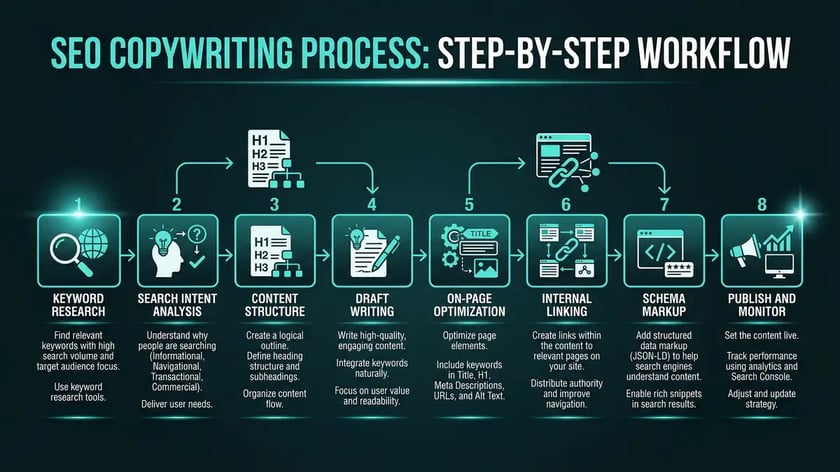
Step 1: Keyword Research — The Foundation of Every SEO Article

Key Takeaway
SEO copywriting is not creative writing with keywords sprinkled in — it is a systematic 8-step process from keyword research through measurement. Companies that deploy this framework report 700%+ ROI over three years because each optimized article compounds traffic and leads indefinitely at zero incremental cost.
Keyword research is not optional. It is the diagnostic step that determines whether your content has any chance of ranking. Long-tail keywords account for 70% of all search traffic, which means the most valuable opportunities are specific, intent-rich phrases — not broad head terms with impossible competition.
Building Your Keyword Portfolio
Every article targets a keyword hierarchy:
- Primary keyword. The main term your page will rank for. Appears in the title, H1, first 100 words, URL slug, and meta description. Example: "seo copywriting"
- Secondary keywords. Related terms that support the primary keyword and expand ranking surface. Used in H2 headings and throughout the body. Example: "seo content writing," "writing for seo"
- Supporting language. Semantic variations, question-based queries, and long-tail phrases woven naturally into the content. Example: "how to write seo content," "seo writing best practices"
| Keyword Type | Placement | Density Target |
| Primary keyword | Title, H1, first 100 words, meta description, URL | 1-2% of total word count |
| Secondary keywords | H2 headings, body paragraphs, image alt text | 0.5-1% each |
| Supporting language | Natural integration throughout, FAQ section | As naturally appropriate |
| Question keywords | H3 headings in FAQ section, subheadings | 1 per FAQ answer |
Tools for Keyword Research
Professional SEO copywriting requires professional tools. Free tools provide directional data; paid platforms deliver competitive intelligence:
- Google Keyword Planner: Free with Google Ads account — provides search volume ranges and competition levels for initial keyword discovery
- Ahrefs: Industry-leading keyword difficulty scores, SERP analysis, and content gap identification. Essential for competitive research
- Semrush: Comprehensive keyword database with intent classification, topic clustering, and position tracking
- Google Search Console: Your actual ranking data — the ground truth for which queries already drive impressions and clicks to your site
- People Also Ask / AnswerThePublic: Question-based keyword discovery that maps directly to FAQ sections and AI answer optimization

Avoid This Mistake
Writing content before completing keyword research and search intent analysis. 90% of content that fails to rank does so because it targets the wrong keyword, mismatches search intent, or competes against pages with fundamentally different formats. The research phase is not optional — it determines whether your content has any chance of ranking.
Step 2: Search Intent Analysis — Write What Google Wants to Rank
Keyword volume means nothing without intent alignment. Google classifies every query into one of four intent categories, and your content must match the dominant intent to rank:
| Intent Type | User Goal | Content Format | Example Query |
| Informational | Learn something | Guide, tutorial, explainer | "how to write seo content" |
| Commercial | Compare options before buying | Comparison, review, best-of | "best seo writing tools" |
| Transactional | Complete a purchase or action | Product page, pricing, signup | "hire seo copywriter" |
| Navigational | Find a specific page or brand | Brand page, login, docs | "semrush keyword tool" |
Before writing a single word, search your target keyword and analyze the top 10 results. Note the content format (listicle, guide, comparison), the average word count, the heading structure, and which SERP features appear (featured snippets, People Also Ask, video carousels). Your content must match or exceed the format Google is already rewarding.
Step 3: Content Structure — The Architecture That Earns Rankings
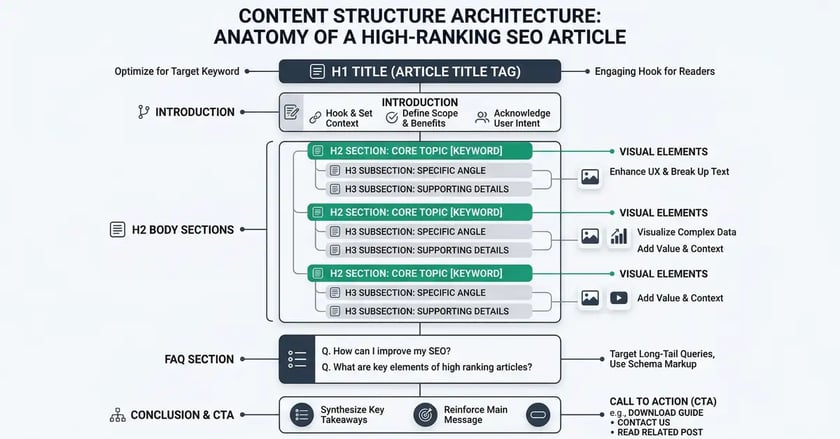
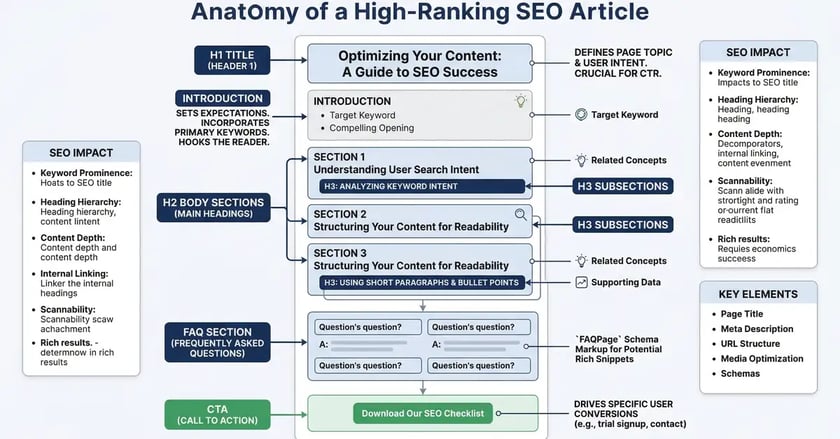
Structure is not formatting. It is information architecture — the logical hierarchy that tells both readers and search engines what your content covers and how it is organized. As Google's SEO documentation confirms, well-structured content with clear heading hierarchies performs measurably better in search results.
The Anatomy of a High-Ranking SEO Article
- Title tag (H1). Contains primary keyword, under 60 characters, compelling enough to earn clicks in SERP results. One H1 per page — no exceptions
- Introduction (first 100 words). States the problem, establishes authority, includes primary keyword naturally, and previews what the reader will learn. BLUF: bottom line up front
- Body sections (H2 headings). Each H2 targets a secondary keyword or major subtopic. Divide into digestible sections of 200-400 words. No more than 3 consecutive paragraphs without a visual break (table, list, image, blockquote)
- Subsections (H3 headings). Break complex H2 sections into scannable subtopics. Use question-based H3s where appropriate — these map directly to "People Also Ask" snippets
- Visual elements. Tables for data comparisons, ordered lists for processes, unordered lists for features, blockquotes for expert citations, images for concept illustration
- FAQ section. 4-6 questions with H3 headings. Each answer is 40-80 words — concise enough for featured snippet extraction, detailed enough to satisfy the query
- Conclusion with CTA. Summarize key takeaways and provide a clear next action
Pages exceeding 2,000 words with thorough topic coverage consistently outrank thinner content — but length must serve comprehensiveness, not padding. Write as much as the topic demands, no more. — First Page Sage
Key Takeaway
Structure is not formatting — it is information architecture. Well-structured content with clear heading hierarchies, scannable sections, and visual breaks performs measurably better in both traditional search and AI answer engines. Every article needs an H1, H2s targeting secondary keywords, and H3s for subtopics.
Step 4: Writing SEO Content That Humans Actually Read

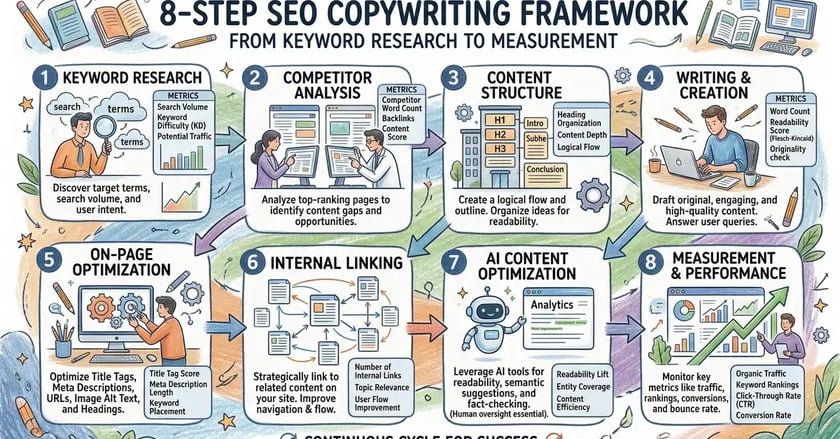
The best-optimized article in the world fails if nobody reads past the first paragraph. SEO copywriting balances two competing demands: search engine requirements and human engagement. Here is how to serve both:
Readability Principles
- Short paragraphs: 2-3 sentences maximum. Wall-of-text formatting kills engagement regardless of content quality
- Active voice: "Deploy a topic cluster strategy" — not "A topic cluster strategy should be deployed." Strong verbs drive authority
- Concrete data: Replace vague claims with specific numbers. "Increased traffic significantly" becomes "increased organic traffic by 47% in 90 days"
- Scannable structure: Readers skim before they read. Bold key phrases, use descriptive subheadings, and front-load important information in each section
- Audience-appropriate tone: Professional for B2B decision-makers, conversational for consumer audiences. Match your brand voice consistently
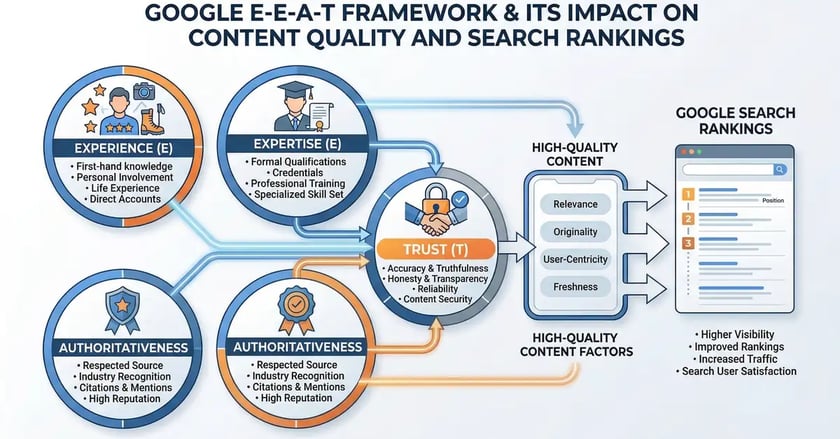
E-E-A-T Signals: Proving Your Expertise
Google's E-E-A-T framework (Experience, Expertise, Authoritativeness, Trust) directly influences how content is evaluated. Embed these signals throughout your writing:
- Author credentials: Include author bios with relevant expertise. A blog post about SEO written by someone with demonstrable SEO experience ranks higher
- Cited sources: Link to authoritative external references — research papers, industry reports, official documentation. This builds trust with both readers and search engines
- Original data: Include proprietary statistics, case studies, or unique analysis that cannot be found elsewhere
- Real-world examples: Demonstrate experience through specific implementation stories, client results, or documented outcomes
Step 5: On-Page SEO Optimization Checklist
After writing your draft, apply this on-page optimization checklist. Each element represents a ranking signal that compounds with the others:
| Element | Optimization Rule | Impact |
| Title tag | Primary keyword + compelling hook, under 60 chars | High — direct ranking factor |
| Meta description | Primary keyword + value proposition + CTA, 145-155 chars | Medium — affects CTR, indirect ranking |
| URL slug | Short, keyword-rich, hyphens between words | Medium — direct ranking signal |
| H1 heading | One per page, contains primary keyword | High — primary content signal |
| H2/H3 headings | Secondary keywords, logical hierarchy | Medium — structure + keyword signals |
| Image alt text | Descriptive, includes relevant keywords naturally | Medium — accessibility + image search |
| Internal links | 5-12 per article, descriptive anchor text | High — distributes authority + crawlability |
| External links | 5-8 authoritative sources per article | Medium — trust signal + E-E-A-T |
| Schema markup | Article + FAQPage + BreadcrumbList JSON-LD | High — rich results + AI citation |

Ready to deploy systematic SEO copywriting that compounds traffic and leads? See how peppereffect architects content engines for B2B founders.
View Marketing InfrastructureStep 6: Internal Linking — The Most Underutilized Ranking Lever
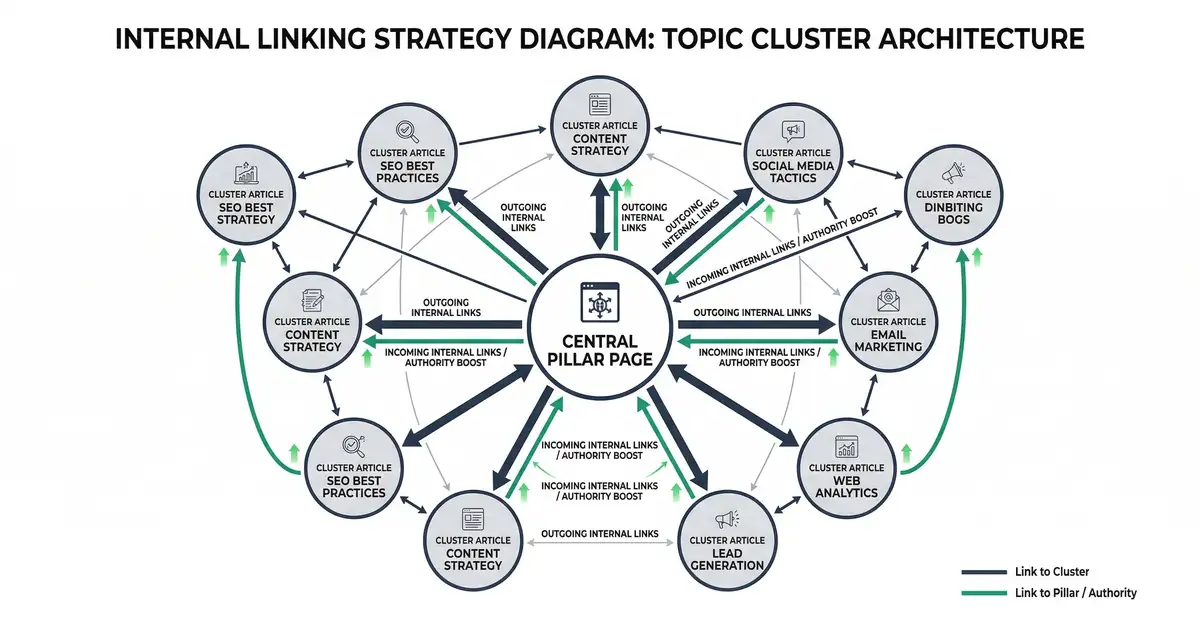

A strategic internal linking structure can boost rankings by up to 40% and improve organic traffic by 30%. Yet most B2B companies treat internal links as an afterthought, adding random cross-links instead of building deliberate authority pathways.
Internal Linking Rules
- Quantity: Aim for 2-5 contextual links per 1,000 words. Keep total page links under 150 to maintain link equity distribution
- Anchor text: Use descriptive, varied anchor text that flows naturally. Avoid overusing exact-match keywords — Google flags this as manipulation
- Placement: Embed important links early in content or above the fold. In-body links carry more weight than navigation or footer links
- Topic clusters: Link cluster articles to their pillar page and to related cluster content. This creates the semantic web that signals topical authority
- New content promotion: When publishing new articles, revisit 2-3 existing related articles and add links to the new page. This accelerates indexing and ranking
Key Takeaway
The compound effect makes SEO copywriting the highest-ROI marketing investment available. A single well-optimized article generates leads for 36+ months after publication at zero incremental cost. Companies deploying systematic content operations outperform those publishing ad-hoc by 5–10× on organic pipeline generation.
Step 7: Optimizing for AI Answer Engines (GEO and AEO)
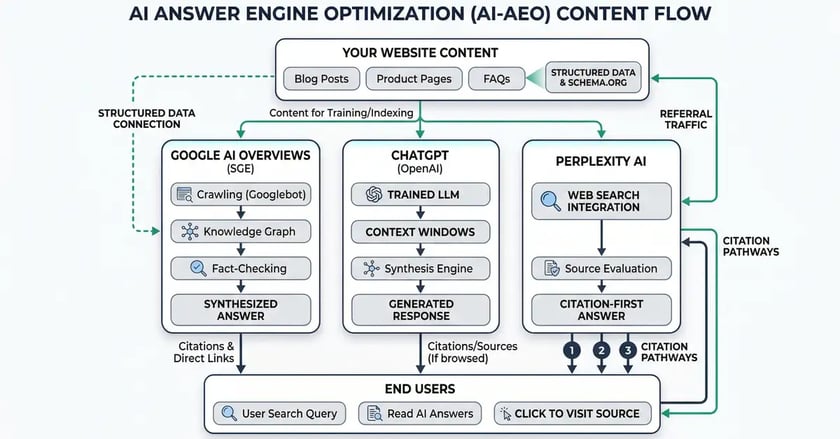
Traditional SEO optimizes for blue links. Generative Engine Optimization (GEO) and Answer Engine Optimization (AEO) ensure your content surfaces in AI-generated answers from Google's AI Overviews, ChatGPT, and Perplexity. The two strategies are complementary, not competing.
AEO Optimization Techniques
- Question-based structure: Use H3 headings phrased as natural language questions. AI engines extract these as direct answers
- Concise answer paragraphs: Follow each question heading with a 40-80 word direct answer. Then expand with supporting detail. This "inverted pyramid" structure feeds both featured snippets and AI citations
- Structured data markup: Deploy FAQPage JSON-LD schema on every article with FAQ sections. This explicitly signals question-answer pairs to search engines
- Entity-rich content: Include named statistics with sources, specific dates, and verifiable data points. AI engines preferentially cite content they can fact-check
- Authoritative citations: Link to and reference credible sources. AI engines evaluate source credibility when selecting content for citations
Measuring SEO Copywriting ROI
Content that cannot be measured cannot be optimized. Track these KPIs to quantify the business impact of your SEO copywriting investment:
| KPI | Benchmark | Measurement Tool |
| Organic traffic growth | +40-60% within 90 days | Google Analytics / GSC |
| Keyword rankings (top 20) | 60%+ of target keywords | Ahrefs / Semrush / GSC |
| Cost per lead (organic) | $31 avg (vs $181 PPC) | CRM attribution reporting |
| Content conversion rate | 2.5-5% visitor to lead | HubSpot HubSpot Content Hub strategies / Google Analytics |
| Dwell time | 3+ minutes average | Google Analytics |
| Featured snippet capture | 10%+ of target queries | Ahrefs SERP features report |
The compound effect is what makes SEO copywriting the highest-ROI marketing investment available. According to First Page Sage, SEO content marketing delivers 700%+ ROI over a 3-year horizon — because each published article continues generating traffic and leads indefinitely at zero incremental cost. A single well-optimized blog post can generate leads for 36+ months after publication.
FAQ
What is SEO copywriting?
SEO copywriting is the practice of creating content that is simultaneously optimized for search engine rankings and engaging for human readers. It combines keyword research, search intent analysis, content structure, on-page optimization, and persuasive writing to produce articles that rank organically, drive qualified traffic, and convert visitors into leads.
How long should SEO content be?
Effective SEO content should be as long as the topic demands — typically 2,000-3,500 words for comprehensive guides and pillar pages. Research shows pages exceeding 2,000 words with thorough coverage outrank thinner content, but length should serve comprehensiveness, not arbitrary word count targets. A 1,200-word article that fully answers the query outperforms a 3,000-word article padded with filler.
How many keywords should I target per article?
Target one primary keyword per article, supported by 2-4 secondary keywords and unlimited natural supporting language. This hierarchy prevents keyword cannibalization across your content library while maximizing ranking surface for each piece. Use your primary keyword at 1-2% density and secondary keywords at 0.5-1% each.
What is the difference between SEO writing and regular copywriting?
Regular copywriting focuses on persuasion and conversion — compelling readers to take action. SEO copywriting adds a structural layer: keyword targeting, search intent alignment, heading hierarchy optimization, internal linking, schema markup, and meta tag optimization. The best SEO copywriting achieves both — content that ranks on page one and converts visitors once they arrive.
How do I optimize content for AI search engines?
Optimize for AI answer engines by structuring content with question-based H3 headings followed by concise 40-80 word answers, deploying FAQPage JSON-LD schema markup, citing authoritative sources with named statistics, and writing entity-rich content with verifiable data points. This Generative Engine Optimization (GEO) approach ensures your content surfaces in AI-generated answers from Google AI Overviews, ChatGPT, and Perplexity.
How long does SEO content take to rank?
New SEO content typically takes 4-8 months to reach stable rankings for competitive keywords. Content published within an established topic cluster structure can rank in 2-4 months due to inherited authority from pillar pages. Content targeting low-competition long-tail keywords may rank within weeks. Consistent publishing cadence accelerates the entire domain's ranking velocity over time.
Conclusion: Deploy the SEO Copywriting System
SEO copywriting is not a creative exercise. It is a systematic process — keyword research, intent analysis, structured writing, on-page optimization, internal linking, schema markup, and performance measurement. Each step compounds with the others to produce content that ranks, converts, and generates pipeline.
The companies winning in organic search are not writing better prose. They are deploying better systems — producing one optimized article per day, measuring results weekly, and iterating based on data. The SEO copywriting framework in this guide is the exact system we use to scale B2B content operations from zero to 90 articles in a single quarter.
Ready to architect a content engine that compounds? Book your Growth Mapping Call to deploy SEO copywriting at scale.
Resources
- Google SEO Starter Guide — Official Documentation
- First Page Sage — SEO Content Best Practices
- Ahrefs — SEO Keyword Research Platform
- Moz — Internal Links SEO Best Practices
- Generative Engine Optimization (GEO) — peppereffect
- B2B Lead Generation — peppereffect