

Why Your HubSpot Content Strategy Determines Revenue Growth
Most B2B companies deploy HubSpot as a CRM — then leave 80% of its content infrastructure unused. The result: fragmented blog posts that generate impressions but not pipeline. Meanwhile, competitors running a systematic HubSpot content strategy report 3.5x more leads and 25% higher conversion rates than those relying on ad-hoc publishing. SEO content marketing architecture HubSpot SEO tool stack
The difference is not volume. It is architecture. HubSpot Content Hub — the platform's integrated content management system — provides the structural foundation for topic clusters, AI-assisted creation, smart personalization, and closed-loop analytics. When deployed as an operating system rather than a blog editor, it becomes the single highest-ROI channel in your marketing stack.
17.5%
HubSpot Market Share
B2B marketing automation
700%+
Content Marketing ROI
3-year compound return
53%
Traffic From Organic
All website visitors
4.5×
Lead Quality Improvement
With content hub strategy
This article breaks down the exact framework:
- How HubSpot Content Hub works as a content operating system
- The topic cluster and pillar page architecture that drives SEO authority
- How Breeze AI tools accelerate content production without sacrificing quality
- A head-to-head comparison of HubSpot vs WordPress for B2B content marketing
- Implementation roadmap with measurable KPIs and ROI benchmarks
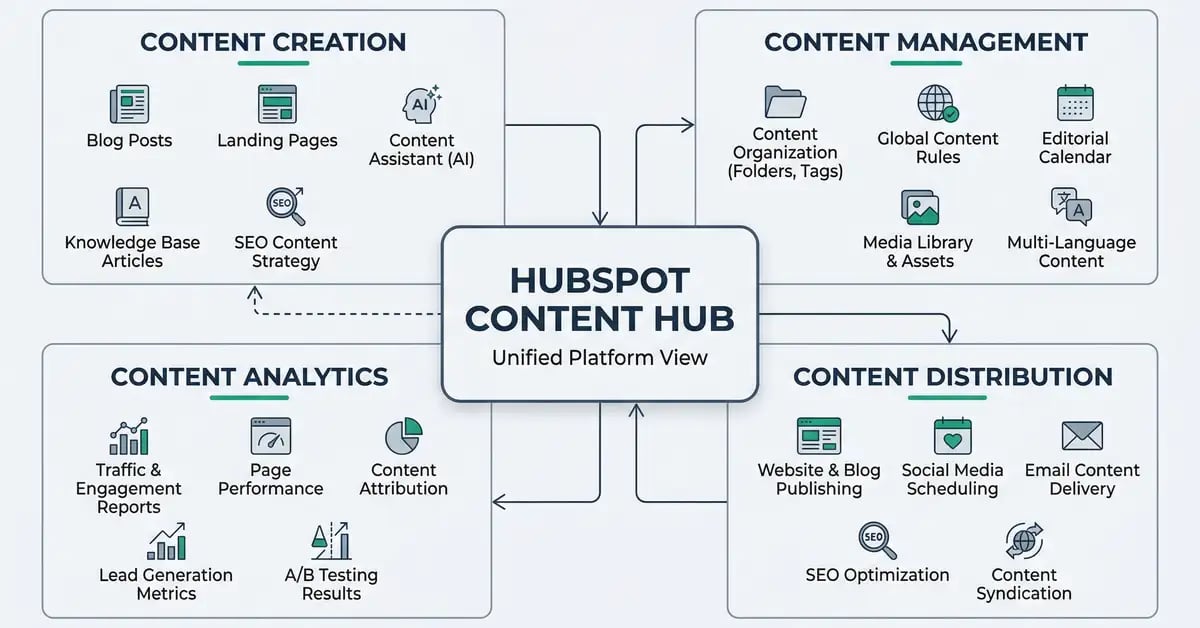
HubSpot Content Hub: The Content Operating System
Key Takeaway
HubSpot content strategy is not about publishing blog posts — it is about building a content-powered revenue engine. When content hub, CRM, and automation work as an integrated system, each piece of content compounds traffic, leads, and pipeline.
HubSpot Content Hub is not a standalone CMS. It is a content management layer integrated directly into HubSpot's CRM platform — meaning every page, blog post, and landing page has native access to contact data, deal stages, and behavioral analytics. This integration eliminates the data silos that plague WordPress-based marketing stacks.
The platform consolidates five capabilities that typically require separate tools:
- Content creation and management: Blog, landing pages, website pages, and email — all managed from a single dashboard with drag-and-drop editing and brand-consistent templates. HubSpot's Content Hub now unifies what previously required separate Marketing Hub tools
- SEO recommendations engine: Real-time on-page optimization suggestions including keyword usage, meta descriptions, header structure, and internal linking opportunities
- Smart content personalization: Dynamic content blocks that adapt based on visitor lifecycle stage, list membership, device type, or referral source — no custom code required
- Built-in analytics: Attribution reporting that connects content performance directly to contact creation, deal progression, and closed revenue
- Breeze AI suite: AI-powered content generation, SEO recommendations, image creation, and content remix tools built natively into the editor
Companies using HubSpot's integrated content tools see 20% easier traffic scaling and report significantly higher marketing-qualified lead volumes compared to disconnected CMS platforms. — HubSpot State of Marketing Report
The 4 Pillars Playbook breaks down the entire framework with deployment maps, KPIs, and real case studies across SaaS, recruiting, and coaching.
Open the Interactive PlaybookTopic Clusters and Pillar Pages: The SEO Architecture
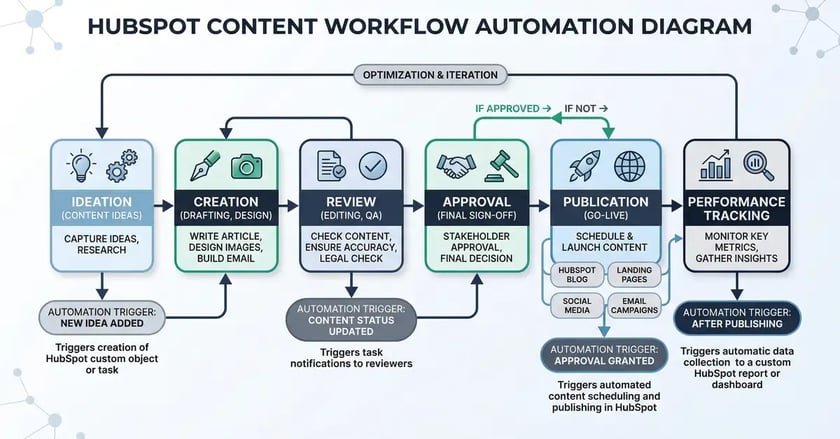
The topic cluster model is the structural backbone of any effective HubSpot content strategy. Instead of publishing isolated blog posts competing against each other for rankings, you build interconnected content networks that signal topical authority to search engines.
How Topic Clusters Work
A topic cluster consists of three components:
- Pillar page. A comprehensive, long-form page (2,000–5,000 words) covering a broad topic. This page targets a high-volume head keyword and serves as the authoritative hub. Example: Lead Generation as a pillar page targeting "B2B lead generation."
- Cluster content. Supporting blog posts that target long-tail variations and subtopics. Each cluster post links back to the pillar page and to related cluster content. Example: "How to Automate Lead Scoring in HubSpot" linking back to the lead generation pillar.
- Hyperlinked architecture. Bidirectional internal links between pillar and cluster content create a semantic web that search engines crawl and index as a unified topic authority signal.

Why Topic Clusters Outperform Flat Blog Structures
HubSpot's own data confirms that websites structured around topic clusters see measurable gains in search visibility within 90 days of implementation. The mechanism is straightforward: As Google's SEO documentation confirms, search algorithms evaluate topical depth and internal linking density when determining domain authority for a given subject.
A flat blog structure — where each post is an island — forces every article to build authority independently. A cluster structure pools authority across interconnected pages, meaning a single high-performing pillar page elevates the rankings of every cluster article linked to it.
| Metric | Flat Blog Structure | Topic Cluster Model |
| Internal link density | Low (random cross-links) | High (systematic bidirectional) |
| Topical authority signal | Diluted across isolated posts | Concentrated around pillar themes |
| Keyword cannibalization risk | High (multiple posts target same terms) | Low (clear hierarchy per topic) |
| Time to rank (new content) | 4–8 months average | 2–4 months with cluster support |
| Content discovery by crawlers | Dependent on sitemap alone | Enhanced by link architecture |
Avoid This Mistake
Using HubSpot as a publishing tool without leveraging its content intelligence features. 80% of HubSpot users only use basic blogging features, missing the topic cluster tools, SEO recommendations, and content attribution reporting that drive compound returns.
Breeze AI: Accelerating Content Production at Scale

HubSpot's Breeze AI suite — introduced as the platform's native AI layer — transforms content production economics. Rather than replacing human strategists, Breeze automates the repetitive 60–70% of content creation that consumes the most time: first drafts, meta descriptions, social variants, and content remixing.
Key Breeze AI Capabilities for Content Teams
- Breeze Content Agent: Generates blog post drafts, landing page copy, and case study frameworks from brief prompts — producing first drafts in minutes that would take 2–4 hours manually
- Breeze SEO recommendations: Analyzes existing content against ranking competitors and suggests structural improvements, keyword placement adjustments, and internal linking opportunities
- Content remix: Transforms a single blog post into social media posts, email snippets, ad copy, and podcast outlines — extending the ROI of every piece of content by 5–8x
- AI image generation: Creates on-brand visuals directly in the editor, eliminating the need for separate design tools or stock photo subscriptions
The strategic value is not just speed. Breeze maintains brand voice consistency across all generated content by learning from your existing published assets. For B2B teams publishing at scale — our recommendation is one article per day — this consistency is the difference between a coherent content engine and a disjointed content dump.

The Bottom Line
The topic cluster model in HubSpot connects pillar pages to supporting content through strategic internal linking, signalling topical authority to search engines and creating a content ecosystem where each piece strengthens every other.
HubSpot vs WordPress: Which Platform Wins for B2B Content?

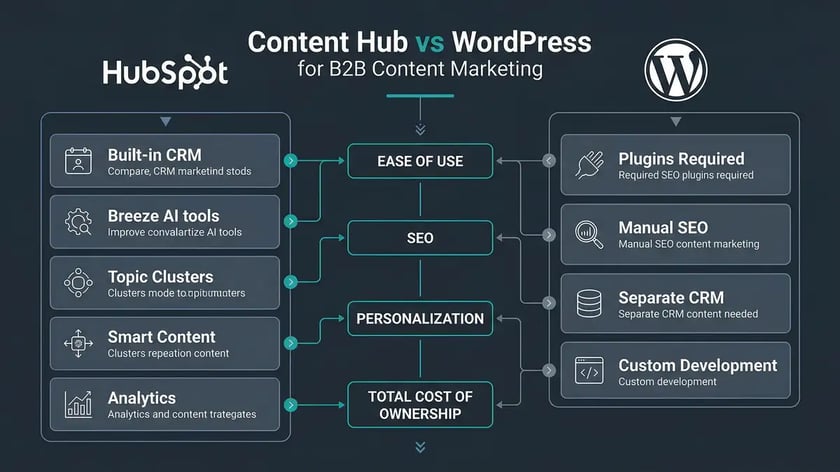
According to W3Techs, WordPress powers 43% of all websites, making it the default choice for many B2B companies. But default does not mean optimal. When evaluated specifically for B2B content marketing — where CRM integration, lead attribution, and personalization drive revenue — HubSpot Content Hub delivers structural advantages that WordPress cannot match without extensive plugin stacking.
| Capability | HubSpot Content Hub | WordPress + Plugins |
| CRM integration | Native — every page visitor linked to contact record | Requires plugin (HubSpot WP, Salesforce connector) |
| SEO tools | Built-in recommendations, topic clusters, content strategy tool | Yoast/RankMath plugin required ($99-299/yr) |
| Content personalization | Smart content blocks, lifecycle-based targeting, no code | Custom development or premium plugins required |
| AI content tools | Breeze AI suite — native, trained on your brand | Third-party AI plugins (quality varies) |
| Attribution reporting | Full-funnel: content → contact → deal → revenue | Google Analytics + CRM + manual connecting |
| Security and hosting | Managed hosting, SSL, CDN, WAF included | Self-managed or premium hosting ($50-300/mo) |
| Total cost of ownership (year 1) | $4,800–$18,000 (Content Hub Pro/Enterprise) | $3,000–$15,000+ (hosting + plugins + dev time) |
The critical difference is not feature-for-feature comparison — it is integration depth. In WordPress, your CMS, CRM, marketing automation, analytics, and SEO tools are separate systems connected by plugins. Each connection is a potential failure point, a data gap, and a maintenance burden. In HubSpot, these are layers of a single platform sharing one database.
For B2B companies where sales and marketing alignment drives revenue, that architectural difference translates to 33% revenue growth from consistent cross-channel content — a benchmark from HubSpot's own customer data.
Ready to transform your HubSpot into a content-powered revenue engine? See how peppereffect architects content systems for B2B growth.
View Marketing InfrastructureBuilding Your HubSpot Content Strategy: The Implementation Roadmap
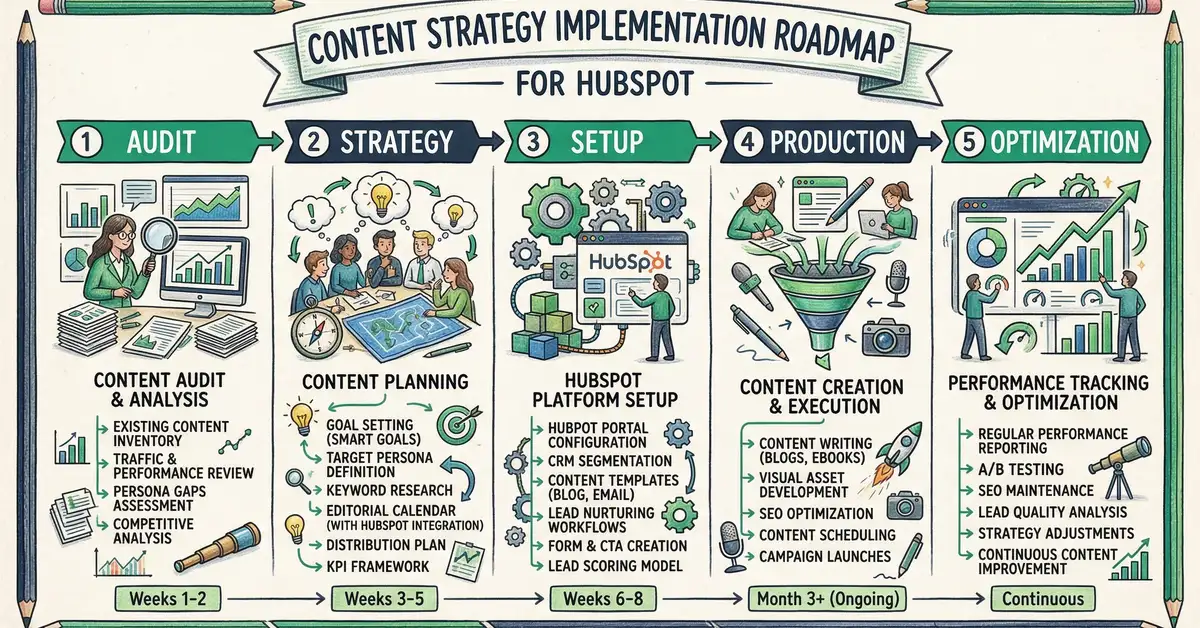
A systematic HubSpot content strategy deploys in three phases over 90 days. Each phase builds infrastructure before scaling volume — the same operational architecture we apply to every client engagement.
Phase 1: Foundation (Weeks 1–3)
- Content audit: Inventory all existing content. Identify underperforming pages, keyword cannibalization, and content gaps using HubSpot's SEO tool and GEO optimization principles
- Topic cluster mapping: Define 4–6 pillar topics aligned to your buyer personas and revenue goals. Map each pillar to 10–15 cluster article opportunities
- Keyword research pipeline: Build a keyword portfolio targeting commercial-intent terms with volume data, keyword difficulty scores, and SERP feature opportunities
- Template and brand setup: Configure HubSpot blog templates, define brand voice guidelines in Breeze AI, and set up content approval workflows
Phase 2: Pillar Development (Weeks 4–8)
- Create pillar pages: Produce 4–6 comprehensive pillar pages (2,000–5,000 words each) targeting your highest-value topics
- Launch cluster cadence: Begin publishing 3–5 cluster articles per week, each linking back to its parent pillar page
- Implement smart content: Deploy personalized CTAs and content blocks based on visitor lifecycle stage — showing different offers to first-time visitors versus returning leads
- Activate Breeze AI: Use content remix to generate social distribution assets, email nurture snippets, and ad copy from every published article
Phase 3: Scale and Optimize (Weeks 9–12)
- Scale to daily publishing: Increase cadence to 1 article per day using Breeze AI for first drafts and your editorial team for strategic review
- Optimize existing content: Update top-performing pages with fresh data, expanded sections, and improved internal links
- Attribution analysis: Review HubSpot's content attribution reports to identify which topics and formats drive the most pipeline value
- Iterate clusters: Expand high-performing topic clusters with additional subtopic articles. Prune or consolidate underperforming content
What This Means
Content attribution in HubSpot closes the loop between marketing activity and revenue. Track which content pieces generate the most pipeline value, then double down on the formats and topics that convert.
Measuring ROI: The Content Strategy KPIs That Matter
Vanity metrics — pageviews, social shares, time on page — tell you what is popular. Revenue metrics tell you what is profitable. A properly configured HubSpot content strategy tracks both, but optimizes exclusively for the latter.
| KPI | Target (90-Day) | HubSpot Tool |
| Organic traffic growth | +40–60% from baseline | Traffic Analytics |
| Marketing qualified leads (MQLs) | +25% from content sources | Contact Attribution Report |
| Content-influenced pipeline | Track $ value of deals touching content | Revenue Attribution |
| Cost per lead (organic) | $31 avg (vs $181 PPC, $811 trade shows) | Campaign Analytics |
| Cluster topic rankings | Top 20 positions for 60%+ of target keywords | SEO Tool + GSC Integration |
| Content conversion rate | 2.5–5% blog visitor → lead | Landing Page Analytics |
The compound effect is where HubSpot content strategy delivers outsized returns. According to First Page Sage's research, SEO-driven content marketing generates 700%+ ROI over a 3-year horizon — because unlike paid advertising, organic content compounds. A blog post published today continues generating leads 12, 24, and 36 months from now at zero incremental cost.
Optimizing for GEO and AEO: Future-Proofing Your Content
Search is evolving beyond traditional blue links. Generative Engine Optimization (GEO) and Answer Engine Optimization (AEO) ensure your HubSpot content surfaces in AI-generated answers from Google's AI Overviews, ChatGPT, and Perplexity.
The implementation within HubSpot is structural:
- FAQ sections with H3 headings: Every article should include 4–6 questions that mirror natural language queries. HubSpot's template automatically renders these as scannable, crawlable sections
- Structured data markup: Deploy Article, FAQPage, and BreadcrumbList JSON-LD schemas on every page. HubSpot supports custom head HTML injection for this purpose
- Entity-rich content: Include named statistics, cited sources, and authoritative references. AI engines preferentially cite content with verifiable data points
- Conversational keyword targeting: Optimize for question-based queries ("how does HubSpot topic cluster work") alongside traditional keywords
This dual optimization strategy ensures your content captures traffic from both traditional search and the emerging AI answer ecosystem — protecting your investment as search behavior shifts.
FAQ
What is a HubSpot content strategy?
A HubSpot content strategy is a systematic approach to creating, organizing, and optimizing content using HubSpot's Content Hub platform. It leverages topic clusters, pillar pages, Breeze AI tools, and CRM-integrated analytics to produce content that drives organic traffic, generates leads, and directly contributes to revenue growth.
How do HubSpot topic clusters improve SEO?
Topic clusters improve SEO by creating interconnected networks of content around core themes. A comprehensive pillar page links to and from multiple cluster articles, creating a semantic web that signals topical authority to search engines. This architecture reduces keyword cannibalization, accelerates time-to-rank for new content, and concentrates domain authority around your highest-value topics.
Is HubSpot Content Hub better than WordPress for B2B?
For B2B companies prioritizing lead generation and sales alignment, HubSpot Content Hub offers structural advantages: native CRM integration, built-in personalization, full-funnel attribution reporting, and the Breeze AI suite. WordPress is more flexible for custom development but requires extensive plugin stacking to match HubSpot's integrated capabilities. Total cost of ownership is comparable, but HubSpot delivers faster time-to-value for revenue-focused content operations.
What is Breeze AI in HubSpot?
Breeze AI is HubSpot's native artificial intelligence suite that includes content generation, SEO recommendations, image creation, and content remix tools. It operates directly within the HubSpot editor, enabling marketing teams to produce first drafts, generate social media variants, and optimize existing content — reducing production time by an estimated 60–70% for routine content tasks.
How long does it take to see ROI from a HubSpot content strategy?
Most B2B companies see measurable organic traffic increases within 90 days of implementing a topic cluster strategy. Pipeline impact typically follows within 4–6 months as content begins ranking and generating qualified leads. Full compound ROI — where SEO-driven content delivers 700%+ returns — materializes over a 12–36 month horizon as the content library grows and individual articles continue generating leads at zero incremental cost.
How does GEO optimization work with HubSpot content?
Generative Engine Optimization (GEO) ensures your HubSpot content surfaces in AI-generated search answers. Implementation includes adding FAQ sections with H3 headings, deploying JSON-LD structured data schemas via HubSpot's head HTML injection, incorporating cited statistics and authoritative sources, and targeting conversational question-based keywords alongside traditional search terms.
Conclusion: Deploy the Content Operating System
A HubSpot content strategy is not a publishing schedule. It is an operating system for revenue growth — one that compounds over time while paid channels deliver linear returns at increasing costs.
The architecture is clear: topic clusters for SEO authority, Breeze AI for production velocity, smart content for personalization, and closed-loop analytics for continuous optimization. Companies that deploy this infrastructure report 25% higher conversion rates, 3.5x more leads from content, and measurable pipeline attribution within 6 months.
The question is not whether to invest in content. It is whether your current platform gives you the structural advantage to win. Book your Growth Mapping Call to architect a HubSpot content strategy that decouples your revenue growth from headcount. HubSpot Content Hub traffic strategies
Resources
- HubSpot Content Hub — Official Product Page
- HubSpot Topic Clusters: The Complete Guide
- HubSpot State of Marketing Report 2025
- Generative Engine Optimization (GEO): The Complete Guide
- B2B Lead Generation — peppereffect
- Sales Administration — peppereffect
- Content Marketing Institute — B2B Content Marketing Report
conversion-focused on-page SEO
AI search visibility measurement SEO copywriting that ranks and converts