The AI Execution Gap: Where AI Agencies Operate
Eighty-eight percent of enterprises now use AI regularly. Yet only 6% achieve high-performer status — according to McKinsey's 2025 State of AI report. That's not a technology problem — it's an execution problem. AEO and AI search visibility where generative AI delivers value
The gap between AI experimentation and AI performance is where AI agencies operate. They're the connective tissue between boardroom ambition and operational reality: designing, implementing, and scaling AI solutions that move revenue and reduce friction in B2B operations.
$184B
AI Services Market 2030
Grand View Research
72%
Enterprises Adopting AI
By end of 2026
5.2×
ROI From AI Implementation
McKinsey benchmark
33%
Implementation Success Rate
Without expert guidance
This guide cuts through the noise. You'll learn:
- What an AI agency actually is — and the three dominant models
- How AI agencies differ from consultancies, SaaS platforms AI for SaaS, and IT vendors
- The selection framework that separates high-performance partners from expensive failures
- ROI benchmarks and why only 24% of AI implementations achieve profit impact
- Where the agentic AI frontier is heading — and why it matters for your business
What Is an AI Agency?
Key Takeaway
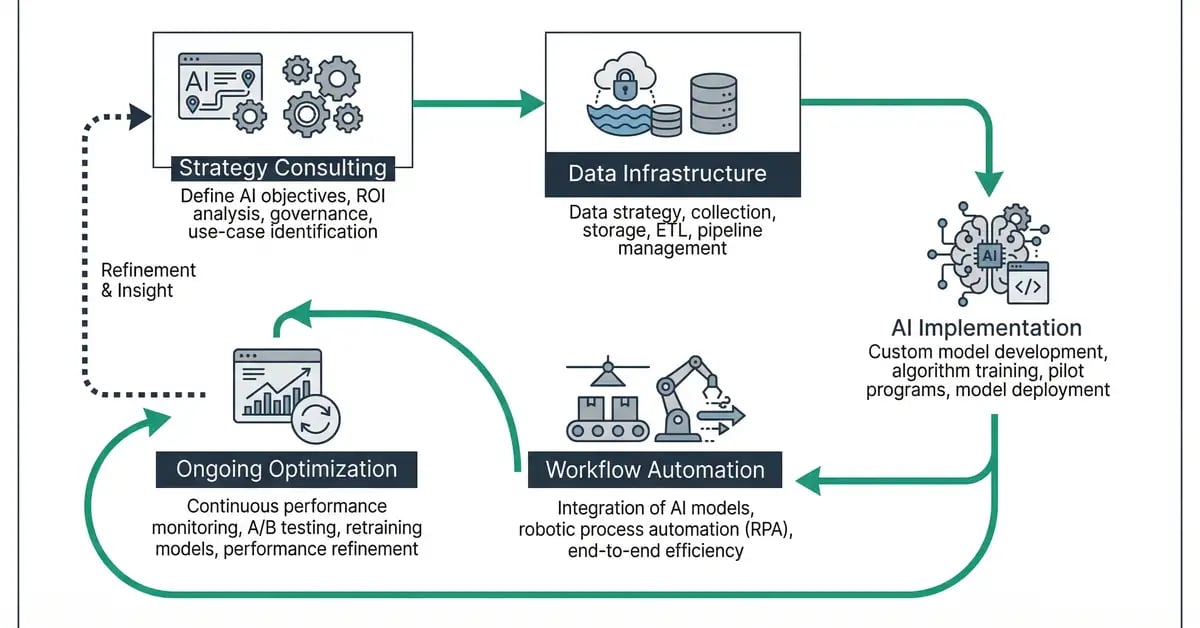
An AI agency is not a traditional consultancy that advises — it is an implementation partner that installs. The distinction matters: advice without execution produces reports, while implementation produces revenue infrastructure that compounds.
An AI agency designs, implements, and scales artificial intelligence solutions directly into business operations. This is distinct from consulting (strategy without execution), SaaS platforms (tools without integration), and IT vendors (locked into proprietary stacks).
An AI agency takes ownership of the bridge: from your current state to an AI-powered operating system. They audit your workflows, identify automation opportunities, architect solutions, deploy them, and then measure outcomes — typically with accountability tied to results.
Three dominant models exist:
| Agency Model | How It Works | Best For |
| Service-based | You pay for hours, project scope, or retainer. Deep customisation. | Complex, multi-system transformations |
| Automation-focused | Specialised in specific workflows (lead gen B2B lead generation systems, support, contracts). Faster deployment. | Targeted workflow automation AI workflow automation platforms |
| Hybrid | Combines service delivery with proprietary tools or frameworks. Scalable after initial build. | Organisations wanting long-term AI infrastructure |
The best agencies combine methodology (proven implementation frameworks), technology expertise (framework-agnostic), and industry vertical knowledge. They speak fluent operations, not just AI.

What Services Do AI Agencies Offer?
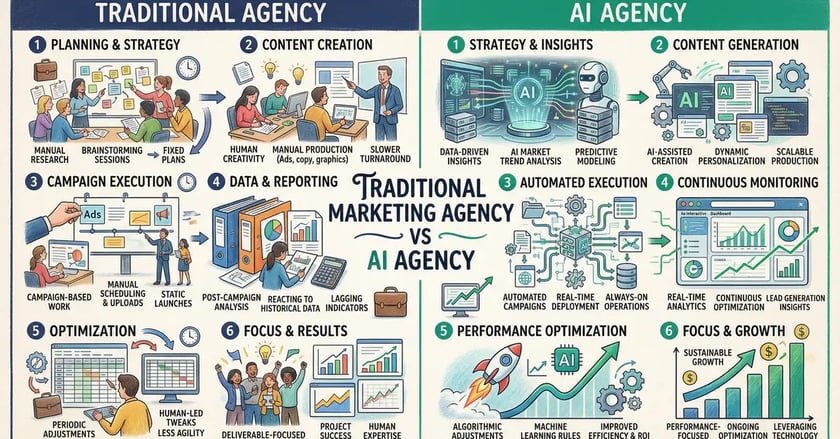
The service portfolio depends on the agency model, but the core offerings cluster around four areas aligned with B2B growth infrastructure:
Lead Generation and Marketing Automation
AI agencies build automation into your marketing infrastructure. This includes AI-powered lead scoring, prospecting automation, content personalisation engines, and predictive pipeline analysis. The outcome: more qualified leads, lower customer acquisition cost, faster sales cycles sales automation for B2B.
Business Process Automation
From data entry to invoice processing, document classification to vendor management — AI agencies identify manual, repeatable workflows and automate them. The payoff is measurable: organisations implementing AI automation report 25% reductions in operational costs for customer service functions alone.
Agentic AI Implementation
This is the frontier. Rather than automating discrete tasks, agentic AI systems make decisions autonomously within guardrails you define. An AI agent might manage customer support, nurture dormant pipeline, or optimise your ad spend — all without human intervention until escalation thresholds are triggered.
$48.3 billion by 2030 — that's the projected size of the AI agents market, growing at 43.3% CAGR. — BCC Research
Data Strategy and Infrastructure
AI only works on clean data. Many agencies include data audits, warehouse design, API integration, and analytics architecture as preconditions to automation. Without this foundation, AI implementations fail.
Industry-Specific Verticals
Specialised agencies focus on specific sectors — SaaS, professional services, fintech, healthcare — where they understand regulatory constraints, buyer behaviour, and operational pain points.
Ongoing Optimisation and Scaling
Deployment isn't the endpoint. The best agencies monitor performance, iterate prompts and workflows, scale successful automations, and retire underperformers. This is where you realise compounding ROI.
Avoid This Mistake
Choosing an AI agency based on technology capabilities alone. 67% of AI implementations fail not because of technology limitations but because of poor change management, unclear business objectives, and misaligned expectations. Evaluate agencies on business outcomes delivered, not tools used.
AI Agency vs Consultancy vs SaaS: What's the Difference?
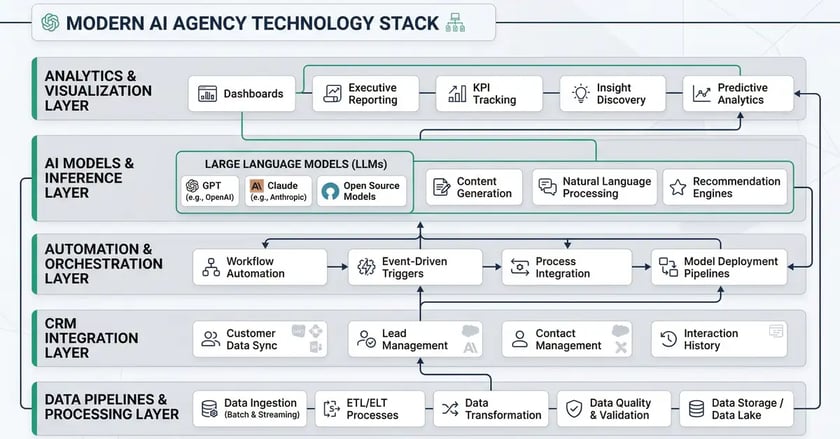
The market conflates these categories. They're not the same. The distinctions matter for your budget, timeline, and risk profile.
| Dimension | AI Agency | Management Consultancy | SaaS Platform | IT / Systems Integrator |
| Delivery model | End-to-end: diagnose, design, implement, optimise | Strategy and recommendations only | Self-serve tools within walled garden | Large-scale infrastructure projects |
| Timeline to value | 3–6 months | 12–18 months | 1–4 weeks (limited scope) | 6–18 months |
| Typical cost | £50k–£500k | £300k–£2M | £500–£50k/year | £200k–£5M+ |
| Accountability | Outcome-based (ROI-tied) | Limited (deliverable-based) | None (self-serve) | Project completion |
| Technology flexibility | Framework-agnostic | Vendor-neutral (in theory) | Locked to own platform | Locked to partner stack |
| Post-launch support | Continuous optimisation | Rare (new SOW required) | Product updates only | Maintenance contracts |
| Best for | B2B orgs needing execution + results | Board-level strategy validation | Teams with technical capacity | Enterprise-scale infrastructure |
As Harvard Business Review notes, AI is fundamentally reshaping the consulting model. But most consultancies still default to strategy-without-execution. You'll pay £300k–£2M for a six-month strategy project — then scramble to hire another firm to execute it.
AI agencies operate across the full value chain. They're technology-agnostic, outcome-accountable, and typically cost 30–60% of traditional consulting. You own the solution — no vendor lock-in.
The Bottom Line
The best AI agencies operate at the intersection of strategy and execution — understanding your business model deeply enough to identify high-impact automation opportunities, then building and deploying the systems that capture those opportunities.
Why B2B Leaders Are Turning to AI Agencies

Five structural pain points drive the shift:
- Technology selection paralysis. Hundreds of AI platforms, frameworks, and point solutions. According to Menlo Ventures' enterprise AI research, organisations now deploy three or more model families. An AI automation agency cuts through this with diagnostic methodology.
- Implementation execution gap. Most organisations can buy a tool. Few can implement it end-to-end. Data integration, workflow redesign, staff enablement, change management — these are operational challenges. An AI agency owns the entire journey from lead generation to sales administration to back-office operations.
- Data quality barriers. Sixty percent of AI implementations stall because of poor data quality, not poor AI. Agencies begin with data audits — identifying silos, quality issues, missing fields, and legacy constraints.
- Talent shortage. Ninety-four percent of leadership teams report AI skill shortages in-house, according to the World Economic Forum. An AI agency is rented expertise — top-tier talent without the headcount cost.
- Regulatory uncertainty. AI governance is evolving. Specialised agencies understand the compliance landscape and implement guardrails, audit trails, and explainability frameworks.

Looking for an AI agency that installs revenue infrastructure, not just delivers reports? See how peppereffect architects AI operating systems for B2B founders.
Explore Our ApproachHow to Evaluate an AI Agency: The Selection Framework
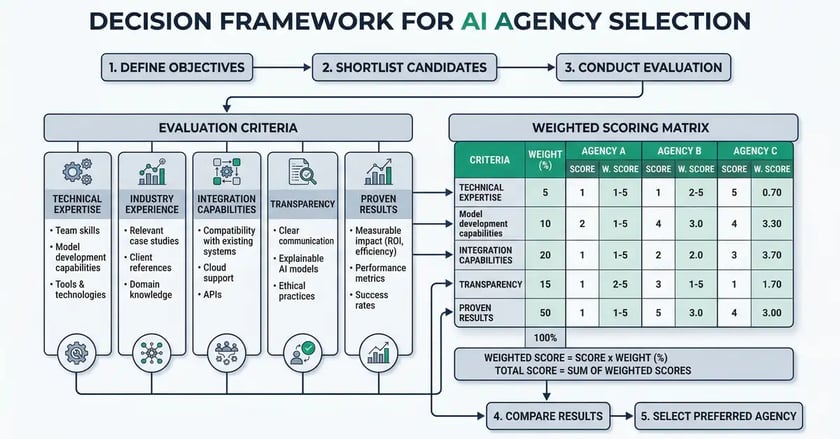
Not all AI agencies are equal. A poor implementation costs money and time — worse, it kills your team's appetite for AI. Use this three-dimension framework:
Dimension 1: Capability Verification
Ask for case studies in your vertical. Request quantified outcomes: revenue impact, cost savings, implementation timeline, ongoing costs. Ask how they measure success — if they can't define KPIs, walk away.
- Green flags: Vertical-specific case studies, quantified ROI, named client references, published methodology
- Red flags: Vague case studies, no quantified ROI, universal solution promises, no vertical specialisation
Dimension 2: Implementation Methodology
Do they have a repeatable process? Do they start with data audits? How do they handle change management? What's their deployment cadence?
- Green flags: Documented methodology, phased rollout approach, change management plan, post-launch optimisation
- Red flags: No documented process, 30-day turnaround promises for complex automation, no post-launch plan
Dimension 3: Commercial Alignment
The best agencies align incentives with outcomes — hybrid models with base fee plus performance bonus tied to measured ROI.
- Green flags: Outcome-based pricing, transparent metrics, willingness to share risk, clear scope definitions
- Red flags: Purely hourly billing, no outcomes measurement, unwillingness to quantify impact, vague pricing
What This Means
The future of AI agencies is agentic AI deployment — installing autonomous systems that handle multi-step business processes with minimal human oversight. Companies that partner with agencies building this capability now will have a 2–3 year head start.
The ROI of Working with an AI Agency
The numbers are compelling — but context matters.
210% ROI over three years with payback periods under six months — that's the baseline for organisations working with AI agencies.
Here's how that breaks down by function:
| Function | Key Metric | Typical Impact |
| Marketing automation | Customer acquisition cost | 25% reduction |
| Customer service automation | Operational costs | 25% savings |
| Back-office automation | Productivity | 34% gains |
| Overall AI implementation | Efficiency gains | 44% of organisations |
| Overall AI implementation | Profit impact | Only 24% of organisations |
That last row is critical. Efficiency does not equal profitability. A system that processes invoices faster is efficient. A system that reduces your headcount requirements and reinvests savings into growth is profitable. An agency's job is closing that gap — designing automations that flow efficiency into revenue impact.

The Agentic AI Frontier: Where AI Agencies Are Heading
AI has evolved through three stages:
- Task automation — process a document, classify an email
- Workflow automation — handle a multi-step process end-to-end
- Agentic automation — make autonomous decisions within guardrails
An AI agent perceives its environment, reasons about it, and takes action autonomously. It might manage your customer support queue, nurture cold leads, reconcile invoices, or optimise your ad spend — all without human intervention until an issue escapes its guardrails.
According to McKinsey's research on the agentic organisation, by 2028 teams of two to five humans will supervise 50–100+ specialised agents executing end-to-end business processes. An estimated 15% of work decisions will be made autonomously by AI agents.
The agencies leading this shift are architecting not just tools but operating systems — integrated, autonomous, continuously learning systems that operate your business across operations and every customer-facing function. This is the evolution from "AI helps us work" to "AI works for us."
Frequently Asked Questions
How much does an AI agency cost?
Cost ranges from £50k to £500k+ depending on scope and complexity. Boutique agencies or automation specialists might charge £50–150k for focused implementations. Full-service strategic implementations run £200–500k+. Some agencies work on hybrid models: base fee plus performance bonus. Always ask for ROI-based pricing if available — it aligns incentives.
How long does an AI implementation take?
Simple automations (email workflows, basic chatbots) deploy in 4–8 weeks. Complex multi-system integrations take 4–6 months. Data quality remediation can add 2–3 months. Ask for a pilot phase: 6–8 weeks to prove ROI on a single workflow before scaling.
Can an AI agency replace my marketing team?
No. An AI agency automates repetitive work, not strategy. Your team shifts from execution (manual lead scoring, outreach sequencing) to higher-value work: messaging, positioning, campaign strategy. AI handles the machinery. Your team handles the thinking.
What's the difference between an AI agency and an AI consultancy?
Consultancies diagnose and recommend. Agencies diagnose, design, implement, and optimise. A consultancy outputs a roadmap; an agency outputs a running system. Most B2B leaders need agencies because the constraint isn't strategy — it's execution.
How do I know if my business is ready for an AI agency?
You're ready if: (1) you have a specific operational pain point; (2) you have accessible data (even if messy); (3) you can dedicate one internal stakeholder to the project; (4) you're willing to iterate. Start with a diagnostic audit — most agencies offer this for free or at low cost.
Should I build AI capabilities in-house or hire an agency?
In-house is slower and more expensive. Hiring AI specialists takes 3–6 months and costs £100–200k annually. Building methodology in-house takes 12–18 months. An agency compresses this to 3–6 months with proven methodology. Many organisations take the hybrid path: use an agency to establish the foundation, then hire in-house to maintain and iterate.
The Bottom Line: Closing the Execution Gap
The AI infrastructure for B2B is mature. The frameworks exist. The tools work. What separates high-performers from the rest is execution discipline and speed to value.
An AI agency accelerates that journey. They take your operation, diagnose where AI creates outsized ROI, architect a solution, implement it, and then optimise continuously. They're the inverse of consultancies that recommend and disappear — they're outcome-accountable partners with skin in the game.
The organisations winning now aren't experimenting with AI; they're installing AI operating systems across marketing infrastructure, sales administration, operations, and customer experience. That's where peppereffect operates as your Master Growth Architect — designing and building AI-powered growth systems tied to measurable outcomes and structural cost reduction.
The gap between AI experimentation and AI performance is an execution gap. Explore how we close it.
Resources
- McKinsey — The State of AI in 2025
- Menlo Ventures — The State of Generative AI in the Enterprise
- McKinsey — The Agentic Organisation
- Harvard Business Review — AI Is Changing the Structure of Consulting Firms
- World Economic Forum — AI's Dual Workforce Challenge
- BCC Research — AI Agents Market to Grow 43.3% Annually
- DataGrid — AI Agent Statistics and ROI Data
moving beyond chatbots to agentic AI
comparing agency versus in-house AI teams
multi-agent AI framework architectures
complete automation playbook for B2B operations
measure AI search visibility Intelligence-First Methodology agentic automation platform comparison build vs buy software technology ROI