

What Is the Intelligence-First Methodology?
The Intelligence-First Methodology is an operating discipline that reverses the sequencing of a typical AI project: define the business outcome, data prerequisites, governance model, and measurement framework before selecting a single platform or writing a single prompt. It exists because the opposite approach — technology-first — is failing at industrial scale. MIT's Project NANDA, an analysis of 300+ enterprise AI initiatives published in July 2025, found that 95% of generative AI pilots delivered zero measurable profit-and-loss impact, with only 5% producing genuine revenue acceleration. Fortune's coverage of the MIT findings framed this as the GenAI Divide: a systematic separation between organisations that architect AI around outcomes and those that install AI around enthusiasm.
The cost of getting this wrong is no longer rhetorical. BCG's 2025 research indicates that enterprises invested roughly USD 154 billion in AI during a single recent year, yet 74% saw no tangible value — implying approximately USD 114 billion of zero-return spend in twelve months. BCG's "AI at Work 2025" report and IBM's May 2025 CEO study both independently conclude the same thing: the failure is methodological, not technological. The winning 5% are not using better models. They are operating a different methodology.
What you'll learn in this article:
- Why enterprise AI failure is systematic — and exactly which failure modes drive the 95% collapse
- The Technology-First vs Intelligence-First sequencing distinction that separates the winning 5%
- The five layers of the Intelligence-First Methodology and how to deploy them as a logic-gated system
- Quantified success patterns from JPMorgan Chase, Klarna, Zurich Insurance, and Moderna
- The governance architecture that prevents Shadow AI, agentic drift, and silent model failure
- A measurement framework CFOs will defend — and the metrics that replace "adoption" theatre
Key Takeaway
AI does not fail because models are weak. It fails because organisations select tools before defining outcomes, underinvest in data readiness, and measure adoption instead of business value. Intelligence-First inverts that sequence: outcome → data → workflow → agent → measurement. The discipline is reproducible, and it is the only known path out of the 95% trap.

Why Do 95% of AI Projects Fail?
The failure rate landscape is consistent across every major research institution — which is itself the most important finding. When MIT, RAND, Gartner, IBM, BCG, and S&P Global converge on the same diagnosis from different methodologies, the pattern is systemic rather than anecdotal. RAND Corporation's research, compiled from interviews with 65 experienced AI practitioners, identified failure rates exceeding 80% for AI projects reaching meaningful production deployment — roughly double the rate of traditional IT projects, despite greater financial investment and executive attention.
The acceleration is the alarming part. Writer.com's 2026 enterprise adoption analysis documents that 42% of US companies abandoned most of their AI initiatives during 2025, sharply up from 17% in 2024. This is not pilot fatigue. It is organisations now conducting their first serious budget reviews on AI pilots commissioned in 2022-2023, and cancelling the ones that cannot defend a P&L number. Harvard Business Review's November 2025 analysis frames the same phenomenon through an operational lens: most AI initiatives were architected as technology experiments rather than business transformation programmes, and finance functions are now removing the budget.
| Source | Measurement | Failure Rate | Population |
| MIT Project NANDA (Jul 2025) | Zero measurable P&L impact from GenAI | 95% | 300+ initiatives |
| RAND Corporation (2025) | Failure to reach production deployment | 80%+ | 65 AI practitioners |
| S&P Global (2025) | US companies abandoning most AI initiatives | 42% | US enterprises (up from 17% in 2024) |
| IBM CEO Study (May 2025) | Initiatives not delivering expected ROI | 75% | 2,000 global CEOs |
| BCG (2025) | No tangible value from AI investment | 74% | Surveyed enterprises |
| Gartner (2025 forecast) | Agentic AI project abandonment by 2027 | 40% | Projected enterprise pipeline |
Sources: MIT Project NANDA via Fortune, RAND 80% analysis, Writer.com 2026 report, IBM CEO Study 2025, BCG AI at Work 2025, Gartner agentic AI forecast.
What Causes AI Projects to Fail?

The critical finding across all major research institutions is that AI projects fail not because models lack capability but because of systematic organisational and methodological failures. RAND's analysis identified the highest-impact failure cause as non-technical: misaligned incentives and absence of end-user co-design kill more AI projects than inadequate models ever will. The technology works. The organisation around the technology does not.
The failure modes stack. Data readiness is cited by 43% of Chief Data Officers as the top obstacle to AI success (Informatica's 2025 CDO Insights survey), yet most enterprises treat data infrastructure as a sunk cost rather than a prerequisite. Gartner predicts 60% of AI projects lacking AI-ready data will be abandoned by 2026. Misspecified problem definition is a second failure mode — a model can solve its stated prediction target with high accuracy yet deliver zero business value because nobody changed how they work in response to the output. Governance voids compound the problem: in autonomous workflows, a single misclassification propagates silently through downstream systems, corrupting financial records before any user-visible failure appears.
Incentive misalignment is the failure mode that most engineering teams never see coming. Artificial intelligence initiatives are typically funded through centralised technology budgets whilst success metrics reside with decentralised business units, creating orphaned projects nobody owns. Implementation teams are rewarded for deployment velocity rather than business outcome achievement — so they ship quantity, not quality. And vendor relationships frequently create financial incentives to oversell capability during sales cycles, leading to inflated expectations followed by under-delivery during implementation.
Insufficient change management investment is the fifth root cause. McKinsey's research on large-scale technology transformations demonstrates that organisations typically involve only 2% of employees directly in transformation efforts. Companies involving at least 7% double their chances of delivering positive excess total shareholder returns, with top performers involving 21-30%. Technology-first AI programmes almost always sit at the 2% mark, which mathematically precludes enterprise-wide adoption regardless of model quality.
Vendor dependency is the seventh root cause, and it is escalating. A Zapier survey of 542 US C-level executives found that 74% of enterprises expect operational disruption if an AI vendor's services terminate, with 27% reporting complete reliance on specific AI vendors for most business operations. This fragility converts technology platforms from flexible assets into core business liabilities. The Freedom Machine philosophy exists to prevent exactly this outcome — vendor-agnostic orchestration, auditable architecture, and modular agent deployment.
Key Takeaway
The seven root causes of AI failure are non-technical: misaligned incentives, inadequate data readiness, misspecified problems, governance voids, insufficient change management, technology-first selection, and vendor lock-in. Fix the organisation around the model, or the model cannot deliver value no matter how sophisticated it is.
How Does Intelligence-First Differ from Technology-First?
The distinction is deceptively simple: intelligence-first starts with outcome, technology-first starts with enthusiasm. But the downstream consequences of that sequencing choice cascade through project governance, budget allocation, organisational structure, and measurement discipline. Technology-first methodology, which characterises approximately 95% of current enterprise AI implementations, begins with executive excitement about a platform and then scans internally for problems that platform might solve. Intelligence-first begins with a quantifiable business problem and evaluates technology only after the outcome, data requirements, and workflow change have been specified.
The budget allocation difference is stark. Technology-first projects typically route 15-25% of budget to data infrastructure and 50-70% to model development, on the assumption that sophisticated models require proportional investment. Intelligence-first reverses this: 50-70% of initial budget supports data readiness, governance, metadata, and quality assurance; 15-25% goes to model development. The inversion reflects the hard-won finding that AI success depends overwhelmingly on data quality and workflow integration rather than algorithmic sophistication.
| Dimension | Technology-First | Intelligence-First |
| Starting point | Platform/model selection | Business outcome definition |
| Budget to data readiness | 15-25% | 50-70% |
| Governance owner | CIO/CTO (centralised tech) | CFO + business unit leadership |
| Success metric | Model accuracy, tool adoption | Cost reduction, revenue impact, time saved |
| Pilot objective | Demonstrate capability | Test hypothesis + generate learning |
| Build vs. partner | Internal build (~33% success) | Vendor partnership (~67% success) |
| Typical ROI outcome | Zero measurable P&L impact (95% of cases) | 100-400% ROI year one (5% of cases) |
Sources: MIT Project NANDA (vendor vs. build success rates), Fortune on CFO-led AI, Unosquare on budget allocation.
CFO-led AI is the single strongest empirical predictor of success. IBM's 2025 study of 2,000 CEOs found that 76% of companies with CFO-led AI achieved "great value", substantially above any other organisational role. The mechanism is financial accountability discipline: CFOs establish clear ROI criteria before a project commences and cancel when metrics are not met. Technology-led AI implementations, by contrast, optimise for capability demonstration rather than business outcome — which is why so many of them produce impressive demos followed by no measurable impact.
Most enterprises stall because they cannot operationalise outcome-first discipline across lead generation, sales administration, and CRM automation simultaneously. peppereffect architects the complete system.
Request a Growth Mapping Call
What Are the 5 Layers of the Intelligence-First Methodology?
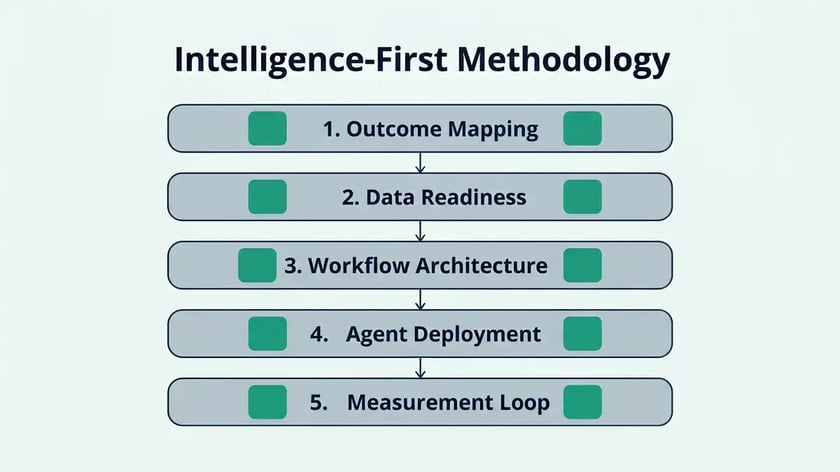
The methodology is a sequenced stack, not a checklist. Each layer is a logic gate: the next layer does not begin until the current one has passed its success criteria. Skipping layers is how organisations end up in the 95%. Compressing layers is how organisations end up with technically successful pilots that never scale. The five layers, executed in order, are Outcome Mapping, Data Readiness, Workflow Architecture, Agent Deployment, and the Measurement Loop.
Outcome Mapping
Define the specific, quantifiable business outcome in a single sentence: "We will reduce [cost] by [%] within [timeframe]" or "We will increase [revenue metric] by [amount] by [date]." Establish the RAND-style "use-case charter" — workflow currently operating, quantifiable outcome to be improved, success criteria, data required, and organisational change required. If the team cannot complete these sentences with concrete specificity, do not proceed to Layer 2.
Data Readiness
Apply Gartner's definition: data aligned to the specific use case, actively governed at the asset level, supported by automated pipelines with quality gates, managed through live metadata, and continuously quality-assured. Allocate 50-70% of initial project budget to this layer. McKinsey's 2025 global AI survey found organisations reporting significant financial returns from AI are twice as likely to have redesigned end-to-end data workflows before selecting modelling techniques.
Workflow Architecture
Design the end-to-end workflow before selecting the agent or model. Specify handoff points between human and machine, decision rights, escalation logic, and audit trails. This is where lead nurturing sequences, proposal generation, and onboarding flows are redesigned for agentic execution rather than bolted onto legacy processes. Workflow architecture is the layer where Technology-First implementations most visibly fail: they skip it entirely.
Agent Deployment
Only now does technology selection occur. Vendor partnership succeeds 67% of the time versus 33% for internal build, according to MIT NANDA. Select the specific agent or model that best addresses the defined outcome with the prepared data inside the designed workflow. Deploy in a phased manner with measurement gates: top performers achieve 90-day pilot-to-full-implementation timelines versus nine months for the broad enterprise.
Measurement Loop
Continuous measurement with a defined reporting cadence: weekly utilisation and quality tracking, monthly proficiency assessment, quarterly business value calculation, annual portfolio review. Track time saved per task, accuracy achieved, decision velocity, cost reduction, and revenue impact — not login counts. This is the layer that converts a successful pilot into a durable, scaled business asset.
Avoid This Mistake
Do not compress Layers 2 and 3 to accelerate time-to-pilot. Organisations that skip data readiness or workflow architecture in pursuit of a faster demonstration generate the exact failure pattern MIT documents: technically impressive pilots that cannot be operationalised because the data was never ready and the workflow was never designed. Slower through the gates is faster to value.
How Do Successful Companies Deploy AI?
The winning 5% distinguish themselves through deliberate methodological choices that replicate across organisation sizes and verticals. The named case studies are unambiguous: JPMorgan Chase, Klarna, Zurich Insurance Group, and Moderna all share the same success signature — outcome-first definition, back-office operational focus, vendor partnership where domain expertise matters, phased implementation with measurement gates, and governance anchored in finance and business unit leadership rather than centralised technology organisations.
JPMorgan Chase's generative AI programme now operates 450 use cases with enterprise-wide data readiness initiatives underpinning the scale. The bank concentrated initial deployment on three major back-office functions — including EVEE Intelligent Q&A for call centre specialists and the LLM Suite for firm-wide knowledge access — rather than chasing customer-facing transformation. This is Intelligence-First in action: identify specific workflow problems, partner where appropriate, measure, scale what works.
Klarna's investor disclosures demonstrate the outcome at organisational scale: since Q4 2022, the company has achieved 104% revenue growth whilst simultaneously reducing operating expenses by 8%. That inverse relationship — revenue up, opex down — is precisely the outcome every CFO pursuing AI transformation wants, and exactly what the other 95% of AI programmes fail to deliver. Zurich Insurance Group's AI deployment generated a 58-fold reduction in claim review time and USD 40 million in annual underwriting leakage savings through Expert AI natural language processing, with HighRadius cash application software achieving 85% straight-through invoice processing. Zurich built almost nothing internally — it partnered where partnership was the higher-probability path to outcome.
| Company | Intelligence-First Signature | Quantified Outcome |
| JPMorgan Chase | Back-office focus, phased scaling | 450 use cases in production |
| Klarna | Systemic deployment, opex discipline | +104% revenue, -8% opex since Q4 2022 |
| Zurich Insurance Group | Vendor partnership, claims workflow | 58x faster claim review, $40M annual savings |
| Moderna | Competency-based measurement | AI Fitness Score tracks reasoning-model use |
| Google Cloud customers | Phased agent deployment | 74% achieve ROI in year one |
Sources: Tearsheet on JPMorgan Chase, Klarna Investor Relations, Klover.ai on Zurich Insurance, Moderna AI Fitness Score analysis, Google Cloud ROI research.
Moderna's AI Fitness Score is the measurement innovation worth stealing. Rather than counting logins or query volume — metrics that reflect activity, not competency — Moderna tracks whether employees are using reasoning models for complex, multi-step work. The distinction matters because reasoning-model usage correlates with genuine AI-human collaboration, while shallow query usage does not. This is the kind of measurement discipline Layer 5 of the Intelligence-First stack operationalises, and it is one of the reasons Google Cloud's research documents 74% of organisations deploying AI agents in production achieve ROI in the first year.
What Is the Governance Problem with Shadow AI?

Shadow AI — tool adoption proceeding outside formal governance — has become endemic. KPMG's 2025 Shadow AI research found 41-44% of employees use AI in ways that contravene established policies. That is not a rogue-employee problem. It is a governance-design problem. Most enterprise AI governance frameworks were architected for traditional software lifecycles with annual review cycles, while AI capability evolves monthly. The result is governance that is simultaneously too complex, too generic, and too stale to be useful — so employees rationally route around it.
The downstream exposure is severe. Writer.com's 2026 enterprise survey reports 67% of executives believe their organisations have already suffered data leakage or security breach attributable to unapproved AI tools, 35% of employees have entered proprietary information into public AI tools, and 36% of enterprises have no formal plan for supervising AI agents. Add the documented USD 67.4 billion in enterprise losses from LLM hallucinations in 2024 alone, and the cumulative risk profile becomes material to enterprise valuation.
Intelligence-First governance is continuous, embedded, and outcome-linked. Rather than a static compliance document reviewed annually, it is a real-time monitoring layer wired into the workflow itself — audit logging on every autonomous decision, hallucination detection at the output layer, drift monitoring against baseline performance, and kill-switch authority vested in the business unit accountable for the outcome. The architecture matches the velocity of the technology it governs, which is the only way to prevent Shadow AI from recurring.
How Should You Measure Intelligence-First Success?
Only 51% of organisations can confidently evaluate AI ROI, according to CloudZero's State of AI Costs 2025. Nearly half of enterprise AI spenders cannot determine whether their investments produce value — while spend accelerates at 36% annually, and the share of organisations spending over USD 100,000 monthly on AI tools more than doubled from 20% in 2024 to 45% in 2025. This is the definition of capital allocation without feedback loops, and it is why a rigorous measurement framework is the final, non-negotiable layer of the Intelligence-First Methodology.
The measurement framework has three components. Baseline establishment: before AI deployment, capture current-state performance — time per task, quality levels, error rates, and cost. Without the baseline, no subsequent measurement can prove impact. Leading indicators: weekly tracking of utilisation quality (not volume), output accuracy, workflow throughput, and handoff success rates. Lagging indicators: monthly proficiency assessment, quarterly business value calculation, annual portfolio review. The cadence matters because lagging indicators alone do not allow course correction; leading indicators alone do not prove value to finance.
Key Takeaway
Adoption is not a business outcome. Logins, queries, and tool deployments are vanity metrics. Measure time saved per task, decision velocity, error reduction, cost reduction, and revenue impact. CFO-led AI projects achieve "great value" 76% of the time because the CFO refuses to accept anything else — and that financial discipline is the mechanism that converts successful pilots into scaled, durable assets.
Frequently Asked Questions
Why do most AI projects fail?
Most AI projects fail because of systematic organisational dysfunction rather than technological limitation. MIT's Project NANDA documented a 95% failure rate for generative AI pilots in July 2025, and RAND Corporation identified 80%+ failure for broader AI projects reaching production. The root causes are consistent across research: misaligned incentives, inadequate data readiness, misspecified problem definition, governance voids, insufficient change management investment, technology-first selection methodology, and vendor dependency. Fixing any one of these in isolation does not rescue a failing programme — the failure modes compound. The Freedom Machine approach treats AI as a business transformation programme rather than a technology initiative, which is the only architecture that addresses all seven root causes simultaneously.
What is the difference between intelligence-first and technology-first AI?
Technology-first methodology begins with platform or model selection and then scans internally for problems that platform might solve. Intelligence-first inverts the sequencing: define the quantifiable business outcome, establish data readiness, design the workflow architecture, and only then select the agent or model. The downstream consequences are profound. Technology-first typically allocates 15-25% of budget to data infrastructure; intelligence-first allocates 50-70%. Technology-first places governance under the CIO or CTO; intelligence-first positions the CFO and business unit leadership as accountable owners. MIT research indicates technology-first AI programmes account for the 95% failure rate, while intelligence-first programmes deliver 100-400% year-one ROI.
How much should a company budget for AI implementation?
Successful AI programmes allocate approximately 50-70% of initial investment to data readiness (extraction, normalisation, governance, metadata, quality dashboards, retention controls), 15-25% to model development and training, and 10-20% to integration and deployment. Ongoing operations and monitoring consume an additional 20-30% of initial project cost annually. The most common budget failure is underestimating data readiness — 85% of organisations misestimate implementation costs by more than 10%, and nearly 25% are off by 50% or more, with estimates almost invariably too low. Organisations that insufficiently fund data infrastructure encounter production failures requiring expensive remediation, which is precisely the pattern documented in the BCG analysis of USD 114 billion in wasted AI spend.
Who should own AI projects in the organisation?
IBM's 2025 CEO study found that CFO-led AI projects achieve "great value" 76% of the time, substantially higher than any other organisational owner. The mechanism is financial accountability discipline: CFOs define clear ROI criteria before a project commences and cancel when metrics are not met, which prevents the "impressive pilot, zero business value" pattern endemic to technology-led programmes. Intelligence-first governance typically operates as a shared model — CFO or finance leadership accountable for outcome achievement, business unit leadership accountable for workflow integration, and technology leadership accountable for platform reliability and security. This tri-party structure distributes risk and aligns incentives across the dimensions that actually determine project success. Integrate it with your CRM automation and sales administration governance from day one.
What is shadow AI and why is it dangerous?
Shadow AI is the use of artificial intelligence tools outside formally approved governance frameworks — employees using ChatGPT, Claude, or other public models for work-related tasks without organisational authorisation or oversight. KPMG's 2025 research found 41-44% of employees use AI in ways that contravene established policies, and 67% of executives believe their organisations have already suffered data leakage or security breaches from unapproved AI tools. The danger is not the technology but the absence of audit trails: proprietary information enters public model training datasets, hallucinated outputs feed downstream decisions without validation, and organisations have no way to respond to regulatory inquiry or customer escalation. Intelligence-first governance prevents Shadow AI by providing sanctioned, integrated alternatives for the workflows employees are trying to complete, rather than by restricting access.
How long should an AI pilot take?
Top-performing organisations achieve 90-day timelines from pilot to full implementation, while the broader enterprise average is nine months or longer — a 10-fold velocity difference that reflects discipline rather than technology choice. The 90-day pattern is possible because successful organisations move deliberately through defined phases with explicit success criteria between stages, rather than conducting extended ambiguous pilots. Google Cloud research indicates 74% of organisations deploying AI agents in production achieve ROI within the first year, and those organisations start with proven use cases but select strategically — customer service resolution, inventory optimisation, content personalisation — where autonomous decision-making creates immediate measurable value. Long pilots are almost always a symptom of missing Layer 1 (Outcome Mapping) or Layer 2 (Data Readiness), not a symptom of ambitious scope.
What is the Intelligence-First Methodology's most important layer?
Layer 1 — Outcome Mapping — is the most important because every subsequent layer depends on it. If the business outcome is not specified with quantitative precision ("reduce [cost] by [%] within [timeframe]"), Layer 2 cannot determine which data is required, Layer 3 cannot design the correct workflow, Layer 4 cannot select the appropriate agent, and Layer 5 cannot measure success. MIT research identifies "defined outcome before build starts" as the single characteristic separating the 5% of successful implementations from the 95% failing to deliver impact. In practice, if a project team cannot complete the RAND-style use-case charter with concrete specificity, the correct response is to stop the project and return to Outcome Mapping — not to proceed and hope clarity emerges during build. Pair Outcome Mapping with the 4 Pillars diagnostic to identify which business functions offer highest-leverage outcomes.
Install the Intelligence-First Operating System
peppereffect architects logic-gated AI operating systems across the 4 Pillars — lead generation, sales administration, operations, and marketing classics. We install the five-layer Intelligence-First stack, connect it to measurable P&L outcomes, and hand you a Freedom Machine that decouples revenue from headcount. No billable-hours model. No generic consulting. A deployable system.
Book a Growth Mapping CallResources
- Fortune — MIT report: 95% of GenAI pilots at companies are failing (August 2025)
- BCG — AI at Work 2025: Momentum Builds, but Gaps Remain
- IBM Newsroom — CEOs Double Down on AI While Navigating Enterprise Hurdles (May 2025)
- Harvard Business Review — Most AI Initiatives Fail. This 5-Part Framework Can Help (November 2025)
- McKinsey QuantumBlack — The State of AI: Global Survey 2025
- Google Cloud — The ROI of AI: Agents Are Delivering for Business Now
- Writer.com — Enterprise AI Adoption 2026: Why 79% Face Challenges Despite High Spend
- KPMG — Shadow AI Is Already Here: Take Control, Reduce Risk, Unleash Innovation (2025 PDF)
- Squirro — Why 40% of Agentic AI Projects Will Fail (Gartner forecast analysis)
- CloudZero — The State of AI Costs 2025