

What Is an AI Proposal Generator?
An AI proposal generator uses artificial intelligence to create business proposals in minutes instead of hours — pulling client details, pricing systems-dependent proposal pricing, service descriptions, and legal terms from integrated systems, then drafting polished, personalised documents with minimal manual input. For B2B sales teams buried in administrative work, this represents the difference between responding to a prospect within the critical first hour and losing the deal to a competitor who moved faster. HubSpot research confirms that companies responding to a lead within one hour are 7x more likely to qualify that lead than those who respond even an hour later.
The market has responded accordingly. The global sales enablement platform market — which includes proposal automation as a core component — reached $6.91 billion in 2026 and is projected to hit $20.02 billion by 2033 at a 16.4% CAGR, according to Coherent Market Insights. Yet a paradox persists: while 81% of B2B sales teams claim to have implemented AI, only 19% of individual sales reps actually use the AI features built into their tools. The gap between organisational intent and frontline execution is where most proposal automation initiatives stall — and where the real opportunity lives.
This article breaks down exactly how AI proposal generators work, what measurable ROI they deliver, which platforms lead the market in 2026, and how to implement one without killing adoption. If you are a SaaS CEO or sales leader trying to automate your sales administration and decouple revenue growth from headcount, this is the systems-level blueprint.
What you'll learn in this article:
- Why manual proposal creation is the highest-cost bottleneck in B2B sales administration
- How AI proposal generators integrate with CRM, CPQ, and e-signature systems to automate the full document lifecycle
- Measurable ROI benchmarks: time savings, close rate improvements, and sales velocity acceleration
- A platform comparison framework for choosing the right proposal automation software for your stack
- The shift from generative AI to agentic proposal automation — and what it means for 2026
- Implementation roadmap with change management strategies that prevent the 81/19 adoption gap
Key Takeaway
An AI proposal generator eliminates the 3-8 hour manual bottleneck per B2B proposal by pulling CRM data, pricing, and templates into polished documents in minutes. Companies using proposal software see close rates increase from 20% to 36% — a 1.8x improvement — while freeing sales teams to spend time on revenue-generating activities instead of document assembly.

Why Do B2B Sales Teams Lose 70% of Their Week to Admin Work?
Sales professionals spend nearly 70% of their week on administrative tasks, leaving only 30% for actual selling activities. This is not a minor inefficiency — it is a structural failure in how most B2B organisations operate. When you break it down, typical B2B teams allocate just 25-40% of working hours to customer-facing and prospecting activities, while high-performing, well-automated teams achieve 45-55%. The remaining hours disappear into internal meetings (5-10 hours weekly), CRM data entry, approvals, deal desk coordination, forecasting, and — critically — manual proposal creation.
The proposal bottleneck is particularly destructive because it sits at the exact point where deals are won or lost. Creating a custom B2B proposal typically requires 3-8 hours of manual effort per document: gathering project requirements, defining scope, establishing timelines, specifying technology stacks, calculating pricing, and integrating legal terms. For a team of five sales reps each creating four proposals per month, that consumes 240-640 hours annually — the equivalent of 2.3 full-time employees doing nothing but assembling documents. Meanwhile, the sales pipeline stalls because prospects who don't receive timely proposals lose interest and move to competitors who responded faster.
The broader sales environment compounds this pressure. According to Everstage's 2026 sales productivity benchmarks, only 43.5% of sales professionals hit quota in recent quarters. Win rates have declined 18% versus 2022 and 27% versus 2021, while sales cycles grew 16% before stabilising. Average deal values dropped 21% as tighter budgets increase scrutiny on every purchase. Sales teams are working harder to close smaller deals in longer cycles with lower success rates — and manual proposal creation makes every one of those metrics worse.
| Metric | Current Benchmark | Impact on Proposals |
| Admin time per week | 70% of working hours | Only 30% left for selling and proposal follow-up |
| Manual proposal creation | 3-8 hours per document | Delays response by days, killing deal momentum |
| Quota attainment | 43.5% of reps hit quota | Admin burden directly erodes selling capacity |
| Win rate decline | -18% vs. 2022 | Slower proposals mean fewer competitive bids submitted |
| Sales cycle growth | +16% YoY before stabilising | Longer cycles amplify every day lost to proposal delays |
| Average deal value | -21% decline | Teams must close more deals to hit same targets |
Sources: Everstage — Sales Productivity Statistics 2026, HubSpot — B2B Sales Admin Time, Umbrex — Sales Time vs Admin Time
How Does an AI Proposal Generator Actually Work?

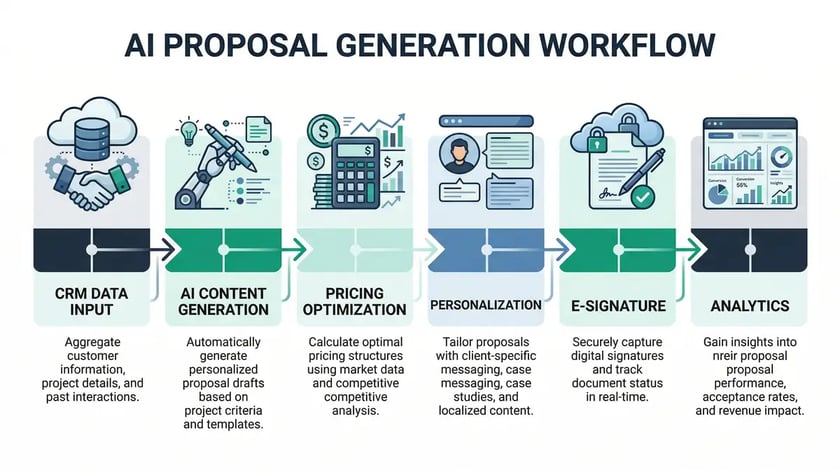
An AI proposal generator ingests data from your CRM, pricing engine, and content library, then uses natural language generation to produce a complete, personalised proposal draft in seconds. The system learns patterns from historical proposals — linking product bundles to buyer personas, understanding how pricing tiers change based on volume or contract length, and recognising which value propositions resonate with different industries. According to DealHub's technical overview, the fundamental process begins when a seller inputs key deal data, which the AI maps to relevant proposal sections, applies natural language generation, and presents a draft for review before final delivery.
The personalisation layer is what separates AI proposal writers from basic template tools. Instead of filling in merge fields, the AI adapts content based on CRM data, industry vertical, buyer persona, and past interactions — adjusting headlines, case studies, and messaging to fit each deal. It inserts approved products, pricing, and legal content from clause libraries, then locks branding, legal language, and pricing formats into templates to prevent reps from making commitments inconsistent with company strategy. This is a critical distinction from manual proposal creation, where every document is effectively a one-off risk.
The integration architecture connects three critical systems into a seamless document workflow:
CRM Integration — Single Source of Truth
The proposal generator connects to your CRM system (HubSpot, Salesforce) to pull contact details, deal stage, company data, and interaction history. Proposify's HubSpot integration allows reps to create, edit, send, and track proposals directly within the CRM without ever leaving it — with live proposal updates flowing to the HubSpot timeline automatically.
CPQ Engine — Dynamic Pricing and Configuration
For complex product offerings, Configure-Price-Quote (CPQ) integration ensures pricing accuracy. XaitCPQ integrated with Salesforce enables teams to manage hierarchical price books based on customer-specific data, apply date-driven and risk-adjusted pricing models, and cut quote creation time by up to 70% while improving bid response rates by 65%.
E-Signature and Analytics — Close Without Friction
Built-in e-signature capabilities let prospects view branded proposals, review pricing, and sign without switching platforms. Real-time analytics track which sections prospects spend time on, how long they engage, and whether they scroll through pricing tables — enabling strategic follow-up timing based on actual prospect behaviour instead of assumptions. Learn more about document intelligence and prospect tracking.

What ROI Can You Expect from Proposal Automation Software?
The financial case for proposal automation is not marginal — it is transformational. One independent analysis calculated a net benefit of $945,787 in the first year with a 7,889% ROI and payback in under a month, according to Bidara's proposal automation ROI calculator. While that figure reflects a high-volume enterprise scenario, even mid-market implementations show compelling returns when you stack the three primary benefit layers: labour cost savings, close rate improvements, and sales velocity acceleration.
Consider a mid-market software company with 20 sales reps, each creating four proposals monthly (960 annually), currently spending 5 hours per proposal. That is 4,800 hours annually — 2.3 FTE at fully loaded cost of $345,000-$460,000 per year. Proposal automation reduces creation time to 30 minutes per proposal (including AI generation, review, and revision), saving 2.07 FTE or $310,500-$414,000 annually in labour cost alone. But the revenue impact dwarfs labour savings: a 6% improvement in win rates (based on interactive proposal research) on 960 proposals at 30% baseline win rate and $50,000 average deal value generates $8.64 million in additional annual revenue.

The close rate improvements are well-documented across the industry. The baseline B2B close rate sits at approximately 20%, but companies using proposal software increase this to 36% — a 1.8x improvement, as reported by Proposify's close rate analysis. Interactive pricing tables increase close rates by an additional 6%. Most counterintuitively, proposals with revisions show progressively higher close rates: one revision delivers a 37% improvement, two revisions a 42% improvement, and three revisions a 50% improvement. This means proposal systems should facilitate easy iteration, not discourage it. Use the peppereffect automation ROI calculator to model these returns for your specific scenario.
| ROI Dimension | Metric | Impact |
| Labour cost savings | 2.07 FTE freed annually (20-rep team) | $310,500-$414,000/year |
| Close rate improvement | 20% → 36% (1.8x uplift) | $8.64M additional annual revenue potential |
| Interactive pricing uplift | +6% close rate | Compounds across all proposals submitted |
| RFP response time | 25 hours → 2.5 hours (90% reduction) | Enables 10x more RFP responses per quarter |
| RFP win rate | 45% average → 50%+ with AI tools | $500K additional revenue per 100 RFPs at $100K ACV |
| Implementation payback | 4-52 weeks depending on volume | First-year ROI exceeds 300-500% |
Sources: Bidara — Proposal Automation ROI Calculator, Proposify — Boost Close Rates, Inventive AI — RFP Response Trends 2026
Key Takeaway
Proposal automation ROI compounds across three layers simultaneously: labour savings ($310K-$414K/year for a 20-rep team), close rate improvements (1.8x uplift from 20% to 36%), and velocity acceleration (90% reduction in RFP response time). The implementation payback period is typically 4-52 weeks, making this one of the highest-ROI investments in B2B sales infrastructure.
How Do You Choose the Right AI Proposal Writer for Your Stack?
Platform selection should follow a three-dimensional framework: process maturity, integration architecture, and vendor viability. Organisations with documented proposal processes, governance frameworks, and content libraries extract more value from comprehensive platforms, while those with ad-hoc, rep-driven processes benefit from simpler template-focused tools initially. The second dimension is integration depth: if your CRM and marketing automation stack runs on HubSpot or Salesforce, prioritise proposal solutions with native integrations rather than requiring middleware or custom development.
| Platform | Starting Price | Best For | Key Differentiator |
| Proposify | $19/user/month | B2B sales teams (mid-market) | HubSpot-native integration, control-focused positioning |
| PandaDoc | $19/user/month | Enterprise document automation | $100M+ ARR, comprehensive integrations, payment collection |
| Qwilr | $35/user/month | Interactive web proposals | Dynamic pricing tables, multimedia engagement, real-time analytics |
| Better Proposals | $13/user/month | Agencies and freelancers | Bootstrapped profitability, simplicity, affordability |
| GetAccept | $25/user/month | Video-enhanced sales | Embedded video messages, differentiated engagement |
| Loopio | Custom pricing | RFP response management | Specialised RFP workflows, compliance matrices |
Sources: G2 — Proposify Pricing, Oneflow — Best Proposal Management Software 2026, Better Proposals — Sales Enablement Tools
The vendor viability dimension matters more than most buyers realise. Proposify's journey from near-failure to stabilisation — growing to nearly 100 employees at just $5-6M ARR, burning $400,000 per month at peak, then restructuring to reach $8-11M ARR with sustainable unit economics — illustrates both the opportunity and the risk in this market. PandaDoc's $100 million ARR and billion-dollar valuation signals market leadership and ability to support customers across multiple verticals. For risk-averse organisations, established platforms with strong track records present lower adoption risk, while innovation-focused teams may benefit from newer solutions offering agentic AI capabilities.
Ready to architect your proposal automation system? Read our complete guide to B2B proposal automation for the full implementation blueprint.
Book a Growth Architecture CallWhat Is the Shift from Generative AI to Agentic Proposal Automation?
The defining evolution in proposal automation in 2026 is the shift from generative AI (writing text) to agentic AI (executing workflows). Generative AI produces a draft that a rep must manually insert into a document. Agentic AI handles the complete workflow autonomously: pulling RFP requirements from incoming documents, identifying relevant content from libraries, generating customised responses, checking compliance against requirements, executing approval workflows, and routing the final proposal for signature. As Mindbreeze describes it, agentic AI represents systems designed not only to respond but to act — understanding goals and executing multi-step tasks autonomously within enterprise-grade guardrails.
The adoption data supports this shift. McKinsey research shows that roughly 80% of large and medium-size enterprises report having agentic AI in place in some form — from early pilots to fully scaled deployments. Over the next 12 months, companies expect the share of fully implemented agentic AI solutions to increase by a factor of 2.3x to 2.4x. In RFP management specifically, autonomous agents now handle document "shredding," compliance checking, and response assembly, transforming AI from a drafting tool into a strategic partner that manages the entire bid lifecycle. The result: 90% faster response times compared to manual processes, with RFP responses averaging approximately 2.5 hours instead of the 25-hour industry standard.
Signal-based personalisation adds another layer. Teams using real-time triggers — funding rounds, hiring surges, intent signals — to time outreach see 18% reply rates versus 3.4% for generic cold email, according to Prospeo's B2B sales trends data. Signal-qualified leads drive 47% better conversion rates, 43% larger deal sizes, and 38% more closed deals. When an AI agent workflow recognises that a prospect has received Series B funding, it can automatically surface growth-stage case studies, adjust pricing recommendations for higher budgets, and emphasise scalability features — all without manual intervention. This is the Freedom Machine philosophy applied directly to the proposal function.
Avoid This Mistake
Do not confuse "experimenting with AI" for actual adoption. While 81% of B2B sales teams claim AI implementation, only 19% of individual reps actually use AI features in their sales tools. The remaining reps default to generic chatbot prompts, copy-pasting output into workflows. Sellers who effectively partner with integrated AI are 3.7x more likely to meet quota — but "effectively" means AI embedded into lead scoring, account research, and proposal generation, not "write me a cold email" prompts to ChatGPT.
How Do You Implement an AI Proposal Generator Without Breaking Adoption?
Implementation typically spans 6-16 weeks from project initiation to full production deployment. The critical success factor is not the technology selection — it is the change management architecture that ensures frontline reps actually use the system daily. Most proposal automation initiatives fail at the adoption layer, not the integration layer. The 81/19 paradox (81% organisational adoption claims vs. 19% actual individual usage) exists because sales operations teams purchase tools without designing the adoption pathway for the people who must use them every day.
A structured implementation roadmap prevents this failure pattern:
Foundation and Quick Wins (Months 1-3)
Implement proposal software with CRM integration, establish baseline template libraries, and centralise proposal creation. Target 50% reduction in manual proposal creation time. Demonstrate value to reps and stakeholders through pilot user cohorts representing different segments — SMB, enterprise, new business, expansion deals. Measure pilot users' time savings and let them share success stories naturally to build momentum.
Advanced Personalisation and Analytics (Months 4-8)
Connect signal and intent data to proposal systems, implement e-signature automation, and expand analytics to section-level engagement tracking. Target 6-10% close rate uplift and enable sales management to identify coaching opportunities based on proposal performance data. Set explicit selling-time percentage targets by segment or role and review weekly.
Agentic Workflows and Compliance Automation (Months 9-16)
Integrate RFP automation for organisations managing high RFP volumes. Implement autonomous workflows that route proposals through approval processes and trigger follow-up sequencing based on engagement signals. Deploy AI workflow automation for compliance checking, with agentic systems achieving 95% accuracy in compliance validation while reducing revisions and improving proposal quality.
Manager enablement is the most underestimated lever for adoption sustainability. Sales managers must understand new workflows, know how to review AI-generated proposals for quality and compliance, and be equipped to coach reps on effective use. When approvals consume more than 10% of rep time, streamlining this through the proposal automation platform creates immediate personal benefit that drives adoption organically. Publishing "two-click" guides for common proposal generation tasks reduces perceived complexity and enables quick competency gains across the entire sales and nurturing infrastructure.
Key Takeaway
The 6-16 week implementation timeline matters less than the adoption architecture. Position proposal automation as elevating reps from administrative coordinators to strategic relationship managers, demonstrate time savings through pilot cohorts, and enable managers to coach from proposal analytics. The organisations that close the 81/19 gap — moving from "we bought the tool" to "every rep uses it daily" — are the ones that capture the full 1.8x close rate improvement and 90% time reduction the technology enables.
Frequently Asked Questions
How much does an AI proposal generator cost?
Pricing ranges from $13-$49 per user per month for standard plans across leading platforms. Better Proposals starts at $13/user/month for freelancers and agencies, while Proposify and PandaDoc begin at $19/user/month for B2B sales teams. Enterprise plans with advanced CPQ integration, custom workflows, and dedicated support typically require custom pricing. Implementation costs average $20,000-$50,000 for mid-market companies, covering setup, CRM integration, template creation, and training — with payback periods of 4-52 weeks depending on proposal volume.
Can AI proposal generators integrate with HubSpot CRM?
Yes — several leading platforms offer native HubSpot integrations. Proposify's HubSpot marketplace integration allows reps to create, edit, send, and track proposals directly within HubSpot, with automatic contact sharing, deal linking, and live proposal updates on the HubSpot timeline. PandaDoc offers similar CRM integration capabilities. These integrations eliminate the duplicate data entry that traditionally consumed significant rep time and ensure proposal activity is visible within your existing CRM automation workflows.
What is the difference between an AI proposal generator and a template tool?
Template tools fill in merge fields with static data — name, company, date. An AI proposal generator uses natural language generation to create personalised content based on buyer persona, industry vertical, deal context, and past interactions. It adapts headlines, case studies, value propositions, and pricing recommendations dynamically, then learns from historical proposal performance to improve future outputs. The distinction is automation versus intelligence: templates save formatting time, while AI proposal writers save research, writing, and personalisation time across the entire sales administration workflow.
How long does it take to implement proposal automation software?
Typical implementation spans 6-16 weeks from project initiation to full production deployment. Pre-implementation planning requires 2-3 weeks for stakeholder identification, business requirements documentation, and current-state process mapping. System configuration and testing takes 4-6 weeks, covering template creation, content library population, integration building, and end-to-end workflow validation. User training and rollout adds 2-4 weeks. Organisations with unified CRM data systems and standardised product catalogues experience smoother implementations, while those with fragmented systems and manual pricing processes require additional customisation time.
What close rate improvement can I realistically expect?
Industry benchmarks show the average B2B close rate increases from 20% to 36% when using proposal software — a 1.8x improvement. Interactive pricing tables add another 6% uplift. RFP-specific win rates improve from the 45% average to 50%+ with AI-powered tools. However, these improvements depend on adoption quality: teams where reps actively use integrated AI features see dramatically better results than those where the tool sits unused. The key is pairing the technology with change management that ensures frontline adoption.
Is proposal automation only for large enterprise sales teams?
No. The market offers solutions across every company size. Platforms like Better Proposals ($13/user/month) serve freelancers and small agencies, while Proposify and PandaDoc cater to mid-market B2B teams. The ROI scales with proposal volume — a solo consultant sending five proposals monthly still saves 15-40 hours per month and can scale their service business without proportional headcount growth. The critical factor is not company size but proposal volume and the strategic importance of response speed in your sales cycle.
How does agentic AI differ from generative AI in proposal workflows?
Generative AI produces a text draft that a rep must manually review, format, and insert into a proposal document. Agentic AI executes the complete workflow autonomously: it ingests RFP requirements, identifies relevant content from libraries, generates customised responses, checks compliance, routes through approvals, and delivers the final document for signature. McKinsey reports that 80% of large enterprises now have agentic AI in some form, with fully implemented solutions expected to increase by 2.3-2.4x over the next 12 months.
Stop Losing Deals to Manual Proposal Bottlenecks
peppereffect architects AI-powered sales administration systems that eliminate proposal delays, accelerate deal velocity, and decouple your revenue growth from headcount. Our 4 Pillars methodology installs autonomous proposal generation as part of a complete B2B growth operating system.
Book Your Growth Architecture CallRead the complete proposal automation guide →
Resources
- Coherent Market Insights — Sales Enablement Platform Market Forecast 2026-2033
- Everstage — Sales Productivity Statistics: Trends and Data for 2026
- Proposify — Boost Close Rates with Smarter Proposal Management
- Inventive AI — RFP Response Trends and Benchmarks 2026
- McKinsey — Winning B2B Customers in Technology and Telecommunications
- DealHub — What Is an AI Proposal Generator?
- Loopio — 38 Statistics on RFP Win Rates and Proposal Management
- HubSpot — How B2B Sales Teams Reduce Admin Time