What Are Multi-Agent AI Frameworks and Why Do B2B Companies Need Them?
Multi-agent AI frameworks are orchestration platforms that coordinate multiple specialized AI agents to execute complex business workflows autonomously. Instead of relying on a single large language model to handle everything from lead qualification to proposal generation, these frameworks assign discrete tasks to purpose-built agents that communicate, delegate, and collaborate — mirroring how high-performing B2B teams actually operate. The global multi-agent enterprise systems market reached $7.12 billion in 2026 and is projected to hit $49.64 billion by 2031 at a compound annual growth rate of 47.46%, according to Mordor Intelligence.
For B2B companies deploying agentic workflows across lead generation, sales administration, and operations, framework selection determines deployment speed, total cost of ownership, and long-term scalability. Gartner predicts that 40% of enterprise applications will include task-specific AI agents by the end of 2026, up from less than 5% in 2025, according to OutSystems research published via BusinessWire. This eightfold acceleration means the framework decision you make today will shape your operational architecture for the next three to five years.
What you'll learn in this article:
- How LangGraph, CrewAI, OpenAI Agents SDK, AutoGen, and Anthropic Managed Agents compare on architecture, production readiness, and cost
- Real benchmark data from 750 test runs showing token consumption differences across frameworks
- Total cost of ownership calculations from startup MVP through enterprise deployment
- A decision framework for selecting the right multi-agent architecture for your B2B use case
- Why 94% of organizations are concerned about AI agent sprawl — and how to avoid it
Key Takeaway
Framework selection for multi-agent AI systems should be driven by state management requirements, integration depth, and total cost of ownership — not GitHub star counts or vendor marketing. Multi-agent systems consume up to 15x the tokens of single-agent equivalents, making architectural decisions the single largest determinant of operational cost.
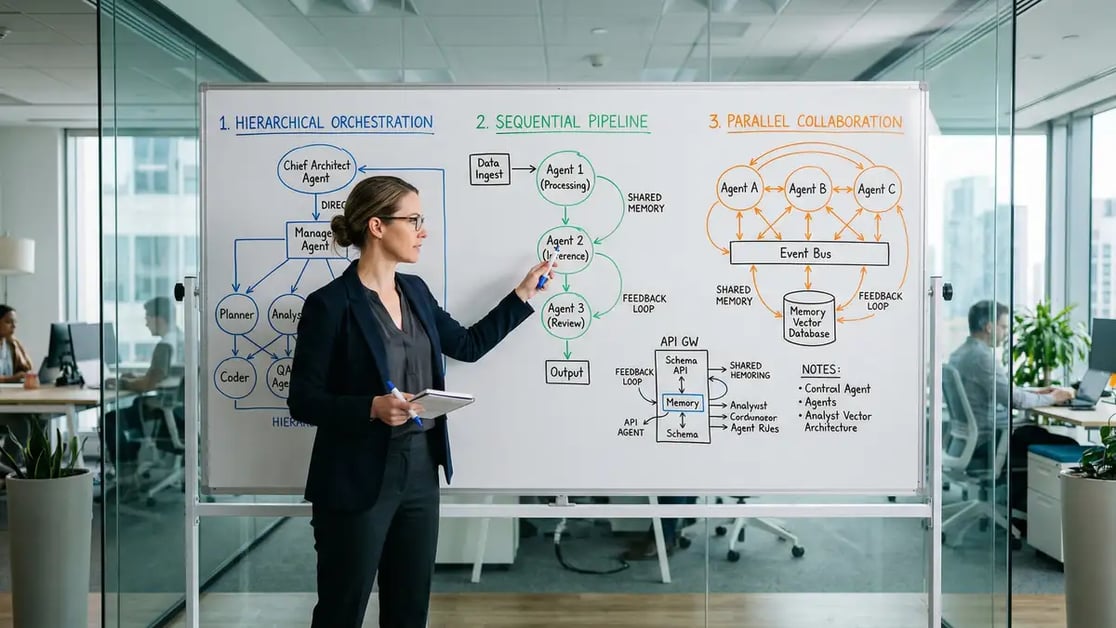
How Do the Leading Multi-Agent AI Frameworks Compare on Architecture?
The five dominant frameworks each take fundamentally different approaches to orchestrating multi-agent collaboration. Understanding these architectural differences is essential because they determine everything from debugging capability to token efficiency — and ultimately your automation ROI.

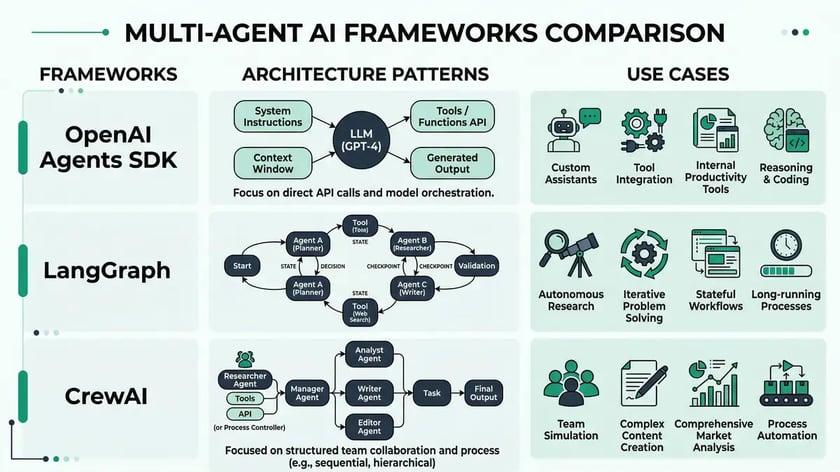
LangGraph models agent workflows as directed graphs with typed state objects. Nodes represent agents or functions, edges define transitions including conditional routing, and a shared state object flows through the graph. The standout feature is built-in checkpointing — every state transition is persisted to durable storage, enabling time-travel debugging and human-in-the-loop approvals at any execution point. LangGraph leads adoption with 27,100 monthly searches and 126,000 GitHub stars, with production deployments across LinkedIn, Uber, and 400+ companies, as reported by HighPeak Software. The learning curve typically requires one to two weeks to reach production competency.
CrewAI takes a role-based team approach where agents are defined with a role, goal, and backstory. It simplifies multi-agent orchestration through predefined agent types — researchers, writers, reviewers, managers — that map intuitively to organizational functions. CrewAI reached 45,900+ GitHub stars and powers over 12 million daily agent executions in production according to NXCode. Working multi-agent systems can be defined in under 20 lines of Python, with teams reporting idea-to-production timelines of under one week versus 4-6 weeks with LangGraph.
OpenAI Agents SDK emerged in March 2025 replacing the experimental Swarm library, built around the handoff primitive where agents transfer control explicitly while carrying conversation context through transitions. This reduces context saturation — instead of all agents seeing all previous outputs, each agent receives only relevant execution history, maintaining bounded context sizes. The SDK includes built-in guardrails for input/output validation and end-to-end tracing, as documented by HappyCapy Guide.
Microsoft AutoGen (AG2) introduces GroupChat as its primary coordination pattern where multiple agents participate in shared conversations and a configurable selector determines who speaks next. This excels at code generation and research tasks where agents need to iterate and critique each other's outputs through structured debate. The trade-off is cost: a 4-agent debate with 5 rounds represents 20 LLM calls minimum.
Anthropic Managed Agents, announced April 8, 2026, abstracts away sandboxing, orchestration, and observability infrastructure. It virtualizes the core agent components — session, harness, and sandbox — enabling each to be swapped independently. This removes 3-6 months of infrastructure engineering work but creates vendor lock-in to Anthropic's infrastructure, as detailed by Anthropic's engineering blog.
| Dimension | LangGraph | CrewAI | OpenAI SDK | AutoGen/AG2 | Anthropic Managed |
| Orchestration Model | Directed graph with typed state | Role-based teams, sequential | Explicit handoffs | Conversational GroupChat | Hosted harness abstraction |
| State Persistence | Built-in checkpointing + time travel | Task outputs, auto context passing | Context variables, ephemeral | Conversation history, in-memory | Managed sessions |
| Vendor Lock-in Risk | Low (open-source, any LLM) | Low (open-source, model-agnostic) | High (OpenAI-optimized) | Low (open-source, any LLM) | High (Anthropic infra) |
| Token Efficiency | Good (selective context flow) | Moderate (sequential overhead) | Excellent (handoff isolation) | Poor (debate overhead) | Good (managed optimization) |
| Learning Curve | 1-2 weeks | 1 day | 2-3 days | 1-2 weeks | 1 day (no infra) |
Sources: HighPeak Software, NXCode, HappyCapy Guide
What Do the Performance Benchmarks Actually Show?
Marketing claims and GitHub stars tell you nothing about production economics. Benchmark data from 750 test runs across five frameworks reveals where the real costs hide — and the results challenge the assumption that more agents always produce better outcomes.
A comprehensive benchmark conducted by AIMultiple tested five frameworks on three progressively complex tasks. CrewAI's sequential execution model forces all agents to execute in order, causing exponential token growth as each agent's output compounds into the next agent's context. In the most complex task, CrewAI's framework overhead reached 1.35 million tokens — approximately 24x higher than AutoGen's 56,700 tokens and 100x higher than LangGraph's 13,500 tokens. This architectural rigidity ensures completeness but creates massive cost overhead.
Real-world latency measurements reveal equally stark differences. A six-agent mesh architecture produced P95 latency of 18 seconds at $8-12 per query. Restructuring to a two-agent pipeline reduced latency to 3 seconds and cost to $0.40 per query — with less than 1% accuracy difference, according to analysis from CodeBridge Technology. This is the core trade-off: additional agents provide marginal accuracy improvements at exponential cost.
| Framework | Token Overhead (Complex Task) | P95 Latency | Cost per Query | Accuracy |
| LangGraph | ~13,500 tokens | 2-4 sec | $0.30-0.80 | High (consistent) |
| CrewAI | ~1,350,000 tokens | 8-15 sec | $2.00-8.00 | High (sequential) |
| OpenAI Agents SDK | ~15,000 tokens | 2-3 sec | $0.20-0.60 | High (bounded context) |
| AutoGen/AG2 | ~56,700 tokens | 10-18 sec | $4.00-12.00 | Highest (debate refines) |
| Single-Agent Baseline | ~5,000 tokens | 1-2 sec | $0.05-0.15 | Good (94% accuracy) |
Sources: AIMultiple Benchmark (750 runs), CodeBridge Technology
Key Takeaway
Multi-agent systems consume up to 15x the tokens of single-agent equivalents. A compliance document workflow costing $6,200 annually with a single agent balloons to $93,000 with a four-agent pipeline — for a 3 percentage point accuracy improvement. Before selecting a multi-agent framework, validate that multi-agent orchestration is genuinely justified versus a well-prompted single agent with optimized workflow automation.
Avoid This Mistake
Don't default to multi-agent architectures because they sound more sophisticated. A single-agent system classifying documents at 94% accuracy only reaches 97% with a four-agent pipeline — while costing 3.7x more in API fees and requiring 3-5x the engineering hours. Start with a single agent, measure where it fails, and add agents only at specific failure points.
What Does Each Framework Actually Cost to Deploy?
Framework platform fees represent only 5-15% of total multi-agent system costs. The remaining 85-95% comes from underlying LLM API charges and supporting infrastructure. Understanding the full total cost of ownership prevents budget surprises that derail B2B automation initiatives.

OpenAI Agents SDK follows pure consumption pricing with GPT-5.4 at $2.50 input / $15.00 output per million tokens, and GPT-5.4 Mini at $0.75/$4.50 for lighter tasks, as detailed by MetaCTO. LangGraph operates through LangSmith on a tiered subscription at $20-200/month plus LLM costs. CrewAI offers a freemium model with enterprise tiers at $50-200/month. Hidden costs consistently consume 30-50% of budgets: integration development ($10,000-60,000), security hardening ($15,000-45,000), testing ($10,000-30,000), and change management ($10,000-30,000).
A critical cost optimization strategy is model tiering, where frontier models handle complex reasoning while budget models handle routing and classification. Assigning GPT-5.4 to orchestration, GPT-5.4 Mini to lead qualification, and GPT-4.1 Nano ($0.10/$0.40 per million tokens) to data classification reduces average cost per execution by approximately 50%, as analyzed by MindStudio. Cache pricing innovations offering 90% discount on cached input tokens further reduce costs by 40-70% for workflows processing repeated context.
| Cost Category | Startup / MVP | Series A/B | Enterprise |
| Recommended Framework | CrewAI (speed) | LangGraph (control) | LangGraph + MCP |
| Initial Build | $25-50K | $100-300K | $500K-2M+ |
| Annual Ongoing Cost | $50-200K | $200K-1M | $1-5M |
| Team Size Required | 1-2 engineers | 3-5 engineers | 10-20+ engineers |
| Deployment Timeline | 2-4 weeks | 8-12 weeks | 6-12 months |
| Agent Count | 1-5 agents | 5-15 agents | 50-200+ agents |
Sources: GroovyWeb, MindStudio, MetaCTO
Need help architecting the right multi-agent framework for your B2B operations? Talk to our team about building your autonomous growth infrastructure.
Book a Growth Mapping CallHow Should B2B Companies Choose the Right Framework?
Framework selection should follow explicit decision criteria — not default to the highest GitHub star count. The build vs. buy decision starts with a fundamental question: does your workflow actually require multi-agent orchestration, or would a well-prompted single agent with retrieval-augmented generation deliver equivalent results at a fraction of the cost?
If multi-agent orchestration is justified, classify your workflows by orchestration pattern requirements:
Assess Multi-Agent Necessity
Before selecting any framework, validate that multi-agent orchestration is genuinely required. If a single agent with optimized prompts and RAG achieves 90%+ accuracy on your workflow, the 15x token cost of multi-agent systems is unjustifiable. Map each workflow step — only add agents where a single agent demonstrably fails.
Classify Your Orchestration Pattern
Sequential workflows (steps in predetermined order) → CrewAI. Conditional routing (pathways depend on intermediate outputs) → LangGraph or Google ADK. Long-running with checkpointing → LangGraph only. Debate/refinement tasks → AutoGen. Match the framework to your workflow's structural requirements.
Evaluate Vendor Lock-in Tolerance
If you need flexibility to mix models from multiple providers (OpenAI, Anthropic, open-source), prioritize model-agnostic frameworks: LangGraph, CrewAI, AutoGen. If deep integration with a specific vendor's stack is strategically valuable — such as Anthropic's managed infrastructure for regulated industries — lock-in becomes an acceptable trade-off.
Quantify 3-Year Total Cost of Ownership
Use 3-year projections, not initial platform fees. A CrewAI MVP costs $50-150K in Year 1 but $200-600K over three years. A LangGraph production system runs $150-400K in Year 1 but $400K-1.2M over three years. Factor in integration development (20% of budget), security hardening (15%), and change management (10%).
Plan for Interoperability Standards
The Agent-to-Agent (A2A) Protocol reached 150+ supporting organizations within one year. Model Context Protocol (MCP) is becoming foundational infrastructure. Select frameworks with native A2A and MCP support — this future-proofs your architecture for heterogeneous multi-framework deployments.
Which B2B Use Cases Benefit Most from Multi-Agent Systems?
Not every B2B workflow justifies multi-agent complexity. The highest-ROI deployments share specific characteristics: they involve multiple data sources, require reasoning across interconnected business context, and benefit from specialized agent expertise at discrete workflow stages. The key is matching use case complexity to framework capability without over-engineering.
Lead generation and qualification represents the highest-impact near-term application. AI agents reduce time-to-first-contact from hours to seconds while maintaining structured CRM-ready data capture, as documented by Nurix AI. A typical multi-agent lead generation pipeline assigns one agent to prospect research, another to qualification scoring against Ideal Customer Profile criteria, and a third to personalized outreach sequencing. CrewAI's role-based framework maps particularly well here — agents defined as "researcher," "qualifier," and "outreach coordinator" mirror actual sales team structures.
Sales pipeline management benefits from LangGraph's conditional routing when deal progression requires different agent paths based on prospect behavior signals. Teams integrating AI agents report 83% revenue growth compared to teams without agent support, with deal size increases of 15% and sales cycle compression of 25%. The orchestration pattern assigns agents to account research, opportunity scoring, follow-up sequencing, and proposal generation.
Operations and fulfillment workflows — including client onboarding, project management, and content operations — deploy multi-agent systems where quality control across multiple dimensions matters more than speed. A content operations workflow routes through researcher, writer, editor, fact-checker, and publication agents sequentially, delivering 40-60% reductions in editorial time while maintaining human-in-the-loop oversight at critical quality gates.
| B2B Use Case | Best Framework | Agent Count | Deployment Time | Expected ROI |
| Lead Qualification | CrewAI (sequential) | 3-4 agents | 2-4 weeks | 3-5x pipeline increase |
| Sales Pipeline | LangGraph (conditional) | 4-6 agents | 6-10 weeks | 25% cycle compression |
| Client Onboarding | CrewAI or LangGraph | 3-5 agents | 4-8 weeks | 60% time reduction |
| Content Operations | CrewAI (role-based) | 4-5 agents | 2-4 weeks | 40-60% editorial savings |
| Compliance Processing | LangGraph (checkpointing) | 3-4 agents | 8-12 weeks | Accuracy: 94% → 97% |
Sources: Nurix AI, CodeBridge Technology

What Are the Biggest Risks of Multi-Agent AI Deployments?
The multi-agent AI market's explosive growth comes with a sobering counterpoint: approximately 40% of multi-agent AI projects are expected to be cancelled by 2027 due to escalating costs, unclear business value, or poor risk management. Understanding these risks before deployment prevents your initiative from becoming a statistic.
AI agent sprawl represents the most pervasive organizational risk. According to the OutSystems 2026 State of AI Development report, 94% of organizations report concern that AI sprawl is increasing complexity and security risk, yet only 12% have implemented centralized governance for agentic AI. Each business unit deploying agents independently using different frameworks creates cumulative technical debt that compounds with every new agent added to the stack. The solution is establishing a centralized agent governance framework before scaling beyond pilot deployments.
Vendor lock-in creates architectural constraints that compound over time. The Enterprise Agentic AI Landscape analysis documents how agentic workflows built on proprietary orchestration layers create switching costs that increase with every workflow deployed. Open standards — particularly the Agent-to-Agent Protocol and Model Context Protocol — provide insurance against lock-in. Both CrewAI (version 1.10) and Google ADK now support native A2A and MCP, enabling agents built on different platforms to coordinate through standardized protocols.
Cost escalation catches organizations off guard when pilot success triggers production scaling. The 15x token multiplier between single-agent and multi-agent systems means a workflow costing $500/month in pilot can reach $7,500/month at production scale before anyone reviews the invoice. Implement model tiering from day one: assign frontier models only to complex reasoning agents and use budget models for routing, classification, and data extraction. This single architectural decision reduces total token costs by 40-60%.
Key Takeaway
The organizations succeeding with multi-agent AI are those treating framework selection as an architectural decision with 3-5 year consequences, not a technology experiment. Stanford research shows that executive sponsors engaged at "strategic integration" level — tying AI adoption to corporate OKRs — achieve organization-wide transformation, while "passive approval" sponsors achieve only isolated departmental improvements.
Where Is the Multi-Agent AI Market Heading Through 2028?
Three trends will reshape the multi-agent framework landscape over the next two years, and B2B companies making framework decisions today need to account for each.
Framework consolidation is accelerating. Microsoft merged AutoGen and Semantic Kernel into a unified Agent Framework. CrewAI secured $18 million in funding and reports that nearly half of Fortune 500 companies now use CrewAI agents. The current fragmentation of 10+ production-ready frameworks will likely narrow to 3-5 dominant platforms by 2028, with LangGraph maintaining leadership through comprehensive state management and neutral vendor positioning, and CrewAI capturing the rapid-prototyping segment.
Open standards are decoupling framework selection from vendor lock-in. The A2A Protocol surpassed 150 supporting organizations within one year and achieved production integration with Azure AI Foundry, AWS Bedrock, and Google Cloud, according to the Linux Foundation. This standardization means organizations can adopt best-of-breed frameworks for specific tasks rather than forcing all use cases onto a single platform — the buy-foundation-build-differentiation model that automation platforms like n8n already enable.
Extended thinking capabilities may reduce multi-agent necessity. Advanced reasoning models from both OpenAI and Anthropic enable individual agents to reason through complex problems with increasing reliability. This could shift architectural patterns away from multi-agent consensus toward single-expert agents with deeper reasoning — reducing both cost and complexity for B2B companies evaluating AI platforms.
Frequently Asked Questions
What is a multi-agent AI system?
A multi-agent AI system coordinates multiple specialized AI agents to execute complex workflows collaboratively. Instead of one large language model handling everything, discrete agents handle specific tasks — research, qualification, writing, analysis — and communicate through an orchestration framework. For B2B companies, this mirrors how high-performing teams operate: specialists collaborating on a shared objective, with each agent bringing domain-specific expertise to its assigned workflow stage. The orchestration framework manages agent communication, state persistence, and error recovery.
Is CrewAI free to use?
CrewAI offers a free tier supporting unlimited users and executions against self-hosted models, making it genuinely free for development and testing. Enterprise tiers providing dedicated infrastructure, advanced monitoring, and priority support range from $50-200/month. However, platform fees represent only 5-10% of total costs — the dominant expense is underlying LLM API consumption, typically $100-1,000/month for production workloads depending on model selection and transaction volume.
How do I build a multi-agent AI system for B2B?
Start by validating that multi-agent orchestration is genuinely needed — a single agent with optimized prompts handles 80% of B2B workflows at a fraction of the cost. If multi-agent is justified, select your framework based on orchestration pattern requirements: CrewAI for sequential workflows requiring rapid prototyping, LangGraph for conditional routing with state persistence, or OpenAI Agents SDK for handoff-based delegation. Connect to your existing CRM and marketing automation stack through APIs or Model Context Protocol integrations. Budget 2-12 weeks for deployment depending on complexity.
Which multi-agent framework is best for lead generation?
CrewAI is the strongest choice for B2B lead generation workflows because its role-based team structure maps directly to sales operations: a researcher agent profiles prospects, a qualifier agent scores against ICP criteria, and an outreach agent sequences personalized communication. For companies needing conditional routing based on lead behavior signals — where hot leads get immediate follow-up while nurture candidates enter different sequences — LangGraph provides the graph-based orchestration required for that complexity.
How much does it cost to deploy multi-agent AI in a B2B company?
Total cost depends on organizational scale. Startups deploying a CrewAI MVP should budget $25-50K for initial build and $50-200K annually including LLM costs. Series A/B companies implementing LangGraph production systems require $100-300K initial investment and $200K-1M annually. Enterprise deployments with governance and standardization across multiple agent systems run $500K-2M+ initial and $1-5M annually. Hidden costs — integration, security, testing, and change management — typically consume 30-50% of total budgets.
What is the difference between LangGraph and LangChain?
LangChain is a broader framework for building LLM-powered applications with 750+ integrations, while LangGraph is specifically designed for multi-agent orchestration using directed graph architecture. LangGraph builds on LangChain's ecosystem but adds critical production features: built-in checkpointing for state persistence, time-travel debugging, conditional routing between agents, and human-in-the-loop approval gates. Think of LangChain as the integration layer and LangGraph as the orchestration engine — most production multi-agent deployments use both together.
Can I switch multi-agent frameworks later without rebuilding?
Partially. Frameworks with native support for the Agent-to-Agent (A2A) Protocol and Model Context Protocol enable gradual migration by running agents on different frameworks simultaneously. CrewAI 1.10 and Google ADK both support A2A natively. However, deeply embedded state management logic, custom orchestration patterns, and framework-specific tooling create switching costs that compound with every workflow deployed. The pragmatic approach: select your primary framework carefully, then use A2A/MCP standards to integrate specialized agents from other frameworks where needed.
Stop Evaluating Frameworks. Start Deploying Autonomous Growth Infrastructure.
peppereffect architects multi-agent AI operating systems across the 4 Pillars — Lead Generation, Sales Administration, Operations, and Marketing Infrastructure. We select and deploy the right framework for each workflow, so you get production results in weeks instead of spending months on framework evaluation.
Book Your Growth Mapping CallLearn How We Deploy AI Systems for B2B →
Resources
- Mordor Intelligence — Multi-Agent Enterprise Systems Market Size, Share & 2031 Growth
- AIMultiple — Multi-Agent Frameworks Benchmark: Challenges & Strengths (750 Runs)
- CodeBridge Technology — Single-Agent vs Multi-Agent AI: A CTO's Decision Framework
- Anthropic Engineering — Scaling Managed Agents: Decoupling the Brain from the Hands
- Linux Foundation — A2A Protocol Surpasses 150 Organizations in First Year
- MindStudio — How to Optimize AI Agent Token Costs with Multi-Model Routing
- Towards AI — Top AI Agent Frameworks in 2026: A Production-Ready Comparison
- Kai Waehner — Enterprise Agentic AI Landscape 2026: Trust, Flexibility, and Vendor Lock-In