

What Is AI Project Management?
AI project management is the application of machine learning, natural language processing, and autonomous agents to automate status reporting, predict project risks, and optimize resource allocation — replacing the manual data-gathering that consumes up to 42% of a project manager's working week. The global AI project management market reached $2.1 billion in 2024 and is projected to hit $8.7 billion by 2030, a 23.8% CAGR driven by remote work complexity and the integration of large language models into platforms like Asana Intelligence, Monday.com AI, and ClickUp Brain.
For B2B leaders running 50–200 person organizations, the shift from manual project tracking to autonomous status updates represents one of the highest-leverage AI workflow automation investments available. Instead of chasing teammates for updates every Monday morning, AI systems aggregate signals from GitHub commits, Jira tickets, Slack threads, and calendar data — then generate real-time project health scores with explanatory summaries your CFO can actually read.
What you'll learn in this article:
- How much time manual status updates actually cost your organization (and the hidden decision delays)
- How autonomous status generation works — from data ingestion to natural language summaries
- Red flag alerting accuracy benchmarks for budget overruns, timeline slippage, and resource bottlenecks
- A 4-phase implementation framework to deploy AI project management in 12 months
- Why 43% of AI PM implementations fail — and how to avoid the common traps
Key Takeaway
AI project management doesn't replace project managers — it eliminates the 12–16 hours per week they spend on manual status gathering, freeing them to focus on strategic decisions, stakeholder relationships, and risk mitigation. Companies deploying AI PM tools see 18–32% improvement in on-time delivery within 18 months.
How Much Time Do Manual Status Updates Actually Cost?
Project managers spend 35–42% of their working week on manual status updates, meeting coordination, and stakeholder reporting — according to the PMI Pulse Report (2025). That breaks down to roughly 14–17 hours per week on work that produces zero strategic value. Status report compilation alone consumes 8.2 hours weekly, followed by cross-tool data gathering at 6.4 hours.

The financial impact scales fast. A mid-market firm with 12 project managers at $85,000 all-in cost burns approximately 6,912 hours annually on manual status work — nearly two full-time PM equivalents worth of salary spent on tasks a machine handles better. At a $48/hour blended rate, that's $331,000+ in annual opportunity cost before you count the downstream damage.
The hidden costs cut deeper than hours. Manual reporting cycles (typically 3–5 days) delay risk identification, meaning issues caught 8–14 days earlier with AI monitoring save a median project extension of 2.3 weeks. And 34% of manually compiled status reports contain factual inconsistencies or outdated metrics — 18% miss critical red flags that later cause scope creep or timeline slippage. For organizations already investing in CRM automation and sales automation, project management is often the last major manual bottleneck.
| Activity | Hours/Week | % of PM Time | AI Replaceability |
| Status report compilation | 8.2 | 20.5% | 92% |
| Cross-tool data gathering | 6.4 | 16% | 88% |
| Executive summary creation | 5.1 | 12.75% | 79% |
| Risk/issue documentation | 4.3 | 10.75% | 71% |
| Meeting prep & coordination | 3.8 | 9.5% | 64% |
| Strategic project management | 12.2 | 30.5% | N/A |
Source: PMI Pulse Report 2025, Forrester Research 2025
How Do Autonomous Status Updates Work?
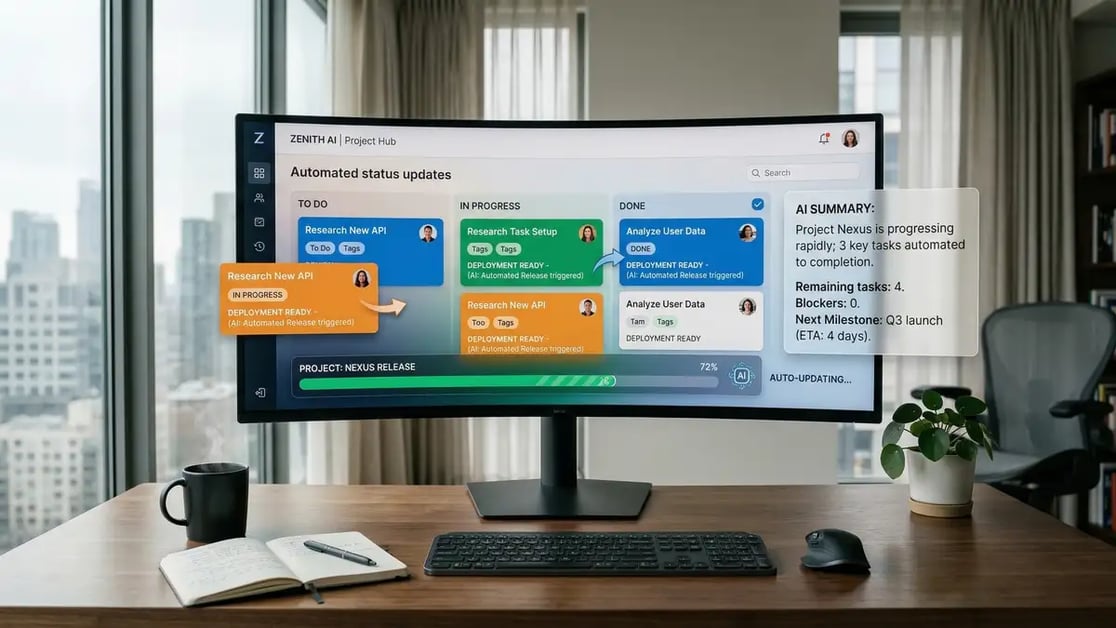
Tier 1 AI project management platforms generate real-time status updates by aggregating signals from 8–12 data sources with sub-hour latency. The process follows a five-stage pipeline that transforms raw data from your existing tools into actionable project health scores and natural language summaries.
The ingestion layer connects bidirectionally with GitHub or GitLab (commit velocity, PR review delays), Jira or Linear (burndown, cycle time, blocker counts), Slack (risk language detection, team sentiment), and calendar systems (stakeholder availability, scheduling gaps). Each signal is normalized to a common schema and deduplicated — a GitHub commit linked to a Jira ticket registers as one event, not two.
From there, the system computes derived metrics (burn rate, moving averages, trend direction) and feeds them into ensemble ML models trained on historical project outcomes. The output is a risk score (0–100) for each project and milestone, accompanied by a natural language explanation written at an accessible reading level. A typical alert reads: "Q2 Product Launch at 73% risk of 14–21 day delay. Root causes: backend sprint velocity declining 12% week-over-week, 3 critical-path bugs reopened, lead architect at capacity. Recommended: descope non-critical features by Friday."
This is the same architectural pattern behind agentic workflows — autonomous systems that observe, reason, and recommend without waiting for human prompts. The difference is scope: while general-purpose AI agents handle open-ended tasks, AI project management agents operate within a defined monitoring boundary with specific risk thresholds and escalation paths.
What Are the Best AI Project Management Tools in 2026?
The AI project management tool landscape in 2026 divides into Tier 1 platforms with production-grade autonomous capabilities and Tier 2 platforms still transitioning from rule-based to ML-driven systems. Tier 1 vendors — Asana Intelligence, Monday.com AI, ClickUp Brain, and Linear — deliver real-time status generation from 8–12 heterogeneous data sources with predictive red flag detection. Tier 2 platforms like Notion AI and early Microsoft Project Copilot offer semi-automated updates requiring human review.

Pricing for mid-market teams ranges from $8–$16/user/month for Jira AI add-ons to $54–$132/user/month for full-featured platforms like Asana and Monday.com. The key differentiator isn't price — it's integration depth. Platforms that connect natively to your existing GitHub, Slack, and calendar stack deliver value in weeks. Those requiring custom API work take months. For B2B organizations already running automated fulfillment systems, the project management layer is the natural next automation target.
| Platform | Auto Status | Red Flag ML | Data Sources | Mid-Market Price |
| Asana Intelligence | Yes (8 sources) | Budget, timeline, dependency | GitHub, Jira, Slack, Salesforce | $64–$132/user/mo |
| Monday.com AI | Yes (10 sources) | Predictive ML | GitHub, Figma, Slack, Outlook | $54–$108/user/mo |
| ClickUp Brain | Yes (12 sources) | Custom ML models | GitHub, GitLab, Slack, Zapier a Zapier alternative | $48–$96/user/mo |
| Jira AI (Atlassian) | Yes (6 sources) | Velocity, cycle time | Confluence, Slack, Bitbucket | $8–$16 add-on/user/mo |
| Linear + AI | Yes (7 sources) | Burndown prediction | GitHub, Slack, API | $60–$240/mo (team) |
| Notion AI | Partial (5 sources) | Limited (roadmap Q3 2026) | Slack, Zapier, GitHub (limited) | $108–$180 team plan |
Sources: Gartner Magic Quadrant 2026, G2 2026, vendor pricing pages (March 2026)
How Accurate Is AI Red Flag Alerting for Projects?
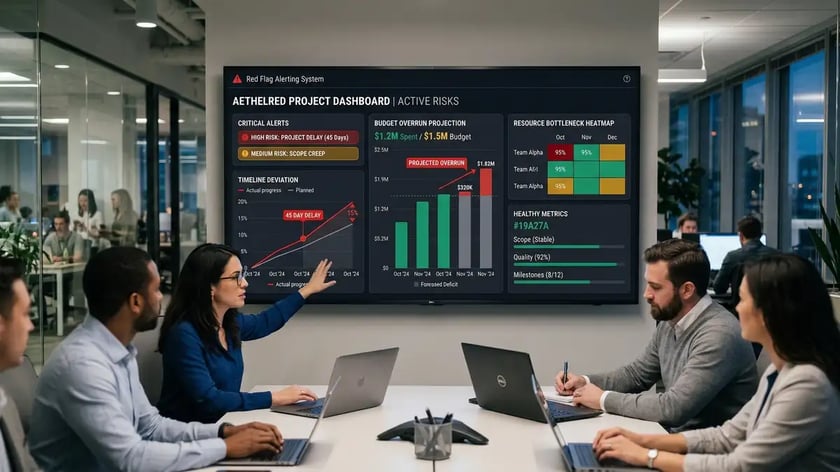
AI predictive systems detect budget overruns with 78–82% accuracy an average of 2–3 weeks before human identification, according to joint research from MIT Sloan and Gartner (2025). Resource bottleneck detection performs even better at 85–89% accuracy with 3–7 day lead time, while scope creep — the most ambiguous risk category — achieves 64–71% accuracy with a higher false positive rate of 18–24%.
The detection mechanism combines three approaches: historical deviation analysis (flagging metrics deviating more than two standard deviations from trend), cohort benchmarking (comparing your project metrics against similar projects in the same industry), and trend extrapolation (projecting current velocity to estimate whether deadlines will be met). When multiple signals degrade simultaneously — budget, velocity, and team morale declining together — the system weights the red flag significantly higher.
| Red Flag Type | Detection Accuracy | Lead Time | False Positive Rate |
| Budget overrun (>10% variance) | 78–82% | 14–21 days | 8–12% |
| Timeline slippage (>5% schedule variance) | 71–76% | 10–16 days | 11–15% |
| Resource bottleneck (>110% capacity) | 85–89% | 3–7 days | 6–9% |
| Scope creep (untracked requirement growth) | 64–71% | 7–14 days | 18–24% |
| Dependency blocker (critical path at risk) | 88–92% | 2–5 days | 5–8% |
Source: MIT Sloan/Gartner Collaborative Study 2025
Key Takeaway
Red flag alerting delivers the highest value on dependency blockers (88–92% accuracy) and resource bottlenecks (85–89%) — the risks that cascade fastest when missed. Start your AI PM deployment focused on these two categories before expanding to scope creep and budget variance monitoring.
Ready to architect autonomous project monitoring into your operations? Explore our Operations & Management infrastructure.
Book Your Growth Mapping Call
How to Implement AI Project Management in 4 Phases
The difference between the 57% of AI PM deployments that succeed and the 43% that fail comes down to phased implementation with clear success metrics at each gate. Based on Forrester's implementation failure analysis and vendor best practices, here's the 12-month roadmap that works for mid-market organizations.
Pilot (Weeks 1–8)
Select 1–2 non-mission-critical projects. Configure your tool with the "core 4" integrations: GitHub/GitLab, Jira, Slack, and calendar. Run daily audits of auto-generated status updates vs ground truth. Success metric: status report generation drops from 2 hours to 15 minutes per PM. Budget: $4,000–$8,000.
Validation (Weeks 9–16)
Expand to 5–8 projects across different teams. Introduce red flag alerting and tune ML thresholds to keep false positives below 12%. Train PMs on interpreting AI recommendations. Success metric: alerts arrive 10+ days before manual discovery. Budget: $2,000–$4,000.
Scaling (Weeks 17–32)
Full rollout to all PMs and projects. Establish governance for red flag escalations and response SLAs. Integrate with executive dashboards. Target: 90%+ PM adoption, manual status time below 20% of working week. Budget: $6,000–$12,000.
Optimization (Weeks 33–52)
Build custom ML models specific to your business patterns. Integrate with downstream BI/analytics platforms. Establish a Centre of Excellence with power users mentoring peers. Quantify ROI and build the business case for adjacent automation — such as client onboarding automation or lead nurturing sequences. Budget: $8,000–$15,000.
Why 43% of AI PM Implementations Fail
The top failure modes are data silos (34% of failures — Jira tickets not linked to GitHub commits), change resistance (28% — PMs continuing manual workflows in parallel), and alert fatigue (19% — thresholds set too loose, generating 50+ low-signal alerts daily). One enterprise customer started with 80 daily alerts; within 6 weeks only 12 were being acted on. After re-tuning to the top 8 per day, action rate jumped to 87%. Start strict, loosen gradually.
Will AI Replace Project Managers?
No — and the data is emphatic. 91% of project management professionals report AI as "job enrichment" rather than a replacement threat, according to a PMI survey of 8,000+ professionals (2026). PMs using AI tools advance to senior strategic roles 3.2 years faster than peers and report 34% higher job satisfaction because they spend time on high-value activities instead of status report compilation.
The role transformation is structural. Before AI adoption, 42% of PM time goes to manual status and reporting. After 18 months with AI tools, that drops to 15% — and the freed capacity shifts to strategic planning (35% of time, up from 15%) and proactive risk identification (22%, a new category entirely). The PM role evolves from "information processor" to "decision-maker and strategist." This mirrors the pattern we see across AI agency engagements: automation eliminates the tedious work, humans handle the judgment calls.
Where AI cannot replace PMs: stakeholder conflict resolution, ambiguous requirements translation, team motivation and coaching, executive sponsorship, and cross-functional influence. These are the skills that compound with experience — and they become more valuable, not less, as AI handles the administrative burden. For organizations measuring their automation ROI, the PM efficiency gain is typically one of the fastest-payback investments in the portfolio.
| Metric | Before AI PM | After AI PM (18 months) | Improvement |
| On-time delivery rate | 62% | 78–82% | +18–32% |
| Average project delay | 18 days | 8–10 days | –56% |
| Scope creep incidents (per 10 projects) | 6.2 | 2.1–2.8 | –55% to –65% |
| Budget overrun frequency | 34% | 12–14% | –60% |
| PM time on reporting | 42% of week | 18–22% of week | –50% to –57% |
Source: Forrester Total Economic Impact 2025
Architect Your AI Project Management Infrastructure
peppereffect designs and installs autonomous project monitoring systems that eliminate manual status work and detect red flags weeks before they become crises. From tool selection to phased rollout — engineered for B2B organizations scaling beyond founder-led operations.
Book Your Growth Mapping CallFrequently Asked Questions
Will AI replace project management entirely?
No. AI replaces the administrative and reporting components of project management — status compilation, data gathering, and basic risk flagging — which consume up to 42% of a PM's week. The strategic, interpersonal, and judgment-intensive aspects (stakeholder negotiation, team coaching, ambiguous requirement translation) remain firmly human. PMI's 2026 survey of 8,000+ professionals shows 91% view AI as job enrichment. PMs using AI tools advance to senior roles 3.2 years faster because they demonstrate strategic rather than administrative value.
How to use AI for project management effectively?
Start with the "core 4" integrations: connect your AI PM tool to GitHub/GitLab, Jira, Slack, and your calendar system. This captures 80% of the available value. Run a pilot on 1–2 non-critical projects for 8 weeks, auditing AI-generated status updates daily against ground truth. Once accuracy exceeds 85%, expand to 5–8 projects and introduce red flag alerting with strict thresholds (fewer alerts, higher quality). Scale organization-wide only after validating that PMs trust and act on the AI recommendations. The full implementation follows a proven AI workflow automation pattern.
What are AI agents for project management?
AI agents for project management are autonomous systems that take independent action — such as reassigning tasks based on team capacity, notifying upstream teams about downstream delays, or proposing daily task prioritization based on deadlines and dependencies. Monday.com's Work OS Agents (public beta, Q1 2026) already auto-propose task reassignment when one team member hits 120% capacity while another with matching skills sits at 65%. These agentic workflows represent the next evolution beyond passive monitoring toward active project orchestration.
What are the best AI project management tools in 2026?
The Tier 1 platforms for autonomous status updates and red flag alerting are Asana Intelligence, Monday.com AI, ClickUp Brain, and Linear. All four generate real-time status from 8–12 data sources with predictive ML models for risk detection. For mid-market teams (50–200 employees), pricing ranges from $48–$132 per user per month. Jira AI offers a lower-cost entry at $8–$16 add-on per user, though with fewer data sources. Choose based on your existing tool stack — the platform that integrates natively with your GitHub, Slack, and Jira setup delivers value fastest.
How much does AI project management software cost?
For a mid-market team of 12 project managers, expect $7,800–$19,000 annually in software costs (depending on platform tier), plus $12,000–$20,000 in first-year implementation and training. Total Year 1 investment: $20,000–$39,000. Against the $331,000+ annual opportunity cost of manual status work, the ROI typically exceeds 1,000% in Year 1. Payback period ranges from 3–4 months (clean data, good adoption) to 12–18 months (data cleanup required). The automation ROI calculator can help you model the specific numbers for your team size.
Resources
- PMI Pulse of the Profession 2025–2026 — Project Management Workforce Survey
- Forrester Total Economic Impact — AI-Powered Project Management (2025)
- Gartner Magic Quadrant for IT Project & Portfolio Management (2026)
- MIT Sloan — Predictive Analytics for Project Risk Detection (2025)
- Asana Intelligence — AI-Powered Project Status & Risk Management
- ClickUp Brain — Autonomous Project Management Architecture
- Monday.com AI — Real-Time Status Updates & Work OS Agents
- Statista — Global AI Project Management Market Size & Forecast
onboarding infrastructure for high-ticket services
human oversight in AI workflows Intelligence-First Methodology for AI deployment
data-driven decision making project management for consulting firms an integrated technology stack reclaim founder hours