

What Is Project Profitability and Why Are B2B Service Firms Losing 5–10% of Revenue Without Tracking It?
Project profitability measures the actual financial return each engagement generates after accounting for all direct costs — labor, tools, subcontractors, and overhead allocated to delivery. For B2B professional services firms — consulting practices, executive search firms, agencies, and coaching businesses — project profitability is the single metric that determines whether growth translates into margin expansion or margin erosion. According to a March 2026 IDC White Paper sponsored by Kantata, professional services firms that delay or avoid implementing systematic profitability tracking lose 5–10% of annual revenue through compound inefficiencies in administration, resource utilization, scope management, and billing delays — with one modeled scenario revealing over $7 million in value erosion.
The profitability crisis runs deeper than occasional project overruns. PM360 Consulting analysis of over 50,000 projects globally found that 71% fail to meet on-time, on-budget, and satisfactory-results criteria simultaneously. Only 9% achieve on-budget and on-time delivery. For a $50 million B2B services firm, the IDC-quantified 5–10% leakage translates to $2.5–$5 million in annual value destruction — revenue that disappears into manual coordination, idle capacity, unmanaged scope creep, and billing delays that most leadership teams never see on a single report.
What you'll learn in this article:
- Why project profitability tracking separates high-margin firms from those trapped in the revenue-growth-without-profit cycle
- The five hidden inefficiency streams that silently erode margins across consulting, recruiting, agency, and coaching verticals
- Utilization rate benchmarks by industry and how a 5-point improvement drives measurable margin expansion
- How to build a project profitability tracking system using AI-powered resource management and real-time dashboards
- The PSA software landscape and why firms implementing automation report 300–500% ROI within the first year
Key Takeaway
Project profitability is not a default outcome — it is a deliberate engineering achievement. Firms that fail to track utilization, realization, and margin in real time incur losses estimated at 5–10% of annual revenue through distributed inefficiencies that remain invisible until margins tighten or growth stalls. The PSA market reaching $16.92 billion in 2026 reflects this competitive reality: tracking profitability is no longer optional.

What Are the Five Hidden Inefficiency Streams That Destroy Project Margins?
The IDC study identified five primary inefficiency streams that compound into the 5–10% annual revenue loss. Understanding these mechanisms is essential because they operate simultaneously across different functions — making them invisible when measured in isolation but devastating when aggregated.

Stream 1: Administrative time consumption. Up to 20% of skilled employees' time is lost to administrative work that should be automated — status updates, manual time entry, report compilation, and inter-team coordination. For a 50-consultant firm billing $200 per hour, this represents roughly $2 million in annual capacity consumed by non-revenue activities. AI workflow automation eliminates the bulk of this waste by routing information autonomously rather than requiring human coordination at every handoff.
Stream 2: Idle capacity from misutilization. Up to 10% of employee time is lost to idle capacity caused by poor resource allocation — consultants waiting for project starts, mismatched skill assignments, and bench time between engagements. The SPI 2025 PS Maturity Benchmark found that average billable utilization fell to just 68.9% in 2024, well below the 75% optimal threshold and the 80–85% target that Runn's industry benchmarks recommend for sustainable performance.
Stream 3: Margin leakage from unmanaged scope. An estimated 5% of margin disappears through scope creep — work delivered beyond initial agreements without corresponding pricing adjustments B2B proposal pricing architecture. HubiFi research found that poor change order management allows clients to request additional work without fee renegotiation, creating absorbed costs that erode profitability project by project.
Stream 4: Billing delays. A 3% delay in invoice issuance from project completion to billing creates cash flow gaps, deferred revenue recognition, and increased write-offs as unbilled time ages beyond client dispute windows.
Stream 5: Attrition costs. Rising employee fatigue and disengagement from overwork and administrative burden drives attrition rates of 15–20% annually in consulting, with each departure costing 50–200% of annual salary in recruiting, onboarding, and productivity ramp-up costs.
| Inefficiency Stream | Revenue Impact | Root Cause | Solution |
| Administrative overhead | Up to 20% of staff time | Manual coordination | Workflow automation |
| Idle capacity | Up to 10% of staff time | Poor resource matching | AI-powered scheduling |
| Scope creep | ~5% margin leakage | No change order process | Variation tracking system |
| Billing delays | ~3% revenue delay | Manual invoicing | Automated billing triggers |
| Employee attrition | 50–200% of salary/departure | Burnout from manual work | Capacity-balanced workloads |
Sources: IDC/Kantata 2026, HubiFi
What Are the Utilization Rate Benchmarks by Industry and Why Do They Matter for Project Profitability?
Resource utilization rate — the percentage of available hours spent on billable client work — is the single highest-leverage variable in project profitability for any services firm. A 5-percentage-point utilization improvement from 75% to 80% for a 25-consultant firm billing at $200/hour generates approximately $375,000 in additional annual gross margin without adding a single hire. Conversely, a 5-point drop from 80% to 75% destroys $93,750 per consultant annually — $2.3 million across a 25-person team.

The SPI Research data reveals a troubling trend: billable utilization has been declining steadily, from 73.2% in 2021 to 68.9% in 2024 — well below the 75% minimum threshold for healthy margins. This decline reflects both increased non-billable administrative burden and a deliberate industry shift toward sustainable workload management, as firms recognize that pushing utilization above 85% accelerates burnout and attrition.
For executive search firms, utilization benchmarks carry specific implications. Recruiters spend an estimated 35–42% of their time on manual sourcing activities that AI-powered recruiting tools can automate, directly impacting the revenue-generating hours available for client relationship management and candidate assessment. Hunt Scanlon research identifies submission-to-interview ratio, time-to-fill, and cost-per-hire as the operational efficiency metrics that correlate most strongly with placement profitability.
| Industry Vertical | Target Utilization | Actual Average | Margin Impact per 5-Point Gap |
| IT Services / Consulting | 70–80% | ~70% | ~$375K per 25 consultants |
| Management Consulting | 75–85% | ~70% | ~$375K per 25 consultants |
| Accounting Firms | 65–85% | ~60% firm-wide | Significant at scale |
| Marketing / Digital Agencies | 70–80% | Varies widely | Agency-specific |
| Architecture / Engineering | ~80% | ~75% | ~$375K per 25 staff |
| Executive Search | 70–80% | 58–65% (manual firms) | High — recruiter time is revenue |
Sources: Runn, SPI 2025 Benchmark, Hunt Scanlon
Key Takeaway
The gap between target and actual utilization rates represents the single largest untapped profit lever in most B2B services firms. High-maturity firms tracked by SPI Research's PS Maturity Benchmark report +739% revenue growth, +537% margin improvement, and +71% higher utilization compared to Level 1 peers — proving that systematic operational infrastructure directly drives profitability at scale.

How Do Margin Benchmarks Differ Across Consulting, Recruiting, Agency, and Coaching Verticals?
Project profitability manifests differently across B2B service verticals because each has distinct cost structures, delivery models, and pricing mechanisms. Understanding vertical-specific margin benchmarks prevents firms from measuring themselves against irrelevant standards — a coaching business targeting 40% margins would be dramatically underperforming, while a consulting firm achieving 40% would be performing above average.
Boutique consulting firms operate at 20–40% gross margins, with only high-performing outliers achieving 50–70%+. The Ruddr analysis of consulting KPIs finds that gross margins must consistently exceed 40% to drive acceptable net profit, while the industry average across all professional services hovers at 44%. Three critical KPIs determine consulting profitability: annual revenue per billable consultant, net revenue growth, and client retention rate.
Executive search firms command premium placement fees (typically 20–30% of first-year compensation) but face unique profitability pressures: extended search timelines consuming recruiter capacity, candidate falloff requiring restart costs, and the manual sourcing bottleneck that limits placement velocity. Financial Models Lab benchmarks show talent acquisition businesses targeting 70%+ utilization with CAC around $2,500 and 8-month breakeven cycles.
Digital agencies target 70–80% gross margins but frequently operate below this threshold due to scope creep, rapid technology change requiring continuous capability investment, and competitive commoditization of standard services. The gap between target and reality makes capacity management the critical profitability lever for agencies.
Coaching and advisory businesses target 80%+ gross margins reflecting their high-touch, low-logistics delivery model. Financial Models Lab data shows that coaching firms need an LTV/CAC ratio of 3:1 or higher, checked quarterly, to confirm their growth model works — making client retention and program completion rates the primary profitability drivers.
| Vertical | Target Gross Margin | Primary Profitability Lever | Biggest Margin Threat |
| Boutique Consulting | 40–70% | Utilization rate + bill rate | Scope creep + bench time |
| Executive Search | 55–75% | Placement velocity + retention | Manual sourcing bottleneck |
| Digital Agencies | 70–80% | Scope control + resource matching | Commoditization + scope creep |
| Coaching / Advisory | 80%+ | Client retention + LTV/CAC | Short engagement duration |
Sources: Ruddr, Financial Models Lab, HubiFi
Ready to architect a project profitability system that protects margins as you scale? Explore peppereffect's Operations & Management systems built for B2B services firms.
Book a Growth Architecture Call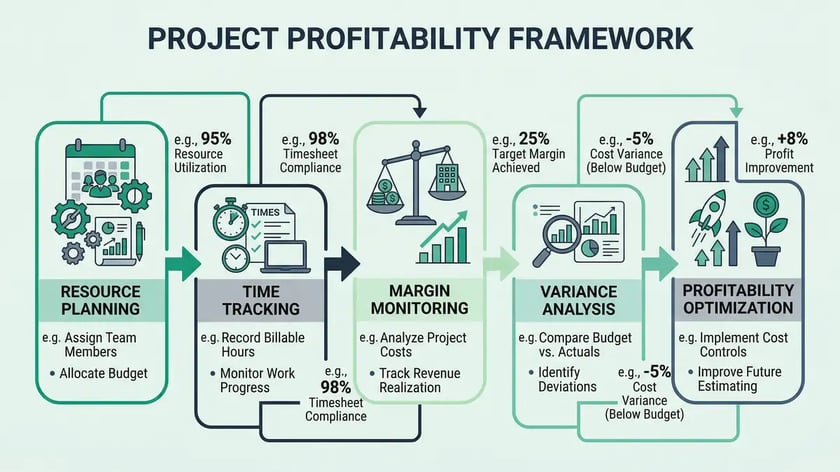
How Do You Build a Project Profitability Tracking System in 5 Steps?
The firms that consistently achieve top-quartile margins don't rely on end-of-month financial reviews to discover profitability problems. They build real-time tracking infrastructure that surfaces cost pressure 30–90 days before margins are destroyed — enabling proactive intervention rather than post-mortem analysis. Here's the five-step framework for building that system.
Establish Utilization and Realization Targets by Role
Set role-specific targets rather than firm-wide averages. Senior consultants might target 65% billable utilization (with 35% allocated to business development and mentoring), while delivery consultants target 80%. Track both utilization (hours worked / hours available) and realization rate (hours billed and collected / hours worked) — the gap between these two metrics reveals where billing process inefficiencies destroy earned revenue.
Deploy Integrated Time and Cost Tracking
Replace manual spreadsheet tracking with integrated systems connecting time capture, project management, and financial accounting. TimeRewards research shows firms with poor time tracking systems experience 15–25% billable hours leakage annually — for a 50-person firm billing $200/hour, that represents $780,000–$1.3 million in lost revenue. Automated time capture eliminates 80%+ of this leakage by reducing reliance on memory-based entry.
Build Real-Time Margin Dashboards by Project and Client
Move from monthly financial reporting to daily margin visibility. WhatsDAsh analysis found that manual reporting consumes 4–10 hours per client per month — for a 15-client agency, that's 60–150 hours monthly (equivalent to 1.5–3.75 FTEs). Automated dashboards eliminate this overhead while providing continuous margin monitoring that catches budget overruns as they happen, not weeks later.
Install Change Order and Scope Variation Workflows
Formalize the process for handling scope changes: every client request outside the original agreement requires documented approval, pricing adjustment, and timeline extension before work begins. This single discipline — which most firms lack — prevents the 5% margin erosion from unmanaged scope identified by IDC. Integrate variation tracking with your pipeline management system so that scope expansions become revenue opportunities rather than absorbed costs.
Deploy AI-Powered Predictive Analytics for Overrun Detection
Use AI agent workflow automation to analyze project velocity, resource consumption patterns, and historical data to predict which engagements are trending toward budget overrun — 30–90 days before the overrun materializes. This shifts project management from reactive firefighting to proactive margin protection, enabling resource reallocation, scope renegotiation, or pricing adjustment while there's still time to preserve profitability.
Avoid This Mistake
Don't implement project profitability tracking as a finance-only initiative. The IDC research found that services leaders describe the pattern of manual coordination leading to delayed data as a "self-reinforcing death spiral" — where inconsistent data weakens staffing and financial decisions, forcing leaders into reactive management. Profitability tracking must integrate across delivery, resource management, and finance functions to break this cycle.
What Does the PSA Software Market Look Like and What ROI Can Firms Expect?
The Professional Services Automation market reached $16.92 billion in 2026 and is projected to grow at 11.17% CAGR to reach $28.73 billion by 2031, according to Mordor Intelligence. This growth reflects not discretionary technology spending but rather a market-wide recognition that the cost of inaction exceeds the cost of implementation. The broader professional services software market reached $51.1 billion in 2024, growing 11.9% year-over-year.
ROI evidence supports aggressive PSA investment. Firms implementing integrated profitability tracking systems report 8–12% cost savings and 10–15% schedule improvements within 12–18 months. The Ravetree analysis of PSA impact shows that agencies implementing automation see utilization increases of 15–25% within the first year, invoicing error reductions of 25%, and break-even achievement within 7–10 months — delivering 300–500% ROI annually thereafter.
The McKinsey December 2025 Economic Conditions survey adds competitive context: while 63% of all respondents expect company profits to rise, only 55% of professional services respondents share that optimism — the most cautious sentiment since September 2022. This gap suggests defensive margin management is becoming the dominant strategic posture, making profitability tracking infrastructure even more critical for firms seeking to outperform sector averages.
| PSA Implementation Metric | Benchmark | Timeframe |
| Cost savings | 8–12% | 12–18 months |
| Schedule improvements | 10–15% | 12–18 months |
| Utilization increase | 15–25% | First year |
| Invoicing error reduction | 25% | First year |
| Break-even on investment | 7–10 months | — |
| Annual ROI post break-even | 300–500% | Year 2+ |
Sources: Mordor Intelligence, Ravetree
Key Takeaway
AI adoption in professional services is accelerating rapidly — StaffingHub reports AI adoption surged to 61% of staffing agencies in 2025 (up from 48% in 2024). Firms integrating AI into delivery workflows gain competitive advantage through faster delivery, lower costs, and higher quality. The Kantata 2025 State of the PS Industry Report identifies integrating AI agents into delivery workflows as the #1 challenge PS leaders face — requiring entirely new approaches to resource planning, utilization measurement, and profitability calculation.
How Does Project Profitability Impact Firm Valuations and Exit Strategy?
For founders planning eventual exit, project profitability tracking isn't just an operational discipline — it's a direct multiplier on enterprise value. Griffin Financial Group's Q4 2025 Staffing Market M&A Report reveals that mid-market professional services firms trade at 4.0–4.5x EBITDA for commercial services, 5.0–6.0x for professional staffing, and 5.5–7.0x for high-growth IT and healthcare segments. After deal activity dipped to 93 transactions in 2024, Q1 2025 saw a 25% year-over-year increase in deal volume — the strongest pace since late 2022.
The valuation premium tells a clear story: profitable, specialized, technology-enabled firms command premium multiples, while generic, low-margin, analogue firms find fewer eager buyers and face consolidation pressure. Earn-outs and performance ratchets are common deal structures, meaning buyers pay for future performance quality rather than historical results — making margin sustainability and profitability tracking systems directly material to transaction value.
For a $5 million EBITDA professional staffing firm, the difference between a 4.5x and 6.0x multiple represents $7.5 million in additional enterprise value — achievable primarily through demonstrable profitability tracking infrastructure, margin consistency, and the scalable operations systems that buyers associate with predictable future performance.
Frequently Asked Questions
What is resource utilization in project management?
Resource utilization measures the percentage of available working hours that team members spend on productive, billable activities. The optimal target for most professional services firms is 80–85% overall utilization, with billable utilization specifically targeting 70–80%. Runn's industry benchmarks show significant variation by sector — IT services targets 70–80%, accounting firms average 60% firm-wide, and marketing agencies aim for 70–80%. The key insight is that pushing utilization above 85% accelerates burnout and attrition, making sustainability as important as productivity.
How do you calculate project profitability?
Project profitability equals total project revenue minus all direct costs (labor hours × cost rate, tools, subcontractors, allocated overhead). Express this as a percentage: (Revenue – Direct Costs) / Revenue × 100 = gross margin percentage. For accuracy, track both utilization rate (billable hours / available hours) and realization rate (collected revenue / potential revenue from hours worked). The gap between these two rates reveals where billing inefficiencies and write-offs erode earned margin. AI-powered tracking automates this calculation in real time rather than relying on end-of-month manual reconciliation.
What is a good profit margin for a consulting firm?
Boutique consulting firms typically operate at 20–40% gross margins, with high-performing firms achieving 50–70%+. The industry-wide average sits at approximately 44% gross margin. Ruddr's KPI analysis indicates that consulting firms need gross margins consistently above 40% to generate acceptable net profit after fixed overhead. The primary levers for margin improvement are utilization rate management, bill rate optimization, and delivery efficiency gains through automation.
How much revenue do professional services firms lose from poor time tracking?
Industry research consistently shows that firms with manual time tracking systems experience 15–25% billable hours leakage annually. For a 50-person firm billing $200 per hour with 1,500 available billable hours per employee, this represents $780,000–$1.3 million in lost annual revenue. The leakage occurs through forgotten time entries, rounding errors, and the reluctance to log small work increments — all of which automated time capture systems eliminate by recording activity in real time rather than relying on end-of-day memory reconstruction.
What is PSA software and how does it improve project profitability?
Professional Services Automation (PSA) software integrates time tracking, resource management, project management, and financial accounting into a unified platform that provides real-time margin visibility across every engagement. The PSA market reached $16.92 billion in 2026 and is growing at 11.17% CAGR. Firms implementing PSA report 15–25% utilization increases within the first year, 25% invoicing error reduction, and 300–500% annual ROI — with break-even typically achieved within 7–10 months of deployment.
How do executive search firms measure placement profitability?
Executive search profitability depends on three primary metrics: revenue per recruiter, time-to-fill, and placement retention rate. Hunt Scanlon identifies submission-to-interview ratio and cost-per-hire as the operational efficiency metrics most correlated with placement margins. Since recruiters spend 35–42% of time on manual sourcing, AI recruiting automation creates the single largest profitability improvement opportunity for search firms — redirecting that capacity from sourcing administration to revenue-generating client and candidate engagement.
What utilization rate should my firm target?
Target utilization depends on your service model and role mix. Runn recommends 80–85% overall utilization as the sustainable optimal rate, but this should be decomposed by role: senior practitioners at 60–70% (allowing for BD, mentoring, and thought leadership), delivery specialists at 75–85%, and junior staff at 80–90%. The SPI Research data shows that the industry-wide average of 68.9% leaves meaningful room for improvement — even a 5-point increase drives material margin expansion without requiring additional hires.
Deploy Project Profitability Infrastructure That Scales With Your Firm
peppereffect architects AI-powered operations systems that give B2B services firms real-time margin visibility, automated resource tracking, and predictive analytics — so you protect profitability as you scale without adding headcount to administration.
Book Your Growth Architecture CallResources
- IDC/Kantata — The Cost of Inaction: Business Impact of Not Using PSA
- SPI Research — 2025 Professional Services Maturity Benchmark
- Mordor Intelligence — Professional Services Automation Market Size 2031
- Runn — Resource Utilization Rate Benchmarks by Industry
- PM360 Consulting — Project Management Failure Statistics
- Hunt Scanlon — Key Performance Indicators for Recruitment Firm Success
- Griffin Financial Group — Staffing Market M&A Report Q4 2025
- BPM — Professional Services Industry Outlook 2026