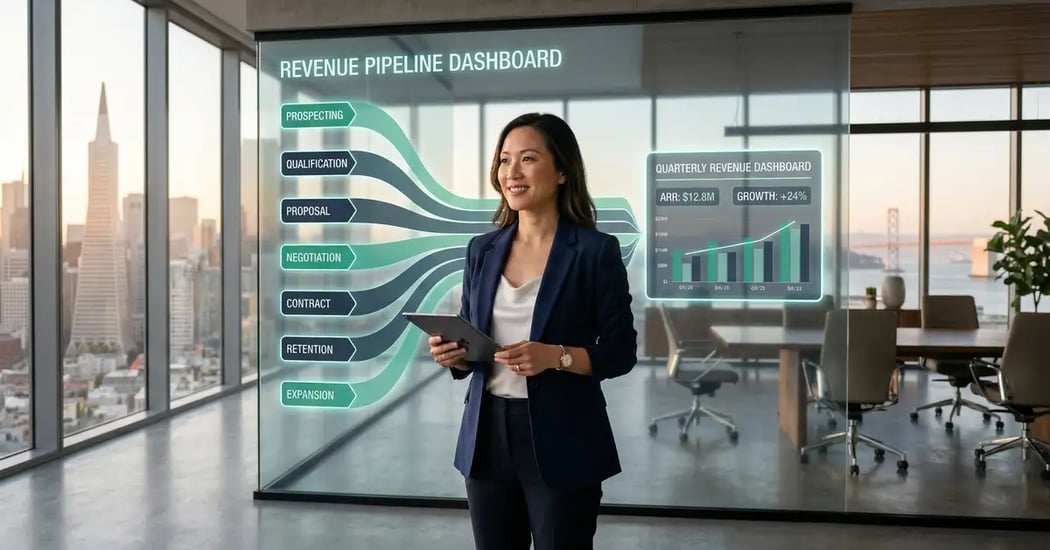

What is a B2B lead generation system — and why do founders need seven of them?
A B2B lead generation system is a logic-gated, largely autonomous infrastructure that produces qualified pipeline without depending on individual salespeople, marketers, or the founder's calendar. It is not a tactic, a tool, or a campaign. It is a closed loop: trigger → action → measurement → optimisation, running continuously in the background of the business.
In 2026, the founders winning predictable growth are not the ones with the loudest single channel. They are the ones with a portfolio of interlocking systems. Companies relying on a single lead source experience materially higher customer acquisition cost (CAC) volatility every time an algorithm shifts or an inbox provider tightens its filters. Diversified, decoupled architectures are the antidote — and the only sustainable path to decoupling pipeline from headcount.
Cold email open rates have fallen from roughly 36% in 2023 to 27.7% today, with platform-wide reply rates at 3.43%. LinkedIn now drives 80% of all B2B social media leads. The average B2B SaaS website converts just 2.3% of visitors into leads, while top performers exceed 10%. The gap between average and top is no longer about "trying harder." It is about building the right systems in the right configuration.
What you'll learn in this article:
- The 7 lead generation systems every B2B founder needs to install in 2026
- Real benchmarks for cold outbound, paid acquisition, content/AEO, referral, capture, nurture, and attribution
- Why channel concentration is the most expensive risk on your P&L
- How to sequence the build so each system compounds the next
- The agentic automations that decouple each system from headcount
Key Takeaway
Lead generation in 2026 is not a tactic — it is an operating system. The seven systems below are not optional channels to pick from; they are interlocking modules of a single revenue engine. Install fewer than five and you absorb the full volatility of every algorithm change. Install all seven, sequenced correctly, and you build a freedom machine that produces qualified pipeline whether you are at your desk or on a beach in Marbella.
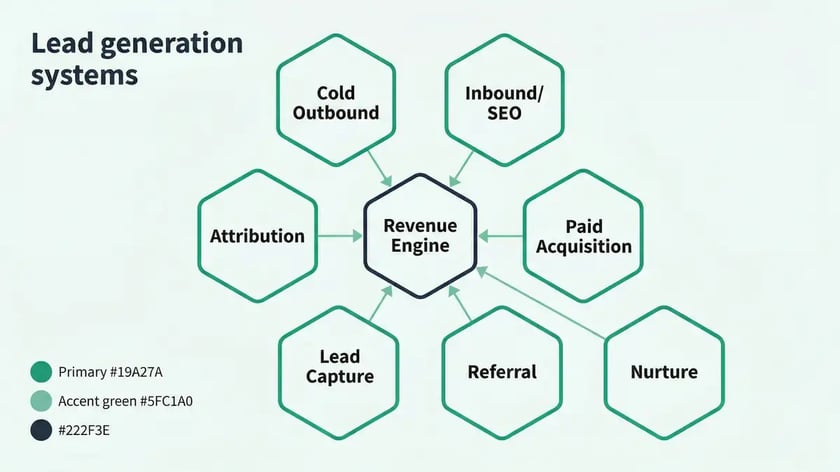
System 1 — The Cold Outbound System: AI-personalised email plus LinkedIn multichannel
The death of cold outbound has been wildly exaggerated. What died is untargeted, unpersonalised, single-channel outbound. What replaced it is a system: intent triggers feeding AI-personalised email sequences, layered with LinkedIn touches, all gated by deliverability and sender reputation.
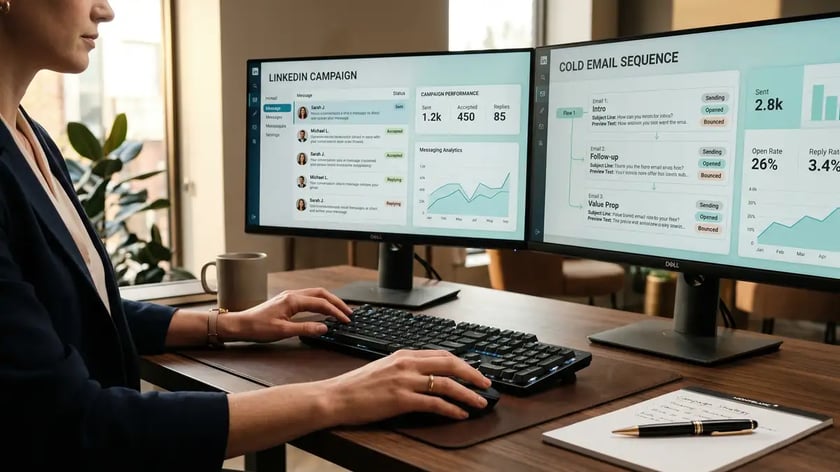
The 2026 benchmarks are unforgiving but defensible. Average cold email reply rates have settled at around 3.43%, but timeline-based or trigger-personalised hooks are achieving up to 10.01% reply rates — a 3x lift from layering one variable. Multichannel sequences using three or more touchpoints deliver 287% more responses than single-channel outreach. The math is simple: stop running email-only or LinkedIn-only sprints. Cold email vs. LinkedIn outreach is a false choice. The right answer is both, sequenced.
| Outbound Tactic | Reply Rate | Notes |
| Generic cold email | 3.43% | Platform average, 2026 |
| Trigger / timeline personalised | 10.01% | 3x lift from one personalisation variable |
| Multichannel (3+ touchpoints) | +287% volume | vs. single-channel sequences |
| LinkedIn open rate post-connect | ~64% | Native messaging benchmark |
Sources: Martal Group B2B Cold Email Statistics 2026, Digital Bloom B2B GTM Benchmarks 2025, Outreaches.ai 2025.
The deliverability layer is what separates a Cold Outbound System from a campaign. Domain architecture, warm-up protocols, and inbox-placement monitoring turn outreach from a Russian roulette into a metered process. Without it, even the best AI personalisation lands in spam. With it, you compound. See our full B2B cold email outreach playbook for the technical build.
System 2 — The Inbound Content & AEO System: getting cited by ChatGPT, Perplexity, and Google AI
Search behaviour has bifurcated. Buyers still type queries — but they increasingly type them into ChatGPT, Claude, Perplexity, and Google AI Overviews. Your B2B website now needs to serve two audiences: human readers and the LLMs that summarise content for them. The discipline is called Answer Engine Optimization (AEO), sometimes Generative Engine Optimization (GEO). They are the same idea: structured, citation-friendly content that AI engines can quote verbatim.
The system is built on topic clusters — pillar pages anchoring tight clusters of supporting articles, with structured data, FAQ schema, and source attribution baked in. SEO budgets in B2B still under-allocate against organic's contribution: organic search drives a disproportionate share of B2B website traffic, yet receives a fraction of the average marketing budget. Companies that build the inbound engine first compound forever — every article becomes both a search asset and an LLM training input.
Key Takeaway
Inbound is the only lead generation system whose marginal cost approaches zero. Every other system requires fresh spend or fresh effort each cycle. The Inbound & AEO System produces compounding asset value — articles published in 2024 still drive pipeline in 2026. Build it second, never last.
System 3 — The Paid Acquisition System: bottom-funnel intent capture, not awareness theatre
Paid media in B2B should not be confused with paid media in B2C. Brand impressions are not the goal. Capturing buyers who have already declared intent — by searching "[your category] vs [competitor]," "[your category] pricing," or "[your category] alternatives" — is the goal. Search ads targeting these high-intent terms convert at roughly twice the rate of informational queries.
LinkedIn Ads belongs in this system, but only when paired with account-based targeting. Audience layering — combining job function, seniority, company size, and intent signals — drives ROAS several multiples higher than broad demographic blasts. The error most founders make is buying impressions instead of buying leads. Paid is a system, not a vanity metric. Read our breakdown of how SaaS CEOs are using AI to cut CAC by 50% for the full intent-based bidding architecture.
Want to see how peppereffect installs all four pillars — including paid acquisition — into one connected lead generation system? Book a Growth Mapping Call to architect your build.
Book a Growth Mapping CallSystem 4 — The Referral & Partnership System: highest-converting leads in your business

Referrals are the highest-quality lead source in any B2B business — and the most under-engineered. Referral-sourced leads close at materially higher rates than cold outbound, carry larger average contract values, and churn far less than cold-acquired customers. They are also the leads founders most often hope for rather than build a system to produce.
The Referral & Partnership System has three sub-modules: a structured client referral program (with clear incentive tiers and automated tracking), formal co-marketing partnerships with complementary vendors, and a partner attribution layer so you actually know which partners drive revenue. Co-marketing campaigns consistently produce higher lead volume at lower cost-per-lead than single-company campaigns — but only when the partnership operates as a system, not a handshake. The tooling is mature; the discipline is rare.
If you are a high-ticket consultant or executive search firm, this system is your biggest leverage point. Mature consulting practices typically source 30%+ of pipeline from partners and referrals — and that share rises every year as the brand compounds.
System 5 — The Lead Capture & Qualification System: stop leaking leads at the front door
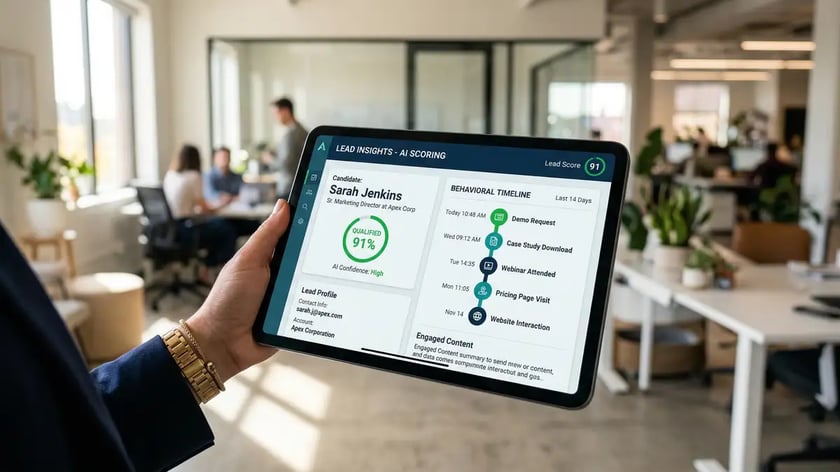
A landing page with a five-field form is a lead-leakage machine. Every additional form field shaves several percentage points off conversion. The system replaces this with progressive profiling, conversational AI for pre-qualification, and intelligent SDR routing. The shift is from "ask everything upfront" to "ask the right thing at the right moment, then route to the right human in seconds."
Conversational AI has crossed from novelty to default. Most B2B teams now deploy chatbots for first-touch qualification, and the lead-quality lift is real — AI pre-screening filters low-fit leads before they reach SDRs, raising MQL-to-SQL conversion materially. The follow-on is automated routing: when a qualified lead is identified, the system instantly assigns it to the right SDR by territory, skill, or capacity.
The reason this matters is brutal. The average lead response time for B2B website leads is roughly 17 hours — and slow responses are losing companies up to 95% of potential revenue per lead. Cutting that response time from hours to minutes is the highest-leverage automation in your business. Sales automation at the routing layer is how the math reverses.
Avoid This Mistake
Most founders treat lead capture as a website task and lead qualification as a sales task — and miss that they are the same system. If your forms feed a CRM that an SDR checks twice a day, you are not running a Lead Capture System. You are running a lead leakage system with extra steps.
System 6 — The Lead Nurture & Re-engagement System: behavioural sequences, not calendar blasts
Most B2B leads are not ready to buy on first touch. The buying committee in B2B now averages roughly seven stakeholders, and the average decision involves many months of internal alignment. The Nurture System is what carries the relationship across that distance — and what reactivates the dormant pipeline you have already paid to acquire.
The 2026 standard is behaviour-triggered, not calendar-based. Sequences fire when a lead downloads a whitepaper, returns to a pricing page, or opens (but never clicks) three consecutive emails. Behavioural triggering consistently outperforms generic drip campaigns by multiples on engagement and conversion. Just as critically: dormant lead reactivation costs roughly 70% less than new acquisition and converts at materially higher rates.
| Nurture Tactic | Performance Lift |
| Behaviour-triggered vs. calendar-based | ~4x engagement, ~2.8x conversion |
| Segmented vs. broadcast email | +34% open, +28% conversion |
| Dormant lead reactivation cost | ~70% less than new acquisition |
| Multi-stage funnel vs. single-stage | +41% MQL-to-opportunity progression |
Sources: Snov.io Lead Generation Statistics 2026, Blondish Lead Generation Statistics.
The Nurture System is also where ghosted deals come back to life. If your CRM has thousands of "dead" opportunities, you are sitting on a six-figure recovery opportunity that your competitors are ignoring. See our full architecture in B2B lead nurturing: the omnipresent follow-up machine.
System 7 — The Attribution & Pipeline Intelligence System: knowing what actually works

The seventh system is the one most founders skip — and the one with the highest leverage. Without multi-touch attribution, you cannot tell which of the previous six systems is actually producing pipeline, which is producing noise, and which is being unfairly credited or starved by your last-touch reporting.
Most B2B companies still rely on last-touch attribution. The result is systematic under-investment in top-of-funnel systems (content, paid awareness, partnership) that influence deals but never get credit for the close. Companies that implement multi-touch attribution typically reallocate budget meaningfully toward top-of-funnel and report higher win rates and lower CAC as a result. Pipeline intelligence at this layer is what turns lead generation from art into engineering.
Key Takeaway
The Attribution & Pipeline Intelligence System is the operating system layer beneath the other six. It is what allows you to allocate spend rationally, fire underperforming channels, and double-down on what works. If you are not measuring multi-touch, you are flying blind — and your competitors who installed RevOps are not.
How to sequence the build: a 6-month installation plan
You do not install seven systems in seven weeks. You sequence them so each compounds the next. The order matters because some systems depend on data, audiences, or content that earlier systems produce.
Months 1–2: Capture & Qualification + Attribution foundation
Fix the front door before turning on more traffic. Install lead routing, response automation, and basic multi-touch attribution. Without this layer, every dollar spent in months 3–6 partially leaks.
Months 2–3: Cold Outbound + Inbound foundation
Launch the Cold Outbound System for short-cycle pipeline while seeding the topic-cluster content engine that will compound for years. These two run in parallel: outbound for now, inbound for forever.
Months 3–4: Nurture + Re-engagement
Now that leads are flowing in, build the Nurture System to convert the 95% who are not buying today. Reactivate dormant pipeline as a fast win.
Months 4–5: Paid Acquisition layer
With attribution and nurture in place, paid spend can finally be measured cleanly. Layer high-intent search and ABM-targeted LinkedIn ads on top of the existing systems.
Month 6: Referral & Partnership formalisation
With proof points, case studies, and a working revenue engine, you can credibly approach co-marketing partners and formalise referral programs. Build this system once you have something worth referring.
Frequently Asked Questions
What is a B2B lead generation system?
A B2B lead generation system is a logic-gated infrastructure — usually combining software, automation, and clear ownership — that produces qualified pipeline without depending on individual effort. It differs from a "tactic" in that it runs continuously, measures itself, and compounds. The seven systems in this article (cold outbound, inbound/AEO, paid, referral, capture, nurture, attribution) are the canonical set every B2B founder should install. Read our pillar on what B2B lead generation actually is in 2026 for the full architecture.
How do I generate leads in sales without hiring more SDRs?
The lever is automation, not headcount. Most B2B teams discover they can roughly double pipeline volume per SDR by installing three things: AI-powered cold outbound sequencing, automated lead routing with sub-five-minute response, and behaviour-triggered nurture. Together these recover the time SDRs currently spend on manual prospecting, qualification, and follow-up. SaaS companies in particular are achieving 2x–3x pipeline lift per rep without adding headcount when these systems are deployed correctly.
What is the difference between B2B lead generation and B2C lead generation?
B2B sales involve longer cycles, larger deal sizes, and buying committees that average around seven stakeholders. B2C is typically single-decision-maker, shorter cycles, lower ACV, and emotion-driven. The systems above are built for B2B precisely because they account for committee dynamics, attribution complexity across long cycles, and the need for high-touch nurture across months — not minutes. B2C lead generation can be far simpler, often relying on a single ad-to-checkout funnel.
What is lead generation in digital marketing?
Lead generation in digital marketing is the process of attracting strangers, capturing their interest with a value exchange (content, demo, consultation), and converting them into known prospects in your CRM. In B2B, the most effective digital channels in 2026 are organic search/AEO, LinkedIn outbound, intent-based paid search, and partner-driven referral. The mistake most teams make is treating these as separate disciplines. They are modules of a single system, and they fail when run in isolation.
How long does it take to install all seven lead generation systems?
The realistic timeline is six months, sequenced as in the installation plan above. Trying to install all seven in parallel is the most common reason builds fail — each system depends on the data, audiences, or assets that earlier systems produce. The order matters more than the speed. Founders who sequence correctly have a measurable, working freedom machine within two quarters; those who try to do everything at once usually have a half-built mess in the same window.
Which lead generation system should B2B SaaS founders prioritise first?
For B2B SaaS founders in the $10M–$40M ARR range, the highest-leverage first build is usually the Lead Capture & Qualification System combined with Attribution. The reason is simple: you almost certainly already have traffic and leads — what you do not have is the infrastructure to convert and measure them. Once that is fixed, the Cold Outbound System produces the fastest incremental pipeline. SaaS-specific architectures follow a slightly different sequence than consulting or recruiting.
How does AI change lead generation in 2026?
AI changes three things: personalisation at scale (AI-generated cold email and ad copy that performs better than templates), agentic execution (workflows that do the work autonomously rather than just notifying a human), and predictive scoring (lead-quality models trained on your actual conversion data, not generic rules). Agentic workflows are the deepest change — they allow each of the seven systems to run with progressively less human intervention, which is what makes the freedom machine possible.
Install the Operating System for B2B Growth
peppereffect installs all 7 lead generation systems as a single connected architecture — the Freedom Machine. We do not run campaigns. We deploy infrastructure that produces pipeline without scaling headcount. Book a Growth Mapping Call and we will architect your build, sequenced for your stage and ICP.
Book a Growth Mapping CallRead: The Freedom Machine → B2B lead generation architecture lead generation automation
Resources
- Martal Group — B2B Cold Email Statistics 2026
- Martal Group — Lead Generation Statistics 2026
- Snov.io — 115+ Lead Generation Statistics for 2026
- Credofy — Slow Lead Response Time Costing 78% of Sales
- Outreaches.ai — Cold Outreach Benchmarks 2025
- The Digital Bloom — 2025 B2B GTM Channel Benchmarks
- Oliver Munro — SaaS Marketing Statistics & Benchmarks 2026
- ConnectSafely — LinkedIn Statistics 2026
- Blondish — Lead Generation Statistics 2025–2026
- Highspot — 2026 Lead Management Playbook for B2B Sales Teams