

Why Most B2B Content Fails — and What to Do Instead
97% of B2B teams use content marketing. Only 29% say it's effective. That gap — between content production and content that actually drives revenue — is the defining failure of most B2B marketing programs. Companies publish blog posts, whitepapers, and social content at an accelerating pace, yet pipeline stays flat, sales cycles stretch longer, and the marketing team can't prove ROI. SEO content marketing
The problem isn't volume. It's alignment. Most B2B content is built around what the brand wants to say — not what the buyer needs to know. Nearly 80% of B2B buyer research happens before a prospect ever speaks with sales. If your content doesn't answer their questions at that critical stage, someone else's will.
Marcus Sheridan's They Ask, You Answer framework flips this equation. Instead of guessing what content to create, you listen to the questions your prospects actually ask — then answer them with radical transparency. The framework has helped thousands of B2B companies transform their content from a cost center into a revenue engine. River Pools generated over $35 million in sales from a single article explaining fiberglass pool pricing. Yale Appliance grew from a $37 million single-store operation to a $100+ million, four-store business by answering every customer question online. RetroFoam doubled revenue and increased leads by 2,942% by focusing exclusively on buyer questions.
The framework has since evolved into Endless Customers (updated April 2025), expanding beyond content creation repurposing expert content with AI into a full revenue system. This guide covers everything a B2B leader needs to deploy it as a growth engine:
- The core philosophy and why it works for B2B specifically
- The Big 5 content types that drive 80% of buyer decisions
- A comparison of They Ask, You Answer versus traditional content marketing
- Implementation roadmap with tactical steps
- How to measure content marketing ROI and prove pipeline impact
- Integration with modern AI search and GEO strategies
What Is They Ask, You Answer?
The Bottom Line
They Ask, You Answer means answering buyer questions honestly, completely, and before competitors do. This works because 80% of B2B buyers research before contacting sales — your content is your first sales conversation.
They Ask, You Answer is a B2B content marketing strategy built on one principle: if your prospects have a question, your website should answer it — honestly, completely, and before the competition does.
Developed by Marcus Sheridan after his swimming pool company nearly went bankrupt during the 2008 financial crisis, the framework transformed a struggling small business into the most trafficked pool website in the world. That single pricing article — "How Much Does a Fiberglass Pool Cost?" — has generated over $35 million in attributable revenue and became the proof of concept for an entire business philosophy.
The methodology is now taught through IMPACT, the consultancy Sheridan co-founded, and has been implemented by thousands of companies across B2B SaaS, manufacturing, professional services, and financial services.
The Core Principles
They Ask, You Answer rests on four pillars that differentiate it from traditional content marketing:
- Radical transparency. Answer every question your buyer has — including the uncomfortable ones about pricing, problems, and how you compare to competitors. The companies that are willing to address what others hide earn disproportionate trust. River Pools published pricing content when every competitor refused to — and captured the entire market's attention.
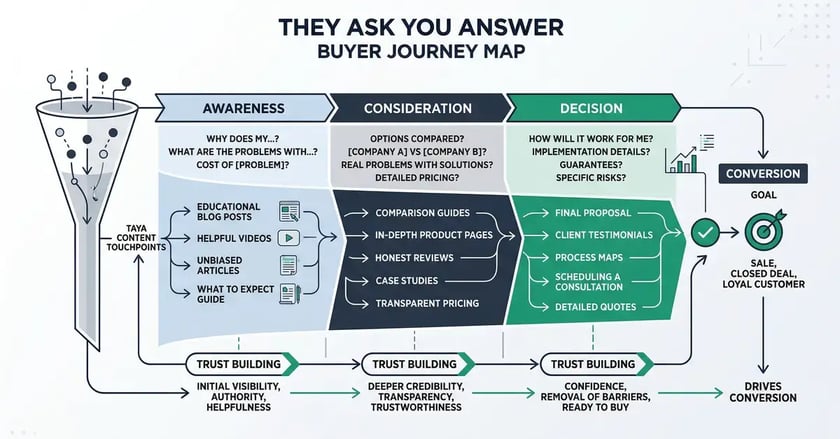
- Buyer obsession. Every piece of content starts with a real question from a real prospect. Not keyword research. Not editorial calendars built in isolation. The sales team's inbox and call recordings are your content goldmine. With 80% of B2B research happening before a buyer contacts sales, your content is your first sales conversation.
- Assignment selling. Content isn't just for attracting traffic — it's a sales tool. When a prospect asks a question on a call, the sales rep sends them the relevant article before the next meeting. Educated prospects close faster and stay longer. Companies using assignment selling report shorter deal cycles and higher close rates because prospects arrive at meetings pre-qualified.
- Organizational commitment. They Ask, You Answer isn't a marketing tactic. It's a company-wide philosophy that requires leadership buy-in, sales participation, and a culture of teaching rather than selling. Most implementations take 18–24 months to fully embed across an organization.

The Big 5: Content Types That Drive Buyer Decisions
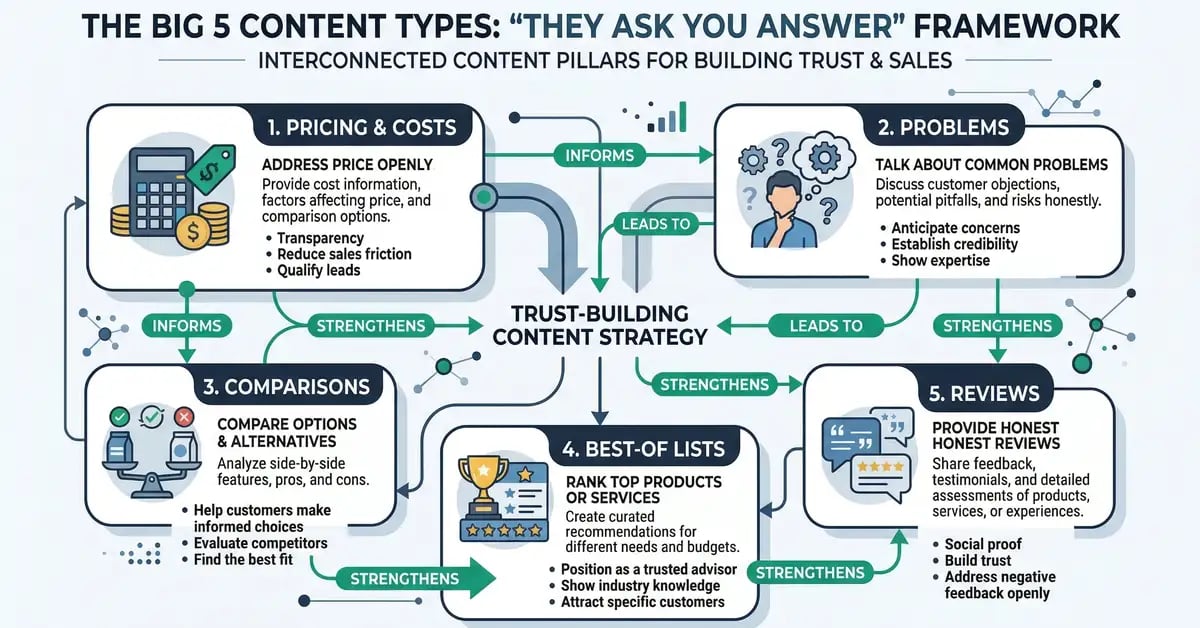
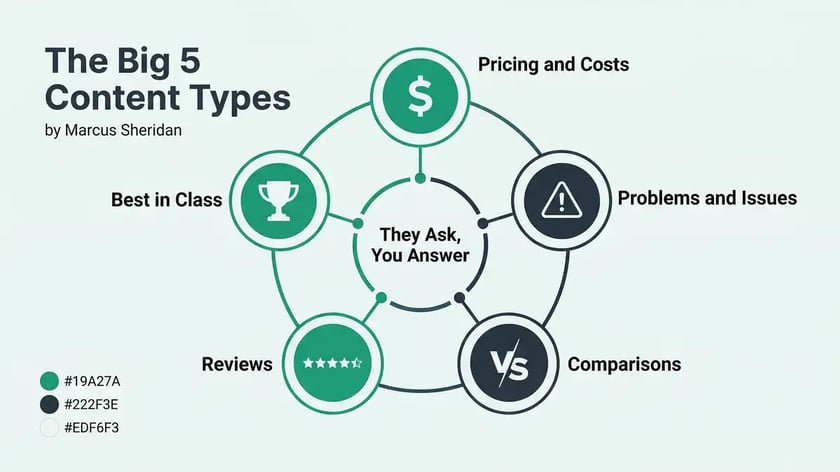
At the heart of They Ask, You Answer are the Big 5 — five content categories that address the topics buyers research most before making a purchasing decision. These aren't theoretical. They're derived from decades of buyer behavior data and validated across thousands of B2B implementations by IMPACT's research.
| Big 5 Category | What Buyers Ask | Why It Matters | Proven Results |
| Pricing and Costs | "How much does it cost?" | Most searched, most avoided by sellers — transparency builds trust | River Pools: $35M+ from one pricing article |
| Problems and Issues | "What are the downsides?" | Honest problem acknowledgment creates realistic expectations | Builds buyer confidence, reduces post-sale churn |
| Comparisons | "How does X compare to Y?" | Buyers compare regardless — control the narrative | Positions you as trusted advisor, not just vendor |
| Reviews | "What do others say about this?" | Social proof accelerates purchase decisions | Yale Appliance: $37M → $100M+ with review-driven trust |
| Best in Class | "What's the best option?" | Curated lists position you as the industry authority | High AI citation rates — AI engines sample and quote these |
River Pools generated $35 million in revenue from a single pricing article. The Big 5 content categories target the exact inflection points where B2B buyers make or break their purchasing decisions. — The Ambitions Agency
Why B2B Companies Avoid the Big 5
Most B2B companies resist publishing Big 5 content because it feels risky. Talking about pricing exposes your margins. Discussing problems feels like handing ammunition to competitors. Comparing yourself to alternatives seems like giving buyers a reason to leave.
The reality is the opposite. Buyers research these topics whether you publish about them or not. The only question is whether they find your perspective — or your competitor's. Companies that embrace Big 5 content consistently report higher lead quality, shorter sales cycles, and stronger client relationships. RetroFoam's 2,942% increase in leads came entirely from answering the questions their sales team heard every day.
Avoid This Mistake
The most common failure is treating They Ask, You Answer as a content tactic instead of a company-wide philosophy. Many teams publish isolated Big 5 articles without sales alignment, organizational commitment, or ongoing execution — and predictably see no ROI. Full implementation requires 18–24 months and participation from leadership, sales, and subject matter experts across the organization.
They Ask, You Answer vs Traditional Content Marketing
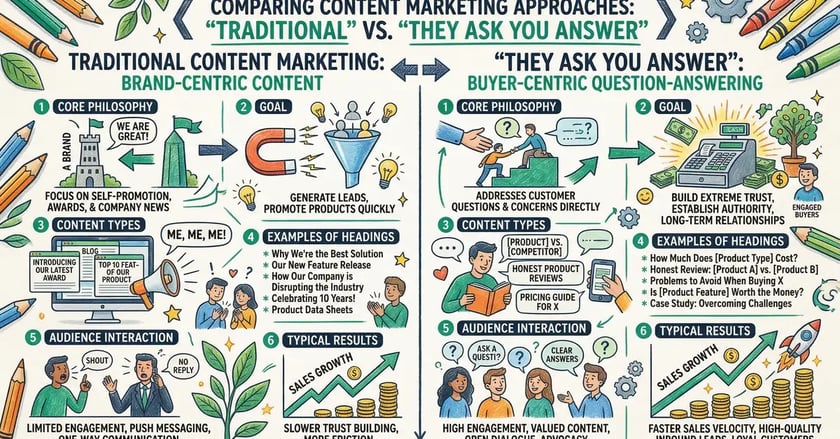
Understanding where They Ask, You Answer diverges from conventional marketing infrastructure is critical for implementation. The differences aren't cosmetic — they're structural.
| Dimension | Traditional Content Marketing | They Ask, You Answer |
| Content source | Editorial calendar driven by brand priorities | Buyer questions from sales calls, support tickets, search queries |
| Pricing content | Hidden — "contact us for a quote" | Published transparently with context and ranges |
| Sales integration | Marketing creates, sales ignores | Assignment selling — sales actively uses content in deal cycles |
| Tone | Promotional, feature-focused | Educational, honest, buyer-first |
| Success metric | Traffic, impressions, MQLs | Revenue influenced, sales cycle length, close rate |
| Competitive content | Avoided — fear of promoting competitors | Embraced — comparisons build trust and authority |
| Ownership | Marketing department | Company-wide commitment — leadership, sales, subject matter experts |
| Cost per lead | PPC: $181/lead, trade shows: $811/lead | SEO + content: $31–$92/lead with 700%+ ROI |
The most significant shift is from content as a marketing function to content as a revenue system. In the They Ask, You Answer model, content isn't measured by how many blog views it generates — it's measured by how many deals it helps close and how much time it saves the sales team. SEO and content marketing combined regularly deliver over 700% ROI, with thought leadership campaigns achieving 748% ROI with approximately 9-month breakeven.

Key Takeaway
Success with They Ask, You Answer comes from systematic execution, not better strategy. Publishing 3–4 articles per week over 18 months builds topical authority, feeds AI search engines, and creates a sales tool that compounds. Consistency beats perfection.
Implementation Roadmap: Deploy They Ask, You Answer in 90 Days
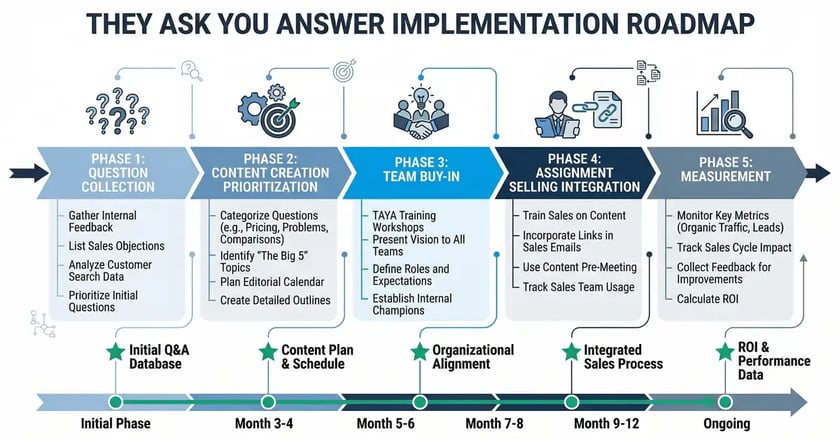
Theory doesn't generate revenue. Execution does. Most companies implement the full Endless Customers system over 18–24 months, but you can build a strong foundation in 90 days. Here's the phased approach:
Phase 1: Discovery (Weeks 1–2)
- Audit your sales team's inbox. Identify the 50 most common questions prospects ask before, during, and after the sales process. These are your first 50 articles.
- Mine support tickets and chat logs. Customer success teams hear questions that marketing never sees. Extract them systematically.
- Run keyword research. Validate buyer questions against search volume data. Prioritize questions that have both high search volume and high commercial intent — tools like DataForSEO and Semrush can map questions to volume.
- Map the buyer journey. Assign each question to a stage: awareness, consideration, or decision. This determines content format and depth.
Phase 2: Foundation (Weeks 3–6)
- Publish your first Big 5 article — pricing. This is the hardest and most impactful first step. Address your most-asked pricing question with full transparency. Remember: River Pools built a $100M+ business starting with one pricing article.
- Create comparison content. Write honest, detailed comparisons of your solution versus 2–3 alternatives. Include scenarios where competitors might be a better fit — this builds trust that no amount of promotion can buy.
- Build the content team. Identify subject matter experts across your organization who can contribute to content. They don't need to write — they need to share their expertise for a content manager to shape.
- Train sales on assignment selling. Every sales rep should know your content library and be able to send the right article at the right moment in the deal cycle.
Phase 3: Scale (Weeks 7–12)
- Publish 3–4 articles per week. Maintain a cadence that builds topical authority. Quality over quantity, but consistency matters for SEO and generative engine optimization.
- Integrate video. Record 1:1 video answers to the most impactful questions. Video achieves the highest content ROI at 31%, outperforming all other formats. Video builds trust faster than text and performs well in AI search results.
- Measure assignment selling adoption. Track which articles sales reps send, how prospects engage, and the correlation with close rates.
- Optimize for AI search. Structure content for citation by AI engines — concise answers in the first 50 words, structured data markup, and entity-clear formatting. With 60% of Google searches now ending without a click, optimizing for AI-generated answers is no longer optional. This bridges They Ask, You Answer with modern GEO strategy.
Ready to build a content system that actually drives revenue? Let's align your content strategy with buyer questions and sales processes.
Explore Marketing InfrastructureMeasuring Content Marketing ROI: The Metrics That Matter
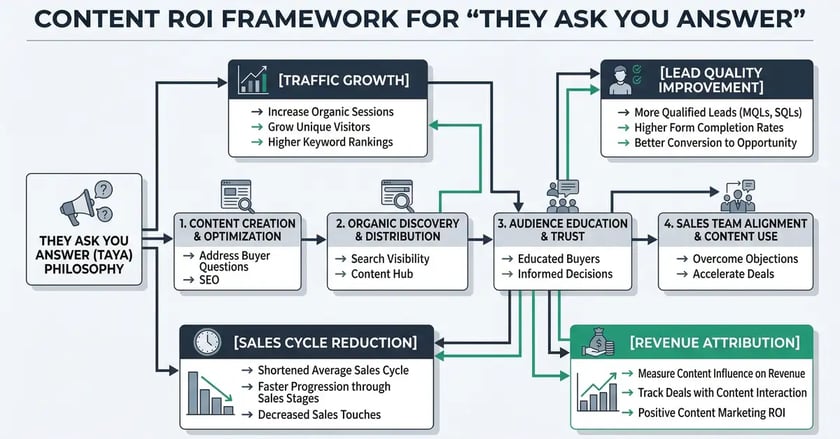
Among B2B marketers with a content strategy, only 12% say they're highly effective — exceeding their goals. The difference between the top performers and everyone else isn't talent or budget. It's measurement discipline and the willingness to tie content directly to revenue, not vanity metrics.
They Ask, You Answer demands a different measurement framework than traditional content marketing. Here are the KPIs that actually connect content to pipeline:
| KPI | What It Measures | Target | Why It Matters |
| Content-influenced revenue | Pipeline that touched content before closing | 40%+ of closed-won deals | Proves content drives revenue, not just traffic |
| Assignment selling rate | % of deals where sales uses content | 80%+ of active deals | Measures sales-marketing alignment |
| Sales cycle compression | Days from first touch to close | 20-30% reduction in 6 months | Educated buyers decide faster |
| Cost per lead by channel | SEO vs PPC vs events vs content | SEO: $31 | Content: $92 | PPC: $181 | Validates content economics vs paid channels |
| Lead quality score | Content-sourced vs other leads | Higher conversion rate | Big 5 content pre-qualifies prospects |
| AI citation rate | Brand mentions in AI search answers | Top 3 for core topics | Future-proofs visibility as AI search grows |
What This Means
They Ask, You Answer content is an appreciating asset. Unlike paid ads that stop working when funding stops, a pricing article published today continues generating leads, building trust, and feeding AI search results 12, 24, and 36 months from now at zero cost. This compounding effect delivers 700%+ ROI versus 200% for PPC and 50–100% for trade shows.
They Ask, You Answer in the AI Search Era
The framework is more relevant now than when Sheridan created it. Over 60% of Google searches now end without a click, and AI-powered search engines are reshaping how B2B buyers discover and evaluate vendors. ChatGPT, Perplexity, and Google AI Overviews don't rank pages — they synthesize answers and cite the sources they trust.
They Ask, You Answer content is structurally optimized for AI citation because it does exactly what AI engines reward: answers real questions with authoritative, structured, data-backed content. Here's how the framework maps to generative engine optimization principles:
- Question-first content maps directly to how users query AI engines — clear questions, concise authoritative answers
- Transparency signals (pricing, comparisons, problem acknowledgment) build the trust that AI engines use to determine citation-worthiness
- Structured, extractable formatting — tables, lists, clear H2/H3 headings — makes content machine-parsable for AI synthesis
- "Best in Class" content gets sampled and quoted by AI engines — these list-style articles have among the highest AI citation rates of any content type
- Topical authority clusters created by systematically answering every question in a topic area match the entity-mapping that AI engines use to evaluate expertise
The convergence is powerful: companies deploying They Ask, You Answer are simultaneously building the content infrastructure that wins in AI search. The same content that closes deals through assignment selling earns citations in ChatGPT and Perplexity — compounding ROI across both channels.
FAQ: They Ask, You Answer for B2B
What is They Ask, You Answer?
They Ask, You Answer is a business and content marketing framework developed by Marcus Sheridan. The core principle: when your prospects have questions, your website should answer them with radical transparency. The framework centers on the Big 5 content categories — pricing, problems, comparisons, reviews, and best-in-class lists — that address the topics buyers research most before purchasing. It has evolved into Endless Customers (updated April 2025), expanding from content strategy into a full revenue system that aligns marketing, sales, and leadership around buyer obsession.
What are the Big 5 content types?
The Big 5 are the five content categories that most influence purchasing decisions: pricing and costs (what things cost and why), problems and issues (honest acknowledgment of challenges), comparisons (how options stack up), reviews (what customers say), and best-in-class lists (curated recommendations). These topics are the most searched by buyers yet the most avoided by sellers. River Pools proved the power of Big 5 content by generating $35 million from a single pricing article.
How does They Ask, You Answer differ from traditional content marketing?
Traditional content marketing is brand-driven — companies publish what they want to say. They Ask, You Answer is buyer-driven — companies publish what prospects need to know. Key differences include transparent pricing content instead of "contact us" gates, honest competitor comparisons instead of avoidance, sales integration through assignment selling, and company-wide ownership rather than marketing-only responsibility. The framework measures success by revenue influenced and sales cycles shortened, not just traffic generated.
How long does it take to see results from They Ask, You Answer?
Initial traffic improvements typically appear within 60–90 days of consistent publishing. Meaningful pipeline impact — shorter sales cycles, higher close rates, improved lead quality — generally materializes within 6 months. Full organizational transformation takes 18–24 months. RetroFoam doubled revenue and saw a 2,942% lead increase through disciplined execution. The key variable is consistency — companies that publish 3–4 Big 5 articles per week see faster results than those publishing sporadically.
Can They Ask, You Answer work alongside AI and automation strategies?
They Ask, You Answer is highly complementary to AI and automation strategies. The framework produces exactly the type of structured, authoritative, question-answering content that AI search engines prefer to cite. Companies can use AI tools to scale content production, automate content distribution through CRM automation, and leverage workflow automation to deliver the right content to the right prospect at the right stage. The framework's emphasis on genuine expertise and transparency provides the human depth that AI-generated content alone cannot replicate.
What is assignment selling and why does it matter?
Assignment selling is the practice of sales reps sending relevant content to prospects between meetings. Instead of waiting for the next call to address objections, the rep sends a blog post, video, or comparison guide that addresses the buyer's specific concern. This approach works because 80% of B2B buyer research happens before they contact sales — assignment selling feeds that research with your perspective rather than a competitor's. Companies using assignment selling consistently report higher close rates and shorter deal cycles because prospects arrive at meetings informed and pre-qualified.
Build the Content Engine That Compounds
They Ask, You Answer isn't a content marketing trend — it's an operating philosophy that transforms how B2B companies earn trust, generate leads, and close deals. peppereffect architects the systems that make buyer-driven content compound: from content strategy through answer engine optimization to full lead generation infrastructure.
Book Your Growth Mapping CallExplore the B2B Lead Generation Guide →