

What Is AI Content Repurposing and Why Does It Matter for B2B?
AI content repurposing is the systematic use of artificial intelligence to transform a single piece of expert content — typically video or audio — into dozens of derivative assets across every channel your buyers inhabit. It is the difference between a founder who records one video and publishes one video, and a founder who records one video and publishes 30 days of LinkedIn posts, blog articles, email sequences, podcast clips, and quote graphics — all without touching a keyboard a second time.
The math is brutal for B2B thought leaders who still create content manually. 34.3% of marketers dedicate 10 to 15 hours per week to content creation, according to Typeface's 2026 content marketing research. Meanwhile, 54% of B2B content receives minimal distribution beyond its initial publication — meaning more than half of every hour invested yields exactly one impression in one channel. That is not a content strategy. That is a content graveyard.
The generative AI content creation market has exploded to $19.75 billion in 2025 and is projected to reach $143 billion by 2035 at a 21.9% CAGR, according to Precedence Research. But the founders capturing outsized returns are not simply using AI to write more — they are using AI to multiply what they have already created. This is content atomization: one expert recording, refined into an entire distribution engine.
What you will learn in this article:
- Why the "Technician's Trap" of manual content creation is the single biggest bottleneck for high-ticket consultants and coaches
- The AI Content Refinery framework: a 5-stage system that turns 30 minutes of expert video into 30 days of multi-channel distribution
- Which AI content repurposing tools and workflows deliver the highest multiplication rates
- Real benchmarks on time savings, engagement rates, and content atomization ROI
- How to build a Freedom Machine for content that runs without you
Key Takeaway
AI content repurposing is not about producing more content. It is about extracting maximum distribution leverage from the expert insight you have already captured — turning one 30-minute recording into 20-30 derivative assets that feed every channel for an entire month.

Why Do B2B Thought Leaders Burn Out on Content Creation?
The Technician's Trap is real and measurable. A Viral Nation study found that 52% of content creators are experiencing burnout, with 40% citing creative fatigue as the primary driver. For B2B founders and consultants running $2M-$10M businesses, this is not an abstract creator-economy problem — it is the reason their pipeline dries up every time they stop posting.
The Content Marketing Institute's 2026 B2B report reveals the scale of the challenge: 91% of B2B marketers increased content output in 2025, but only one in three has a scalable content creation model. The rest are trapped in a manual cycle — ideate, draft, edit, design, publish, repeat — that consumes the very hours they should be spending on high-value client work and strategic business scaling.

The burnout economics get worse at scale. 59% of creators report burnout negatively impacts their careers, and 37% consider leaving content creation entirely. For a high-ticket consultant like our ICP David Vance — whose entire coaching business growth depends on maintaining thought leadership visibility — stopping content is not an option. But continuing the manual grind while serving clients is not sustainable either.
This is precisely the problem that a systematic content repurposing strategy solves. Instead of creating 20 unique pieces per month from scratch, you create one high-density expert recording and let AI decompose it into everything else. The input is 30 minutes. The output is 30 days of distribution. The founder's expertise is the irreplaceable ingredient; the multiplication is infrastructure.
How Does the AI Content Refinery Framework Work?
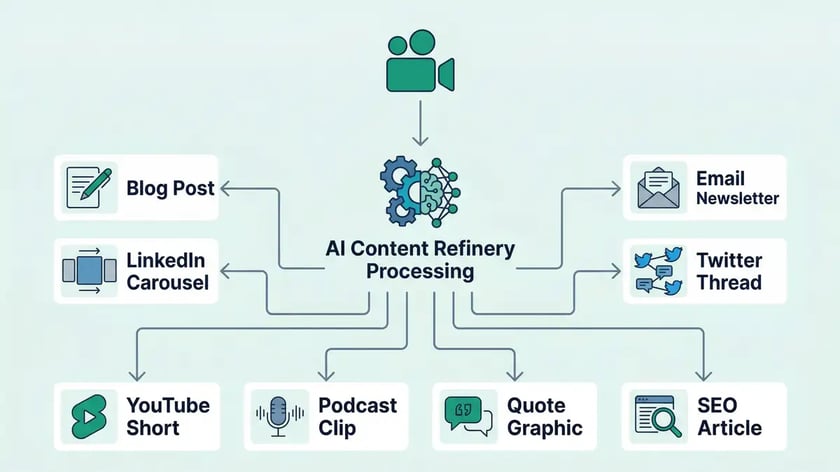
The AI Content Refinery is a 5-stage content atomization system that mirrors industrial refining: raw material goes in one end, high-value derivative products come out the other. At peppereffect, we architect this as a logic-gated workflow using agentic workflows — each stage has defined inputs, quality gates, and outputs that feed the next stage autonomously.
Capture: Record the Expert Source
Record a 30-minute video or audio session covering one core topic. Use a structured prompt framework: state the problem, share 3-5 key insights, include one counterintuitive data point, and close with an actionable recommendation. This source recording becomes your "crude oil" — the raw material for everything downstream.
Extract: AI Transcription and Intelligence Layer
Run the recording through AI transcription (94-99% accuracy for clear audio) and layer on content intelligence — identifying key quotes, statistics, frameworks, and argument structures. This stage produces a structured content brief, not just a raw transcript. Tools like Descript, Otter.ai, and Claude handle extraction in under 10 minutes.
Refine: Generate Derivative Assets
AI transforms the structured brief into 15-25 derivative assets: a long-form blog article, 5-7 LinkedIn posts, 3-4 email newsletter segments, 2-3 short-form video scripts, quote graphics, and carousel frameworks. Each asset is tailored to its channel's format, length, and engagement patterns — not a copy-paste of the transcript.
Quality Gate: Human Editorial Review
Every derivative passes through a human editorial filter. AI-generated content achieves 62% "acceptable with minor edits" according to HubSpot research — meaning 38% needs substantial revision. The editorial stage preserves your authentic voice, catches factual errors, and ensures brand alignment. Budget 15-20 minutes for this stage.
Distribute: Scheduled Multi-Channel Deployment
Load all assets into your scheduling infrastructure — AI workflow automation handles the deployment cadence. One recording now feeds LinkedIn (daily), email (weekly), blog (weekly), short-form video (3x/week), and podcast (weekly) for 30 days. Total founder time investment: 30 minutes of recording + 20 minutes of editorial review.
Sources: MarTech — Content Atomization, Convince & Convert — Content Atomization
What Are the Real Time Savings from AI Content Repurposing?
The efficiency gains are not marginal — they are transformational. Manual content repurposing of a 60-minute video into 10 derivative assets takes 180-240 minutes. AI-assisted repurposing reduces this to 45-60 minutes — a 70-80% time reduction that fundamentally changes what is possible for a time-constrained founder.
| Task | Manual Time | AI-Assisted | Savings |
| Video transcription (60 min) | 120-180 min | 5-10 min | 90-95% |
| Blog article from recording | 90-120 min | 15-20 min | 80-85% |
| Social content generation (5 posts) | 45-60 min | 8-12 min | 85-90% |
| Email newsletter from source | 90-120 min | 20-30 min | 75-80% |
| Full repurposing (1 video → 10 assets) | 180-240 min | 45-60 min | 70-80% |
Sources: Typeface Content Marketing Statistics 2026, DoneForYou AI Content Repurposing Case Study
The case study evidence is equally compelling. DoneForYou's AI repurposing case study documents a 43% increase in social media engagement and a 28% boost in lead generation when brands implemented AI-driven content repurposing, while reducing production costs by up to 65%. This is not incremental improvement — it is a structural step-change in content economics.
For our ICP David Vance — a $5M coaching business founder — the arithmetic is decisive. At 10 hours per week of manual content creation, he is spending 520 hours annually on content. A content repurposing strategy with AI reduces this to approximately 130 hours — reclaiming 390 hours per year. At his effective hourly rate, those reclaimed hours represent substantial revenue capacity that was previously locked inside the content treadmill.
Key Takeaway
AI content repurposing does not replace expert insight — it multiplies its distribution. The founder's 30 minutes of irreplaceable expertise remains the source. AI handles the mechanical work of reformatting, adapting, and scheduling across channels — work that previously consumed 10-15 hours per week.
Ready to architect a content repurposing system for your B2B business? Let peppereffect map your content infrastructure and identify where AI can reclaim your time.
Book Your Growth Mapping CallWhich Content Formats Deliver the Highest ROI When Repurposed?
Not all derivative content performs equally. The data from Wyzowl's 2026 State of Video Marketing confirms that video remains the highest-performing source format: 91% of businesses now use video, with 85% reporting it helps generate leads and 83% saying it has directly increased sales.

But the real leverage comes from what you do after the video is recorded. According to Social Insider's 2026 LinkedIn benchmarks, native document posts (carousels) achieve a 7.00% engagement rate — significantly higher than text-only posts. Video posts on LinkedIn generate 5x more conversations than text, and video watch time grew 36% year-on-year in 2025. This means your repurposed short-form video clips and carousel frameworks extracted from one source recording can outperform original text content.
The 2025 Edelman-LinkedIn Thought Leadership Impact Report adds a critical dimension: 63% of hidden buyers — decision-makers not on the official buying team — consume more than an hour of thought leadership content per week. And 95% say strong thought leadership makes them more receptive to sales outreach. This validates the entire repurposing thesis: your 30-minute recording, distributed across formats, reaches buyers you did not even know were watching.
| Repurposed Format | Engagement vs. Original | Best Channel | Shelf Life |
| Short-form video clips | 70-85% | LinkedIn, YouTube Shorts | 2-7 days peak |
| LinkedIn carousels/documents | 80-120% (often exceeds) | 3-7 days peak | |
| Blog article from transcript | 40-60% | Organic search (SEO) | 6-24 months |
| Email newsletter segments | 15-25% open rate | 24-48 hours peak | |
| Podcast audio extraction | 30-50% | Apple/Spotify | 12-60 months |
| Quote graphics | 50-70% | LinkedIn, Instagram | 1-3 days peak |
Sources: Social Insider LinkedIn Benchmarks 2026, Wyzowl State of Video Marketing 2026, Edelman-LinkedIn 2025 Thought Leadership Report
The critical insight here is that B2B content strategy is not about choosing one channel. It is about occupying every channel simultaneously from a single source — and AI content repurposing tools make this operationally feasible for teams of one.

How Do You Build a Scalable Content Repurposing System?
The difference between ad-hoc repurposing and a scalable system is infrastructure. The Content Marketing Institute reports that only 34% of B2B marketers have a documented, systematic repurposing workflow — while 38% repurpose ad hoc and 28% do not repurpose at all. The 34% with systems are the ones scaling content output without scaling headcount.
Building a content repurposing system requires three architectural layers, similar to how we architect automated fulfillment systems at peppereffect:
Layer 1: The Capture Protocol. Standardize your recording setup — same lighting, same audio quality, same structured prompt framework every session. This consistency means your AI extraction layer produces predictable, high-quality raw material. Invest in a decent microphone and ring light ($200-$500 total) and use a teleprompter app with your topic framework pre-loaded.
Layer 2: The AI Processing Pipeline. Connect your transcription tool to your content generation layer. The eMarketer research shows 95% of B2B marketers are now using AI tools in some capacity, with 89% using them for generating marketing copy. The processing pipeline should automate: transcription → content brief extraction → derivative asset generation → formatting per channel specifications. Tools like n8n and Make.com can orchestrate this entire flow.
Layer 3: The Distribution Engine. Schedule all derivative assets across channels with a 30-day distribution calendar. The key principle is temporal spacing — do not publish everything at once. Spread your LinkedIn posts across 20-25 publishing slots, your email segments across 4-5 sends, and your blog content across 2-4 articles. This creates the perception of constant, consistent presence from a single recording session.
Avoid This Mistake
Do not skip the human editorial review stage. AI-generated repurposed content achieves only 62% "acceptable with minor edits" quality. Publishing unreviewed AI output will damage your thought leadership credibility — the Edelman report shows 64% of buyers trust thought leadership more than product sheets, but only when quality is high. Budget 15-20 minutes per batch for editorial review.
What Does AI Content Repurposing Mean for SEO and AEO?
Repurposed content is not just a social media play — it is an SEO content marketing multiplier. Every blog article generated from your source recording targets new keyword clusters. Every FAQ answer extracted from your video feeds answer engine optimization visibility. Every internal link between repurposed articles strengthens your topical authority for generative engine optimization.
The Convince & Convert research on content atomization documents how one 60-minute recording can produce 10+ supporting assets — including tweets, LinkedIn carousels, blog transcripts, audiograms, and quote graphics — each targeting different search queries and AI citation opportunities. When structured properly, a single source recording can target 15-20 unique keywords across its derivative content library.
For B2B companies investing in lead generation infrastructure, this creates compounding returns. Each repurposed blog article adds to your indexed page count, builds internal linking density, and creates new entry points for organic traffic. Over 12 months, a weekly recording cadence produces 50+ source recordings → 500+ derivative assets → 100+ indexed blog pages — a content moat that competitors cannot replicate through manual effort alone.
Key Takeaway
Content repurposing is not just about social distribution — it is a compounding SEO and AEO asset strategy. Each source recording, properly atomized, targets multiple keyword clusters and AI citation opportunities simultaneously, building topical authority faster than single-channel content creation ever could.
Frequently Asked Questions
What is the best AI tool for content repurposing?
The best AI content repurposing setup combines specialized tools in a pipeline rather than relying on a single platform. Use Descript or Otter.ai for transcription, Claude or GPT-4 for content generation and reformatting, and workflow orchestration tools like n8n or Make.com to connect them into an automated sequence. The right tool depends on your specific content formats and distribution channels — the architecture matters more than any individual tool.
How many pieces of content can you create from one video?
A well-structured 30-60 minute expert video typically yields 15-25 derivative assets: one long-form blog article, 5-7 LinkedIn posts, 3-4 email segments, 2-3 short-form video clips, 2-3 quote graphics, one podcast episode, and one carousel framework. The Convince & Convert content atomization research documents teams producing 10+ assets per 60-minute recording as standard practice.
Does repurposed content perform as well as original content?
Repurposed content typically achieves 40-85% of original content engagement depending on the format, according to industry benchmarks. LinkedIn carousels created from source material can actually exceed original engagement at 80-120%. The key variable is editorial quality — AI-repurposed content that receives human editorial review performs significantly closer to original than unreviewed output.
How much time does AI content repurposing actually save?
AI-assisted content repurposing reduces total production time by 70-80% compared to manual creation. A full repurposing workflow — from one 60-minute source video to 10 derivative assets — drops from 180-240 minutes manually to 45-60 minutes with AI. For a founder spending 10 hours weekly on content, this translates to approximately 390 hours reclaimed per year. Learn more about quantifying these gains with our automation ROI calculator.
Is AI content repurposing good for SEO?
Yes — when executed strategically. Each repurposed blog article targets new keyword clusters, builds internal linking density, and creates additional indexed pages for organic discovery. A weekly recording cadence can produce 100+ indexed blog pages per year, each targeting different search queries. The compounding effect on B2B SEO is significant because topical authority grows with every interlinked piece in your content library.
What type of source content works best for repurposing?
Video and audio recordings of expert insight perform best because they capture natural language, storytelling cadence, and authentic voice — elements that make derivative content feel human rather than machine-generated. Wyzowl's 2026 data shows 91% of businesses now use video, with 85% reporting it generates leads. Structure your recordings around one core problem, 3-5 insights, and one actionable takeaway for maximum atomization potential.
How does content repurposing fit into a broader B2B growth strategy?
Content repurposing is the content engine within a Freedom Machine architecture. It feeds your LinkedIn lead generation, nurtures prospects through email sequences, and builds the organic search presence that attracts the 95% of buyers not yet in-market. For high-ticket consultants and coaches, it is the mechanism that decouples thought leadership visibility from personal time investment.
Stop Creating Content Manually. Start Architecting a Content Refinery.
peppereffect installs AI content repurposing systems that turn your expert knowledge into 30 days of multi-channel distribution — from a single 30-minute recording. Reclaim your hours. Scale your visibility. Build the Freedom Machine.
Book Your Growth Mapping CallExplore our B2B Content Strategy framework →
Resources
- Wyzowl — State of Video Marketing 2026: 12 Years of Data
- Content Marketing Institute — B2B Content and Marketing Trends 2026
- Edelman-LinkedIn — 2025 B2B Thought Leadership Impact Report
- Precedence Research — Generative AI in Content Creation Market Size Report
- MarTech — Content Atomization: Maximize ROI by Repurposing Your Best Ideas
- Convince & Convert — Content Atomization: The Underutilized Hero of Content Marketing
- DoneForYou — Case Study: AI Content Repurposing Multi-Channel Marketing ROI
- Viral Nation — The Creator Burnout Crisis: Why Over Half of Influencers Are at a Breaking Point