What is AI for executive search?
AI for executive search is the deployment of autonomous agents that execute the labour-intensive core of senior-level talent acquisition — market mapping, multi-source candidate discovery, enrichment, signal monitoring, and initial outreach — whilst senior partners retain ownership of confidential client advisory, relationship stewardship, and final placement decisions. Unlike first-generation applicant tracking system matching, autonomous sourcing platforms in 2026 combine large language model reasoning, tool access across LinkedIn / Crunchbase / GitHub / SEC filings, persistent market-map memory, and real-time signal monitoring to compress time-to-shortlist from weeks to days. future of executive search what an executive search firm does 7-stage retained search workflow retained vs contingency comparison 12-step blueprint to launching your agency named methodologies of the Big 5
The shift is no longer experimental. 97 percent of executives report their company deployed AI agents in the past year, and more than half of talent leaders plan to add autonomous AI agents to their teams in 2026 (WRITER Enterprise AI Adoption Survey 2026; Korn Ferry Talent Acquisition Trends). For elite executive search firms, this is the decisive operating-leverage moment: firms that install autonomous sourcing architecture correctly gain 3–5x placement capacity per researcher without proportional headcount expansion.
What you'll learn in this article:
- Why 70 percent of executive search researcher time is still consumed by manual sourcing — and which failure points autonomous agents eliminate
- The 2026 autonomous sourcing architecture: reasoning loops, tool orchestration, persistent market maps, and signal monitoring
- Platform comparison across HireEZ, SeekOut, Fetcher, Findem, Eightfold, Juicebox, Gem, Metaview and Ezekia with 2026 pricing
- The 8-stage deployment framework for boutique search firms: 12–24 weeks from mandate definition to operational normalisation
- Six failure modes that destroy deployment ROI — bias amplification, LinkedIn over-reliance, hallucinated data, EU AI Act exposure, spray-and-pray damage, confidentiality breaches
- Regulatory obligations under the EU AI Act, NYC Local Law 144, Colorado SB 24-205, and post-Brexit UK GDPR
Key Takeaway
AI for executive search is not about replacing partners — it is about installing autonomous infrastructure that absorbs the 70 percent of researcher time currently consumed by manual sourcing, enrichment, and signal monitoring, so that partners can direct more strategic judgment to fewer, higher-value tasks: confidential client advisory, candidate relationship stewardship, and negotiation. Boutique firms that architect this division correctly gain placement velocity whilst preserving the confidentiality and advisory depth that justify premium retained fees.

Why is executive search sourcing still so manual in 2026?
Despite two decades of ATS automation, approximately 70 percent of executive search researcher hours remain consumed by candidate identification, verification, and preliminary market mapping — functions that blend database searches, Boolean query formulation, social-network navigation, and manual cross-referencing against client mandates (True Search, 2026). This persistence is not a failure of technology adoption; it reflects structural constraints inherent to executive-level placements.
First, the talent supply for senior roles is genuinely scarce. Whilst millions of mid-market candidates populate public databases, Chief Technology Officer, Chief Financial Officer, Chief Sustainability Officer, and Chief AI Officer positions are filled by a finite pool of executives with demonstrated experience in closely analogous roles. Search consultants cannot rely on high-volume passive candidate pools as a primary sourcing stream; they must conduct directed talent mapping, identify prospects often in competitor organisations or adjacent industries, and navigate confidential outreach protocols where direct LinkedIn messaging or cold calling could trigger internal political exposure for the candidate.

Second, Boolean search limitations compound this manual effort. Traditional Boolean query construction — AND, OR, NOT, and quotation marks — remains the dominant search methodology across most platforms, but cannot distinguish between a CTO who scaled from 50 to 500 engineers and one who operated in a stable 50-person environment. It cannot assess leadership philosophy, change-management acumen, board experience, or cultural fit. Consequently, search researchers expend substantial effort filtering keyword-matched candidates — a process that is simultaneously labour-intensive and potentially biased, as human researchers inevitably apply unstated preference weightings (e.g., favouring certain geographies, educational backgrounds, or employer pedigrees).
Third, data explosion across multiple sources adds a second layer of complexity. Candidate signals are distributed across LinkedIn (1 billion+ monthly active users), GitHub (code repositories and project history for technical executives), patent databases (innovation records for R&D-intensive backgrounds), industry press releases, conference speaker rosters, and specialist forums within verticals such as deep tech, sustainability, or financial services. Executive search consultants must manually navigate these sources, cross-reference individuals across platforms, and synthesise fragmented information into a coherent candidate profile.
Why Boolean-Only Sourcing Caps Firm Growth
Executive cost-per-hire has risen 113 percent since 2017 and 21 percent since 2022 (SHRM Benchmarking Report, 2025). US average time-to-fill has increased 24 percent since 2021, reaching 42 days. Firms that remain dependent on Boolean-only sourcing cannot absorb this rising cost burden without eroding margin. Autonomous sourcing is no longer a competitive advantage — it is becoming a structural requirement for margin preservation.
How does autonomous AI sourcing actually work?
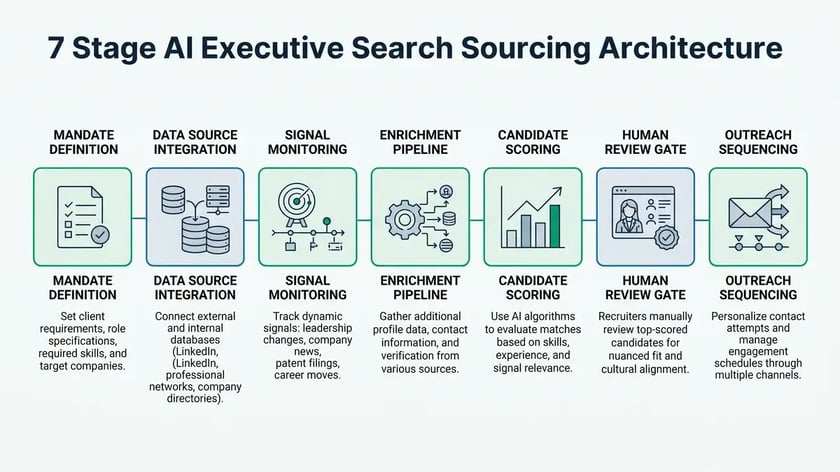
Contemporary autonomous sourcing platforms differ fundamentally from first-generation ATS AI executive search automation. Modern agents employ multi-step reasoning loops, tool access orchestration, persistent market-map memory, and real-time signal monitoring. The architecture comprises five integrated layers.
Layer 1 — Reasoning. Large language models trained on recruitment, organisational, and business intelligence data interpret natural-language mandate descriptions ("We need a Chief Operating Officer who has scaled European operations in the software-as-a-service sector and led digital transformation initiatives"), decompose them into candidate dimensions, and formulate targeted search queries across multiple data sources (Eightfold AI 2026 Talent Intelligence Index).
Layer 2 — Tool access orchestration. Autonomous agents query LinkedIn's professional graph, Crunchbase for funding and employment history, GitHub repositories for technical executives' code contributions, SEC Edgar filings for board experience, and patent databases for innovation records. This is the autonomous equivalent of a researcher manually navigating tabs — compressed from hours to seconds.
Layer 3 — Persistent market-map memory. Rather than treating each search as a discrete transaction, modern platforms maintain structured memory of market maps — cached knowledge about talent pools, skill distributions, recent mobility patterns, and competitive movements within defined specialisations. This persistence accelerates subsequent searches within the same vertical by retrieving previous mapping work and updating it with new signal data.
Layer 4 — Signal monitoring. Autonomous agents continuously monitor defined data sources for signals indicating candidate receptivity or qualification changes — promotions into roles meeting search criteria, exits from organisations, funding events triggering hiring needs at target companies, or board appointment announcements. Signals feed multi-dimensional scoring engines that move beyond keyword matching to evaluate career progression velocity, scale managed, and alignment with client mandate dimensions.
Layer 5 — Brief generation and human review gates. Rather than delivering unstructured lists of LinkedIn links, agents synthesise multi-source data into natural-language briefs summarising each candidate's trajectory, expertise, likely motivations, and specific fit against mandate dimensions — with transparent explainability showing why the match was made. Human-defined quality gates filter by confidence thresholds; only candidates above (for example) 85 percent confidence advance to researcher review.
Key Takeaway
Autonomous sourcing is not chatbot automation of existing workflows — it is architectural replacement of the research layer. Firms that treat AI sourcing as "a better LinkedIn search" will capture marginal efficiency; firms that install the full reasoning + tool + memory + signal + gate architecture capture order-of-magnitude leverage. The distinction determines whether your firm gains 15 percent or 300 percent placement capacity per researcher.
Which AI sourcing platforms should elite search firms evaluate in 2026?
The market for autonomous sourcing platforms serving executive search firms AI candidate screening at scale has matured considerably. Below is the 2026 shortlist for boutique and mid-market firms, with documented pricing and capability focus.
| Platform | Focus | Pricing (2026) | Best Fit |
| HireEZ | Sourcing + talent intelligence, contact enrichment | USD 169–250 per user/month (annual) | Mid-market firms; broad sourcing |
| SeekOut Recruit | 1B+ profiles, AI search + automated outreach | USD 833/seat/month (annual) | Executive search with tech focus |
| SeekOut Spot | Managed agentic AI + human researchers | Delivers shortlist in 2 weeks | Firms outsourcing first-pass research |
| Fetcher | AI screening + expert human sourcing teams | Custom (hybrid model) | Firms wanting human-verified shortlists |
| Findem | Assistive AI, 850M+ profiles, warm paths | Enterprise licensing | Large firms with warm-path priority |
| Eightfold AI | Agentic talent OS, 100x pool expansion | Enterprise | Enterprise search functions |
| Juicebox (PeopleGPT) | Natural-language AI recruiting, unlimited searches | USD 119–199/month | Boutique firms; entry price point |
| Gem | AI-first all-in-one, 800M+ profiles, ATS+CRM | Enterprise | Firms consolidating ATS + sourcing stack |
| Metaview | AI sourcing + interview intelligence for search firms | Per-seat | Specialist executive recruiters |
| Ezekia | Retained-search-specific CRM + candidate intelligence | Per-seat | Pure-play retained search boutiques |
Sources: Juicebox Platform Analysis 2026, SeekOut Pricing, Juicebox Pricing via G2, Metaview AI Recruiting Platforms 2026.
Cost structures show considerable variation by scope. Single-purpose tools focused on screening or scheduling typically cost USD 10,000 to USD 50,000 per year. End-to-end AI worker platforms including sourcing, enrichment, and workflow automation range from USD 45,000 to USD 250,000 in the first year, with steady-state annual costs of USD 30,000 to USD 180,000 thereafter, plus metered usage fees typically ranging from a few hundred to a few thousand USD per month (EveryWorker AI Workers Cost Guide 2026). For most boutique executive search firms, the sweet spot is a per-seat self-service platform in the USD 200–833/month range combined with CRM integration via Ezekia or Gem — and targeted use of managed services (SeekOut Spot, Fetcher) for specialist searches.
Most boutique firms evaluate 6–10 platforms and still deploy the wrong stack. peppereffect installs the integrated sourcing + CRM + outreach architecture recruitment CRM automation — logic-gated, human-governed, and ROI-measured — in 8–14 weeks.
Book a Freedom Machine AuditWhat ROI can elite search firms expect from autonomous sourcing?
Quantitative evidence from 2026 deployments is now robust. Below are the documented benchmarks across time-to-shortlist, placement velocity placement velocity playbook, researcher productivity, and candidate engagement.
| Metric | Baseline | With Autonomous Sourcing | Delta |
| Full-cycle hiring time (tech enterprise) | 24 days | 10–12 days | -50% |
| Time-to-fill reduction (AI-assisted stages) | 42 days US avg | Up to 70% compressed | Up to -30 days |
| Manual engineering test review | ~500 hrs/month | ~200–300 hrs saved | -60% |
| Candidate response time | 24+ hours | Under 2 minutes | -99% |
| Candidate screens per recruiter/week | Baseline | +66% | +66% |
| Admin + documentation time | Baseline | -41% | -41% |
| Quality hire likelihood (AI-assisted outreach) | Baseline | +9% | +9% |
| Hiring goal achievement (AI scheduling) | 1.0x | 1.6x | +60% |
Sources: CodeBridge AI Recruitment Case Study 2026, Pin Global AI Recruitment Statistics 2026, Yena AI Recruiting Statistics 2026.
For boutique executive search firms, candidate volume gains are more modest than enterprise ATS deployments but strategically significant: rather than expanding researcher headcount, firms can expand the number of parallel searches or the depth of candidate mapping per search through autonomous enrichment and signal monitoring. Retained search fees remain stable at 25–35 percent of first-year compensation (Pact & Partners European Executive Search Report 2025), meaning margin expansion comes from the supply side: more placements per researcher at stable fee levels.

A caveat applies to raw productivity metrics. The March 2026 Robert Half survey found that 67 percent of US HR leaders report reviewing AI-generated applications has slowed hiring, with 20 percent reporting delays exceeding two weeks, and 84 percent of HR teams report heavier workloads despite AI deployment (Robert Half AI Hiring Survey, March 2026). This "spray and pray" phenomenon — candidates using AI to generate dozens of applications — overwhelms screening pipelines. Executive search is largely insulated from this dynamic because target candidates are typically passive and contacted directly, but firms must still calibrate their own autonomous outreach to avoid contributing to candidate fatigue.
Key Takeaway
The measurable ROI from autonomous sourcing flows through researcher leverage, not cost reduction. Boutique firms that deploy correctly achieve 50–70 percent time-to-shortlist compression, 60 percent reduction in manual review workload, and 66 percent more candidate screens per researcher per week. At a steady retained fee structure of 25–35 percent, this translates directly to margin expansion — provided the firm preserves human stewardship over the advisory, confidentiality, and relationship dimensions that justify premium fees.
What is the 8-stage deployment framework for boutique search firms?
Executive search boutiques adopting autonomous sourcing typically progress through a structured deployment sequence spanning 12–24 weeks from platform selection to operational normalisation. The framework follows eight sequential stages, each with a specific deliverable and a governance checkpoint.
Mandate and ICP Definition (Week 1–2)
Conduct a structured review of current search mandates and candidate profiles to define Ideal Candidate Profiles with precision. Document target role responsibilities, reporting relationships, required experience dimensions (revenue scale, headcount managed, domain expertise, board exposure, geographic scope), educational pedigree preferences, and cultural-fit indicators. Front-loading this stage translates directly to search efficiency downstream.
Data Source Integration and Enrichment Pipeline (Week 2–4)
Integrate authorised data sources: LinkedIn professional graph (official APIs or integration partnerships), Crunchbase, GitHub, SEC Edgar, patent databases, and internal CRM/candidate-relationship-management data. Establish data governance protocols — permissible collection fields, UK GDPR and EU Data Protection Regulation mapping, data retention and deletion schedules.
Signal Monitoring and Trigger Configuration (Week 4–6)
Configure autonomous agents to monitor defined signals: promotions, exits, funding announcements, board appointments, conference speaking, publications. Establish alert thresholds and notification workflows — what signal strength and recency triggers outreach, and to whom alerts route within the firm. This stage is iterative; signal definitions refine based on early pilot results.
Candidate Scoring Rubric Definition (Week 6–9)
Define multi-dimensional scoring rubrics in collaboration with senior partners. Include career trajectory velocity, scale dimensions (revenue, headcount, geography), strategic experience (M&A, restructuring, international expansion), board exposure, diversity dimensions, and mandate-specific fit factors. Assign weights reflecting client priorities. Calibrate against historical placements to validate predictive power.
Human-in-the-Loop Review Gates (Week 9–11)
Define escalation thresholds by confidence score — candidates ≥85 percent confidence may advance without human review; 70–84 percent flagged for researcher review; below 70 percent rejected with transparent reasoning. Assign review ownership by candidate class. Establish appeals processes for false negatives. This stage is critical for search quality and reputational protection.
Outreach Sequencing and CRM Synchronisation (Week 11–14)
Configure autonomous outreach agents to send personalised, value-driven initial contacts that comply with anti-spam and confidentiality norms. Reference specific career achievements, explain timing, communicate mandate generically without revealing the client, and establish clear next steps. Integrate with CRM for full-team visibility.
Pilot Testing and Calibration (Week 14–18)
Execute controlled pilots against 3–5 representative mandates. Measure outcomes against baselines: sourcing speed, candidate volume, contact response, candidate feedback, search team feedback, and placement outcomes. Calibrate scoring, signals, and messaging based on findings. Autonomous systems optimise in directions that may not align with boutique-firm values if left uncalibrated.
Operational Normalisation and Continuous Governance human-in-the-loop AI controls (Week 18+)
Roll autonomous sourcing into standard workflows. Monthly signal accuracy reviews, quarterly rubric recalibrations, annual bias and fairness audits, and continuous candidate-feedback monitoring. Assign accountability: who owns sourcing quality and who escalates failures? Autonomous systems require continuous human stewardship — they are not set-and-forget deployments.

What failure modes destroy autonomous sourcing deployments?
Six failure patterns account for the vast majority of deployment disasters, each preventable through proper architecture and governance.
Failure 1 — Bias amplification from contaminated training data. Amazon scrapped its AI recruitment tool after discovering it penalised résumés containing the word "women" (as in "women's chess club captain"), a reflection of historical gender imbalance in its technical workforce (MIT Sloan AI in Hiring Case Studies). HireVue's speech recognition algorithms, deployed by 700+ companies including Goldman Sachs and Unilever, disadvantaged non-white and deaf applicants. For executive search, if the system learns that successful placements historically came from McKinsey, Microsoft, or JP Morgan alumni, it will systematically devalue equally qualified candidates from less prestigious employers, non-traditional paths, or underrepresented geographies.
Failure 2 — Over-reliance on LinkedIn signals creates blind spots. Whilst LinkedIn is the dominant professional network, it is curated self-presentation that may not capture true market dynamics. Executives at early-stage companies, PE-backed firms, or non-tech sectors often maintain minimal LinkedIn presence. Privately held companies don't disclose funding or ownership through LinkedIn. Agents relying primarily on LinkedIn miss substantial candidate populations. The solution: multi-source data synthesis integrating LinkedIn with Crunchbase, SEC filings, patent databases, industry press, and conference records.
Failure 3 — Hallucinated contact data and false enrichment. Large language models without retrieval-augmented generation controls can generate plausible but inaccurate information — fabricating job titles, companies, dates of employment, or contact details. When an agent generates a non-existent email or misattributes someone to a company where they never worked, the outreach damages brand. Rigorous data governance: only output verified data from authoritative sources, and flag confidence thresholds to surface uncertain data to human researchers before outreach.
Failure 4 — Regulatory exposure from automated employment decisions. The EU AI Act classifies AI systems for recruitment and selection as high-risk systems subject to mandatory compliance (EU AI Act Annex III). NYC Local Law 144 requires bias audits for any automated employment decision tool (DLA Piper AI Employment Law Update). Colorado SB 24-205 imposes risk assessments and transparency notices from June 30, 2026 (K&L Gates AI in Employment February 2026). Firms deploying without audit frameworks risk regulatory and civil exposure.
Failure 5 — Spray-and-pray AI outreach damages brand. Executive search depends on discrete, confidential engagement. When autonomous tools send dozens of identical messages across a candidate pool, and those messages circulate across professional networks, the firm's brand collapses into commodity recruiting. Boutique firms differentiate through personalised, selective, confidential engagement — over-automation risks destroying the very differentiation that justifies premium fees.
Failure 6 — Confidentiality breaches from over-automation. Clients initiate searches to replace executives, conduct succession planning, or explore leadership options without public visibility. When autonomous agents leave audit trails across multiple platforms, or when enrichment processes expose candidate names or mandates through third-party integrations, client confidentiality breaches (Medallion Partners on Executive Search Confidentiality). One breach can destroy a boutique firm's reputation within weeks.
The Paradox Incident — Vendor Risk Is Now Material
In 2025, 64 million job application records from Paradox, a conversational AI recruiting platform, were exposed due to a legacy test account with administrative access and password "123456" (JD Supra Paradox AI Data Breach Report). Boutique firms must audit vendor SOC 2 compliance, review bias audit documentation, and ensure vendor contracts include clear indemnification. The U.S. Department of Justice's updated Evaluation of Corporate Compliance Programs now directs prosecutors to assess AI risk management — including whether organisations conduct explicit AI risk assessments and train staff on responsible AI use (K&L Gates, February 2026).
How should AI and human partners divide the work?
Effective autonomous sourcing deployment requires clear delineation of what AI handles and what humans must control. This is not automation versus no automation — it is strategic delegation that prese AI for recruitingrves human judgment on dimensions requiring advisory expertise, relationship stewardship, or confidentiality control.
| Autonomous Agents Own | Human Partners Own |
| Sourcing & candidate discovery | Confidential client mandate discussions |
| Multi-source enrichment & profile synthesis | Candidate advisory & relationship stewardship |
| Signal monitoring & trigger alerts | Career motivation diagnosis & fit assessment |
| Initial administrative outreach | Negotiation & reference validation |
| Quantitative scoring & ranking | Board-readiness & governance assessment |
| CRM logging & workflow admin | Reputational & confidentiality gatekeeping |
Source: peppereffect Growth Architecture Framework, synthesising Hunt Scanlon Media AI in Executive Search Leadership 2025.
This division preserves margin. By automating labour-intensive sourcing and enrichment, boutique firms handle more searches per research professional — compressing time-to-shortlist and expanding placement quantity without proportional headcount growth. Simultaneously, by protecting human judgment on advisory, confidential, and reputational dimensions, the firm preserves the relationship depth that justifies premium retained fees. The result: higher placement velocity, lower cost-per-placement, and maintained average client fees. This is the definition of operational leverage.
What are the regulatory obligations in 2026?
The regulatory environment for recruitment AI tightened substantially in 2025 and 2026. Executive search firms deploying autonomous sourcing face material compliance obligations across four frameworks.
EU AI Act. AI systems "intended to be used for recruitment or selection of natural persons, in particular to place targeted job advertisements, to analyse and filter job applications, and to evaluate candidates" are high-risk under Annex III. Requirements: risk assessments, bias monitoring, human oversight, documentation, and meaningful human review of final employment decisions (EU AI Act Annex III). Firms operating in the EU or processing EU candidate data must demonstrate compliance.
NYC Local Law 144. Any covered employer or third party using automated decision tools must audit those tools for bias and provide notice to applicants. The 80/20 rule serves as a practical benchmark — selection rate for a protected group below 80 percent of the most-favoured group signals potential adverse impact warranting further analysis (Fisher Phillips NYC AI Bias Audit Guide 2026).
Colorado SB 24-205. Effective June 30, 2026, imposes obligations on entities doing business in Colorado using high-risk AI tools for employment decisions: risk assessments, transparency notices to candidates, and affirmative steps to prevent algorithmic discrimination.
UK/EU GDPR. Candidate data qualifies as personal data. Firms must establish lawful bases (legitimate interests, consent, or contractual necessity), apply data minimisation, and respect terms-of-service restrictions on platforms like LinkedIn (UK Data Services AI Recruitment Data Protection 2026). Speculative harvesting for future searches violates GDPR.
Vendor due diligence is now material. Firms must audit vendor SOC 2 compliance (Secure Slate SOC 2 Compliance Guide 2026), review bias audit documentation, and ensure contracts include indemnification and responsibility allocations.
Install Your Autonomous Executive Search Engine
peppereffect is the Master Growth Architect installing the integrated AI Operating System for elite executive search firms. We decouple placement capacity from researcher headcount through autonomous sourcing, CRM automation, and human-governed outreach architecture — logic-gated, compliance-audited, and ROI-measured. Book a diagnostic to map your firm's Freedom Machine.
Book Your Growth Mapping CallFrequently Asked Questions
What is AI for executive search?
AI for executive search is the deployment of autonomous agents that execute the labour-intensive core of senior talent acquisition — market mapping, multi-source candidate discovery, enrichment, signal monitoring, and initial outreach — whilst senior partners retain ownership of confidential client advisory, relationship stewardship, and final placement decisions. The architecture combines large language model reasoning, tool access across LinkedIn / Crunchbase / GitHub / SEC filings, persistent market-map memory, and real-time signal monitoring. It is not chatbot automation; it is architectural replacement of the research layer.
How much time does autonomous sourcing actually save?
Documented benchmarks from 2026 deployments show 50 percent compression in full-cycle hiring time (24 days to 10–12 days in the CodeBridge technology enterprise case), up to 70 percent compression in AI-assisted stages, 60 percent reduction in manual review workload, and 66 percent more candidate screens per recruiter per week. For boutique executive search firms, the practical gain is running more parallel searches at greater depth per search, without proportional researcher headcount expansion.
Which AI sourcing platform is best for boutique executive search firms?
There is no single answer — platform selection depends on firm size, vertical focus, and existing tech stack. For most boutiques, the sweet spot combines a per-seat self-service sourcing platform (Juicebox at USD 119–199/month for entry, SeekOut Recruit at USD 833/month for deeper capability) with a retained-search CRM (Ezekia, Metaview) and selective use of managed services (SeekOut Spot, Fetcher) for specialist searches. Enterprise firms evaluate Eightfold, Findem, or Gem for integrated talent operating systems.
Can AI replace human executive search partners?
No — and the firms that believe it can will destroy their brand. Executive search is relationship-intensive by design. Clients engage retained firms precisely because they need confidential advisory, nuanced candidate judgment, and relationship stewardship across the senior talent market. Autonomous agents handle sourcing, enrichment, and initial outreach — the labour-intensive layer. Partners retain ownership of mandate advisory, candidate career counselling, negotiation, references, and reputational gatekeeping. The division preserves the premium fee structure that justifies retained search.
What regulatory risks does autonomous sourcing create?
Material obligations exist under four frameworks. The EU AI Act classifies recruitment AI as high-risk, requiring risk assessments, bias monitoring, human oversight, and documentation. NYC Local Law 144 requires bias audits of automated employment decision tools. Colorado SB 24-205 imposes risk assessments and transparency notices from June 30, 2026. UK and EU GDPR impose data minimisation, lawful basis, and data retention constraints on candidate data processing. Firms must document compliance to avoid regulatory and civil exposure.
How long does deployment take?
The peppereffect 8-stage framework spans 12–24 weeks from kickoff to operational normalisation. Stages 1–2 (mandate definition, data integration) run Weeks 1–4. Stages 3–4 (signal monitoring, scoring rubrics) run Weeks 4–9. Stage 5 (human review gates) runs Weeks 9–11. Stage 6 (outreach sequencing) runs Weeks 11–14. Stage 7 (pilot testing) runs Weeks 14–18. Stage 8 (operational normalisation) runs Week 18+. Firms that attempt compressed deployments without the governance stages consistently hit the six failure modes documented above.
What is the typical ROI payback period?
Boutique firms deploying correctly recover platform costs within 4–8 months through researcher leverage — more placements per researcher at stable retained fees (25–35 percent of first-year compensation per Pact & Partners 2025 report). Steady-state margin expansion comes from decoupling placement capacity from researcher headcount, allowing the firm to absorb rising executive cost-per-hire (+113 percent since 2017) without compressing margin. This is the Freedom Machine economic model: revenue decoupled from linear labour input.
Resources
- Mordor Intelligence — Executive Search Industry Size 2026-2031 Report
- WRITER — 2026 Enterprise AI Adoption Survey
- Eightfold AI — 2026 Talent Intelligence Index Report
- SHRM — 2025 Talent Acquisition Benchmarking Report
- Hunt Scanlon Media — AI in Executive Search Leadership 2025
- EU AI Act — Annex III (High-Risk Recruitment AI Systems)
- DLA Piper — AI Employment Law Update (NYC Local Law 144)
- K&L Gates — AI in Employment Law (Colorado SB 24-205)
- CodeBridge — AI Recruitment Case Study 2026 (50% Hiring Time Reduction)
- Robert Half — AI Hiring Process Survey, March 2026
candidate report automation 8-layer tech stack for executive search firms CTO and Chief AI Officer search