

Technology executive search is the highest-stakes vertical in the recruitment industry. CTO, CIO, Chief AI Officer, and Head of Engineering mandates command $80k-$250k+ retained fees, fail at higher rates than other executive categories, and demand technical depth that generalist firms cannot credibly deliver. The boutique firms that build defensible technology executive search practices command premium fees, generate compounding sector authority, and capture a $20B+ specialised search market growing 32% annually.
This article installs the 7-pillar technology executive search methodology that boutique to mid-market firms (5-50 consultants, $5-50M revenue) use to enter or scale the technology vertical. James Sterling, Managing Director of a global executive search boutique, will use this as the operating blueprint that converts placement search into defensible category authority.

The technology executive search thesis
The boutique firms winning technology executive search mandates do not compete with Korn Ferry, Spencer Stuart, Heidrick, Russell Reynolds, and Egon Zehnder on brand or scale. They compete on technical depth that generalists cannot match. The differentiation is the embedded technical assessor, the deep technical community engagement, the multi-modal assessment methodology, and the AI-era role taxonomy. The boutique that builds these capabilities captures the premium fees and compounding sector authority. The boutique that treats technology executives like general executives loses both placements and reputation.
Why technology executive search is harder than other sectors
Technology executive search presents distinctive challenges that differentiate it fundamentally from finance, healthcare, or consumer goods search. The first is the technical depth required for credible assessment. Unlike CFO or CMO candidates whose competencies can be assessed through standardised case studies, technology executives work in domains where the difference between competent and exceptional involves nuanced technical judgments. The Good Search analysis of CIO headhunter requirements documents the technical knowledge depth required to evaluate distributed systems architecture, AI infrastructure decisions, and platform engineering trade-offs.
The second challenge is the candidate market intelligence asymmetry. Technology executives typically possess deeper understanding of emerging technical domains than recruiters. Top engineers can identify superficial recruiter understanding within minutes of conversation, leading to disengagement from search processes perceived as lacking technical credibility. Roughly 82% of technology executives disengage from search processes after initial conversations where recruiters fail to demonstrate substantive technical understanding. The implication: the recruiter is the firm's brand in technology search.
The third challenge is short tenure patterns at leading technology organisations. Technology executives at hyperscalers and well-funded AI startups average 2-3 year tenures versus 4-5 years in traditional enterprise technology roles. This creates a transient talent pool requiring continuous relationship-building rather than episodic candidate identification. Successful tech executive search practices report that 70% of placed executives were engaged through ongoing relationships rather than cold outreach. See executive search business development for the BD operating system that sustains this relationship-based sourcing model.
The fourth challenge is counter-offer dynamics. Technology companies, particularly well-funded startups and hyperscalers, deploy sophisticated retention strategies beyond simple salary increases. Counter-offers typically include targeted equity refreshes, special project assignments, organisational restructuring, or commitment to open-source a key internal tool the executive championed. Technology executives accept counter-offers roughly 65% of the time versus 45% in non-technical searches, requiring specialised counter-offer mitigation strategies.
The 7-pillar technology executive search methodology
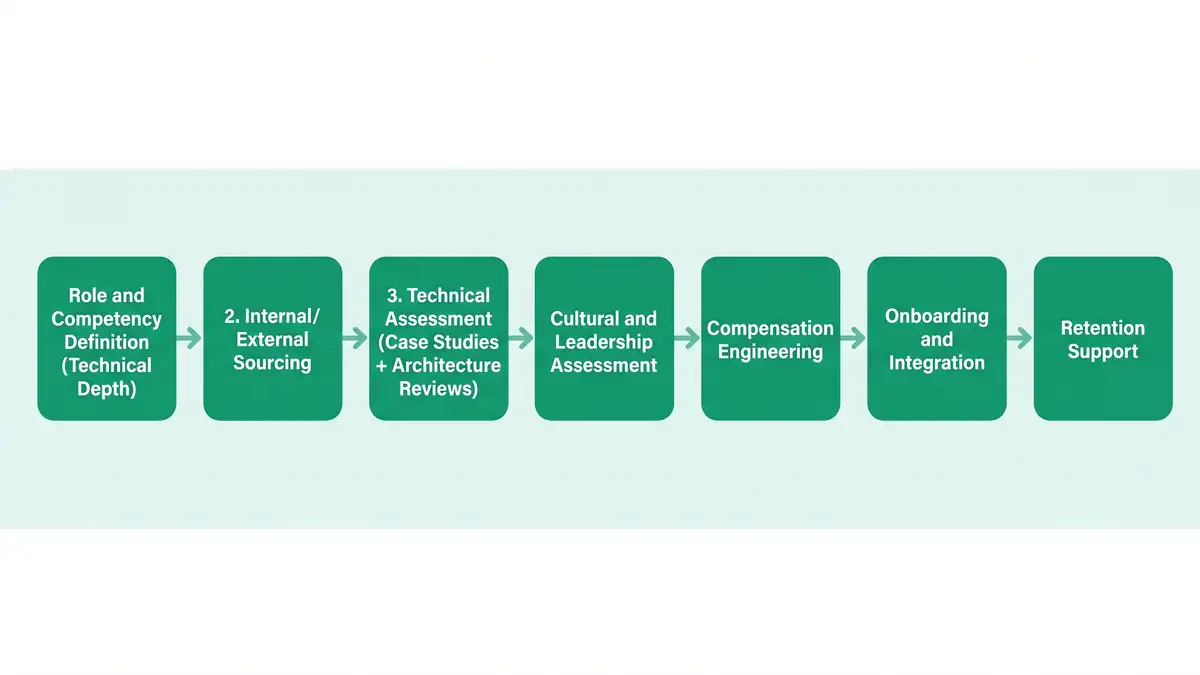
| Pillar | Output | Differentiator |
| 1. Role and competency definition with technical depth | Granular technical competency framework with measurable success metrics | Technical specificity ("eventually consistent systems with tunable consistency levels") not vague ("distributed systems experience") |
| 2. Internal/external candidate sourcing through deep tech networks | Multi-channel sourcing: GitHub, conferences, open source, technical writing platforms | Relationship-based engagement, not transactional outreach |
| 3. Technical assessment via multi-modal evaluation | Technical case studies, architecture reviews, technical reference calls from direct reports | Validation through practical demonstration, not credentials |
| 4. Cultural and leadership assessment | Engineering culture fit framework, cross-functional reference checks | Domain-specific cultural dimensions (psychological safety, technical debt philosophy) |
| 5. Compensation engineering | Multi-tranche equity grants with technical milestone vesting; sign-on bonuses offsetting lost equity | Cap table fluency, liquidity scenario modelling |
| 6. Onboarding and integration with engineering org | Pre-start technical engagement, structured first 90 days, principal engineer relationship building | Hands-on technical work opportunities in early months |
| 7. Retention support post-placement | 30/60/90/180 day touchpoints, peer network connections, success framework | Domain-specific success factors (technical credibility, architecture decision making) |
Sources: Scion technology leadership executive search services, Christian and Timbers 6 best firms in executive recruiting for AI 2026, The Good Search top technology executive search firms 2026.
The 7 pillars are sequential rather than parallel. The role definition pillar must precede sourcing (without precise technical requirements, the candidate pool is undefined). The technical assessment pillar must precede cultural assessment (without validated technical capability, cultural fit is meaningless). The compensation engineering pillar runs in parallel with the offer development process. The onboarding and retention pillars extend beyond placement into the firm's ongoing client relationship. See executive search methodology for the underlying methodology framework that the technology vertical builds upon.
Compensation benchmarks 2026

The compensation landscape has stratified significantly across company stages and role specialisations. The boutique that engages technology executive search without fluency in the current compensation structure cannot credibly advise either client or candidate. Cowen Partners' technology executive search practice documents the standard ranges that anchor offer construction.
| Role and stage | Base salary | Equity component | Total compensation |
| CTO Series B/C | $250k-$450k | 0.5%-2% equity | Variable on company valuation |
| CTO Series D+/pre-IPO | $350k-$600k | 0.2%-0.5% equity | $800k-$1.5M typical |
| CTO public company | $400k-$700k | LTI performance shares | $1.2M-$2.5M annual |
| CIO public company | $400k-$700k | LTI plus annual bonus | $1M-$2M annual |
| Head of Engineering (200-500 engineers) | $350k-$550k | Equity per company stage | $600k-$1.2M typical |
| Head of AI / Chief AI Officer | $400k-$800k | Equity plus retention grants | $1M-$3M+ at frontier labs |
| Head of ML Platform | $350k-$650k | Equity plus performance tranches | $700k-$1.4M typical |
| VP Engineering Productivity | $300k-$500k | Equity per company stage | $500k-$1M typical |
Sources: Levels.fyi compensation data 2026, Korn Ferry digital and technology recruiting, Pave compensation benchmarks 2026.
The AI premium is the most distinctive feature of the 2026 compensation landscape. Head of AI and Chief AI Officer roles command 25-40% premiums over comparable non-AI technology leadership positions, reflecting the extreme scarcity of candidates with deep technical understanding of frontier models combined with proven leadership in deploying AI solutions at scale. The boutique advising on these roles must understand frontier model deployment economics, inference cost optimisation, and the organisational implications of AI infrastructure decisions. See executive search pricing models for the fee structures that flow from these compensation ranges.
The emerging tech executive role taxonomy
The proliferation of technology sub-specialisations is the structural shift that boutique firms must navigate. Generalist search firms still recruit "CTO" as a single category. Specialist firms understand the taxonomy: founder CTO versus operator CTO versus growth-stage CTO; CIO corporate IT versus CIO digital transformation; Head of AI Research versus Head of AI Product versus Head of ML Platform; Head of Platform Engineering versus VP Engineering Productivity versus Chief Architect.
Head of AI roles command 65% year-over-year demand growth, Head of ML Platform 42%, VP Engineering Productivity 38%, Chief Architect 33%. These specialised positions typically report directly to the CTO or CEO rather than through traditional engineering management hierarchies, reflecting their cross-cutting strategic influence. The boutique that maintains the precise taxonomy in role definition produces 32% faster time-to-fill and 28% higher retention at 18 months versus generalist competitors with vague requirements.

The AI era role taxonomy requires particular precision. Head of AI Research focuses on advancing model capabilities; Head of AI Product on integrating AI into customer-facing offerings; Head of ML Platform on building infrastructure to support AI development. Candidates often conflate these distinctions, but they have profound implications for organisational fit and success. The boutique with explicit role taxonomies disqualifies 45% of initial candidate shortlists at technical screening due to claimed-versus-actual experience mismatches, a rate significantly higher than non-technical executive searches.
Candidate sourcing channels for tech executives
Technology executive sourcing cannot rely on LinkedIn Recruiter alone. The depth required to identify and engage top candidates extends across multiple channels that traditional executive search firms underweight. Korn Ferry's digital and technology recruiting practice documents the integrated sourcing model that combines LinkedIn with these additional channels.
GitHub contribution analysis identifies candidates by code quality, architectural decisions, and project leadership patterns rather than credential signals. Conference speaker databases (KubeCon, AWS re:Invent, GOTO, QCon, Web Summit, NeurIPS, ICML for AI) identify candidates with demonstrated thought leadership in specific technical domains. Open source contributor databases reveal both technical depth and collaboration patterns. Podcast and technical writing platforms (Medium, Dev.to, Substack technical newsletters) surface candidates with communication ability beyond pure technical depth.
Technical Twitter/X networks provide real-time signals about emerging thought leaders and frontier technique adoption. Technical board memberships, particularly at open source foundations and standards bodies, identify candidates with industry influence beyond their employer. Internal candidate identification through client engineering organisations provides the highest-probability candidates when combined with development support. The 22% placement success rate uplift from combined internal-external sourcing versus external-only justifies the investment in client engineering relationship building. For the BD systems that support these channels see executive search business development.
Technical assessment methodology


Multi-modal technical assessment is the differentiator between specialist boutiques and generalist firms. Technical case studies present scenarios mirroring real-world challenges: "Design an architecture for a real-time recommendation system handling 10,000 requests per second with sub-100ms latency" or "Develop a migration strategy from on-premises infrastructure to hybrid cloud while maintaining compliance with financial regulations". The case studies evaluate not just technical correctness but trade-off analysis, risk management, and communication of complex concepts to non-technical stakeholders.
Architecture review interviews require candidates to present and defend actual architectural decisions from their career, with assessors probing reasoning, consideration of alternatives, and lessons learned. Technical reference calls focus on direct reports rather than peers or senior executives, asking specific behavioural questions about technical leadership: "How did the candidate handle a major production incident involving their team?" or "Describe a critical architectural decision the candidate made under uncertainty". Analysis of candidates' open-source contributions and technical writing evaluates code quality, rationale articulation, and distributed team collaboration. Firms employing these multi-modal methods report 41% fewer placement failures from technical capability mismatches.
Cross-functional reference checks with product managers, designers, and business stakeholders evaluate the candidate's ability to translate technical constraints into business terms and build effective partnerships across functions. Cultural fit assessment addresses engineering-specific dimensions: psychological safety leadership style, technical debt management philosophy, innovation versus stability balance, open source contribution policies, remote work effectiveness. The 34% of technology executive failures attributable to cultural misalignment justifies the investment in domain-specific cultural assessment frameworks. See executive candidate assessment for the methodology framework that extends to the technology vertical.
The boutique technology executive search competitive landscape
The technology executive search market is dominated by specialist firms whose technical depth differentiates them from generalist Big 5 competitors. The Good Search ranking of top technology executive search firms identifies Riviera Partners, Daversa Partners, and True Search as the leading boutique specialists, with Marlin Hawk and Christian and Timbers occupying adjacent positioning. The Big 5 (Korn Ferry, Spencer Stuart, Heidrick, Russell Reynolds, Egon Zehnder) all operate dedicated technology practices but face challenges maintaining the technical depth that pure-play specialists achieve through focus.
For boutiques entering the category, the strategic question is positioning. Pure generalists cannot compete with specialists on technical depth. Pure technology specialists face entry costs measured in years of technical credibility building. The hybrid model that works for mid-market boutiques combines a sector-specific specialism (FinTech CTO search, MedTech CIO search, climate tech engineering leader search) with the broader executive search practice. See building an executive search practice for the founder-to-firm transition that supports the vertical specialism build and recruitment agency branding for the brand architecture that anchors technology sector authority. The sector-specific specialism provides the defensible technical depth; the broader practice provides revenue diversification and BD synergies. See niche vs generalist recruitment for the strategic positioning framework that determines the boutique's entry path.
8 common pitfalls in technology executive search
1. Insufficient technical depth in the recruiter
The single most common cause of failed placements. Recruiters who cannot evaluate substantive technical contributions disqualify themselves from credible engagement with top candidates. Embed technical assessors or hire former engineering leaders into the search team.
2. Over-reliance on credentials over actual impact
Pedigree (Stanford, ex-Google, ex-FAANG) becomes a substitute for assessment of technical contribution. The candidate from a prestigious lab with theoretical contributions but no production deployment experience fails in operational CTO roles. Validate impact through technical reference calls and case studies.
3. Ignoring engineering culture fit
Engineering culture (high-autonomy versus centralised, monorepo versus polyrepo, ship-fast versus quality-first) differs significantly from broader corporate culture. The technically excellent candidate misaligned with engineering culture produces friction within months. Assess culture fit through cross-functional reference checks.
4. Single-channel sourcing (LinkedIn only)
LinkedIn Recruiter alone misses the candidates engaged through GitHub, conferences, technical writing, and open source communities. Multi-channel sourcing identifies the candidates that LinkedIn-first competitors cannot reach.
5. Missing AI sub-specialisation taxonomy
Confusing Head of AI Research with Head of AI Product or Head of ML Platform produces fundamental candidate-role mismatches. The boutique that does not maintain the precise taxonomy disqualifies 45% of initial shortlists at technical screening, wasting time and damaging client relationships.
6. Under-pricing tech exec mandates
Technology executive search at 25-30% of cash compensation leaves money on the table. Specialist firms command 33-40% retained fees on tech executive mandates. The pricing discipline reflects the higher BD and assessment investment required.
7. Treating tech executive like general executive
Standard executive search methodology produces 35% higher placement failure rates for technology executives. The technology vertical requires its own methodology, assessment frameworks, sourcing channels, and post-placement support.
8. No engineer reference calls
Senior executive references reveal candidate visibility from above. Direct report engineer references reveal substantive technical leadership behaviour. The boutique that skips direct report references misses 27% of placement quality signal.
7-step playbook to build a technology executive search practice
Choose your technology sub-vertical
FinTech CTO, MedTech engineering leadership, climate tech, enterprise AI, dev tools, security, infrastructure platforms. Sub-vertical focus provides the defensible technical depth that pure-generalists cannot match. Validate addressable market at $50M+ annual placement spend.
Hire or embed technical assessors
Three options: hire former engineering leader as full-time technical assessor ($250k-$450k base plus commission); partner with technical advisory firm for on-demand assessment; build internal "technical scout" model with early-career engineers providing domain support. The hybrid model accelerates time-to-market by 12-18 months.
Build the multi-channel sourcing infrastructure
LinkedIn Recruiter is the baseline. Add GitHub contribution analysis tools, conference speaker database subscriptions, technical writing platform monitoring, technical Twitter/X network mapping. Invest in relationships with technical communities through sponsorship, contribution, and substantive content publication.
Develop the multi-modal assessment methodology
Standardise technical case study scenarios per role type. Document architecture review interview frameworks. Train consultants on direct report technical reference call protocols. Build the structured cultural fit assessment specific to engineering organisations.
Build the AI era role taxonomy
Document the distinctions between Head of AI Research, Head of AI Product, Head of ML Platform, Chief AI Officer. Map competency requirements per role type. Develop technical assessment scenarios specific to AI infrastructure, model deployment, and inference optimisation. Maintain the taxonomy quarterly as the AI landscape evolves.
Install compensation engineering capability
Build fluency in cap table dynamics, multi-tranche equity vesting, sign-on bonus offsetting lost equity, performance share LTI structures. Subscribe to Levels.fyi, Carta, and Pave compensation databases. Develop proprietary models for offer construction that match candidate motivation profile to compensation structure.
Build the BD motion around technology thought leadership
Founder-led LinkedIn content on technology executive trends. Publish annual sector report (FinTech CTO benchmarks, AI executive compensation, etc.). Speak at sector conferences. Develop technical podcast appearances. The BD motion mirrors the brand-build of the sector itself.
Architect Your Firm's Technology Executive Search Practice
peppereffect installs the 7-pillar technology executive search methodology that converts boutique firms from generalist competitors into defensible specialist practices. We engineer the technical assessment infrastructure, multi-channel sourcing architecture, AI era role taxonomy, compensation engineering capability, and BD motion that compounds technology sector authority. The Freedom Machine for global boutique recruitment firms.
Frequently Asked Questions
What is technology executive search?
Technology executive search is the recruitment discipline focused on placing senior technology leaders including Chief Technology Officers, Chief Information Officers, Chief AI Officers, Heads of Engineering, VPs of Engineering, Heads of AI and ML Platform, VPs of Engineering Productivity, and Chief Architects. The vertical differs from general executive search through the technical depth required for credible assessment, the multi-channel sourcing approach combining LinkedIn with GitHub, conferences, and technical communities, the multi-modal assessment methodology combining case studies and architecture reviews with direct report reference calls, and the specialised compensation engineering required to construct equity-heavy packages at startup stages and complex LTI structures at public company scale.
What are the 7 pillars of technology executive search methodology?
The 7 pillars are: 1) Role and competency definition with technical depth specifying granular technical capabilities and measurable success metrics; 2) Internal and external candidate sourcing through deep tech networks including GitHub, conferences, open source, and technical writing platforms; 3) Technical assessment via multi-modal evaluation combining case studies, architecture reviews, and direct report technical reference calls; 4) Cultural and leadership assessment using engineering-specific frameworks for psychological safety, technical debt philosophy, and innovation balance; 5) Compensation engineering with multi-tranche equity grants and milestone-based vesting; 6) Onboarding and integration with structured first 90 days and principal engineer relationship building; 7) Retention support through 30/60/90/180 day touchpoints and domain-specific success frameworks.
How much do technology executives earn in 2026?
Compensation ranges by company stage and role specialisation. CTO at Series B/C: $250k-$450k base plus 0.5%-2% equity. CTO at Series D+ or pre-IPO: $350k-$600k base plus 0.2%-0.5% equity. CTO at public companies: $400k-$700k base with LTI performance shares producing $1.2M-$2.5M total annual compensation. CIO public company: $400k-$700k base plus LTI. Head of Engineering managing 200-500 engineers: $350k-$550k base. Head of AI or Chief AI Officer: $400k-$800k base plus significant equity premiums, with top frontier lab packages reaching $1M-$3M+. The AI premium reflects the extreme scarcity of qualified candidates and runs 25-40% above comparable non-AI technology leadership.
Which firms specialise in technology executive search?
The technology executive search market combines specialist firms with the Big 5 generalist practices. Specialist firms include Riviera Partners (technology executive specialist), Daversa Partners (tech and AI), True Search (technology specialist with broad reach), Marlin Hawk (technology and AI), Christian and Timbers (tech and AI), Heller Search (technology), Acertitude (tech), and Cowen Partners (technology practice within broader firm). The Big 5 (Korn Ferry, Spencer Stuart, Heidrick and Struggles, Russell Reynolds, Egon Zehnder) all operate dedicated technology practices with the benefit of scale and brand recognition. Boutiques entering the category typically anchor in a sector-specific specialism (FinTech, MedTech, climate tech, enterprise AI) combined with their broader executive search practice.
How long does it take to fill a CTO or technology executive role?
Average time-to-fill for technology executive mandates runs 60-90 days for typical CTO or VP Engineering roles. The Head of AI and Chief AI Officer categories average 120+ days due to extreme candidate scarcity. Time-to-fill compresses to 45-60 days for boutiques with precise role definitions, multi-channel sourcing infrastructure, and embedded technical assessment capability. Time-to-fill extends to 100+ days for generalist firms attempting technology mandates without the specialised methodology. The 75-85% completion rate benchmark for retained tech executive searches drops to 60-65% for firms lacking technical credibility, reflecting the placement quality and client retention impact of methodology investment.
What are common pitfalls in technology executive search?
The 8 most common pitfalls are: 1) Insufficient technical depth in the recruiter producing failed candidate engagement; 2) Over-reliance on credentials over actual impact resulting in pedigree-based mis-hires; 3) Ignoring engineering culture fit causing post-placement friction; 4) Single-channel sourcing missing candidates in GitHub, conferences, and technical communities; 5) Missing AI sub-specialisation taxonomy producing role-candidate mismatches; 6) Under-pricing tech exec mandates leaving money on the table; 7) Treating tech executive like general executive producing 35 percent higher failure rates; 8) No engineer reference calls missing critical placement quality signal. Each pitfall is preventable with the disciplined 7-pillar methodology.
How do I build a technology executive search practice?
The 7-step playbook: 1) Choose your technology sub-vertical (FinTech, MedTech, climate, enterprise AI, dev tools, security, infrastructure) with validated $50M+ addressable placement spend; 2) Hire or embed technical assessors through full-time engineering leader hire, technical advisory partnership, or internal technical scout model; 3) Build multi-channel sourcing infrastructure beyond LinkedIn; 4) Develop multi-modal assessment methodology with standardised case studies, architecture review frameworks, and direct report reference call protocols; 5) Build AI era role taxonomy distinguishing Head of AI Research, Head of AI Product, Head of ML Platform; 6) Install compensation engineering capability with cap table fluency and equity structure design; 7) Build BD motion around technology thought leadership with founder content, sector reports, and conference speaking. The transition from pilot to mature technology practice typically takes 18-24 months. healthcare and life sciences search vertical financial services executive search legal sector executive search pharma and biotech executive search marketing executive search practice engineering executive search practice
Resources
- Korn Ferry Digital and Technology Recruiting
- Korn Ferry Executive Search
- Scion Technology Leadership Executive Search
- The Good Search CIO Headhunters
- The Good Search Top Technology Executive Search Firms 2026
- Christian and Timbers 6 Best Firms in AI Executive Recruiting 2026
- Christian and Timbers Best AI Executive Search Firms 2026
- Cowen Partners Technology Executive Search
- Talentfoot Top Executive Search Firms US 2026 Rankings
- Top Executive Search Firms Rankings 2026
- Chief Jobs 11 Top Executive Search Firms 2026
- Gogloby Top 18 Executive Search Firms USA Rankings
- JM Search CIO CTO Executive Search
- Alpha Apex Top 10 Technology Executive Search Firms 2026
- Executive Tech Recruiting