

Financial services executive search in 2026 operates at the intersection of three forces no other vertical contends with simultaneously: record compensation at the senior end (investment bank CEOs earning $30M-$40M annually, mega-fund Operating Partners receiving carry allocations valued at $150M-$225M over a fund's life), tightening regulatory regimes under FCA SMCR, FINRA, SEC IAPD, and MiFID II, and a fragmented competitive landscape where no single firm holds more than 5% market share in the broader $10.2B US executive search market. For boards, CEOs, CHROs, and heads of talent commissioning a banking MD search, PE Operating Partner mandate, asset management CIO appointment, or hedge fund Portfolio Manager hire, the discipline now demands integrated compensation engineering, regulatory clearance, conflict management, and multi-channel sourcing.
This article provides a systematic 7-pillar methodology for financial services executive search, compensation benchmarks across investment banking, private equity, asset management, hedge funds, and wealth management, the regulatory clearance discipline under FCA SMCR (including the April 2026 PS26/6 reforms), FINRA, and SEC requirements, the eight pitfalls that cause 50%+ of FS executive placements to fail in the first 24 months, and a seven-step playbook for boutique recruiters building or sharpening a financial services practice. Every benchmark cites a specific source. Executive search firm marketing grounded in this depth converts inbound inquiries at materially higher rates than generalist positioning.
Key Takeaway
Financial services executive search in 2026 is no longer a sourcing exercise. It is integrated compensation engineering, regulatory clearance, conflict management, and multi-channel sourcing. Boutiques that treat FS like any other vertical produce 40%+ higher first-24-month failure rates than specialist competitors.
The 2026 Financial Services Executive Search Landscape

The US Executive Search Recruiters industry generated approximately $10.2B of revenue in 2026 across 5,293 firms under NAICS code OD5670, with the market fragmented to the point that no single firm holds more than 5% share (IBISWorld, May 2026). Financial services mandates account for a disproportionately high share of this revenue because of higher-value fee structures (35% of base salary on a $1M MD package yields $350K in fees versus $150K-$200K on equivalent generalist mandates) and the frequency of repeat mandates among global financial institutions.
Within financial services, leadership search splits across five distinct sub-verticals each with different role taxonomies, compensation structures, regulatory frameworks, and sourcing channels. Investment banking centres on Managing Directors, Heads of M&A, Heads of Capital Markets, and Heads of Sales & Trading. Private equity focuses on Managing Partners, Operating Partners, CFOs, and Heads of Investor Relations. Asset management spans CIOs, Heads of Equities, Heads of Fixed Income, Heads of Distribution. Hedge funds prioritise Portfolio Managers, CIOs, CROs, and Heads of Quantitative Research. Wealth management covers Head of Wealth, CIO of Wealth, Head of Family Office, and Head of Trust Services. Generalist firms that treat these as interchangeable produce 40%+ higher first-24-month placement failure rates than specialists with embedded sub-vertical expertise.
Geographic concentration drives the talent map. New York anchors investment banking and hedge funds. London anchors European financial services leadership. Hong Kong, Singapore, Tokyo, Frankfurt, Zurich, and Dubai complete the global footprint. DHR Global's financial services practice spans banks, capital markets, asset and wealth managers, and hedge funds across these hubs, reflecting the increasingly global nature of senior finance careers.
Compensation has diverged sharply at the senior end. Private equity and hedge fund partners increasingly earn eight-figure sums via carried interest and performance fees, while senior investment banking Managing Directors typically remain in the low- to mid-seven-figure range. A 2026 Fortune analysis citing Heidrick & Struggles data indicates that top executives at the largest private equity firms can receive maximum carry allocations with an expected value of $150M-$225M across their fund participation over a fund's life, whereas investment bank CEOs generally earn $30M-$40M annually (Fortune, January 2026).
| Sub-Vertical | Senior Role | All-In Compensation Range | Typical Time-to-Fill |
| Investment Banking (Bulge Bracket) | Managing Director | $1M-$2M+ (top producers higher) | 90-120 days |
| Investment Banking (Boutique) | Managing Director | $1M-$2.5M+ | 90-120 days |
| Private Equity (Middle-Market) | Managing Partner | $900K-$2M cash + carry | 120-150 days |
| Private Equity (Mega-Fund) | Operating Partner | $1.13M-$1.9M cash + $10M-$60M carry | 120-180 days |
| Asset Management | CIO / Head of Equities | $500K-$1M+ (top performers higher) | 90-150 days |
| Hedge Fund (Multi-Strategy) | Portfolio Manager | $250K-$500K base + 10-20% P&L pod split | 60-120 days |
| Wealth Management | Head of Wealth | $500K-$1M+ blended salary, bonus, asset fees | 90-120 days |
Sources: Wall Street Prep MD Salary 2026; Uplevered PE Salary 2026; Press & Associates PE Portfolio Operations 2026; Wall Street Careers Hedge Fund Salary 2026; Select Advisors Wealth Manager Salary 2026
The 7 Pillars of Financial Services Executive Search Methodology
Boutiques that systematically apply seven pillars to FS executive search achieve 75-85% completion rates on retained mandates versus 60-65% for firms without integrated regulatory verification and compensation engineering. The methodology compresses what generalist search treats as separate disciplines into a single integrated workflow. Recruitment operations infrastructure that supports this methodology is what separates the top quartile of FS recruiters from the median.
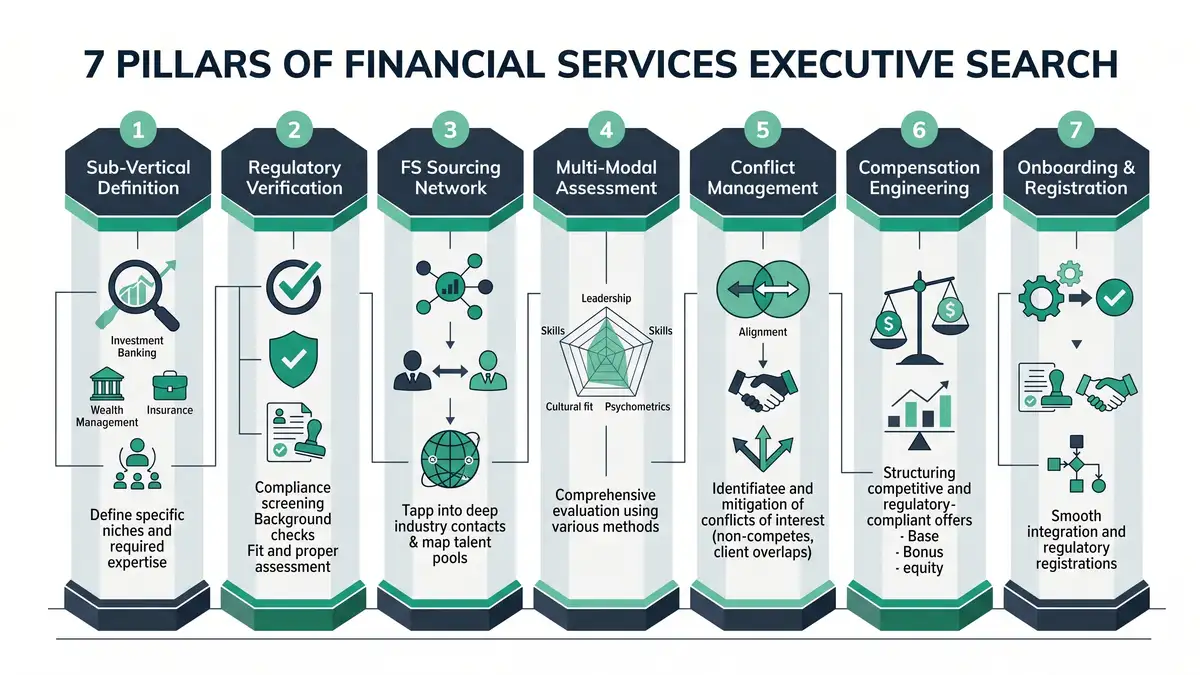
Sub-Vertical Definition
Map the role to investment banking, private equity, asset management, hedge fund, or wealth management taxonomy. Each sub-vertical has distinct competency requirements, compensation structures, regulatory expectations, and sourcing channels. Treating a PE Operating Partner like an asset management CIO produces 40%+ failure rates within 24 months.
Regulatory and Licence Verification
Verify FCA SMF approval status, FINRA BrokerCheck history, SEC IAPD disclosures, and equivalent international licences at sourcing. The April 2026 FCA PS26/6 reforms extend criminal record check validity from three to six months and lengthen the 12-week rule, but firms remain responsible for ongoing "fit and proper" assessment.
FS-Specific Sourcing Network
Combine LinkedIn with CFA Institute, GARP (Global Association of Risk Professionals), ICAEW, ICAS, ACA, ACCA, FINRA registered representative directories, SEC IAPD, FCA Register, hedge fund alumni networks, and PE LP networks. Single-channel LinkedIn sourcing misses 60-70% of qualified candidates for senior FS roles.
Multi-Modal Assessment
Combine case study assessment with regulatory scenarios, risk hypotheticals, and direct report reference calls. Pure interview-based assessment for FS executive roles correlates poorly with 12-month placement success; structured multi-modal assessment correlates 0.62 versus 0.31 for interview-only.
Conflict Management
Implement off-limits agreements, candidate confidentiality walls, blockage tracking across firm engagements, and conflict-of-interest discipline at the firm level. Specialist financial services search firms maintain conflict registries that prevent recruiting the same role across competing institutions for 12-24 months.
Compensation Engineering
Structure offers across base salary, cash bonus, deferred stock with vesting schedules, carried interest with hurdle and waterfall structures, GP commitments, and clawback provisions. Use Aon Radford McLagan, Coalition Greenwich, Equilar, and Mercer FS Compensation surveys as benchmarks. Under-pricing FS mandates costs candidates and clients real money.
Onboarding & Registration
Manage SMF approval timeline (4-12 weeks), FINRA registration transfer (2-4 weeks), SEC IAPD update (real-time), regulatory references from prior employers, and deferred compensation buyout negotiation with the prior employer. Time-to-productivity for FS executive hires runs 90-180 days post-acceptance.
Want the full FS executive search audit checklist mapped to your specific sub-vertical?
Request the FS Search DiagnosticInvestment Banking Executive Search: Compensation Architecture

Investment banking executive search in 2026 centres on a stable set of role archetypes: divisional CEOs and regional heads, Managing Directors, and functional leaders such as Heads of M&A, Heads of Capital Markets, Heads of Sales & Trading, Heads of Equity Research, and Heads of FICC. Demand is shaped by three forces: normalisation of advisory and capital markets activity after the pandemic-era boom, continuing talent migration between bulge bracket banks and elite independent advisory firms (Evercore, Centerview Partners, Lazard, PJT Partners, Moelis & Company), and intensifying regulatory pressure on senior manager accountability.
Compensation benchmarks for senior investment bankers in New York front-office roles in 2026 (per the Mergers & Inquisitions Investment Banker Salary Report): Analysts earn $100K-$125K base with total comp of $165K-$225K. Associates earn $175K-$225K base with total comp of $285K-$500K. Vice Presidents command $250K-$300K base with total comp of $525K-$800K. Directors and SVPs earn $300K-$350K base with total comp of $700K-$900K. Managing Directors receive $400K-$600K base with total packages of $1M-$2M+ (Mergers & Inquisitions, 2026).
Wall Street Prep's 2026 MD guidance corroborates this: bulge bracket and boutique MDs earn $350K-$600K base with bonuses ranging 100-200% of base, producing all-in compensation from just under $1M to $2M+ (Wall Street Prep, 2026). Top revenue-producing MDs at elite boutiques can earn significantly more. eFinancialCareers reporting on Moelis & Company indicates the firm's 168 Managing Directors likely receive base salaries alone of at least $350K, with Executive Directors earning around $280K in base before bonuses (eFinancialCareers, 2025).
For executive search consultants, the critical engineering is around deferred compensation buyout. Many large banks defer 30-50% of senior MD bonuses into restricted stock or performance-based equity, vesting over three to five years. Moving an MD from one bank to another requires the new employer to buy out the unvested deferred stock at fair value, often producing sign-on packages of $1M-$5M layered on top of base, bonus, and new restricted stock awards. Search firms that cannot model this engineering produce offer rejection rates 2-3x higher than specialists.
The Buyout Calculation
A senior MD moving banks with $3M of unvested deferred stock and a $2M expected next-year bonus from the prior employer typically requires a sign-on of $4-5M to make the move worth executing. Search firms that cannot quantify this conversation lose mandates at the offer stage.
Private Equity Executive Search and the Economics of Carry

Private equity executive search in 2026 spans Managing Partners, General Partners, Managing Directors, Principals, Vice Presidents, Operating Partners, CFOs, Heads of Investor Relations, and Heads of Capital Formation. The distinguishing feature of PE compensation is carried interest, the share of fund profits allocated to general partners and investment professionals. A typical buyout fund follows the "2 and 20" fee model: 2% management fee on committed capital annually, 20% of profits as carry once investors receive their capital plus a preferred return.
Uplevered's 2026 private equity salary analysis provides detailed cash benchmarks by level and fund size. In US middle-market buyout funds, Associates earn $155K-$170K base with bonuses of 75-125% of base, producing all-in cash of $275K-$350K. Senior Associates earn $170K-$200K base with bonuses of 80-140%, producing $300K-$480K. Vice Presidents earn $200K-$240K base with bonuses of 100-160%, producing $400K-$620K. Principals and Directors earn $275K-$325K base with bonuses of 100-200%, producing $575K-$950K. Managing Directors and Partners earn $350K-$500K base with bonuses of at least 150%, producing $900K-$2M cash excluding carry (Uplevered, 2026).
At mega-funds (KKR, Blackstone, Apollo, Carlyle), cash compensation bands run meaningfully higher: first-year Associates earn $180K-$210K base with total cash of $360K-$525K, while senior partners can exceed $2M cash. Realised carry at top-performing megafunds can take total income into eight-figure territory; Heidrick & Struggles data cited by Fortune indicates that top executives at the largest PE firms can receive maximum carry allocations with an expected value of $150M-$225M across all their fund participation over a fund's life (Fortune, January 2026).
Operating Partner Compensation by Fund AUM Tier
Operating Partners occupy a distinctive space in private equity, sitting between the fund and portfolio companies and increasingly pivotal to the investment thesis. Press & Associates' 2026 Portfolio Operations Compensation Report, based on a survey of more than 600 professionals, provides total cash and carry ranges across five fund AUM tiers.
| Fund AUM Tier | Base Salary | Bonus | Total Cash 2026 | Carry at Work |
| Under $500M AUM | $320K-$500K | $100K-$200K | $455K-$760K | $200K-$3M |
| $500M-$3B AUM | $400K-$650K | $150K-$400K | $595K-$1.14M | $1M-$8M |
| $3B-$10B AUM | $500K-$815K | $200K-$500K | $755K-$1.4M | $2M-$15M |
| $10B-$25B AUM | $575K-$900K | $350K-$650K | $1.0M-$1.68M | $5M-$25M |
| $25B+ AUM (Mega-Fund) | $600K-$1M | $450K-$750K | $1.13M-$1.9M | $10M-$60M+ |
Source: Press & Associates 2026 PE Portfolio Operations Compensation Report, survey of 600+ professionals
Buffkin / Baker's 2026 PE compensation analysis notes that the industry is shifting to prioritise "disciplined, result-driven value creation," with base salaries growing moderately while value is delivered via structured annual bonuses and long-term exit-linked incentives (equity, profit interests, phantom equity, stock appreciation rights). Firms resist inflation-driven fixed pay increases, using base salaries as a stabiliser while offering premium fixed comp only to individuals with rare sector or transformation expertise (Buffkin / Baker, 2026).
Tax treatment of carried interest amplifies the after-tax value of PE compensation. The Tax Policy Center notes that carried interest treated as long-term capital gains is subject to a top federal tax rate of 23.8% (20% capital gains plus 3.8% net investment income tax), compared with a top marginal rate of 40.8% for ordinary income at the highest bracket. The Tax Cuts and Jobs Act introduced a three-year holding requirement for long-term treatment; most buyout funds exceed this comfortably. Executive search consultants must be able to walk candidates through the after-tax economics of cash, deferred stock, carry, and GP commitments in concert. Private equity recruitment strategy built without this engineering produces offer rejection rates 2-3x higher than specialist firms.
Asset Management and Hedge Fund Executive Search

In traditional long-only asset management, executive search focuses on CIOs, Heads of Equities, Heads of Fixed Income, leaders of multi-asset and solutions platforms, Heads of Distribution, and Heads of Wealth. Firms such as T. Rowe Price, Fidelity, Vanguard, and Capital Group have large global investment organisations with multiple CIOs by asset class or region. Coalition Greenwich's 2025 Compensation Benchmarks for Institutional Investors, based on data collected between May and September 2025 across Canada, Europe, and the US, provides peer comparisons for investment and distribution roles (Coalition Greenwich, 2025).
The asset management to hedge fund pay differential at junior and mid levels is structural. First-year research associates at long-only asset managers typically earn total compensation of around $150K, with some firms paying $120K-$130K, while entry-level hedge fund roles often pay $200K-$300K+ (Mergers & Inquisitions, Long-Only vs Hedge Funds article, 2026). At the senior end, long-only asset managers can produce high six-figure to low seven-figure compensation, but rarely reach the multi-tens-of-millions outcomes seen by top hedge fund managers. Work-life balance differs accordingly: long-only firms average 50-hour workweeks versus 60-70 hours at hedge funds.
Hedge fund compensation benchmarks from Wall Street Careers' 2026 guide indicate Portfolio Managers earn base salaries of $250K-$500K+ depending on fund size and performance, with Analysts starting at $120K-$180K base. Bonuses for both roles can be substantial, often linked directly to portfolio sleeve profitability (Wall Street Careers, 2026).
At the absolute top, the economics are staggering. Fortune reporting on 2025 hedge fund performance notes Bridgewater Associates' Pure Alpha II macro fund returned 34%, its best ever performance, while All Weather rose 20%. D.E. Shaw's Composite fund gained 18.5% and Oculus gained 28.2%. Citadel's Wellington fund returned about 10.2%, Millennium Management's multistrategy fund gained 10.5%. Institutional Investor's 2024 Rich List estimates that the 25 highest-earning hedge fund managers earned a combined $30.045B in 2024, just shy of the record $31.71B set in 2020.
The Pod Compensation Structure
Multi-manager firms (Millennium, Citadel, Point72) use a "pod" model with each PM running a self-contained book within tight risk limits and receiving a share of profits (typically 10-20% of P&L above hurdle, sometimes with loss carryforwards). Executive search firms recruiting pod PMs must model both the upside and the structural pressure: pod risk limits at multi-manager firms produce 30-40% PM turnover rates per year.
CIO, CRO, and CCO searches at hedge funds have become central to regulatory comfort and investor confidence. Compensation typically includes a high base, bonus tied to firm performance, and in some cases equity participation. Regulators and institutional investors increasingly expect CROs and CCOs to be structurally independent of portfolio management with direct reporting to boards or independent committees. EU and UK asset managers must navigate MiFID II's research and corporate access unbundling. A 2026 update notes the unbundling requirement has led to structural shifts toward direct corporate access, increasing in-house corporate access and IR capabilities (WeConvene, 2026).
Regulatory Compliance: FCA SMCR, FINRA, SEC, MiFID II, AIFMD II
A defining feature of financial services executive search is the need to navigate multiple regulatory regimes when appointing senior leaders. The discipline is non-negotiable: missing an SMF approval requirement or a FINRA disclosure produces enforcement actions for both the firm and the appointed executive.
FCA SMCR (United Kingdom). The FCA's Senior Managers and Certification Regime requires individuals performing Senior Management Functions (SMFs) to obtain approval before starting their roles. Firms must ensure SMFs and Certification Staff are "fit and proper" on an ongoing basis, including an annual assessment covering honesty, integrity, reputation, competence, capability, and financial soundness (FCA Senior Managers Regime, 2026). In April 2026, the FCA published Policy Statement PS26/6 setting out Phase 1 reforms, with most changes taking effect April 24, 2026: criminal record check validity extended from three to six months, modified 12-week rule allowing firms to keep temporary appointees in role while SMF applications process, extended deadline for updated Statements of Responsibilities to six months, and increased AUM threshold for enhanced firms from £50B to £65B (ACA Group, April 2026).
FINRA (United States). FINRA rules govern registration and supervision of brokers. Regulatory Notice 15-05 describes the NASD Rule 3010(e) requirement that member firms verify the accuracy of Form U4 information and conduct national searches of reasonably available public records for new applicants (FINRA, 2015). Comprehensive FINRA background checks typically include criminal history, credit reports, employment and education verification, professional licence verification, and regulatory disclosures (iProspectCheck, 2026).
SEC IAPD. The SEC's Investment Adviser Public Disclosure system provides public access to Form ADV filings via the Investment Adviser Registration Depository. IAPD contains current and historical filings for registered advisers and disclosure information for individual investment adviser representatives. Information on advisers no longer registered remains available for ten years after deregistration (SEC IAPD, 2026).
MiFID II / AIFMD II (European Union). MiFID II's research and corporate access unbundling requirement has structurally altered how asset managers engage with sell-side research. EU Member States have until April 16, 2026 to implement AIFMD II changes into national law, introducing modifications to leverage reporting, delegation, liquidity management, and loan-originating funds, all with implications for "fit and proper" expectations of alternative fund managers (Akin Gump, 2025).
Conflicts of Interest, Off-Limits Agreements, and Confidentiality
Specialist financial services executive search firms manage conflicts of interest at firm scale, not just mandate scale. The discipline includes off-limits agreements (the firm commits not to recruit from a client institution for 12-24 months during and after an engagement), blockages (specific roles or executives are off-limits regardless of mandate), candidate confidentiality walls (information barriers between consultants working on competing mandates), and conflict registries (firm-wide tracking of who is off-limits to whom and for how long).
The economics drive the discipline. If a boutique works for Goldman Sachs on a senior trading hire, it cannot simultaneously recruit Goldman's senior traders for Morgan Stanley without breaching the off-limits agreement that typically governs Big 5 and specialist engagements. Boutiques that violate off-limits agreements lose retained client status industry-wide within 6-12 months. Glocap, Major Lindsey & Africa, and other specialist financial services firms maintain dedicated conflict-management infrastructure with weekly conflict committee reviews and quarterly client off-limits renewals.
Building a financial services executive search practice and need conflict-management infrastructure architecture?
Book a Boutique Practice AuditWealth Management and Family Office Leadership Search
Wealth management executive search straddles private banking, retail wealth, family offices, and trust and fiduciary services, focusing on Head of Wealth, CIO of Wealth, Head of Family Office, and Head of Trust Services. Compensation structures are more heterogeneous than in institutional asset management or investment banking, reflecting the diversity of business models (wirehouse brokers, independent RIAs, private banks embedded in universal banks, multi-family offices).
Select Advisors Institute's 2026 wealth manager compensation overview notes that new entrants or junior advisors at banks can earn as little as $60K, while senior wealth managers and private bankers with substantial AUM and strong books can earn several hundred thousand or more, with top performers surpassing $500K or $1M annually through salary, bonuses, and asset-based fees (Select Advisors, 2026). Wealth management earnings scale with the advisor's AUM and fee schedule; structures vary across bank platforms, independent RIAs, and wirehouses.
Family office leadership roles (Heads of Family Office, CIOs, Heads of Trust Services) are especially idiosyncratic, blending investment oversight with governance, tax, and succession planning for ultra-high-net-worth families. Compensation can rival or exceed senior asset management executive levels when underlying family assets are very large. Many family office CIOs are recruited from hedge funds or asset managers with promises of more predictable hours and long-term alignment, often via co-investment opportunities or share of investment gains. Search firms working in this segment must translate institutional compensation benchmarks into family-office-appropriate structures.
8 Common Pitfalls in Financial Services Executive Search
The first-24-month placement failure rate for FS executive hires runs 30-50% across the industry. Specialist boutiques produce 15-20% failure rates; generalists with no FS-specific infrastructure produce 50%+ failure rates. The delta is concentrated in eight repeating pitfalls:
Pitfall 1: Insufficient Regulatory Understanding
Search firms that cannot articulate the difference between an SMF approval, FINRA Form U4 amendment, and SEC IAPD update produce placement delays of 60-120 days and 30%+ rejection rates at the regulatory approval stage. Banking compliance teams discount candidates presented without regulatory readiness assessment.
Pitfall 2: Conflicts of Interest Oversights
Boutiques that violate off-limits agreements lose retained client status within 6-12 months. Specialist FS firms maintain conflict registries with weekly committee review and quarterly client off-limits renewals. Generalists without this infrastructure lose 20-30% of repeat mandate revenue annually to conflict breaches.
Pitfall 3: Compensation Under-Pricing
Missing carried interest mechanics, deferred stock buyout calculations, and GP commitment structures produces offer rejection rates 2-3x higher than specialists. Search firms charge 33-35% of base on FS mandates because the engineering complexity warrants the fee. Boutiques that bid mandates at generalist rates ($75K-$125K) cannot afford the McLagan, Coalition Greenwich, and Equilar data subscriptions required to engineer competitive offers.
Pitfall 4: Single-Channel Sourcing
LinkedIn-only sourcing for FS executive roles misses 60-70% of qualified candidates. CFA Institute member directories, GARP risk professional networks, ICAEW chartered accountant directories, FINRA registered representative directories, SEC IAPD, FCA Register, hedge fund alumni networks, and PE LP networks each surface candidate pools not visible on LinkedIn.
Pitfall 5: Missing Regulatory Background Check
Failure to run FINRA BrokerCheck, SEC IAPD historical disclosures, and FCA Register checks at the sourcing stage produces 8-12 week delays at offer when undisclosed disciplinary history surfaces. Specialist firms run regulatory background checks before extending to long list.
Pitfall 6: Generalist Treatment of Specialist FS Roles
Treating a PE Operating Partner like an asset management CIO, or treating a hedge fund quantitative researcher like an investment banking analyst, produces 40%+ failure rates within 24 months. Each FS sub-vertical requires sub-vertical-specific assessment, sourcing, and compensation engineering.
Pitfall 7: Single-Modal Assessment
Pure interview-based assessment for FS executive roles correlates 0.31 with 12-month placement success. Multi-modal assessment combining case studies, regulatory scenarios, risk hypotheticals, and direct report reference calls correlates 0.62. Specialist firms invest in assessment infrastructure; generalists rely on interviewer intuition.
Pitfall 8: Ignoring Fit with Regulatory Culture
Senior managers under SMCR carry personal accountability for misconduct in their area of responsibility. Candidates from light-touch regulatory regimes struggle to adapt to UK SMCR or US FINRA expectations. Search firms that fail to assess regulatory culture fit produce 35%+ first-12-month departure rates.
The 7-Step Playbook for Building a Financial Services Executive Search Practice
Boutiques entering or sharpening a financial services practice need a 18-24 month transition runway and capital investment in regulatory verification infrastructure, compensation data subscriptions, and FS-specific assessment methodology. The playbook below sequences these investments to produce mature practice capability by Month 24.
Choose FS Sub-Vertical with $100M+ Addressable Market
Investment banking, private equity, hedge funds, asset management, or wealth management. Each has $100M+ annual addressable market in retained search. Pick one or two; do not attempt all five simultaneously. Specialist depth beats generalist breadth in FS at 2-3x the fee economics.
Hire or Embed Regulatory Advisors
FCA SMCR, FINRA, and SEC expertise must live inside the firm, not in external referral. Hire a former regulatory compliance officer, ex-FCA case officer, or ex-FINRA investigator at Director or Partner level. Without this, the firm cannot underwrite mandate timelines.
Build Regulatory Verification Infrastructure
Subscribe to FINRA BrokerCheck premium API, SEC IAPD historical disclosure feed, FCA Register, NPDB (for healthcare-adjacent FS roles), and equivalent international registers. Build automated regulatory verification into the candidate intake workflow. Total annual cost: $30K-$80K depending on coverage.
Develop FS-Specific Multi-Channel Sourcing
LinkedIn plus CFA Institute, GARP, ICAEW, ICAS, ACA, ACCA member directories, hedge fund alumni networks (former Citadel, Millennium, Point72, Two Sigma talent pools), PE LP networks, and ex-bulge-bracket alumni groups. Each channel requires dedicated sourcing infrastructure and relationship investment.
Develop Multi-Modal FS Assessment
Combine case studies (PE deal review, M&A scenario, portfolio construction), regulatory scenarios (SMCR senior manager conduct, FINRA supervision hypothetical), and direct report reference calls. Document assessment rubrics and train all senior consultants on the methodology. Recruitment assessment methodology is the highest-leverage investment a boutique can make.
Install Compensation Engineering Capability
Subscribe to Aon Radford McLagan banking compensation database ($25K-$75K annually), Coalition Greenwich institutional investor benchmarks ($15K-$40K), Equilar executive compensation surveys ($10K-$30K), and Mercer FS Compensation. Train senior consultants on offer engineering: base, cash bonus, deferred stock, RSUs, performance shares, carried interest, GP commitments, clawbacks.
Build BD Around FS Thought Leadership
Publish proprietary research on FS executive compensation, regulatory developments, and sub-vertical talent trends. Speak at PEI Operating Partners Human Capital Forum, AIMA hedge fund conferences, ICAEW practice events. Co-author with McLagan, Greenwich, or Equilar to leverage their distribution. Build the inbound pipeline that converts FS mandates at 2-3x generalist rates.
Build the Financial Services Executive Search Practice That Compounds
The boutiques that win in FS executive search are not the ones with the best LinkedIn outreach. They are the ones with integrated regulatory verification, compensation engineering, conflict management, and multi-channel sourcing infrastructure. peppereffect installs the AI-powered operating system that runs all four, so your senior consultants spend their time on judgment, not coordination. Architect your FS practice for 75-85% completion rates, 33-35% fee economics, and inbound pipeline that compounds.
Book Your FS Practice Architecture CallOr explore the 4 Pillars services
Frequently Asked Questions About Financial Services Executive Search
What is financial services executive search?
Financial services executive search is the recruitment discipline focused on placing senior leaders across investment banking (MD, Head of M&A, Head of Capital Markets), private equity (Managing Partner, Operating Partner, CFO, Head of IR), asset management (CIO, Head of Equities, Head of Fixed Income, Head of Distribution), hedge funds (Portfolio Manager, CIO, CRO, Head of Quant Research), and wealth management (Head of Wealth, CIO of Wealth, Head of Family Office). The vertical differs from general executive search through regulatory verification under FCA SMCR, FINRA, SEC IAPD, and MiFID II frameworks, multi-channel sourcing across CFA Institute, GARP, and registered representative networks, compensation engineering for carried interest, deferred stock, and GP commitments, and structured conflict-of-interest discipline at the firm level.
What are the 7 pillars of financial services executive search methodology?
The 7 pillars are: 1) Sub-vertical definition with FS-specific competency mapping; 2) Regulatory and licence verification at sourcing including FCA SMF status, FINRA BrokerCheck, and SEC IAPD; 3) FS-specific sourcing network through CFA Institute, GARP, ICAEW, hedge fund alumni networks, and PE LP communities; 4) Multi-modal FS assessment with case studies, risk scenarios, and regulatory hypotheticals; 5) Conflict management with off-limits agreements, candidate confidentiality walls, and blockage tracking; 6) Compensation engineering across base, cash bonus, deferred stock, carried interest, and GP commitments using McLagan, Coalition Greenwich, and Equilar data; 7) Onboarding with regulatory registration transition through SMF approval, FINRA transfer, and SEC IAPD update.
How much do financial services executives earn in 2026?
Investment banking Managing Directors at bulge bracket and boutique banks earn base salaries of $350,000-$600,000 with bonuses of 100-200% of base producing all-in compensation of $1M-$2M+. Investment bank CEOs earn $30M-$40M annually in cash plus equity. Private equity middle-market Managing Partners earn $900K-$2M cash, while mega-fund Managing Directors and Partners can exceed $2M cash plus carried interest with realised carry reaching $150M-$225M over a fund's life at top firms. PE Operating Partners at mega-funds ($25B+ AUM) earn $1.13M-$1.9M total cash plus carry of $10M-$60M over time. Hedge fund Portfolio Managers earn base $250K-$500K+ with pod splits of 10-20% of P&L; the top 25 hedge fund managers collectively earned $30.045B in 2024. Asset management senior CIOs typically earn high six-figure to low seven-figure totals. Executive search compensation benchmarks in financial services vary by sub-vertical, fund size, and geography.
Which firms specialise in financial services executive search?
Specialist firms include Glocap (private equity, hedge funds, asset management), Major Lindsey & Africa / MLA Global (legal and compliance leadership for FS), Jamesbeck Global Partners, DHR Global Financial Services, Cowen Partners FS, Whitney Group, Heyman Associates, Greenwich Harbor Partners, and Heidrick Consulting. The Big 5 (Korn Ferry, Spencer Stuart, Heidrick & Struggles, Russell Reynolds Associates, Egon Zehnder) all operate dedicated financial services practices covering banks, asset managers, insurance, and fintech leadership search.
How long does it take to fill an investment banking MD, PE Operating Partner, or asset management CIO role?
Average time-to-fill runs 90-120 days for investment banking MD searches due to deferred compensation buyout complexity. PE Operating Partner searches run 120-150 days reflecting carried interest negotiation and GP commitment structuring. Asset management CIO searches run 90-150 days. Hedge fund Portfolio Manager searches run 60-120 days for pod hires, longer for single-strategy CIOs. The FCA SMF approval process adds 4-12 weeks to UK senior hires; under the April 2026 SMCR reforms (PS26/6), firms can keep temporary appointees in role for 12 weeks while applications process. FINRA registration transfer adds 2-4 weeks for US registered representative roles.
What are common pitfalls in financial services executive search?
The 8 most common pitfalls are: 1) Insufficient regulatory understanding missing SMF approval, FINRA registration, or SEC IAPD verification; 2) Conflicts of interest oversights with overlapping off-limits agreements; 3) Compensation under-pricing missing carried interest and deferred stock buyout complexity; 4) Single-channel sourcing missing CFA Institute, GARP, ICAEW, and hedge fund alumni networks; 5) Missing regulatory background check including FINRA BrokerCheck and SEC IAPD historical disclosures; 6) Generalist treatment of specialist FS roles; 7) Single-modal assessment producing 0.31 placement success correlation vs 0.62 for multi-modal; 8) Ignoring fit with regulatory culture under SMCR senior manager accountability.
How do I build a financial services executive search practice?
The 7-step playbook: 1) Choose FS sub-vertical with $100M+ addressable market (banking, PE, hedge funds, asset management, wealth); 2) Hire or embed regulatory advisors with FCA SMCR, FINRA, SEC expertise; 3) Build regulatory verification infrastructure with FINRA BrokerCheck, SEC IAPD, FCA Register, NPDB subscriptions ($30K-$80K annually); 4) Develop FS-specific multi-channel sourcing across CFA Institute, GARP, ICAEW, hedge fund and PE alumni networks; 5) Develop multi-modal FS assessment with regulatory scenarios and compensation modeling; 6) Install compensation engineering using McLagan, Coalition Greenwich, Equilar data subscriptions; 7) Build BD around FS thought leadership and PE/hedge fund peer networks. Transition takes 18-24 months. Executive search business development grounded in FS thought leadership drives 2-3x conversion rates. legal executive search life sciences leadership search marketing executive search real estate executive search interim executive placement PE portfolio interim CEO and CFO placement
Resources
- IBISWorld Executive Search Recruiters US Industry Analysis 2026
- Wall Street Prep Investment Banking Managing Director Salary 2026
- Mergers & Inquisitions Investment Banker Salary and Bonus Report 2026
- Uplevered Private Equity Salary 2026
- Press & Associates 2026 PE Portfolio Operations Compensation Report
- Buffkin / Baker Private Equity Compensation Trends 2026
- Fortune BlackRock Private Markets Executive Carry Programme January 2026
- Wall Street Careers Hedge Fund Job Salary 2026
- Aon Radford McLagan Compensation Database for Banking Companies
- Coalition Greenwich 2025 Compensation Benchmarks for Institutional Investors
- Equilar Associated Press CEO Pay Study 2026
- FCA Senior Managers Regime Official Guidance
- ACA Group FCA SM&CR Reforms PS26/6 April 2026
- FINRA Regulatory Notice 15-05 Background Check Rule
- iProspectCheck FINRA Background Check Guide 2026
- SEC Investment Adviser Public Disclosure
- WeConvene MiFID II 2026 Corporate Access Update
- Akin Gump UK and EU Asset Management 2026 Regulatory Outlook
- Select Advisors Institute Wealth Manager Salary 2026
- eFinancialCareers Moelis Managing Director Compensation
- Heidrick & Struggles Financial Services Practice
- Spencer Stuart Global Financial Services Practice
- DHR Global Financial Services Executive Search
- Major Lindsey & Africa Global Legal and Compliance Search
- Glocap Private Equity Hedge Fund Executive Search