

Executive search business development is the single hardest problem boutique firms face. The delivery side of the business operates on craft, methodology, and trust built over decades. The growth side depends on a different muscle entirely: the discipline to convert mental availability into qualified pipeline, then qualified pipeline into retained mandates worth six figures. Most boutique firms never build this muscle.
This article installs the 7-pillar business development operating system that elite global boutique executive search firms use to win retained mandates consistently. James Sterling, Managing Director of a 10-50 consultant search firm with $5-20M revenue and 20-30% placement fees, will use this as the operating playbook that decouples firm growth from founder bandwidth.

The BD operating thesis
Elite boutiques do not win retained mandates because they are better recruiters. They win because they run business development as a system with the same operational discipline they apply to search execution. The seven pillars convert episodic referrals into a repeatable engine that compounds reputation, relationship depth, and pipeline coverage. The firm that scales past 15 consultants without losing margin is the firm that institutionalised BD before the founder ran out of bandwidth.
Why BD is the hardest problem for boutique search firms
Boutique search firms typically derive 70% or more of revenue from referrals and repeat business. This is both the strength and the vulnerability of the business model. The strength is high-quality demand at low acquisition cost. The vulnerability is that referrals do not scale linearly with consultant headcount, which produces a structural ceiling around 15 consultants where founder relationships cap firm growth.
The 2026 industry context makes BD discipline more important, not less. Hunt Scanlon reports that the executive recruiting sector grew 11% in 2025 with continued double-digit growth forecast for 2026. The firms compounding fastest are not the firms with the best individual recruiters. They are the firms whose BD engines convert market expansion into named-account pipeline. Bullhorn's GRID 2026 Industry Trends Report confirms that 56% of firms reported revenue growth in 2025 versus 40% the previous year, with the gap widening between firms operating BD as a system and those operating BD as a founder hobby.
The core friction in boutique BD is that the activities that win mandates (executive conversations, board-level introductions, sector positioning) are exactly the activities the founder cannot delegate without losing relationship gravity. Founder-led BD generates roughly 2-5x more pipeline than delegated BD in firms under 25 consultants. The implication is structural: either the founder builds a system that captures and operationalises their relationship work, or the firm caps at the founder's attention bandwidth.
The second friction is the BD-versus-marketing confusion. Marketing builds 1:many mental availability among the 95% of executives not currently in market. Business development is 1:1 relationship work with the named 5% currently in or near a hiring decision. Boutiques need both. Firms that conflate them either burn marketing budget on activities that do not produce pipeline or starve marketing entirely because BD generates the next mandate but never the next decade of mandates.

The 7-pillar BD operating system
Elite boutiques structure BD around seven interlocking pillars. Each pillar produces a measurable output. Each pillar feeds the next. The system compounds when all seven run together because reputation built through speaking events feeds inbound, which qualifies referrals, which validates partnership channels, which strengthens the case for targeted outbound.
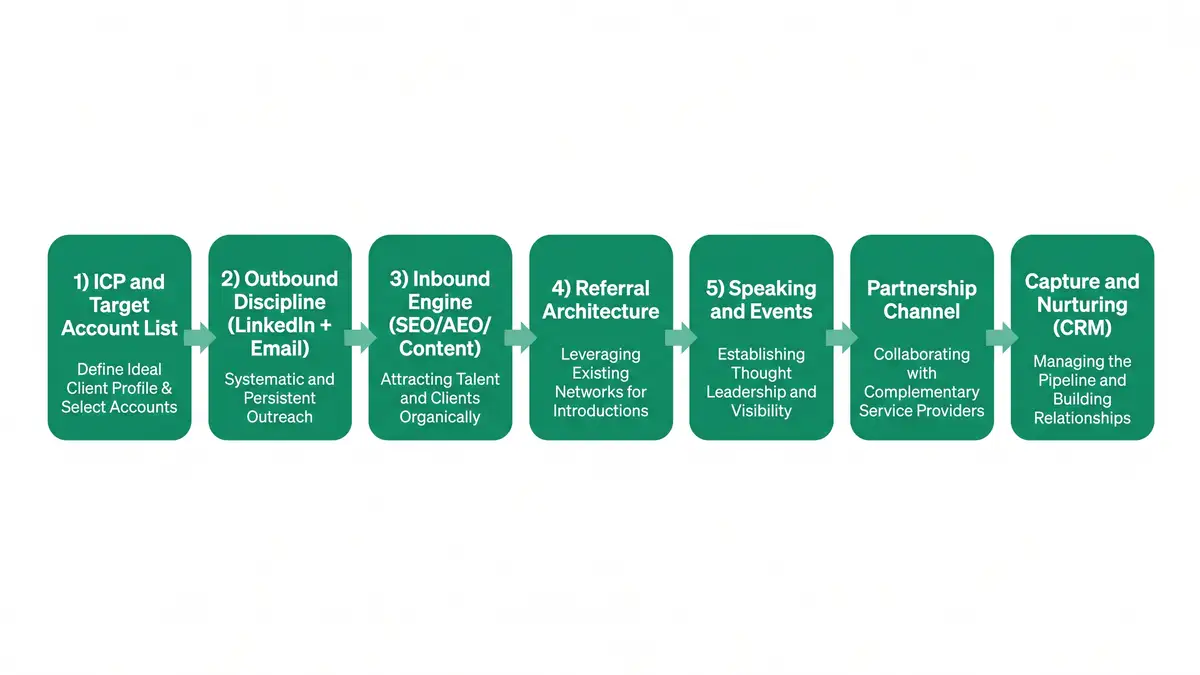
| Pillar | Primary output | Critical metric |
| 1. ICP and target account list | 100-150 named target accounts with decision-maker mapping | 5-15% annual mandate yield from list |
| 2. Outbound discipline (LinkedIn + email) | 4-touch sequences across 50-80 targets per consultant per quarter | 5-10% senior outreach response rate |
| 3. Inbound engine (SEO, AEO, content) | Founder-led thought leadership, 5-10 LinkedIn posts/week, content authority | Inbound MQL contribution to pipeline |
| 4. Referral architecture | Post-placement referral asks, candidate-to-client conversion, partner intros | 30-50% close rate on partner-channel referrals |
| 5. Speaking and event-based BD | Industry conferences, sector roundtables, paid keynotes | 15-30% conversion from event introduction to mandate |
| 6. Partnership channel | PE firms, law firms, accountancies, board advisors | 30%+ of mandate flow from partner channel at maturity |
| 7. Capture and nurturing | BD CRM with touch history, sequences, pipeline coverage analytics | BD-to-mandate conversion tracked end-to-end |
Sources: AESC Professional Practice Standards, Hunt Scanlon 6 executive search trends 2026, JRG Partners on building target company lists.
Pillar 1: ICP and target account list
The target account list is the spine of the BD system. Elite boutiques define 100-150 named target accounts based on industry vertical, revenue band, hiring frequency, decision-maker proximity, and fit with the firm's sector authority. The list is not a CRM dump of every possible client. It is the deliberate selection of the accounts where the firm has the strongest right to win.
The mandate yield benchmark is 5-15% of the named list per year. A 100-account list generates 5-15 active conversations per year. A 150-account list generates 8-23. This is the math that converts BD from luck to capacity planning. JRG Partners analysis of target list creation documents the methodology elite firms use to build, segment, and refresh the list quarterly.
The list lives in the CRM with decision-maker mapping for each account: CEO, CHRO, board chair, talent committee, primary hiring partner. Each decision-maker gets a relationship-stage tag (cold, warm, engaged, active mandate). HG Insights on target account list methodology sets the broader B2B framework that elite search firms adapt to their executive-level relationship cadence.
Pillar 2: Outbound discipline
Outbound for executive search is not high-volume cold outreach. It is precision-targeted 1:1 work executed by senior partners with sector credibility. The cadence runs four touches per quarter per active target: a personalised LinkedIn message, a substantive email referencing the target's recent activity or hiring signal, a value-add content share (proprietary research, market intelligence), and a follow-up offering a short market briefing call.
Senior BD response rates on this cadence run 5-10%, which translates to 4-8 meaningful conversations per consultant per quarter from a 100-target list. The conversion from conversation to qualified opportunity sits at 25-40% for warm targets and 10-20% for cold. The conversion from qualified opportunity to retained mandate sits at 15-25%, which is the difference between BD as an art and BD as a measurable system.

Pillar 3: Inbound engine
The inbound engine builds mental availability among the 95% of executives not currently in market. The mechanics combine founder-led LinkedIn thought leadership (5-10 posts per week), proprietary content published on the firm site (SEO and AEO optimised for sector queries), podcast appearances on sector platforms, and quarterly research publication that becomes a citation-worthy reference.
Founder-led LinkedIn outperforms brand-page content roughly 3:1 on engagement and decisively on reach into senior buyer audiences. The firms compounding inbound see it convert into 15-25% of total mandate flow within 18-24 months of disciplined publication. For the integrated marketing layer that feeds this engine see executive search marketing.
Pillar 4: Referral architecture
Referrals are the highest-quality pipeline source for boutique search firms but most firms leave them on the table because they treat referrals as serendipity rather than as a system. Elite boutiques operationalise referrals through three mechanisms: post-placement referral asks (built into the 30-day integration check-in), candidate-to-client conversion (the placed executive becomes a client at their next firm), and partner network introductions (PE operating partners, law firms, accountancies who advise the same C-suites).
The close rate on partner-channel referrals runs 30-50% compared to 5-10% on cold outbound. The mathematics of compounding referrals favours the firm that institutionalises the ask. AESC Professional Practice Standards formalise the off-limits and confidentiality discipline that protects referral relationships at scale. See managing client relationships in executive search for the partnership model that feeds repeat-client referral flow.
Pillar 5: Speaking and event-based BD
Speaking is the highest-leverage BD activity for senior consultants. A single keynote at a sector conference puts the speaker in front of 100-500 in-market or near-market buyers in a position of authority that no outbound sequence can match. Industry events, sector roundtables, and invited keynotes produce 15-30% conversion from introduction to mandate, an order of magnitude above cold outreach.

The system runs on a 12-month speaker calendar with 3-6 booked engagements per senior consultant. Each engagement has a defined follow-up sequence (LinkedIn connect within 24 hours, value-add content share within 7 days, market briefing offer within 30 days) that converts audience attention into conversation. The events themselves are selected by buyer concentration rather than topic prestige.

Pillar 6: Partnership channel
The partnership channel is the most underexploited pillar for boutique firms. Private equity firms, M&A law firms, corporate finance advisors, board advisory firms, and management consultancies all advise the same C-suite buyers the search firm targets. They have continuous deal flow, refresh portfolio companies regularly, and need talent assessment they trust. The mature partnership channel contributes 30%+ of mandate flow at firms with disciplined partner-network architecture.
The partnership model requires reciprocity. The search firm provides value to partners (market intelligence, talent benchmarking, candidate referrals into partner-portfolio companies) in exchange for warm introductions and co-marketing access. For the executive search specifically focused on the PE portfolio company channel, see executive search for private equity portfolio companies.
Pillar 7: Capture and nurturing
The CRM is the BD nervous system. Elite boutiques run BD on the same CRM that holds candidate and mandate data, with a discrete BD module covering: target account list status, decision-maker contact history, sequence touch logs, qualified opportunity tracking, conversion analytics, partner channel referral source attribution, and pipeline coverage versus quarterly targets.
The discipline that compounds value is multi-touch nurturing of cold and warm targets over 12-24 month cycles. Most boutique BD fails because the consultant who made the first touch never makes the eighth touch when the buyer becomes in-market. The CRM is the asset that prevents this failure mode. For the underlying platform selection see recruitment CRM software comparison for boutique search firms.
Retained versus contingency BD economics
The BD playbook differs sharply between retained and contingency search because the buyer journey, sale cycle, and conversion economics are structurally different.
| Dimension | Retained search | Contingency search |
| Average mandate value | $80k-$200k+ (33-40% upfront) | $30k-$80k (no upfront) |
| BD cycle length | 4-12 weeks from qualified lead | 1-4 weeks |
| Close rate from qualified lead | 15-25% | 5-10% |
| Trust required pre-engagement | High (board-level confidence) | Lower (transactional) |
| BD investment per mandate | 20-40 hours senior time | 3-8 hours |
| Repeat mandate probability | 60-75% within 24 months | 15-25% |
| Optimal BD channel mix | Founder-led, referral, partnership, speaking | Outbound, content marketing, job board sourcing |
Sources: Loxo on starting an executive search firm, MA Executive Search 2026 trends, peppereffect industry analysis.
The implication for boutique firms is that the BD operating system must be calibrated to the dominant model. Pure retained boutiques invest in the high-trust pillars (founder-led, referral, partnership, speaking) and run inbound as a long-cycle credibility builder. Hybrid firms allocate BD effort proportionally to revenue mix. For the deeper economics see executive search pricing models: retainer, contingency, and hybrid.
Industry benchmarks and BD performance metrics
| Metric | Elite firms | Average firms |
| BD investment as % of revenue | 8-12% (growing firms) | 3-5% (mature, founder-dependent) |
| Target account list size | 100-150 named | Unstructured |
| Mandate yield from list (annual) | 10-15% | 0-5% (no list) |
| Founder LinkedIn cadence | 5-10 posts/week | 0-2 posts/week |
| Speaking engagements/year/partner | 3-6 booked | 0-1 |
| Partner channel % of mandate flow | 30%+ | 5-10% |
| BD-to-mandate cycle (retained) | 4-8 weeks | 10-16 weeks |
| Repeat client revenue share | 60-75% | 30-45% |
Sources: Hunt Scanlon Top 50 Americas, Hunt Scanlon AI adoption analysis, Bullhorn GRID 2026.
The implication is structural: firms with disciplined BD systems compound revenue 2-3x faster than those operating on founder relationships alone. The 2025 industry growth rate of 11% masks wide dispersion. Top-quartile firms grew 25-40% while bottom-quartile firms shrank. The differentiator is the maturity of the BD operating system, not the quality of search execution. See recruitment firm profitability for the margin mechanics that flow from BD discipline.
The founder transition: from doer to architect
Boutique firms hit a structural ceiling around 15 consultants because founder BD bandwidth becomes the binding constraint. The transition path runs in three stages. Stage one (5-15 consultants): founder operates all six client-facing pillars personally, builds the systems infrastructure, documents the playbook. Stage two (15-25 consultants): founder delegates two-thirds of outbound and inbound to a dedicated BD specialist at $120k-$250k base plus commission, retains founder-only access to top-50 partnership relationships and speaking calendar. Stage three (25+ consultants): firm hires a Head of BD or Growth at $200k-$400k+ with team responsibility, founder shifts to founder-as-rainmaker role focused on strategic relationships and partnership channels.
Firms that skip stage one (no documented BD system) cap at the founder's bandwidth and either plateau or sell early. Firms that skip stage three (no Head of BD by 30 consultants) suffer pipeline coverage degradation as the BD specialist becomes overloaded. The structural insight is that BD investment compounds only when it scales with consultant headcount. See scaling a recruitment firm from 5 to 50 consultants for the broader scaling playbook.
BD metrics dashboard
The CRM dashboard surfaces seven BD metrics in real time. Without these metrics BD operates on partner intuition. With them BD operates as a managed pipeline.
Target account list size and freshness
Total named accounts, accounts added/removed per quarter, decision-maker mapping completeness. Stale lists fail. Quarterly refresh against industry M&A activity, leadership transitions, and hiring signals.
Qualified opportunities per quarter
Pipeline coverage versus mandate target. Elite firms run 3-5x mandate target in qualified pipeline (if target is 8 mandates per quarter, pipeline carries 24-40 opportunities). Coverage shortfall is the leading indicator of revenue miss.
Average BD cycle length
Days from first qualified conversation to signed mandate. Tracking by source (outbound, inbound, referral, partnership) identifies which channels accelerate or decelerate the funnel.
BD-to-mandate conversion rate
Percent of qualified opportunities that close. Track by partner, by sector, by channel. The variance between best and worst partner conversion rates exposes coaching opportunities.
Mandate ASP by source
Average mandate value from referral, partnership, founder relationship, outbound, inbound. The pattern usually shows partnership and referral mandates 20-30% higher ASP than cold-source mandates.
Partner channel contribution
Percent of pipeline and closed mandate flow from each partner relationship. Elite firms target 30%+ from partnership channel at maturity, which signals diversification away from founder dependency.
Founder versus team BD contribution
Percent of pipeline sourced by founder versus by consultants/BD specialist. Maturing firms watch this ratio shift from 80/20 to 40/60 between stage 1 and stage 3. The shift is the operational signal that BD is institutionalised.
Need to install the BD operating system that decouples your firm's growth from your bandwidth?
8 common BD pitfalls in boutique executive search
1. Founder bottleneck without delegation architecture
Founder operates all BD personally, never documents the playbook, never trains successors. Firm caps at founder bandwidth and plateaus around 15 consultants.
2. No defined ICP or target account list
Pipeline reactive rather than proactive. BD energy scattered across unqualified inquiries. Mandate yield random rather than systematic.
3. Single-channel reliance
Firm dependent entirely on referrals (high quality but unscalable) or entirely on outbound (low close rate without referral validation). Multi-pillar diversification is non-negotiable past 15 consultants.
4. BD CRM discipline failures
BD touches not logged, sequence cadences not enforced, pipeline coverage not surfaced. The CRM becomes an afterthought and BD reverts to memory-based execution.
5. BD-to-mandate handoff failures
BD specialist generates the qualified lead but does not transfer relationship context to the delivery consultant. Client experiences inconsistency between BD promise and delivery reality.
6. Mistaking marketing for BD
Firm invests marketing budget on brand awareness and expects BD pipeline as the output. Marketing builds mental availability among the 95% not in market. BD converts the 5% who are. Both required.
7. Hiring BD specialist too early
Firm hires Head of BD at 10 consultants without the founder having documented the playbook. Specialist underperforms because the system does not exist. Wait until stage 2 (15-25 consultants) with documented protocol.
8. No metrics tied to pipeline coverage
Revenue measured monthly, pipeline coverage measured never. Firm wakes up to revenue miss in the quarter it cannot recover from. Pipeline coverage is the leading indicator. Track weekly.
7-step playbook to install repeatable BD
Define ICP and 5 named sector verticals
Workshop with partners to identify the 3-5 verticals where the firm has structural sector authority. Document buyer persona (CEO, CHRO, board chair, talent committee), typical mandate trigger (succession, growth, post-PE acquisition, leadership crisis), and average fee band.
Build 100-150 named target account list
Per vertical, list the 20-30 accounts where the firm has the strongest right to win. Cross-check against existing client list, partner relationships, board chair networks, sector M&A activity. Total list 100-150 accounts.
Map decision-makers in CRM
For each account, document CEO, CHRO, board chair, talent committee chair, primary hiring partner if PE-owned. Tag relationship stage (cold, warm, engaged). Identify the most senior consultant who has the strongest relationship gravity for each.
Install 4-touch outreach sequence
LinkedIn personalised message referencing shared connection or recent activity. Substantive email with sector intelligence. Value-add content share (research, market briefing). Follow-up offering 30-minute market briefing call. 4 touches across 6-8 weeks per active target.
Deploy founder thought leadership cadence
Founder commits to 5-10 LinkedIn posts per week covering sector dynamics, hiring intelligence, leadership insight. Add 1-2 podcast appearances per month and 3-6 speaking engagements per year. Track engagement against pipeline contribution.
Operationalise referral architecture
Embed post-placement referral asks into the 30-day integration check-in. Build candidate-to-client conversion tracker for placed executives entering new firms. Develop named partner network of 20-50 PE firms, law firms, accountancies with quarterly value-add touchpoints.
Install quarterly BD review with pipeline analytics
90-minute quarterly review covering target list health, pipeline coverage versus mandate target, conversion rate by channel, mandate ASP by source, partner channel contribution, founder versus team BD ratio. Action items for each gap. Refine playbook each quarter.
Architect Your Firm's BD Operating System
peppereffect installs the 7-pillar business development operating system that converts boutique executive search firms from founder-dependent businesses into institutional pipeline engines. We engineer the target account list, CRM architecture, outreach sequences, founder thought leadership, partnership channel, and BD analytics that compound retained mandate flow at scale. The Freedom Machine for global boutique recruitment firms.
Frequently Asked Questions
What is executive search business development?
Executive search business development is the discipline of converting market opportunity into qualified retained mandate pipeline. It encompasses target account identification, decision-maker mapping, outbound outreach, inbound thought leadership, referral architecture, speaking engagements, partnership channels, and CRM-based capture and nurturing. Unlike transactional sales, executive search BD requires 1:1 relationship building with C-suite buyers over 4-12 week cycles per retained engagement, with close rates of 15-25% from qualified lead and average mandate values of $80k-$200k+ at 30-40% upfront retainer.
What are the 7 pillars of the executive search BD operating system?
The 7 pillars are: 1) ICP and target account list with 100-150 named accounts and decision-maker mapping; 2) Outbound discipline through 4-touch LinkedIn and email sequences; 3) Inbound engine combining founder-led thought leadership, SEO/AEO content, podcasts, and research publication; 4) Referral architecture covering post-placement referral asks, candidate-to-client conversion, and partner network introductions; 5) Speaking and event-based BD at industry conferences and sector roundtables; 6) Partnership channel with private equity firms, law firms, accountancies, and board advisors; 7) Capture and nurturing through CRM tracking, multi-touch sequences, and BD-to-mandate conversion analytics. Each pillar produces measurable output. The seven compound when run together.
How long does the BD cycle take for a retained executive search mandate?
The BD cycle from qualified lead to signed retained mandate typically runs 4-12 weeks for boutique firms with disciplined operating systems versus 10-16 weeks for firms without standardised BD protocols. The acceleration comes from clear ICP definition reducing qualification time, structured 4-touch sequences shortening relationship-building, and partner channel referrals carrying pre-built trust into the conversation. Close rate from qualified lead sits at 15-25% for retained engagements compared to 5-10% for contingency. Elite firms maintain 3-5x mandate target in qualified pipeline coverage at any time.
What percentage of mandate flow should come from each BD channel?
For a mature boutique firm at stage 3 maturity (25+ consultants), the target channel mix is roughly: 30%+ from partnership channels (PE firms, law firms, accountancies), 25-30% from referrals (existing client referrals, post-placement, candidate-to-client conversion), 15-25% from inbound (SEO, AEO, founder thought leadership, podcast appearances), 15-25% from speaking and event-based BD, and 10-15% from disciplined outbound outreach. Founder-led mandates remain 30-50% of total even at maturity but increasingly come through institutional channels rather than personal relationships alone.
How much should boutique search firms invest in business development?
Growing boutique firms (under $10M revenue) invest 8-12% of revenue in BD covering BD specialist compensation, marketing technology, speaking and event budget, content production, partnership marketing, and founder time allocation. Mature founder-dependent firms operating largely on referrals invest only 3-5% of revenue, which produces the structural growth ceiling. The investment becomes paid back through pipeline coverage and mandate ASP uplift within 4-6 quarters of disciplined deployment. Firms compounding past 25 consultants invest the higher rate because BD becomes a managed engine rather than a founder hobby.
When should boutique search firms hire a dedicated BD specialist?
The BD specialist hire typically lands between 15 and 25 consultants when the founder cannot sustain personal coverage of the target account list and partner network simultaneously with delivery oversight. Compensation runs $120k-$250k base plus commission tied to qualified opportunities generated and mandates closed. The hire fails if the firm has not documented the BD playbook first because the specialist has no system to execute. The transition to Head of BD or Growth happens at 25-50 consultants with $200k-$400k+ compensation and team responsibility for the full 7-pillar architecture.
What are common business development pitfalls for boutique executive search firms?
The 8 most common pitfalls are: 1) Founder bottleneck without delegation architecture; 2) No defined ICP or target account list; 3) Single-channel reliance (only referrals or only outbound); 4) BD CRM discipline failures; 5) BD-to-mandate handoff failures between specialist and delivery consultant; 6) Mistaking marketing for BD or vice versa; 7) Hiring BD specialist too early before the playbook is documented; 8) No metrics tied to pipeline coverage. Each pitfall is preventable with the 7-pillar operating system installed in sequence with quarterly governance review. succession services as a BD opener brand identity that fuels BD pull financial services executive search
Resources
- Hunt Scanlon: 6 executive search trends shaping leadership in 2026
- Hunt Scanlon: AI adoption linked to stronger revenue growth across executive search firms
- Hunt Scanlon Top 50 Executive Search Firms in the Americas
- Hunt Scanlon: Executive recruiting sector grew 11% (PR Newswire)
- Bullhorn GRID 2026 Industry Trends Report
- Bullhorn: Staffing firms using AI twice as likely to grow revenue
- Staffing Hub: AI adoption driving revenue growth for staffing firms
- AESC Professional Practice Standards
- AESC announces updated professional practice standards
- JRG Partners: How is the target list of companies created in retained search
- HG Insights: How to build a target account list for your GTM
- Loxo: How to start an executive search firm
- Talentfoot: Top boutique executive search firms 2026 rankings
- Top Executive Search Firms Rankings 2026
- Chief Jobs: 11 Top Executive Search Firms in 2026
- People Managing People: 10 Best Executive Recruiting Firms 2026
- Leonar: 8 Best Executive Search ATS Platforms 2026
- MA Executive Search: The future of executive recruiting trends 2026
- Cowen Partners executive search firm
- N2Growth: Executive search firm services
- Stanton Chase executive search firm USA