

Recruitment agency branding is the strategic discipline that decouples firm growth from individual relationship intensity. Boutique executive search firms that build defensible brand identity command 30-50% fee premiums, generate 60-75% repeat client share, and reduce client acquisition cost by 40-60% compared to undifferentiated competitors. The boutiques that operate as commodity placement businesses leave the brand premium on the table and cap their growth at founder bandwidth.
This article installs the 7-pillar brand architecture that boutique to mid-market executive search and recruitment firms (5-50 consultants, $5-50M revenue) use to build defensible brand identity in a fragmented industry. James Sterling, Managing Director of a global executive search boutique, will use this as the strategic asset that converts the firm from a personality business into an institutional brand that compounds enterprise value.

The brand strategy thesis
Recruitment agencies do not lose mandates because of weak delivery. They lose because the buyer cannot tell them apart from competitors at the BD conversation. The 7-pillar brand architecture converts intangible reputation into operational assets (positioning statement, visual identity, verbal identity, founder thought leadership, content brand assets) that compound mental availability among target buyers and command pricing premiums. The boutique that builds brand before scale captures the structural advantage. The boutique that defers brand investment caps growth at founder bandwidth. See building an executive search practice for the founder-to-firm transition that brand investment enables and scaling a recruitment firm for the operating cadence that brand discipline supports.
Why most recruitment agencies sound exactly the same
Recruiter Insider's analysis of why most recruitment agencies sound exactly the same documents the structural problem. Buyers comparing 3-5 recruitment agencies see identical positioning statements ("trusted partner," "results-driven," "world-class"), interchangeable visual identities (corporate blue, generic photography, undifferentiated logos), and matching verbal voice (passion, excellence, expertise). The undifferentiated brand is the default state across 65-75% of the recruitment industry.
The mathematics is brutal. When buyers cannot differentiate between agencies on brand, the decision criterion collapses to relationships and price. The agency with the strongest personal relationship wins the next mandate. The agency without the relationship competes on price. Both outcomes destroy enterprise value: the relationship-based firm caps at founder bandwidth, and the price-based firm trades at 3-5x EBITDA versus 8-12x for differentiated specialists. See recruitment firm valuation for the multiple math that flows from brand strength.
The 2026 industry context accelerates the imperative. Bullhorn GRID 2026 industry trends documents the widening gap between top performers and laggards. Hunt Scanlon's Top 50 Americas ranking shows that the firms commanding premium fees built their brand assets over 10-20 years of compounding. The boutique that delays brand investment cedes the next decade of compounding to better-positioned competitors. See executive search marketing for the demand generation layer that converts brand strength into inbound mandate flow.
The 7-pillar brand architecture
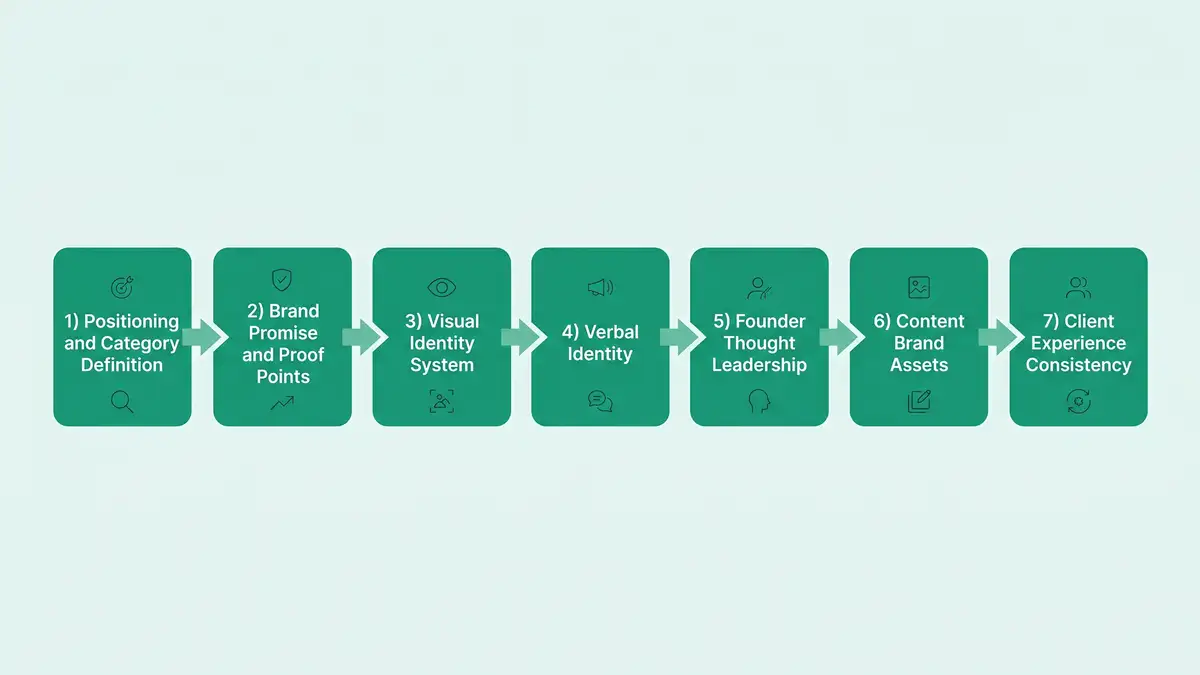
Elite recruitment firm brands are built on seven interlocking pillars. The framework is sequential: the foundation pillars (positioning, brand promise) must precede the expression pillars (visual identity, verbal identity), which must precede the activation pillars (founder thought leadership, content brand assets, client experience consistency). Skipping the foundation produces visual identity that does not survive market scrutiny.
| Pillar | Output | Investment range |
| 1. Positioning and category definition | Documented positioning statement, target buyer, competitive alternative, unique value, proof points | $15k-$60k (workshop + research) |
| 2. Brand promise and proof points | Brand promise documented, 3-5 named proof points, evidence catalogue | $10k-$30k |
| 3. Visual identity system | Logo, colour palette, typography, photography style, brand standards | $25k-$100k |
| 4. Verbal identity | Brand voice principles, tone guidelines, lexicon, tagline | $15k-$50k |
| 5. Founder thought leadership | 5-10 LinkedIn posts/week, 1-2 podcast appearances/month, 3-6 speaking engagements/year | $30k-$120k/year (production + agency) |
| 6. Content brand assets | Annual research report, sector frameworks, proprietary methodologies | $40k-$150k/year |
| 7. Client experience consistency | Brand touchpoint mapping, deliverable templates, communication standards | $20k-$60k (one-time) |
Sources: Strategies on recruitment agency branding, ThreeSixty Digital on building brand identity as a recruitment agency, April Dunford introduction to positioning.
Pillar 1: positioning and category definition
The positioning statement is the foundation that every other pillar rests on. April Dunford's positioning framework defines positioning as the answer to five questions: what is the competitive alternative, what unique value does the firm provide, who is the buyer that values it most, what is the category the firm operates in, what proof points support the claims.
For boutique recruitment firms, the positioning workshop typically reveals that the firm has been competing in the wrong category. The generalist boutique that positions against Korn Ferry and Spencer Stuart loses because the firm cannot deliver the global scale. The same firm repositioned against in-house talent teams in a specific sector wins because the comparison favours the boutique's specialised depth. See niche vs generalist recruitment for the positioning architecture that drives category choice.

Pillar 2: brand promise and proof points
The brand promise is the single concrete claim the firm makes to clients. Marty Neumeier's Brand Gap framework defines the brand promise as the gap between expectation and experience that the firm consistently closes. The promise must be specific enough to differentiate, defensible through evidence, and operationalised through delivery standards. "Trusted partner" is not a brand promise. "Shortlisting board-ready candidates in 21 days" is a brand promise because it is specific, measurable, and verifiable.
Proof points are the evidence that supports the promise. Documented case studies, quantified outcomes, named client logos, third-party rankings, and proprietary frameworks all serve as proof. The boutique with 3-5 named proof points anchored in measurable client outcomes outperforms the generic competitor that relies on testimonial language alone.
Pillar 3: visual identity system
Visual identity covers the firm name, logo, colour palette, typography, photography style, and brand standards documentation. Vistaprint's guide to types of logos documents the choice between wordmark, mark, monogram, and combination logo. ERE's analysis of colour psychology in recruitment documents the industry convention (corporate blues, professional greys) that the differentiated boutique must consciously break or consciously embrace.
The naming decision is the single highest-leverage visual identity choice. Founder name brands (Russell Reynolds, Spencer Stuart, Egon Zehnder) carry founder credibility but cap at founder lifespan. Descriptive names (Korn Ferry, Heidrick and Struggles) carry no semantic load but scale. Sector names (Storm2, Storm4, fintech specialists) signal niche but constrain expansion. The boutique that chooses naming consciously aligned with the firm's 10-year strategic direction avoids the brand pivot cost down the line.
Pillar 4: verbal identity

Verbal identity defines how the firm sounds: the brand voice principles, tone guidelines for different contexts, the lexicon of preferred and avoided words, and the tagline that distills the positioning into a memorable phrase. Motto's analysis of verbal identity fundamentals documents the methodology that converts brand voice from subjective preference into operational standards.
The recruitment industry has a verbal identity crisis. The over-used vocabulary of "passion," "excellence," "world-class," "trusted partner," and "results-driven" appears across the majority of boutique firm websites. The boutique that consciously eliminates these clichés and replaces them with sector-specific, evidence-based language captures the differentiation premium. Helms Workshop's guide to brand voice documents the four-dimension voice framework (formal-casual, serious-funny, respectful-irreverent, enthusiastic-matter-of-fact) that converts abstraction into deployable standards.
Pillar 5: founder thought leadership
Founder-led thought leadership is the highest-leverage activation pillar for boutiques in the 0-5 year horizon. The founder is the brand. Matchr's analysis of top recruitment thought leaders documents the LinkedIn cadence (5-10 posts per week), podcast appearance frequency (1-2 per month), and speaking engagement target (3-6 per year) that produces meaningful brand pull at boutique scale.

The mathematics of founder content compound. Founder LinkedIn pages typically generate 3:1 engagement versus brand pages because human voice outperforms institutional voice on the platform. The compounding effect over 18-24 months of disciplined publication produces measurable inbound pipeline contribution. Jake Jorgovan's analysis of executive search thought leaders documents the publication cadence patterns of the most influential founder voices in the industry. For the BD operating system that converts founder content into pipeline see executive search business development.
Pillar 6: content brand assets
Content brand assets are the proprietary research, frameworks, and methodologies that anchor the firm's authority. The annual industry research report (Spencer Stuart CEO Transitions, Russell Reynolds Global Leadership Monitor, Heidrick Board Monitor, Korn Ferry Leadership Trends) is the template. The boutique counterpart at smaller scale is the sector-specific annual report, the proprietary methodology framework, or the recurring market intelligence publication.
Spencer Stuart's 2024 CEO Transitions report, Russell Reynolds Global Leadership Monitor, Heidrick Board Monitor series, and Heidrick Impact Report 2024 PDF document the gold standard. BlueSky PR's analysis of using research reports to boost media coverage confirms that the publication of original research generates 3-5x the inbound media coverage of opinion content alone.
Pillar 7: client experience consistency

The seventh pillar converts brand from external positioning into operational consistency. The brand touchpoint map covers every client interaction: kick-off meeting deck, weekly update template, candidate presentation deck, executive summary report, post-placement integration deliverable. Each touchpoint should reflect the brand visual identity and verbal identity. The boutique that polishes the BD presentation but delivers candidate presentations in unbranded Word documents undermines the brand promise at the critical moment.
The communication standards layer covers email signatures, voicemail messages, scheduling tool presentation, follow-up cadence. Consistency across these micro-interactions compounds into the perception of professional polish that differentiated boutiques deliver. See managing client relationships in executive search for the partnership model that integrates brand into the relationship architecture and recruitment firm operations manual for the operating discipline that delivers brand consistency at scale.
Industry positioning frameworks worth studying
The positioning frameworks that work for recruitment firms borrow from B2B brand strategy more broadly. Christensen Institute's Jobs-to-be-Done framework defines positioning by the job the buyer hires the firm to do. SuitBro's analysis of Seth Godin's Purple Cow effect emphasises the remarkable that distinguishes the brand from the commodity competitors.
Hinge Marketing's analysis of expertise as a differentiation strategy documents the professional services brand positioning where deep specialised knowledge becomes the unique value. Zendesk's collection of positioning statement examples shows the structural template that recruitment firms can adapt.
Industry brand investment benchmarks
| Investment dimension | Growing boutique (under $10M revenue) | Mid-market firm ($10-50M) | Mature firm ($50M+) |
| Brand as % of revenue | 3-8% | 2-5% | 1-3% |
| Visual identity refresh cycle | 5-7 years | 5-7 years | 7-10 years |
| Founder LinkedIn posts/week | 5-10 | 5-7 | 3-5 |
| Annual research publication | 0-1 reports | 1-2 reports | 2-5 reports |
| Speaking engagements/year | 3-6 (founder) | 10-20 (partner team) | 30+ (firm-wide) |
| PR investment | $30k-$120k/year | $80k-$300k/year | $200k-$1M+/year |
Sources: Pavilion on B2B brand investment, Edelman B2B Thought Leadership Report 2025, McKinsey on how B2B winners keep growing.
Industry case studies in brand evolution
JM Search's launch of a new brand after 40 years of growth documents the mid-market firm brand refresh playbook. The firm consolidated multi-decade history into a refreshed visual identity, modernised verbal voice, and updated content brand assets to match the firm's expanded scope.
Cowen Partners built the CFO niche brand through consistent thought leadership, sector-specific research, and disciplined verbal identity ("Top 1% CFOs") that anchored the boutique in a defensible category. Stanton Chase's brand approach demonstrates the global boutique playbook where consistent local brand expression supports a unified global identity. Boyden's executive search brand illustrates the partnership-led brand model where senior partner authority anchors firm credibility.
8 common pitfalls in recruitment agency branding
1. Generic positioning ("trusted partner")
Positioning statements that could apply to any agency provide zero differentiation. The boutique that cannot articulate competitive alternative, unique value, and target buyer specifically cedes the buyer comparison to firms that can.
2. Founder name brand at scale ceiling
Founder name brands carry founder credibility but cap at founder lifespan and personality. The founder departure or succession event becomes a brand crisis. Consider descriptive or category names for firms with 10+ year strategic horizons.
3. Brand voice cliches (passion, excellence, world-class)
The over-used vocabulary of professional services destroys differentiation. Conscious elimination of cliches and replacement with sector-specific, evidence-based language captures the verbal differentiation premium.
4. Inconsistent visual identity across touchpoints
Polished BD presentations followed by unbranded Word document deliverables destroy the brand promise at the moment of delivery. Brand consistency must extend to every client-facing artefact.
5. No content brand assets
Firms without proprietary research, frameworks, or methodology IP cannot establish category authority. The annual research publication is the entry-level content brand asset that boutiques typically skip.
6. Hidden founder behind firm brand at boutique scale
Boutique scale requires founder visibility. Firms with founders hiding behind institutional brand pages forgo the 3:1 engagement multiplier that founder content delivers on LinkedIn and other platforms.
7. Brand investment under 1% of revenue
The boutique that allocates less than 1% of revenue to brand cannot fund the visual identity refresh, content brand assets, PR, and thought leadership infrastructure required for differentiation. Target 3-8% for growing firms.
8. Copying competitor positioning
The boutique that surveys the competitor landscape and chooses positioning by reaction (the opposite of generalists, the more specialised, the more boutique) ends up in the same crowded category. Conscious differentiation requires defining the category, not the comparison.
7-step playbook to build the brand
Run a brand audit of the current state
Document the existing positioning (or lack thereof), visual identity inventory, verbal voice in existing content, founder thought leadership cadence, content brand assets in the firm's portfolio, and client experience touchpoints. The audit reveals the gap between current and desired state.
Run the positioning workshop
Two-day workshop with the partner team using the April Dunford methodology. Output: documented competitive alternative, unique value, target buyer, category, and proof points. Validate with 5-10 client interviews before finalising.
Develop visual identity
Engage brand design partner ($25k-$100k investment). Develop logo, colour palette, typography, photography style, and brand standards documentation. Apply across website, deliverable templates, presentation decks, business cards, email signatures.
Develop verbal identity
Document brand voice principles (4-dimension framework), tone guidelines per context, lexicon of preferred and avoided words, tagline. Train all client-facing consultants on the verbal identity. Audit existing content for voice alignment.
Launch founder thought leadership cadence
Commit founder to 5-10 LinkedIn posts/week. Engage ghostwriter or in-house content team to support production. Add 1-2 podcast appearances/month and 3-6 speaking engagements/year. Measure engagement against pipeline contribution monthly.
Publish content brand assets
Commit to one annual sector research report in year one. Add proprietary methodology framework as second asset in year two. Build to 2-3 recurring publications by year three. Each publication anchors the firm in defensible authority.
Install client experience brand integration
Map every client touchpoint. Update every deliverable template, communication standard, and operational artefact to reflect the brand visual identity and verbal identity. The brand promise must show up at every moment of client interaction.
Architect Your Firm's Brand Operating System
peppereffect installs the 7-pillar brand architecture that converts boutique executive search firms from undifferentiated commodity businesses into defensible brand assets. We engineer positioning, visual identity, verbal identity, founder thought leadership cadence, content brand assets, and client experience consistency that compounds 30-50% fee premiums and lifts exit multiples through brand recognition. The Freedom Machine for global boutique recruitment firms.
Frequently Asked Questions
What is recruitment agency branding?
Recruitment agency branding is the strategic discipline of building defensible brand identity for recruitment firms covering positioning, brand promise, visual identity, verbal identity, founder thought leadership, content brand assets, and client experience consistency. The output is a documented brand operating system that differentiates the firm from competitors, commands pricing premiums, drives client acquisition, and compounds enterprise value. Elite boutique firms with strong brands command 30-50% fee premiums and generate 60-75% repeat client share versus 30-45% for undifferentiated competitors.
What are the 7 pillars of recruitment agency branding?
The 7 pillars are: 1) Positioning and category definition documenting competitive alternative, unique value, target buyer, category, and proof points; 2) Brand promise and proof points making a specific verifiable claim with evidence; 3) Visual identity system covering logo, colour palette, typography, photography style, and brand standards; 4) Verbal identity defining brand voice, tone guidelines, lexicon, and tagline; 5) Founder thought leadership with 5-10 LinkedIn posts per week, 1-2 podcast appearances per month, 3-6 speaking engagements per year; 6) Content brand assets including annual research reports, sector frameworks, proprietary methodologies; 7) Client experience consistency mapping brand to every touchpoint and deliverable.
How much should a recruitment agency spend on branding?
Growing boutique firms (under $10M revenue) typically invest 3-8% of revenue in brand covering visual identity, verbal identity, founder thought leadership production, content brand assets, PR, and agency fees. Mid-market firms ($10-50M) invest 2-5% of revenue with greater absolute investment. Mature firms ($50M+) invest 1-3% of revenue but absolute budgets reach $1M+ annually. The boutique that allocates less than 1% of revenue cannot fund the differentiation required for premium positioning.
What makes recruitment agencies sound the same?
Most recruitment agencies sound identical because they share an over-used vocabulary ("passion," "excellence," "world-class," "trusted partner," "results-driven"), interchangeable visual identities (corporate blues, generic professional photography, undifferentiated logos), and parallel positioning statements that fail to articulate competitive alternative or unique value. The structural cause is positioning by reaction (defining the firm relative to competitors rather than relative to buyer jobs) and visual identity by industry convention rather than conscious differentiation. The 65-75% of recruitment agencies operating undifferentiated brands all converge on the same brand vocabulary by default.
Should the founder be the brand for a boutique recruitment agency?
For boutique firms in the 0-5 year horizon, the founder is the brand. Founder LinkedIn pages generate roughly 3:1 engagement versus brand pages because human voice outperforms institutional voice on the platform. The founder thought leadership cadence (5-10 LinkedIn posts per week, 1-2 podcast appearances per month, 3-6 speaking engagements per year) produces measurable inbound pipeline contribution within 18-24 months. The transition from founder-led brand to institutional brand typically occurs between 15 and 25 consultants when partner-level voices supplement founder content. Pure founder dependency caps firm growth at founder lifespan and personality.
What are common pitfalls in recruitment agency branding?
The 8 most common pitfalls are: 1) Generic positioning that could apply to any agency; 2) Founder name brand creating scale ceiling at founder lifespan; 3) Brand voice cliches like passion and excellence; 4) Inconsistent visual identity across touchpoints; 5) No content brand assets to anchor category authority; 6) Hidden founder behind firm brand at boutique scale; 7) Brand investment under 1 percent of revenue; 8) Copying competitor positioning rather than defining own category. Each pitfall is preventable with disciplined 7-step brand build playbook anchored in the April Dunford positioning framework.
How long does it take to build a recruitment agency brand?
The complete 7-pillar brand build typically runs 12-18 months from audit to full operational deployment. Brand audit and positioning workshop occupy months 1-3. Visual identity and verbal identity development run months 4-7. Founder thought leadership cadence launches month 6 and ramps to full cadence by month 12. Content brand assets typically require 12-18 months to first major publication. Client experience brand integration runs continuously from month 6 onwards. Measurable brand pull (inbound pipeline contribution from brand recognition rather than direct outbound) typically becomes visible 18-24 months from cadence launch.
Resources
- April Dunford: Introduction to Positioning
- Marty Neumeier: The Brand Gap
- SuitBro: Seth Godin Purple Cow Effect
- Christensen Institute: Jobs-to-be-Done Theory
- Strategies: Recruitment Agency Branding
- ThreeSixty Digital: Building Brand Identity as a Recruitment Agency
- Recruiter Insider: Most Recruitment Agencies Sound the Same
- Motto: The Fundamentals of Verbal Identity
- Helms Workshop: What is Brand Voice
- Hinge Marketing: Expertise as a Differentiation Strategy
- Zendesk: Positioning Statement Examples
- Matchr: Top Recruitment Thought Leaders
- Jake Jorgovan: Executive Search Thought Leaders
- Spencer Stuart: 2024 CEO Transitions Report
- Russell Reynolds Global Leadership Monitor
- Heidrick Board Monitor Series
- Heidrick Impact Report 2024 (PDF)
- BlueSky PR: Using Research Reports to Boost Media Coverage
- Edelman B2B Thought Leadership Report 2025
- McKinsey: How B2B Winners Keep Growing
- Pavilion: Why Investing in Brand is Essential for B2B Success
- Hunt Scanlon Top 50 Americas
- Bullhorn GRID 2026 Industry Trends
- JM Search: Launches New Brand After 40 Years
- Cowen Partners Consumer Goods Practice
- N2Growth Sales and Marketing Practice
- Stanton Chase About
- Boyden Executive Search
- Talentfoot Top Boutique Executive Search Firm Rankings
- ERE: Psychology of Color in Recruitment
- Vistaprint: Types of Logos
- Top Echelon: Top 5 Mistakes Recruitment Agencies Make