

The strategic question every boutique executive search firm faces at the inflection between 10 and 25 consultants is whether to specialise vertically or remain generalist. The answer determines pricing power, talent depth, repeat client share, addressable market, and ultimately the firm's exit multiple. The wrong answer destroys margin or caps growth. The right answer compounds for a decade.
This article installs the strategic framework that boutique to mid-market executive search firms (5-50 consultants) use to choose between niche specialisation, generalist coverage, or the hybrid model that the global top firms operate. James Sterling, Managing Director of a global executive search boutique with $5-20M revenue, will use this as the decision architecture that drives positioning, BD strategy, and the next 10 years of compounding.

The strategic thesis
Niche beats generalist at the boutique scale. Boutiques that try to be everything to everyone get squeezed between large generalists with brand and scale (Korn Ferry, Spencer Stuart, Heidrick, Russell Reynolds, Egon Zehnder) and niche specialists with sector authority and deep talent pools. The boutiques that compound revenue past 25 consultants either choose a defensible niche or build practice-area depth inside a hybrid generalist model. The boutique generalist without practice-area discipline is the worst position in the market.
Niche vs generalist: definitions that matter
Niche or specialist recruitment firms concentrate vertical depth in 1-3 sectors. They develop sector-specific talent maps, technical assessment frameworks, and trusted client relationships in defined verticals like FinTech, MedTech and life sciences, industrial automation, ESG and sustainability, or cybersecurity. Their value proposition is depth: the consultants know the named candidate universe by memory, understand the technical role requirements without translation, and command premium fees because clients cannot substitute the relationship with a generalist competitor.
Generalist recruitment firms cover multiple sectors horizontally. Their value proposition is reach: they serve clients across industries, can support multi-functional executive searches, and benefit from scale economics in research infrastructure and brand recognition. The global top firms (Korn Ferry, Spencer Stuart, Heidrick and Struggles, Russell Reynolds, Egon Zehnder) operate the hybrid generalist model: scale plus dedicated sector practice areas inside a unified firm.
The hybrid model is what enables compounding past mid-market scale. A pure generalist boutique at 15 consultants competes against generalists 100x larger on brand, and against niche specialists 10x more focused on depth. The hybrid model installs vertical practice areas inside the generalist scope to neutralise that two-front squeeze. The implication for James Sterling: by 20 consultants, the firm must operate at least 2-3 defined practice areas or risk margin compression.
The economic comparison
The financial differential between niche and generalist firms is structural, not cyclical. Niche specialists charge premium fees because their value is not substitutable with generalist coverage. Airswift's analysis of generalist vs specialist recruiters documents the consistent fee premium for verticalised firms. Cowen Partners' analysis of executive search fees by firm type confirms the 30-40% fee premium for specialist boutiques in financial services and CFO search.
| Dimension | Niche specialist boutique | Generalist boutique | Hybrid generalist (top firms) |
| Typical placement fee | 28-35% of cash comp | 20-25% | 25-33% (varies by practice) |
| Average mandate value | $120k-$300k | $60k-$150k | $150k-$500k+ |
| Repeat client share | 60-75% | 30-45% | 50-65% (multi-mandate) |
| Revenue per consultant | $800k-$1.5M | $400k-$700k | $1.2M-$2M+ |
| Time-to-shortlist | 2-5 weeks (deep talent map) | 4-8 weeks | 3-6 weeks (with practice depth) |
| BD cycle length | 2-6 weeks (sector authority) | 6-12 weeks | 4-8 weeks (brand pull) |
| Concentration risk | HIGH (sector downturn exposure) | LOW (diversified) | LOW (multi-practice) |
Sources: Cowen Partners on the two types of executive search firms, Bullhorn GRID 2026, Hunt Scanlon Top 50 Americas, Mordor Intelligence executive search market.
The economic gap explains why niche specialists frequently outperform generalist boutiques of similar scale on EBITDA. A 20-consultant niche firm generating $24M in revenue at 60% margins produces $14M EBITDA. A 20-consultant generalist boutique at $10M revenue at 35% margins produces $3.5M. The valuation multiples at exit also favour niche: niche specialists trade at 8-15x EBITDA versus 4-8x for unfocused generalists per industry analysis of specialisation power. See recruitment firm profitability for the margin mechanics across firm types and executive search pricing models for the retainer-contingency-hybrid fee structures that compound these economics.

The strategic trade-offs
Niche specialisation produces pricing power, deeper talent pools, sector authority, faster placement cycles, and stronger client retention. The trade-off is concentration risk: when the sector enters a downturn, the niche firm absorbs the full impact with no diversification cushion. The FinTech firms that grew 35% annually from 2020-2022 collapsed 40% in the 2023 contraction. The MedTech specialists weathered the same period stably because the sector cycle ran counter.
Generalist coverage produces market diversification, broader BD options, multi-functional executive coverage, and scale economics. The trade-off is commodification pressure: clients view generalist boutiques as substitutable, which compresses fees and erodes margin. N2Growth's analysis of choosing between generalist and specialist firms captures the buyer perspective on substitutability.
The hybrid model neutralises both extremes but requires operational discipline. Each practice area must operate as a coherent vertical with its own talent map, sector intelligence, and consultant specialisation, while sharing infrastructure (CRM, BD systems, methodology, brand) across the firm. Benson Search analysis of retained boutique value documents how the best hybrid firms enforce practice area autonomy inside firm-level integration.
When to go niche
The decision to specialise vertically is not aesthetic. It is a strategic bet on five specific conditions. Hudson Gate Partners analysis of boutique versus generalist positioning outlines the qualifying criteria.
First, the founder or partner team has 10+ years of sector authority documented through prior operating roles, advisory positions, or speaking engagements. Without this depth, the niche firm cannot credibly claim differentiation versus generalist competitors at the BD conversation. Second, the sector has $50M+ annual placement spend among the addressable target accounts. Smaller addressable markets cap growth before scale economics kick in. Third, the sector is growing 8%+ annually with secular tailwinds. Niche firms thrive in growing sectors and suffer disproportionately in contracting ones. Fourth, the top 5 competitors in the sector are non-AI-native or operationally weak. AI augmentation closes some of the historical sourcing depth gap between niche and generalist, so the niche firm needs a defensible position beyond pure sourcing efficiency. Fifth, the founder/team has personal credibility with 30-50+ named buyers in the sector who would take an introductory meeting.
When these five conditions hold, the niche path generates compounding returns. Sector authority produces inbound, which feeds the talent map, which produces faster placements, which produces repeat clients, which produces the case studies that win new mandates. See executive search business development for the BD operating system that converts sector authority into consistent retained mandate flow.
When to stay generalist or go hybrid

Generalist coverage works for boutiques in three specific situations. First, cross-functional executive searches dominate the mandate flow: CEO, COO, board chair, and CHRO roles that span multiple sectors and require breadth rather than depth. Second, the firm has structural scale advantages that produce brand pull across sectors (e.g., partner with Big 4 advisory practice heritage, sector M&A book of business). Third, multi-geography coverage requires breadth: global searches for multinationals that need a single search partner across sectors and regions.
When none of these conditions hold and the firm has 15+ consultants, the hybrid model is mandatory. The hybrid installs 2-5 vertical practice areas inside generalist scope. Each practice has a partner-level lead, a documented talent map of 200-500 named candidates, sector-specific BD targets, and contribution to overall firm thought leadership. Abel and Magy's analysis of generalist multi-specialty vs specialist firms documents the operating mechanics of the hybrid model.
The 2x2 strategic positioning matrix
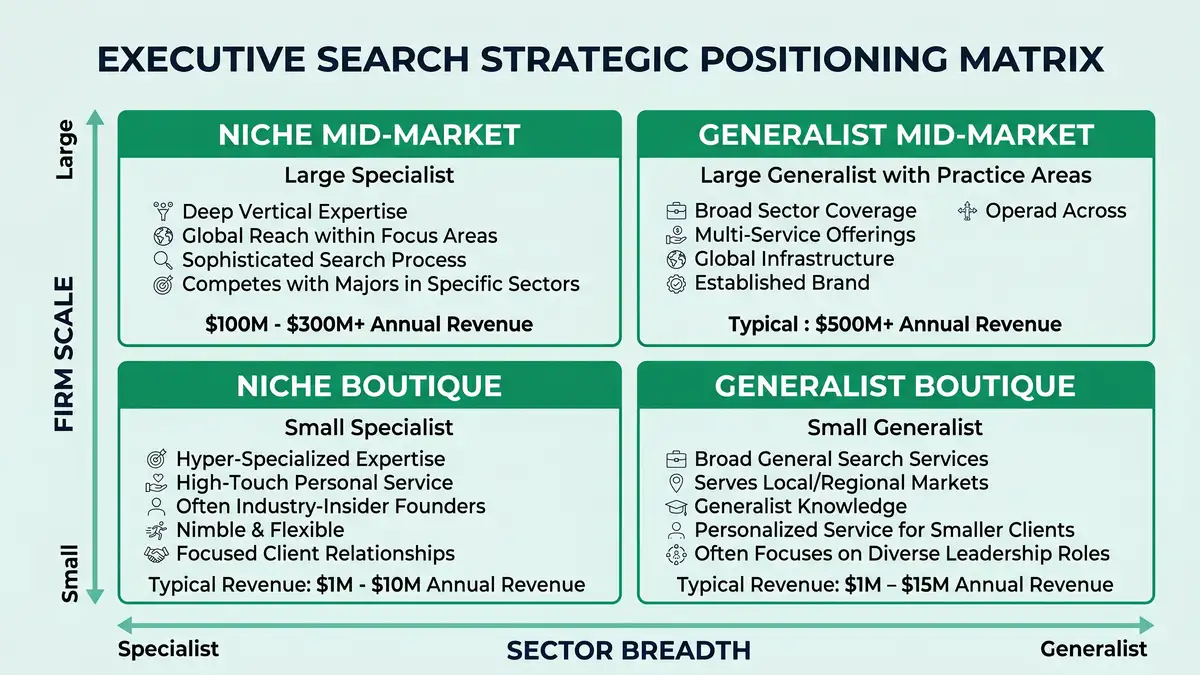
The matrix captures the four viable positions for an executive search firm. Each quadrant has different unit economics, growth trajectory, and exit valuation. The worst position to occupy at boutique scale is generalist with no practice areas (bottom-right of the matrix), which combines low margin from commodification with no defensible moat against either niche specialists or large generalists.
| Quadrant | Characteristic firms | Typical revenue scale | Strategic mode |
| Niche Boutique (small specialist) | Cowen Partners (CFO), FinTech specialists like Storm2 | $2M-$15M | Deep sector authority, premium fees, founder-led |
| Niche Mid-Market (large specialist) | MLA Global (FS), JM Search (PE portfolio) | $15M-$60M | Multi-partner sector authority, practice area depth |
| Generalist Boutique (small generalist) | Unfocused regional generalists | $2M-$10M | Highest risk position; squeeze from both sides |
| Hybrid Generalist (large with practices) | Korn Ferry, Heidrick, Russell Reynolds, Spencer Stuart, Egon Zehnder | $200M-$3B+ | Brand scale + practice depth across 8-15 verticals |
Sources: Hunt Scanlon Top 50, Talentfoot top boutique executive search firms 2026 rankings, N2Growth on selecting a search firm.
The implication for James Sterling at 10-50 consultants is to occupy the niche boutique or niche mid-market quadrant. The generalist boutique quadrant is structurally untenable. The hybrid generalist quadrant requires scale that boutiques cannot reach without a transformational capital event or 15-20 years of compounding. See scaling a recruitment firm from 5 to 50 consultants for the operating cadence that supports the move from niche boutique to niche mid-market and building an executive search practice for the founder-to-firm transition that anchors the niche decision.
Sector-specific examples and market size
The boutique niche specialists that dominate their verticals provide the operating template. Cowen Partners built deep authority in CFO and finance leadership search. JM Search dominates the private equity portfolio company executive search niche. MLA Global built sector depth across financial services. EPM Scientific operates the deep MedTech vertical. Each firm built defensible moat through 10+ years of vertical depth before competitors could replicate the talent map. The JM Search example is covered in detail in executive search for private equity portfolio companies.
The global executive search market reached $38B+ in 2026 according to Mordor Intelligence's executive search market analysis. The boutique segment grew 12-18% annually, materially faster than the overall industry's 11% growth rate reported by Hunt Scanlon's Top 50 Americas roundup. Within boutiques, niche specialists grew fastest, supporting the strategic thesis that vertical specialisation compounds.
How AI changes the niche vs generalist decision

AI augmentation changes the economics in three specific ways. First, AI sourcing reduces the talent-mapping cost advantage that niches historically held. A generalist firm with strong AI tooling can construct a sector talent map in days that previously took a niche firm months to compile. Bullhorn GRID 2026 industry trends documents that AI-augmented firms achieve 3.5-4.5x revenue growth versus laggards, with the productivity uplift compounding faster for generalists with practice-area depth than for pure niche specialists.
Second, AI assessment partially substitutes for sector expertise in initial candidate evaluation. Tools that score candidate fit against role requirements can flag obvious mismatches without the consultant needing deep sector knowledge for first-pass screening. The implication is that the niche firm's defensible moat shifts from sourcing to higher-order activities: assessment depth, client trust, and BD positioning.
Third, AI thought leadership content production compresses the cost of sector authority building. Generalist firms can publish credible practice-area thought leadership at a fraction of the historical cost, accelerating their move into hybrid territory. The implication for niche specialists is that maintaining authority requires continued investment beyond historical baselines. See AI for executive search for the autonomous sourcing architecture that affects both niche and generalist firms.
The net AI impact is to favour the hybrid model. Generalists with AI plus practice areas capture much of the niche advantage without the concentration risk. Pure niche firms must invest more aggressively in non-sourcing differentiation to maintain pricing power. The boutique generalist without practices remains the worst position.
The 6-dimension decision scorecard

Use this scorecard to evaluate the niche versus generalist decision for your firm. Each dimension scores 1-5. Total scores favouring niche above 22 suggest specialisation; below 14 favours generalist or hybrid; 14-22 suggests the hybrid model.
Dimension 1: founder/team sector depth (1 = no sector authority, 5 = 15+ years documented sector leadership). Dimension 2: addressable market size (1 = $10M sector spend, 5 = $200M+ sector spend). Dimension 3: sector growth rate (1 = declining or stagnant, 5 = 15%+ annual growth with secular tailwinds). Dimension 4: competitive concentration (1 = dominated by entrenched specialists, 5 = fragmented with no clear leader). Dimension 5: cross-sector mandate frequency (1 = most mandates span multiple sectors, 5 = mandates are sector-specific). Dimension 6: geographic coverage requirements (1 = global multi-sector coverage required, 5 = regional sector focus sufficient).
8 common pitfalls in the niche vs generalist decision
1. Niching too narrow
Choosing a sector with $5-10M total addressable placement spend caps growth before the firm reaches consultant scale. Validate addressable market before committing.
2. Niching too late
Generalist boutique builds 10 years of mixed sector book of business, then attempts to niche. The existing client base resists, the brand confuses the market, and the firm bleeds revenue during the 2-3 year transition.
3. Staying generalist past 25 consultants without practice areas
The firm enters the worst quadrant of the matrix: too large for founder-led generalism, too unfocused for niche pricing power, too small for hybrid scale advantages. Margin compression follows within 18 months.
4. Niche concentration in a single cyclical sector
Pure FinTech, pure crypto, pure enterprise SaaS specialists collapse 30-50% when sector cycles turn. Always pair the dominant niche with 1-2 adjacent verticals that have counter-cyclical exposure.
5. Hybrid without operational discipline
Practice areas without partner-level ownership, documented talent maps, sector-specific BD targets, and quarterly governance become decorative rather than functional. The firm reverts to undisciplined generalism within 12 months.
6. Mistaking functional specialism for sector specialism
"We do CFO search" is a functional niche that spans every sector. The talent map, BD targets, and sector intelligence required differ fundamentally from a true sector niche. Functional niches work but require different operating systems.
7. Ignoring AI's substitution effect on niche sourcing advantage
Niche firms that relied on talent map depth as their defensible moat without investing in higher-order differentiation (assessment, BD, client trust) lose pricing power as generalists with AI close the sourcing gap.
8. Niching without 10+ years sector authority in the founder team
Specialisation without credibility produces marketing positioning without BD pull. Clients in the sector verify authority before retaining. Founder credibility cannot be manufactured through positioning alone.
7-step playbook to choose your path
Score the 6 dimensions honestly
Workshop with the partner team. Score each dimension 1-5 with documented evidence. Founder sector depth must be measurable through prior roles, advisory positions, speaking engagements, published research. Addressable market size requires sector-specific placement spend research, not generic industry size.
Map the existing client base
Distribute existing clients and revenue by sector. If 60%+ of revenue concentrates in 1-2 sectors, niche is the natural path. If revenue spans 8+ sectors evenly, hybrid is the natural path. The distribution rarely justifies pure generalism for boutiques.
Validate addressable market for the proposed niche
Research sector-specific executive placement spend (Hunt Scanlon, AESC, sector trade associations). Target $50M+ annual addressable market for a defensible niche. Below $25M, the niche caps firm growth.
Stress-test sector cyclicality
Model the firm's revenue trajectory under a 30% sector contraction. If the firm cannot sustain operations through 24 months of sector downturn, pair the dominant niche with 1-2 counter-cyclical adjacent verticals.
Choose niche, hybrid, or strategic generalist
Niche if scorecard above 22 and addressable market validated. Hybrid if scorecard 14-22 or 15+ consultants with mixed client base. Strategic generalist (CEO/board-level cross-sector specialist) only if scorecard heavily favours cross-sector mandates and the firm has scale brand advantages.
Document the practice area operating model
For hybrid path: partner-level practice leads with P&L accountability, documented talent maps of 200-500 named candidates per practice, sector-specific BD targets, quarterly practice reviews. For niche path: full operating system aligned to the vertical with all infrastructure tuned to the chosen sector. See recruitment firm operations manual for the 8-pillar operating discipline that converts practice areas from decorative to functional.
Install quarterly strategic review
Track niche or practice area revenue contribution, fee yield by sector, repeat client share, BD pipeline coverage by sector, sector growth versus firm growth. Refine practice mix annually based on data. Exit weakening practices, double down on accelerating ones.
Architect Your Firm's Strategic Position
peppereffect installs the strategic positioning and operating system that converts boutique executive search firms from undifferentiated generalists into defensible niche specialists or disciplined hybrid practices. We engineer the practice-area architecture, sector-specific BD systems, talent map infrastructure, and AI augmentation layer that drives margin expansion and exit multiple. The Freedom Machine for global boutique recruitment firms.
Frequently Asked Questions
What is the difference between niche and generalist recruitment?
Niche or specialist recruitment firms concentrate vertical depth in 1-3 defined sectors such as FinTech, MedTech, industrial automation, ESG, or cybersecurity. They build sector-specific talent maps, develop technical assessment frameworks, and command premium fees through depth. Generalist recruitment firms cover multiple sectors horizontally and benefit from market diversification and scale economics. The hybrid model combines generalist scope with dedicated vertical practice areas, which is how the global top firms (Korn Ferry, Spencer Stuart, Heidrick, Russell Reynolds, Egon Zehnder) operate. For boutiques, the worst position is unfocused generalism without practice areas because it suffers margin compression from both niche specialists and large generalists simultaneously.
Which is more profitable: niche or generalist recruitment?
Niche specialist boutiques typically achieve significantly higher profitability than generalist boutiques of similar size. Niche firms charge 28-35% placement fees versus 20-25% for generalists, generate 60-75% repeat client share versus 30-45%, and produce $800k-$1.5M revenue per consultant versus $400k-$700k. A 20-consultant niche firm generating $24M revenue at 60% margins produces approximately $14M EBITDA versus a 20-consultant generalist boutique at $10M revenue and 35% margins producing $3.5M. Niche specialists also trade at higher exit multiples (8-15x EBITDA) versus unfocused generalists (4-8x EBITDA).
When should a boutique recruitment firm specialise in a niche?
Five conditions favour niche specialisation: 1) the founder or partner team has 10+ years documented sector authority; 2) the sector has $50M+ annual addressable placement spend; 3) the sector is growing 8%+ annually with secular tailwinds; 4) the top 5 competitors are operationally weak or non-AI-native; 5) the founder team has personal credibility with 30-50+ named buyers in the sector. When these conditions hold, niche specialisation compounds through sector authority producing inbound, which feeds the talent map, which produces faster placements, which produces repeat clients, which produces case studies that win new mandates.
What is the hybrid model in executive search?
The hybrid model combines generalist scope with dedicated vertical practice areas inside a single firm. Each practice operates as a coherent sector vertical with its own partner-level lead, documented talent map of 200-500 named candidates, sector-specific BD targets, and contribution to firm-level thought leadership, while sharing infrastructure (CRM, BD systems, methodology, brand) across the firm. The global top firms all operate this model. For boutiques compounding past 15-20 consultants, the hybrid is mandatory unless the firm pursues pure vertical specialisation. The hybrid neutralises both the concentration risk of pure niche and the commodification pressure of undifferentiated generalism.
How does AI augmentation affect the niche vs generalist decision?
AI augmentation changes the strategic calculus in three ways. First, AI sourcing reduces the talent-mapping cost advantage niche firms historically held: generalists with strong AI tooling can construct sector talent maps in days rather than months. Second, AI assessment partially substitutes for sector expertise in initial candidate screening, shifting the niche firm's defensible moat from sourcing to assessment depth, client trust, and BD positioning. Third, AI thought leadership content production compresses the cost of authority building, accelerating generalists' move into hybrid territory. The net effect favours the hybrid model and forces pure niche firms to invest more aggressively in non-sourcing differentiation to maintain pricing power.
What are common pitfalls in choosing between niche and generalist recruitment?
The 8 most common pitfalls are: 1) Niching too narrow with TAM below $25M; 2) Niching too late after building mixed-sector book of business; 3) Staying generalist past 25 consultants without practice areas; 4) Niche concentration in a single cyclical sector; 5) Hybrid without operational discipline; 6) Mistaking functional specialism (CFO search) for sector specialism (FinTech executives); 7) Ignoring AI's substitution effect on niche sourcing advantage; 8) Niching without 10+ years founder team sector authority. Each pitfall is preventable with disciplined scorecard evaluation, addressable market validation, sector cyclicality stress testing, and quarterly strategic review.
How do I decide whether to go niche, hybrid, or generalist?
Use the 6-dimension scorecard: founder/team sector depth, addressable market size, sector growth rate, competitive concentration, cross-sector mandate frequency, and geographic coverage requirements. Each dimension scores 1-5. Total scores above 22 favour niche specialisation; 14-22 suggests the hybrid model; below 14 suggests strategic generalist (only if combined with scale brand advantages). For most boutiques the path runs niche if scorecard is high and addressable market validated, hybrid otherwise. Pure generalism at boutique scale is rarely defensible. The 7-step playbook walks through scoring, client base mapping, market validation, cyclicality stress testing, path selection, operating model documentation, and quarterly strategic review. valuation multiples that flow from positioning choice brand identity that anchors positioning technology vertical specialism playbook healthcare sector executive search practice
Resources
- Mordor Intelligence: Executive search market analysis
- Hunt Scanlon Top 50 Executive Search Firms in the Americas
- Bullhorn GRID 2026 Industry Trends Report
- Airswift: Generalist vs specialist recruiters
- N2Growth: Choosing a generalist vs specialist executive search firm
- Abel and Magy: Generalist multi-specialty firm versus specialist
- N2Growth: Bigger is not always better when selecting a search firm
- Hudson Gate Partners: Boutique executive search vs generalist recruiters
- Recruiters Websites: Embrace your niche, the power of specialisation in recruiting
- Cowen Partners: The two types of executive search firms and their fees
- Cowen Partners CFO search firm
- Cowen Partners: New rules of executive search 2026
- Benson Search: The value of retained boutique executive search firms
- JM Search about page
- MLA Global careers
- Korn Ferry executive search capability
- Spencer Stuart what we do
- Heidrick and Struggles
- Russell Reynolds executive search capability
- Egon Zehnder expert team
- Talentfoot: Top boutique executive search firms 2026 rankings
- Juicebox: 12 best executive search firms 2026
- JobCompass: Top FinTech recruiting firms
- EPM Scientific: MedTech recruitment
- BrightPath Associates: Industrial automation industry
- Cybersecurity Ventures: Cybersecurity search firms
- Loxo: The account-based prospecting playbook for executive search
- April Dunford: Quickstart guide to positioning
- HBR: Generalists get better job offers than specialists