

Scaling a recruitment firm from 5 to 50 consultants is the inflection journey where most boutiques either compound into mid-market firms with defensible enterprise value or collapse into stalled partnerships fighting culture drift, founder bottleneck, and operational debt. The journey is not a linear hiring exercise. It is four distinct stage transitions, each with its own bottlenecks, governance requirements, and partner alignment mechanics. Firms that compound through all four stages without losing culture compound 8 to 12x enterprise value versus firms that stall in the partner-led-firm trap.
This guide architects the 5 to 50 consultant scaling journey for managing directors of boutique executive search firms transitioning into mid-market scale (James Sterling persona). We benchmark the 4 scaling stages, the 7 bottlenecks that derail firms, partner economics, hiring sequence, culture preservation mechanisms, governance architecture, technology stack evolution, AI augmentation impact, 8 execution pitfalls, and the 7-step playbook. Every recommendation reinforces the operating logic of building an executive search practice and the financial mechanics of recruitment firm profitability.
The 4 Stages of Recruitment Firm Scaling
The 5 to 50 consultant journey resolves into four distinct stages, each with structurally different operational characteristics. Per Recruitly's resource on how to scale a recruitment agency and Staffing Hub's analysis of scaling without losing what made you successful, treating these as one continuous growth journey rather than four discrete stage transitions is the single most common scaling error.
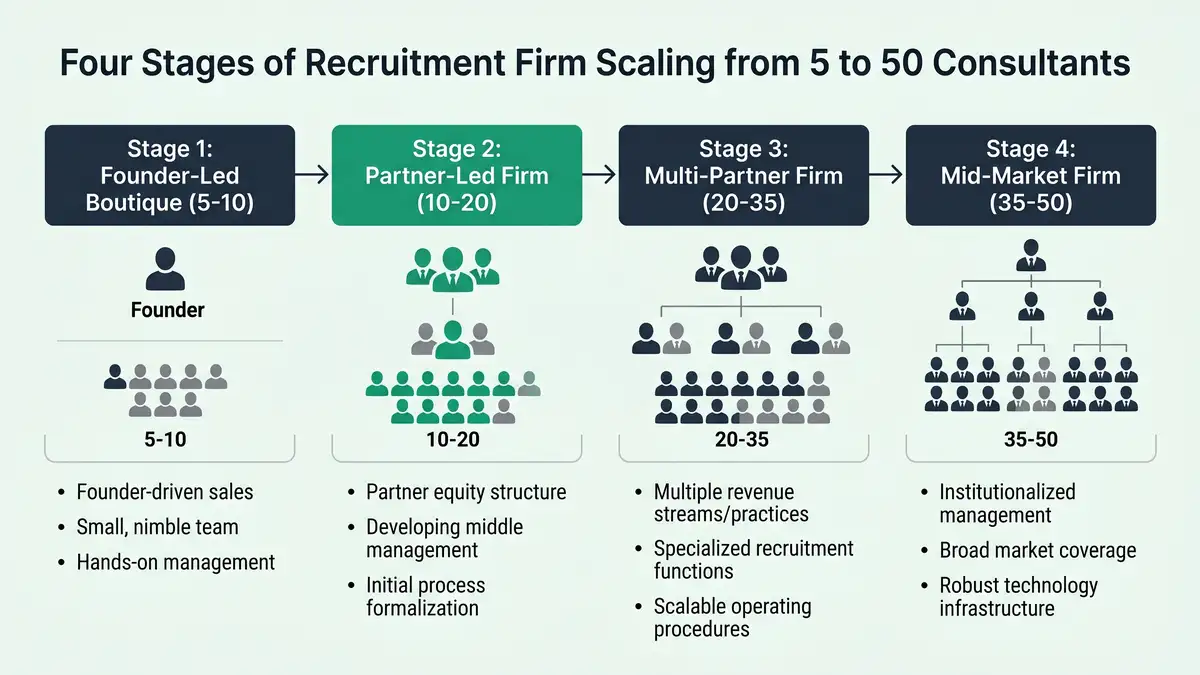
| Stage | Consultants | Key Characteristic | Critical Hire |
| Stage 1: Founder-Led Boutique | 5-10 | Founder handles BD and delivery | First researcher |
| Stage 2: Partner-Led Firm | 10-20 | Methodology productization, second partner | First operations lead |
| Stage 3: Multi-Partner Firm | 20-35 | Governance architecture, sector expansion | Head of research |
| Stage 4: Mid-Market Firm | 35-50 | Geographic expansion, advisory layers | CFO or COO |
Sources: Recruitly scaling recruitment agency, Staffing Hub scaling without losing what worked, N2Growth boutique vs large firm analysis
The scaling thesis
Scaling from 5 to 50 consultants is not linear hiring. It is four distinct stage transitions, each requiring different operating discipline, governance architecture, and partner alignment mechanics. Firms that treat scaling as headcount addition stall in the partner-led trap and lose culture between 15 and 25 consultants. Firms that treat scaling as four sequential operating system upgrades compound 8 to 12x enterprise value over the journey.

The 7 Scaling Bottlenecks That Derail Firms
Founder bottleneck on BD, delivery, and hiring
Per Monkhouse and Company's analysis of recruitment bottlenecks for scaling, the founder bottleneck is the single most common scaling constraint. Firms scaling past 10 consultants where the founder still personally handles all BD, mandate delivery, and hiring decisions stall at the founder's bandwidth. The founder transition from doer to architect is non-negotiable.
No productized methodology
Firms scaling past 15 consultants without a codified mandate playbook, structured assessment protocol, and sourcing operating system rebuild from scratch with every new consultant. Per Pinpoint HQ's analysis of standardized enterprise hiring process, methodology productization is the operating leverage that allows the same partner to oversee 4 to 6 consultants rather than 1 to 2.
Weak partner alignment
Promoting senior consultants to partner without aligned economic incentives, governance role definition, and shared P&L visibility creates partner misalignment that compounds with each new hire. Partner alignment becomes the load-bearing structure of the firm at 15+ consultants.
Technology stack sprawl
Per Tracker RMS's analysis of recruitment tech stacks, firms accumulating tools without integration produce 4-6 percent of revenue in stack cost with marginal productivity return. peppereffect's analysis of recruitment CRM software for boutique firms details the consolidation framework.
Culture drift at 15-25 consultant inflection
Per HBR's analysis of scaling culture in fast-growing companies, 60-70 percent of scaling firms report measurable culture deterioration between 15 and 25 consultants. The drift compounds silently until exit interviews and Glassdoor reviews surface what consultants knew six months earlier.
Governance vacuum
Firms growing past 20 consultants without weekly leadership meetings, monthly partner reviews, quarterly business reviews, and annual strategic planning compound coordination costs that erode margin. Per Gainsight's essential guide to quarterly business reviews, governance discipline at 25+ consultants separates compounding firms from stalling firms.
Succession planning gap
Firms scaling past 25 consultants without a documented succession plan create exit risk and reduce valuation multiples. Per peppereffect's recruitment firm profitability analysis, succession risk compresses valuation by 30-50 percent at exit, undoing years of margin discipline in a single negotiation.
Partner Versus Consultant Economics
The transition from consultant to partner is the single most consequential economic decision in the scaling journey. Per Bain's analysis of how to map your industry's profit pool, the partnership profit pool architecture determines which scaling firms attract and retain top consultants and which lose them to competing partnerships. Per Glassdoor's recruitment partner salary data, partner economics vary 3-5x across firms depending on equity vesting, profit pool structure, and shared economics architecture.
The three dominant partner economic models:
| Model | Structure | Best For |
| Eat-What-You-Kill | Partners retain 60-70% of personal fees | Solo-leaning partnerships, hunter culture |
| Shared Economics 30-40-30 | 30% partners take, 40% reinvestment, 30% bonus pool | Scaling firms 10-30 consultants |
| Equity Vesting Partnership | Equity grant over 4-7 years, profit-share alongside | Long-term compounders, succession-oriented |
Sources: Bain profit pool mapping, Concierge Office Suites eat-what-we-kill model, Glassdoor recruitment partner salary data
Per Greg Savage's recruitment scaling research at TheSRA, the firms that compound past 25 consultants typically operate the shared economics 30-40-30 model with equity vesting for top performers. The eat-what-you-kill model maximises partner take in the short term but underinvests in firm-level capability and creates exit-vulnerability.
Need to architect the partner economics and governance structure for your scaling firm?
Book a Growth Mapping CallThe 7 Critical Hires Across the Scaling Journey
First researcher at 5-7 consultants
The researcher is the first scaling leverage hire. They handle sourcing, candidate research, market mapping while consultants focus on mandate delivery and BD. A skilled researcher typically supports 3-4 consultants. Per peppereffect's talent mapping strategy framework, the research function becomes the proprietary intelligence engine that compounds across mandates.
First operations lead at 8-12 consultants
The operations lead handles CRM administration, financial operations, candidate logistics, scheduling, compliance. Without this hire, partners and consultants spend 15-25 percent of their time on operations rather than mandate delivery.
First non-founder partner at 12-15 consultants
Promoting or hiring the first non-founder partner is the single most consequential scaling decision. The selection criteria: cultural alignment, demonstrated BD capability, capacity to develop other consultants, willingness to invest in firm-level priorities beyond personal mandates.
First business development specialist at 18-22 consultants
Per Search Solution Group's analysis of sales and business development recruitment, the BD specialist hire is the discipline that separates partner-led firms from BD-dependent firms. The specialist handles outbound BD, partnership development, content distribution while partners focus on mandate delivery and strategic relationships.
Head of research at 25-30 consultants
At 25 consultants, the research function needs leadership and operating discipline rather than ad-hoc allocation. The head of research codifies the firm's research methodology, manages the research team, and protects the intellectual capital that compounds across mandates.
Head of operations at 30-35 consultants
Per Anthropic's head of recruiting operations job posting as a benchmark for the role architecture, the head of operations function manages firm-level operations including HR, finance, technology, governance cadence, and partner support. This hire shifts the founder from operating leader to strategic architect.
First CFO or COO at 35-40 consultants
Per Cowen Partners' analysis of CFO search, firms scaling past 35 consultants need dedicated financial or operations leadership at the C-suite level. The CFO or COO hire is the inflection that converts the firm from owner-operator partnership into a managed firm with institutional infrastructure.

Culture Preservation at Scale
Culture deterioration is the silent killer of scaling boutique firms. Per HBR's analysis of scaling culture in fast-growing companies, 60-70 percent of firms scaling past 15 consultants report measurable culture deterioration. Per McKinsey's culture and change practice, the deterioration follows a predictable pattern: hiring discipline relaxes under growth pressure, partner attention shifts from culture to revenue, founder absence increases, governance cadence loses content.

The 5 culture preservation mechanisms that compound through scaling:
Defined values codified into hiring criteria. Per First Steps Financial's analysis of scaling without losing company culture, values that exist only as posters on the wall fail to filter hiring decisions. Values codified into structured interview rubrics and reference check protocols filter every new consultant.
Hiring discipline protected through partner consensus. Every consultant hire at 15+ consultants requires partner consensus, not just one partner's championing. The discipline prevents culture drift through accumulated marginal decisions.
Partner-led onboarding. New consultants spend the first 30 days shadowing a partner across mandate cycles, BD conversations, and firm rituals. The discipline transfers culture through observed practice rather than written documentation.
Weekly all-hands meetings. Per CEO Coaching International's analysis of leadership meeting cadence, weekly all-hands meetings with consistent format (wins, learnings, blockers, sector intelligence) protect the firm's communication culture as scale stretches it.
Quarterly retreats and annual offsites. Per Sarvarth's analysis of how boutique consulting is winning, the firms that compound past 25 consultants typically invest in 2-day quarterly retreats and 4-day annual offsites. The investment looks expensive on a P&L but pays back through culture preservation and partner alignment.
Governance Architecture at Scale
Governance discipline is the load-bearing structure that allows firms to scale past 20 consultants without coordination collapse. Per Gainsight's essential guide to quarterly business reviews, the governance architecture for scaling recruitment firms layers across four cadences.
Weekly leadership meetings. Partner-only cadence focused on operating tactics: mandate pipeline health, partner workload balance, hiring decisions in progress, weekly KPI variance. 60-90 minutes.
Monthly partner reviews. Partners plus heads of research, operations, and BD. Focused on operating discipline: KPI tracking, mandate cycle metrics, recruiter productivity, technology stack ROI. Half-day quarterly.
Quarterly business reviews. Full-firm review of financial performance, mandate mix, partner contribution, client portfolio health, strategic priorities. Per peppereffect's executive search KPI framework, the QBR is the operating discipline that compounds quarterly improvement velocity.
Annual strategic planning. 2-3 day offsite for partners and senior leaders covering 12-month strategic plan, geographic and sector expansion, partner economics review, succession planning updates, technology stack roadmap.
Technology Stack Evolution Across Scaling Stages
The technology stack must evolve through the four scaling stages rather than accumulate disconnected tools. Per Tracker RMS's analysis of recruitment tech stacks, firms that accumulate tools without integration produce 4-6 percent of revenue in stack cost with marginal productivity return.
| Stage | Core Stack | Stack Investment |
| Founder-Led Boutique (5-10) | LinkedIn Recruiter + 1 CRM/ATS + email/calendar | 2-4% of revenue |
| Partner-Led Firm (10-20) | + CRM analytics + sourcing platform | 3-5% of revenue |
| Multi-Partner Firm (20-35) | + talent intelligence + assessment + advanced analytics | 3-5% of revenue |
| Mid-Market Firm (35-50) | + ATS integration + reporting infrastructure + AI augmentation | 2-4% of revenue with amortization |
Sources: Tracker RMS recruitment tech stacks, peppereffect recruitment CRM software comparison
AI Augmentation Impact on Scaling Economics
AI augmentation has reshaped the scaling math for recruitment firms through 2026. Per Bullhorn's GRID report on staffing firms using AI, top-performing AI-augmented firms report 3.5 to 4.5x revenue growth versus laggards. The implication for scaling: boutique firms can compound revenue without proportional headcount, which softens the culture preservation challenge by reducing the hiring pressure.

The 5 AI-leveraged scaling levers: AI-augmented sourcing reduces research staff requirements at scale (one researcher supports 5-7 consultants rather than 3-4); AI-augmented assessment compresses time-to-fill and increases mandate volume per consultant; AI-augmented content generation supports the marketing infrastructure that drives inbound mandate flow; AI-augmented candidate communication reduces operations overhead; AI-augmented analytics improves governance cadence quality. peppereffect's broader guidance on AI for executive search details the human-AI workflow architecture that compounds these scaling levers.
8 Scaling Pitfalls That Derail Firms
1. Hiring mercenary recruiters who close fast but erode culture
Bringing in senior recruiters with strong placement records but weak cultural alignment compounds culture damage across every team they touch. Per First Steps Financial's culture preservation analysis, the short-term revenue from mercenary hires almost always trades against long-term culture and retention.
2. Growing too fast without productization
Adding consultants faster than methodology productization compounds means every new hire rebuilds from scratch and partner attention drains into reactive support. The result: revenue grows but margin compresses and culture deteriorates simultaneously.
3. Partner misalignment under growth pressure
Promoting senior consultants to partner without rigorous economic and governance alignment creates partner factions that compound coordination cost. Once misaligned, partner separation is expensive in cash, equity, and culture.
4. Founder absence from the team at the wrong inflection
The founder transition from doer to architect is essential but must be paced correctly. Founders who disappear from the team between 15 and 25 consultants compound culture drift; founders who hover too long in operating roles cap firm bandwidth at their own.
5. Technology over-investment
Stack investment that exceeds 5-6 percent of revenue rarely pays back in productivity. Per peppereffect's recruitment CRM software comparison, the discipline is integrated platforms over accumulated tools.
6. Real estate over-investment
Premium office space signals brand authority but compresses margin if recruiter productivity does not justify the cost. The 2026 hybrid operating model allows scaling firms to invest in selective premium space (client meeting rooms, partner offices) while distributing core operations.
7. BD outsourcing too early
Hiring a BD specialist before the firm has 18+ consultants compresses founder and partner BD discipline, which compounds when the specialist eventually leaves. BD specialism layers on top of partner BD discipline rather than replacing it.
8. Governance neglect at scale
Per Gainsight's QBR analysis, firms growing past 20 consultants without weekly leadership meetings and quarterly business reviews compound coordination costs that erode margin and culture simultaneously.
The 7-Step Scaling Playbook
Codify the methodology before adding consultants
Document the firm's mandate playbook, assessment protocol, sourcing operating system, and candidate experience design. Methodology productization is the operating leverage that scales partner attention from 2 consultants to 6.
Define partner economics before promoting the first partner
The first partner promotion sets precedent for all subsequent promotions. Define equity vesting, profit pool structure, governance role definition before the conversation, not during it.
Install governance cadence at 15 consultants
Weekly leadership meetings, monthly partner reviews, quarterly business reviews, annual strategic planning. Install before the firm needs them, not after coordination breaks down.
Protect hiring discipline through partner consensus
Every consultant hire requires partner consensus, not just one partner's championing. The discipline filters culture drift through accumulated marginal decisions.
Execute the founder transition between 15 and 25 consultants
Founder shifts from individual contributor to operating system architect. Delegate BD, delegate mandate delivery, delegate hiring decisions. Reinvest the founder's bandwidth in strategic positioning, partner development, and firm-level priorities.
Build the technology stack with consolidation discipline
Add tools deliberately as the scaling stage requires. Avoid accumulation; pursue consolidation. peppereffect's analysis of recruitment CRM software details the vendor selection framework.
Install succession planning at 25 consultants
Document succession plans for the founder and each partner. Per peppereffect's recruitment firm profitability framework, succession risk compresses valuation by 30-50 percent at exit; succession planning is both a strategic discipline and a valuation asset.
Architect Your Firm's Scaling Operating System With peppereffect
peppereffect installs the AI-augmented operating system that compounds recruitment firm scaling from 5 to 50 consultants without culture deterioration. We architect methodology productization, define partner economics, install governance cadence, execute the founder transition, and engineer the operating discipline that converts scaling pressure into compounding enterprise value.
Book a Growth Mapping CallFrequently Asked Questions About Scaling a Recruitment Firm
What are the 4 stages of scaling a recruitment firm from 5 to 50 consultants?
The 4 stages are: Stage 1 founder-led boutique (5-10 consultants, founder handles BD and delivery, critical hire is first researcher); Stage 2 partner-led firm (10-20 consultants, methodology productization and second partner promotion, critical hire is first operations lead); Stage 3 multi-partner firm (20-35 consultants, governance architecture installation and sector expansion, critical hire is head of research); Stage 4 mid-market firm (35-50 consultants, geographic expansion and advisory layers, critical hire is CFO or COO). Each stage has structurally different operational characteristics and decision dynamics.
Why do 60-70 percent of scaling firms lose culture between 15 and 25 consultants?
Culture deterioration follows a predictable pattern: hiring discipline relaxes under growth pressure, partner attention shifts from culture to revenue, founder absence increases as the founder transitions from operating role to strategic role, governance cadence loses content. Per HBR's analysis of scaling culture in fast-growing companies, the 15 to 25 consultant inflection compresses the time between cultural decisions and cultural consequences, making the drift easier to miss until exit interviews and team reviews surface what consultants knew six months earlier.
What are the 3 partner economic models for scaling recruitment firms?
The three models are: Eat-What-You-Kill (partners retain 60-70 percent of personal fees; suits solo-leaning partnerships and hunter cultures); Shared Economics 30-40-30 (30 percent partners take, 40 percent reinvestment in firm capability, 30 percent bonus pool; suits scaling firms 10-30 consultants); Equity Vesting Partnership (equity grant over 4-7 years plus profit-share; suits long-term compounders and succession-oriented firms). Per Greg Savage's scaling research, firms compounding past 25 consultants typically operate the shared economics or equity vesting models with eat-what-you-kill alternatives showing higher partner turnover.
How does the founder transition from doer to architect during scaling?
The founder transition typically occurs between 15 and 25 consultants. The founder delegates BD to the partner team and BD specialist, delegates mandate delivery oversight to senior consultants and partners, delegates hiring decisions to partner consensus. The founder reinvests bandwidth in strategic positioning, partner development, firm-level priorities, and the long-horizon decisions that founders alone can make. Founders who skip this transition compound the founder bottleneck and cap firm bandwidth at their own.
What technology stack does a scaling recruitment firm need at each stage?
Stage 1 founder-led boutique (5-10): LinkedIn Recruiter, one CRM/ATS, email/calendar integration. Stage 2 partner-led firm (10-20): add CRM analytics and sourcing platform. Stage 3 multi-partner firm (20-35): add talent intelligence platform, assessment infrastructure, advanced analytics. Stage 4 mid-market firm (35-50): add ATS integration, reporting infrastructure, AI augmentation layer. Total stack investment typically 2-5 percent of revenue with consolidation discipline driving 20-30 percent productivity uplift versus fragmented stacks. Per peppereffect's recruitment CRM software comparison, the discipline is integrated platforms over accumulated tools.
How does AI augmentation impact scaling economics for recruitment firms?
Per Bullhorn's GRID report on staffing firms using AI, top-performing AI-augmented firms report 3.5 to 4.5x revenue growth versus laggards. For scaling firms specifically, AI augmentation reduces research staff requirements (one researcher supports 5-7 consultants rather than 3-4), compresses time-to-fill and increases mandate volume per consultant, supports the marketing infrastructure that drives inbound flow, reduces operations overhead, and improves governance cadence quality. The implication: boutique firms can compound revenue without proportional headcount, which softens the culture preservation challenge.
What are common scaling pitfalls for recruitment firms?
The 8 most common pitfalls are: 1) Hiring mercenary recruiters who close fast but erode culture; 2) Growing too fast without methodology productization; 3) Partner misalignment under growth pressure; 4) Founder absence from the team at the wrong inflection; 5) Technology over-investment beyond 5-6 percent of revenue; 6) Real estate over-investment in premium space; 7) BD outsourcing too early before 18+ consultants; 8) Governance neglect at scale past 20 consultants. Each pitfall is preventable with disciplined operating cadence and quarterly governance review. recruitment technology stack architecture recruitment firm operations manual winning retained mandates consistently what your recruitment business is actually worth
Resources
- Recruitly: How to Scale a Recruitment Agency
- Staffing Hub: Scale Your Staffing Firm Without Losing What Made You Successful
- N2Growth: Boutique Executive Search Firm vs Large Firm
- Monkhouse and Company: Recruitment Bottleneck for Scaling
- Greg Savage: Recruitment Scaling Research
- Rent A Recruiter: Scale Hiring Process for Business Growth
- Concierge Office Suites: Eat-What-We-Kill Workforce Model
- Bain: How to Map Your Industry's Profit Pool
- Glassdoor: Recruitment Partner Salary
- Sarvarth: How Boutique Consulting Is Winning
- Boutique Consulting Club: Growth Strategy Big Firms Cannot Use
- First Steps Financial: Scaling Without Losing Company Culture
- McKinsey: Culture and Change Practice
- Harvard Business Review: Scaling Culture in Fast-Growing Companies
- Pinpoint HQ: Standardized Enterprise Hiring Process
- Bullhorn GRID: Staffing Firms Using AI
- Tracker RMS: Recruitment Tech Stacks
- Gainsight: Essential Guide to Quarterly Business Reviews
- CEO Coaching International: Leadership Meeting Cadence
- Search Solution Group: Sales and Business Development Recruitment
- Cowen Partners: Chief Financial Officer Search Firm
- Anthropic Head of Recruiting Operations Job Posting
- RecruiterFlow: Time to Hire
- Discovered: Delegating Recruitment for SMBs