

Talent mapping strategy is the operating discipline that converts the executive search firm from a transactional hiring vendor into a strategic market intelligence partner. For boutique and global retained search firms, the firms that systematically map the executive universe before a client commissions a mandate are the firms that win the mandate. The talent map is the firm's authority asset, the proof that the search consultant already knows the market the client is about to enter.
This guide architects talent mapping as the strategic infrastructure that compounds across mandates: methodology, deliverable formats, engagement economics, AI augmentation, execution pitfalls, and the 7-step playbook for boutique firms launching the practice. Every recommendation maps to the boutique constraint set of executive search methodology deployed by James Sterling type managing directors of elite retained firms.
What Talent Mapping Strategy Is and Why It Wins Mandates
Talent mapping is the discipline of systematically identifying, profiling, and ranking the universe of executive talent within a defined market segment, whether sector, function, geography, or competitor org chart. Per KiTalent's definition, strategic talent mapping is the process of systematically identifying, assessing, and understanding the pool of potential candidates in an industry, giving the firm and the client a strategic view of the executive talent landscape rather than a reactive applicant pool.
The discipline is not synonymous with talent acquisition, talent intelligence, or competitor intelligence. Talent acquisition is transactional hiring against an open requisition. Talent intelligence is the broader data discipline that informs workforce planning. Competitor intelligence is a corporate strategy function. Talent mapping sits at the intersection, and per Savannah Group's research on talent intelligence applications, it has emerged as a crucial discipline for organisations accessing the skills and capabilities necessary to achieve strategic goals.
The business development case is the part most firms miss. Talent mapping is not a fulfillment cost center. It is a mandate-winning asset. A boutique firm that arrives at a client meeting with a sector heatmap already in hand, showing the 12 individuals in the global Fortune 500 GTM leadership universe who fit the client's mandate profile, has already demonstrated the market authority that justifies a retainer. Per RecruiterFlow's talent mapping analysis for recruiters, firms that operate proactive talent mapping practices compress sales cycles, justify premium fees, and win competitive pitches at materially higher rates than firms that respond reactively to RFPs.
The talent map is the firm's authority asset
Elite executive search firms do not sell hiring. They sell market intelligence. The talent map is the artifact that proves the firm already knows the market before the client commissions the search. A firm that maps the universe before the mandate exists wins the mandate when the mandate exists. The firm that maps reactively will compete on price for the same talent the proactive mappers already know.

Talent Mapping Strategy Versus Talent Intelligence Versus Market Intelligence
Confusing these three terms is the single most common positioning error in boutique executive search. Per Robert Walters' market intelligence and talent mapping framework, the distinctions matter because each addresses a different client question and commands different fee economics.
Talent mapping answers the question: who are the qualified executive candidates in this specific market segment, ranked and assessed against the client's mandate profile. Deliverable: a defined universe of 50 to 500 individuals with profiles, tiering, and engagement readiness signals.
Talent intelligence answers the broader question: what is the labor market doing in this segment, including talent flow patterns, compensation trends, skills emergence, and competitor capability shifts. Per Korn Ferry's leadership assessment framework, talent intelligence is the discipline that informs workforce planning and succession decisions over multi-year horizons.
Market intelligence answers the strategic question: what is the competitive landscape, where are the growth pockets, and how is the sector restructuring. This is a corporate strategy function that executive search firms occasionally support but rarely lead.
Per Russell Reynolds Associates' research on building a future-fit talent function, the elite firms productize each layer separately and price each accordingly. A boutique that bundles all three into a single retainer dilutes the deliverable and undersells the discipline.
The 6 Talent Mapping Deliverable Formats
Talent mapping is not a single deliverable. It is a portfolio of six distinct formats, each addressing a different client question and command different engagement scope. Per Intellerati's executive search research methodology, elite boutique firms productize across all six rather than offering only sector heatmaps.
| Format | Client Question Answered | Typical Scope | Fee Range |
| Sector Heatmap | Who is the executive universe in this sector | 200-500 candidates | $50k-$150k |
| Function-Specific Mapping | Who are the qualified CFO, CHRO, CTO candidates | 50-150 candidates | $25k-$75k |
| Geography Mapping | Who is available in this region | 100-300 candidates | $35k-$100k |
| Succession-Readiness Mapping | Who could succeed our CEO or CXO in 18-36 months | 20-50 candidates | $35k-$125k |
| Diversity-Lens Mapping | Who are the qualified diverse candidates | 50-200 candidates | $40k-$120k |
| Competitor Org-Chart Mapping | How are competitor leadership teams structured | 5-15 competitor orgs | $50k-$150k |
Sources: Intellerati executive search research, Millman Search CEO succession planning, Spencer Stuart PE portfolio talent function
The 7-Step Talent Mapping Strategy Methodology
Talent mapping is a disciplined methodology, not an ad-hoc research sprint. Per Alcor's talent mapping methodology and Bryq's talent mapping best practices, the seven-step methodology below produces consistent, defensible, client-ready deliverables across sector, function, and geography mappings.
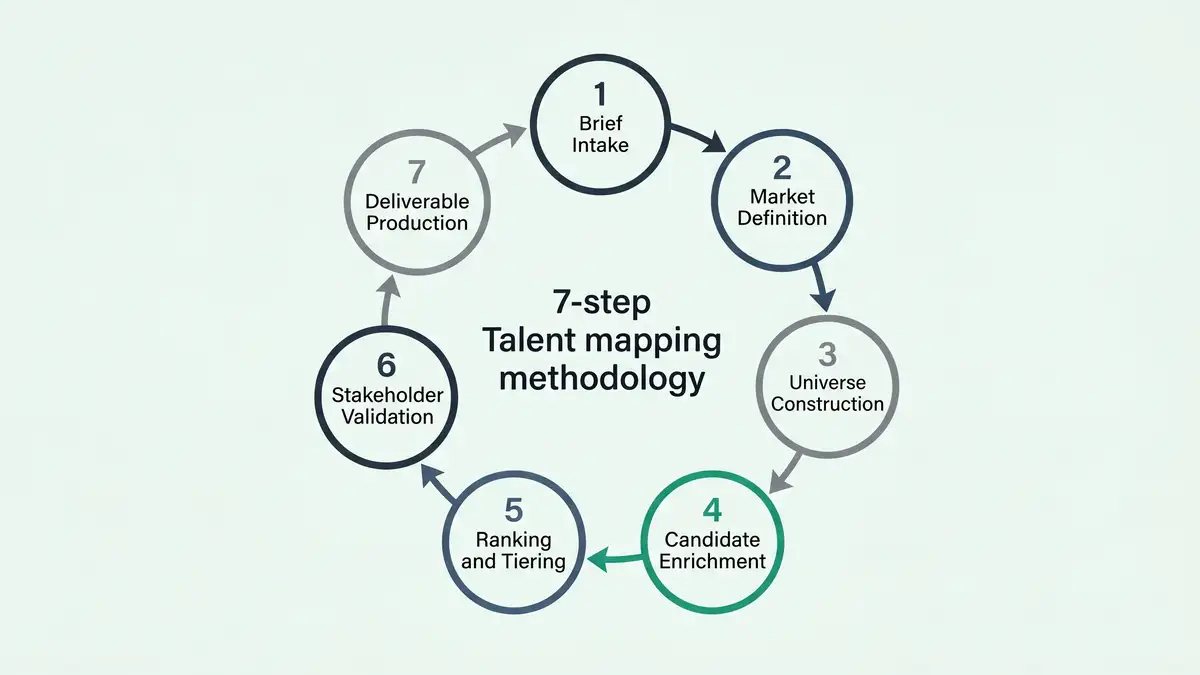
Brief intake and scope definition
Structured intake with the client sponsor: business context, mandate profile or strategic question, segment boundaries (sector, function, geography), candidate universe ambition, deliverable format, engagement timeline. The intake document is the contract; ambiguity here propagates downstream.
Market definition and universe boundary
Define exactly which companies, regions, functions, and seniority bands constitute the target universe. Per Recruitics' talent mapping framework, narrow universe definition is the discipline that distinguishes elite mapping from generic sourcing. A poorly bounded universe produces a 5,000-name spreadsheet that no client can act on.
Universe construction from primary and secondary sources
Combine multiple data sources: LinkedIn Recruiter, SeekOut, HireEZ, Loxo, BoardEx, internal firm CRM, sector-specific communities. Avoid single-source dependence. The universe candidate list at this stage is comprehensive but unranked.
Candidate enrichment and profile depth
For each universe entry, build the structured profile: career trajectory, current role and tenure, compensation band where available, board affiliations, key transitions, notable achievements, off-limits status. Per Fullcast's data hygiene and enrichment guidance, enrichment depth is the variable that separates a usable map from a contact list.
Ranking and tier classification
Tier the universe into three to four bands: Tier 1 (immediate-fit, engaged or warm), Tier 2 (qualified, requires warming), Tier 3 (developmental, longer horizon), Tier 4 (excluded for off-limits or fit mismatch). Tiering is the analytical step that converts data into client decision support.
Stakeholder validation and warm-source verification
Validate tiering and key profiles through off-list reference conversations with industry insiders, board members, former colleagues. The validation step protects against profile drift, surfaces hidden candidates, and builds the relationship currency that compounds across future mandates.
Deliverable production and client briefing
Produce the visual deliverable: heatmap, sector matrix, succession ladder, diversity gap analysis. Brief the client with strategic context, not just candidate lists. The deliverable briefing is where the talent map converts into BD outcome and repeat engagement.
Data Sources for Talent Mapping Strategy in 2026
The 2026 talent mapping data stack combines licensed platforms, public web data, internal firm CRM, and off-list warm intelligence. Per Juicebox's analysis of HireEZ and adjacent platforms, the elite firms deploy a layered stack rather than a single-platform monolith.
| Data Source | Coverage Strength | Best Use in Mapping |
| LinkedIn Recruiter / Sales Navigator | Global executive coverage, current role data | Initial universe construction |
| SeekOut | AI search across multiple networks, diversity filters | Sector and diversity-lens mapping |
| HireEZ | Aggregated profiles, automated outreach | Universe construction at scale |
| Loxo | Talent intelligence layer, AI ranking | Tier classification |
| BoardEx | Board affiliations, executive network mapping | Succession-readiness mapping |
| Internal Firm CRM | Proprietary relationship history, off-limits | Enrichment and validation |
| Off-list Warm Sources | Hidden candidates, validated context | Stakeholder validation |
Sources: Juicebox HireEZ review, Stanton Chase AI in recruitment, Bullhorn GRID 2026 industry trends
Need help architecting your firm's talent mapping operating system?
Book a Growth Mapping CallAI Augmentation in Talent Mapping Strategy 2026
AI augmentation has reshaped what is possible in talent mapping, but it has not replaced the strategic discipline. Per Bullhorn's GRID 2026 industry trends report, top-performing recruitment firms in 2026 are 3.5 to 4.5 times more likely to have grown revenue when they deploy AI capability inside mature operating processes, while firms that bolt AI onto undisciplined processes report no meaningful gains.

What AI augments well in 2026: universe construction at scale (HireEZ AI agentic sourcing, SeekOut AI search, Loxo AI ranking), profile summarisation from unstructured data (career trajectory synthesis, transition pattern extraction), preliminary tier scoring against client briefing parameters, talent flow forecasting based on industry-to-industry mobility patterns. Per Stanton Chase's AI in recruitment study, AI shifts the researcher's role from data assembly to strategic interpretation.
What AI does not augment well in 2026: stakeholder validation through warm sources, judgment calls on cultural fit, sensitive off-list reference conversations, ethics-laden decisions about diversity-lens mapping. Per MIT Sloan's analysis of AI in hiring, AI ranking models can amplify historical biases unless paired with human governance and structured oversight.
The elite boutique firm in 2026 deploys AI inside a deliberate human-AI workflow: AI builds the universe and surfaces patterns, humans validate, rank, and interpret. The firm that delegates the entire mapping discipline to AI without governance produces fast deliverables that erode client trust over 18 months. The firm that refuses AI augmentation produces slow deliverables that competitors out-execute by 2-3x. peppereffect's broader guidance on AI for executive search details how to architect this human-AI operating layer specifically for boutique search.
Talent Mapping Engagement Economics for Boutique Firms
Talent mapping productizes the firm's intellectual capital into a defined fee stream that sits separately from contingent or retained search fees. Per JM Search's recognition among the top 20 retained executive recruiting firms and patterns observed across the practitioner landscape, three fee models dominate the 2026 market.
Project-based mapping ($25k to $150k). Discrete sector, function, or geography mapping with defined scope, universe size, and deliverable format. Best for new client acquisition or strategic one-off engagements. Typical engagement: 4 to 12 weeks with 50 to 500 candidates mapped.
Retainer-bundled mapping ($10k to $30k per mandate). Mapping deliverable bundled with a retained search mandate as the discovery-phase asset. Best for premium-positioning firms that justify higher search fees through mapping inclusion. Typical engagement: 4 to 6 weeks bundled into the broader 12 to 16 week search.
Continuous mapping subscription ($75k to $200k annual). Embedded talent mapping practice with quarterly refresh, client-portal access, and on-demand briefings. Best for serial-acquirer PE firms, Fortune 500 talent functions, and corporate development teams. Typical engagement: 12-month minimum commitment with quarterly deliverable cadence.
Per Millman Search's CEO succession planning framework, the highest-margin model is the continuous subscription because it converts the firm's research capacity into compounding recurring revenue rather than project-by-project intensity. peppereffect's broader analysis of executive search pricing models details how mapping fees stack with retained, contingent, and hybrid fee architectures.

The 5 Market-Intelligence Outputs from Talent Mapping
Beyond the candidate universe itself, every talent mapping engagement should produce five market-intelligence outputs that compound the deliverable's strategic value to the client. Per Russell Reynolds' Global Leadership Monitor, these five outputs are what convert a mapping engagement into a board-level advisory relationship.
Salary and compensation benchmarks. Tier-1 candidate compensation ranges, equity expectations, and total package structures. The benchmark protects the client from offering below-market or overpaying.
Succession-readiness assessment. For internal candidates the client may consider, an honest assessment of readiness gap, development timeline, and likely external alternatives. Per Millman Search, succession-readiness clarity is the highest-value output for board sponsors.
Diversity gap analysis. The mapped universe broken down across demographic, experience, and cognitive diversity dimensions, with explicit identification of gaps and structural barriers. peppereffect's diversity executive search methodology details the slate frameworks that turn diversity gap analysis into placement outcomes.
Competitor org-chart mapping. How competitor leadership teams are structured, where the senior bench depth sits, and which functional roles are most vulnerable to poaching. Strategic intelligence for both client acquisition planning and defensive talent strategy.
Talent flow patterns. Where executives in the mapped universe came from (industry, function, geography) and where they tend to go next. This pattern-level intelligence informs the client's longer-term workforce planning beyond the immediate hiring decision.

8 Talent Mapping Strategy Execution Pitfalls
The eight failure modes below derail boutique talent mapping engagements repeatedly. Each is preventable with disciplined methodology and clear governance. Per Bryq's analysis of common talent mapping pitfalls, the firms that institutionalise these prevention disciplines win disproportionately at the BD layer.
1. Universe definition too broad
A 5,000-name spreadsheet is not a talent map. It is a research dump. Narrow universe definition with explicit segment boundaries is the discipline that distinguishes a strategic mapping from a contact list. Reject project briefs that resist scope narrowing.
2. Single-source data dependence
LinkedIn alone produces a partial universe biased toward platform-active executives. Elite mapping combines LinkedIn, SeekOut, HireEZ, BoardEx, internal CRM, and warm-source intelligence. Single-source dependence produces blind spots that competitors will exploit.
3. No candidate enrichment beyond profile basics
Name, current title, and current employer is not a profile. Per Fullcast's data hygiene research, elite enrichment includes career trajectory, transition patterns, board affiliations, compensation context, and off-limits status. Thin profiles produce thin client value.
4. No ranking discipline
An unranked universe is a candidate dump masquerading as a deliverable. Tier classification (Tier 1 to 4) with explicit criteria converts the universe into decision support. Resist the temptation to deliver flat lists.
5. Stale data at deliverable
Profiles built in week 1 and delivered in week 12 lose accuracy. Bake refresh discipline into the methodology: profile updates within 14 days of delivery, current-role verification, recent-transition flagging. Stale data erodes client trust permanently.
6. GDPR and data privacy compliance gaps
EU candidate data triggers GDPR obligations. US states (CCPA and successors) impose parallel constraints. Per Phenom's GDPR compliance documentation, talent mapping practices must encode lawful basis, retention limits, and data subject access provisions. Compliance gaps create regulatory and reputational exposure.
7. No client validation loops mid-engagement
Delivering the final map at week 12 without mid-engagement client check-ins guarantees scope drift. Build two structured check-ins (week 3 and week 8) into every engagement: universe review, tiering criteria validation, deliverable format confirmation. Mid-engagement validation prevents the rework that destroys margin.
8. Weak deliverable visualization
A spreadsheet attached to an email is not a deliverable that justifies a $75k fee. Invest in heatmap, matrix, and ladder visualizations that convert data into board-room narrative. Deliverable production is the moment the engagement either compounds into repeat business or terminates.
The 7-Step Playbook for Boutique Firms Launching a Talent Mapping Practice
The seven-step playbook below architects the boutique firm's transition from ad-hoc research to productized talent mapping practice. Per RecruiterFlow's practitioner guidance for recruiters and the operational patterns observed across elite boutique firms, this playbook compresses the productization timeline from typical 18-24 months to 6-9 months.
Define a repeatable scope template
Document the firm's standard mapping scope: universe size, deliverable format, engagement duration, validation rhythm. The scope template prevents bespoke negotiation on every engagement and protects margin.
Build the tooling stack
Combine LinkedIn Recruiter, one AI sourcing platform (SeekOut, HireEZ, or Loxo), BoardEx for board mapping, internal CRM as enrichment layer. Avoid single-vendor monoliths. peppereffect's analysis of candidate sourcing tools details the comparative landscape.
Hire dedicated researcher capability
Mapping cannot be the consultant's side activity. Elite boutiques run mapping as a dedicated function with 1-2 researchers per 5-8 consultants. The researcher capability is the multiplier that converts mapping from intensive labor into productized output.
Productize the fee structure
Three tiers: project ($25k-$150k), retainer-bundled ($10k-$30k per mandate), continuous subscription ($75k-$200k annual). Publish fee bands. Pricing transparency accelerates BD conversations.
Develop deliverable templates
Invest in 6 reusable deliverable templates (one per format). Templates compress production time per engagement by 40 to 60 percent and ensure deliverable consistency across consultants. Branding discipline matters as much as content depth.
Train consultants on BD positioning
Mapping is a sales asset. Every consultant must be trained on how to position the firm's mapping practice in BD conversations, when to lead with a mapping offer, and how to convert mapping engagement into broader retained mandate. This is the conversion mechanism that pays for the practice.
Measure outcomes with the 8 mapping KPIs
Universe coverage, enrichment depth, validated Tier 1 rate, deliverable turnaround time, client mandate conversion rate, repeat engagement rate, succession-readiness clarity score, decision-acceleration rate. peppereffect's executive search KPI framework integrates mapping KPIs into the broader firm dashboard.
Architect Your Boutique Firm's Talent Mapping Operating System With peppereffect
peppereffect installs the AI-augmented talent mapping operating system that decouples your firm's growth from individual consultant capacity. We architect mapping methodology, productize fee structures, build the tooling stack, and engineer the BD conversion discipline that converts every mapping engagement into compounding mandate revenue.
Book a Growth Mapping CallFrequently Asked Questions About Talent Mapping Strategy
What is talent mapping strategy in executive search?
Talent mapping strategy is the systematic identification, profiling, and ranking of the universe of executive talent within a defined market segment (sector, function, geography, or competitor org chart). Per KiTalent's talent mapping definition, the discipline produces a strategic view of the executive talent landscape rather than a reactive applicant pool. For elite boutique executive search firms, talent mapping is both a mandate fulfillment asset and a business development authority artifact that justifies retainer fees and wins competitive pitches.
How long does a talent mapping engagement take?
A talent mapping engagement typically takes 4 to 12 weeks depending on scope. Function-specific mappings of 50 to 150 candidates run 4 to 6 weeks. Sector heatmaps of 200 to 500 candidates run 8 to 12 weeks. Continuous mapping subscriptions deliver quarterly refresh cycles over a 12-month engagement. Per Alcor's talent mapping framework, the duration depends on universe size, enrichment depth, and validation rhythm rather than calendar pressure.
How much does talent mapping cost in 2026?
Talent mapping fees in 2026 cluster into three tiers: project-based engagements run $25k to $150k depending on universe size and deliverable scope; retainer-bundled mapping adds $10k to $30k per mandate as a discovery-phase asset; continuous mapping subscriptions run $75k to $200k annually with quarterly refresh cadence. Fees vary by sector complexity, geographic scope, and deliverable depth. Per industry pricing patterns observed across Spencer Stuart's PE portfolio talent guidance, the highest-margin model is continuous subscription because it converts research capacity into recurring revenue.
What is the difference between talent mapping and talent acquisition?
Talent acquisition is the transactional discipline of hiring candidates against an open requisition: post the role, receive applications, advance candidates, close the requisition. Talent mapping is the strategic discipline of identifying and profiling the executive universe in a defined market segment before a mandate exists. Talent mapping informs talent acquisition by surfacing qualified candidates with relationship context. Per Savannah Group's talent intelligence framework, the elite firms productize mapping separately from acquisition and command separate fees.
What are the deliverables of a talent mapping engagement?
Talent mapping engagements produce six deliverable formats: sector heatmap (200-500 candidates), function-specific mapping (CFO, CHRO, CTO universe), geography mapping (regional executive availability), succession-readiness mapping (internal succession candidates), diversity-lens mapping (qualified diverse candidates), and competitor org-chart mapping (competitor leadership structures). Beyond the candidate universe, elite engagements also produce five market-intelligence outputs: salary benchmarks, succession-readiness assessment, diversity gap analysis, competitor org-chart mapping, and talent flow patterns.
How does AI augment talent mapping strategy in 2026?
AI augments talent mapping strategy across universe construction at scale (HireEZ AI agentic sourcing, SeekOut AI search, Loxo AI ranking), profile summarisation from unstructured data, preliminary tier scoring against client briefing parameters, and talent flow forecasting. Per Bullhorn's GRID 2026 industry trends report, top-performing firms deploying AI are 3.5 to 4.5x more likely to have grown revenue. AI does not replace stakeholder validation, cultural fit judgment, or sensitive off-list reference conversations, which remain human-led activities critical to engagement quality.
What are common talent mapping strategy execution pitfalls?
The 8 most common execution pitfalls are: 1) universe definition too broad produces unactionable contact lists; 2) single-source data dependence creates blind spots; 3) thin candidate enrichment beyond profile basics; 4) no ranking discipline produces flat lists; 5) stale data at deliverable erodes client trust; 6) GDPR and data privacy compliance gaps; 7) no client validation loops mid-engagement causes scope drift; 8) weak deliverable visualization undermines the engagement's strategic value. Per Bryq's talent mapping best practices, firms that institutionalise prevention disciplines win disproportionately at the BD layer. employer brand and EVP discovery
Resources
- KiTalent: Talent Mapping Services for Executive Hiring
- Savannah Group: Common Applications of Talent Intelligence
- Korn Ferry: An Introductory Guide to Talent Assessment
- Russell Reynolds Associates: Building a Talent Function That Is Fit For The Future
- Russell Reynolds Associates: Global Leadership Monitor
- RecruiterFlow: Talent Mapping for Recruiters
- Alcor: Talent Mapping in Recruitment Methodology
- Bryq: Talent Mapping Strategies and Best Practices
- Intellerati: Executive Search Research and Talent Mapping
- Robert Walters: Market Intelligence and Talent Market Mapping
- Spencer Stuart: Building Your PE Portfolio Talent Function
- Millman Search: CEO Succession Planning
- Recruitics: Talent Mapping to Source Quality Candidates
- Juicebox: HireEZ Review
- Stanton Chase: AI in Recruitment Study
- MIT Sloan: AI Reinventing Hiring and Avoiding Bias Traps
- Bullhorn: GRID 2026 Industry Trends Report
- JM Search: Top 20 Retained Executive Recruiting Firms
- Fullcast: Data Hygiene and Enrichment
- Phenom: GDPR Compliance Documentation
- Heidrick & Struggles: How Boards Find AI Expertise
- Egon Zehnder: Reinventing Talent Management for a New Era