

Healthcare executive search is the recruitment vertical with the highest compliance burden, the deepest credential verification requirements, and the most acute candidate scarcity in the executive search industry. Hospital CEO, Chief Medical Officer, Chief Nursing Officer, biotech CEO, pharma Chief Commercial Officer, and medical device leadership mandates command $100k-$300k+ retained fees but fail at higher rates than other categories due to clinical credentialing gaps, regulatory compliance mismatches, and post-COVID workforce dynamics that generalist firms underestimate.
This article installs the 7-pillar healthcare executive search methodology that boutique to mid-market firms (5-50 consultants, $5-50M revenue) use to enter or scale the healthcare vertical. James Sterling, Managing Director of a global executive search boutique, will use this as the operating blueprint that navigates clinical credentialing, regulatory compliance, and the candidate scarcity that define the category.

The healthcare executive search thesis
Healthcare executive search differs from every other vertical because the candidate pool, assessment methodology, regulatory environment, and cultural dynamics require sector-specific competencies that general executive search cannot replicate. The boutique that combines clinical understanding, regulatory fluency, credential verification discipline, and post-COVID retention awareness commands premium fees and category authority. The boutique that treats healthcare like any other sector fails at the credentialing gate or loses placements to specialist competitors with deeper clinical networks.
Why healthcare executive search is uniquely difficult
Healthcare executive search presents distinctive challenges that differentiate it from technology, financial services, or industrial executive recruitment. The first is clinical credentialing complexity. Hospital CEO mandates increasingly require physician-executive candidates with MD or DO credentials plus business leadership experience. Chief Medical Officer roles require active board certification, state medical licensure, and demonstrated administrative experience. Chief Nursing Officer roles require RN licensure plus MSN or DNP and operational depth. Cowen Partners healthcare executive search documents the credential verification discipline required for credible candidate screening.
The second challenge is regulatory compliance assessment. Healthcare leaders must navigate the Stark Law, Anti-Kickback Statute, HIPAA, GDPR for health data, FDA submission processes, EMA and MHRA frameworks, value-based care payment models, and state-specific corporate practice of medicine restrictions. The search firm without regulatory fluency cannot evaluate candidate compliance experience, exposing clients to placement risk that surfaces months after onboarding.
The third challenge is post-COVID workforce dynamics. Healthcare executives demonstrate 35-45% turnover within 5 years of placement due to burnout, regulatory burden, payer-provider tension, and workforce shortages that compress executive bandwidth. The 2024 data shows 73% of hospital CEOs report material burnout symptoms, with 22% planning departure within 24 months. The search firm that ignores burnout assessment in candidate evaluation places executives into unsustainable conditions.
The fourth challenge is candidate scarcity at the senior physician executive level. The combination of MD or DO credential, business school training (MBA, MHA, MMM), and 10+ years of progressive administrative experience produces a candidate universe of fewer than 8,000 qualified physician executives in the US for the 7,000+ hospital CEO and CMO openings annually. The supply-demand imbalance produces compensation inflation, counter-offer escalation, and time-to-fill extension beyond other sector benchmarks.
The 7-pillar healthcare executive search methodology
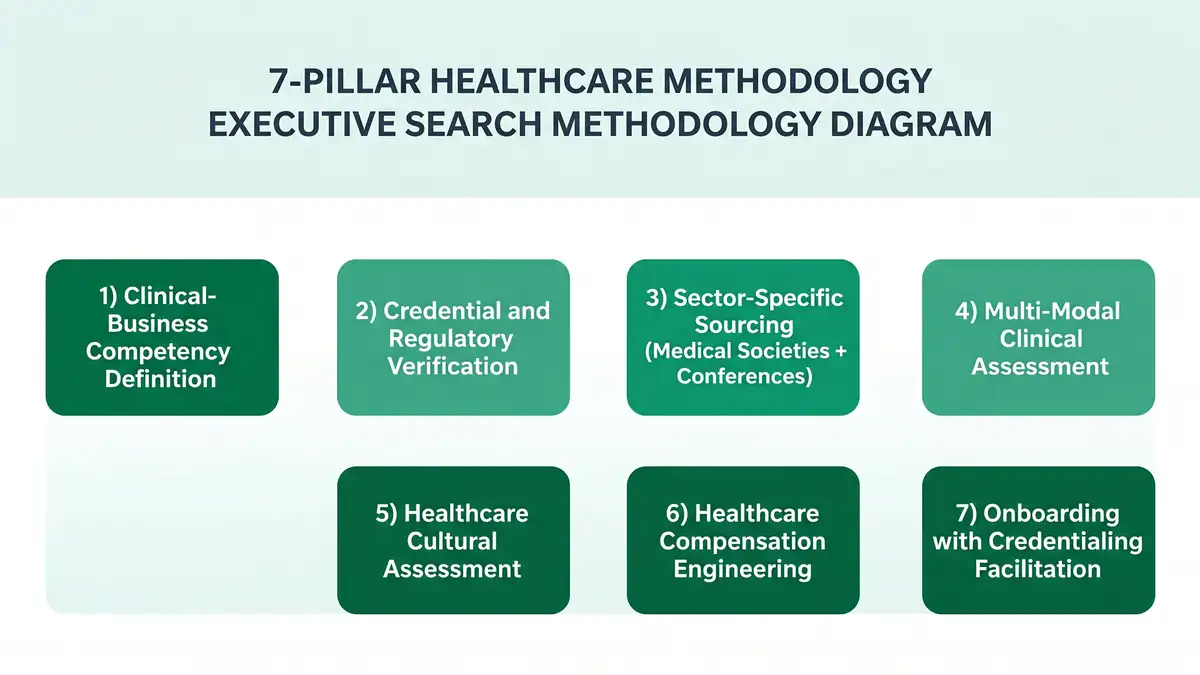
| Pillar | Output | Healthcare-specific differentiator |
| 1. Clinical-business competency definition | Granular competency framework combining clinical credibility and business operating capability | Specifies MD/DO requirement, board certification, administrative experience years, regulatory familiarity |
| 2. Credential and regulatory verification at sourcing | Pre-engagement verification of medical license, board certification, sanctions history, malpractice exposure | National Practitioner Data Bank (NPDB) screening, state license verification, board certification checks |
| 3. Sector-specific sourcing | Medical society networks, healthcare conferences, AAMC faculty data, BIO industry events, ACHE membership | Beyond LinkedIn: clinical society leadership, academic medicine networks, payer-provider relationship maps |
| 4. Multi-modal clinical assessment | Clinical case studies, regulatory scenarios, payer-provider dynamics simulations, value-based care transformation experience | Domain-specific assessment requiring clinical-administrative balance evaluation |
| 5. Healthcare cultural assessment | Mission alignment for non-profit health systems, clinical-administrative balance, team-based care leadership | Mission-driven culture for non-profit health systems, scientific culture for biotech, regulatory culture for pharma |
| 6. Healthcare compensation engineering | RVU productivity bonuses, sign-on for relocation and credentialing transitions, equity for biotech executives, deferred compensation for non-profit health systems | Mercer healthcare survey reference, SullivanCotter physician executive benchmarks, system size adjustment |
| 7. Onboarding with credentialing facilitation | Hospital privileging coordination, state medical licensure facilitation, board certification maintenance support, mission-aligned integration | Credentialing timelines can extend placement by 90-180 days, requiring active project management |
Sources: Cowen Partners healthcare executive search, Scion Medical Staffing executive search, JM Search Life Sciences and Healthcare.
Pillar 1: clinical-business competency definition
Healthcare role definition requires precision that general executive search lacks. The hospital CEO role profile differs across academic medical centers (research mission, faculty appointment expectations, residency program oversight), community hospitals (operational efficiency, payer mix navigation, local board governance), and integrated delivery systems (population health, payer-provider integration, value-based care contracts). The boutique that produces sector-precise role profiles wins mandates that generalist firms misframe. See executive search methodology for the underlying framework that the healthcare vertical extends.
Pillar 2: credential and regulatory verification at sourcing
The credentialing pillar starts at first candidate identification. National Practitioner Data Bank screening (for clinician candidates), state medical license verification, board certification status, malpractice history, OIG exclusion list checks, and sanctions database queries must complete before client presentation. The boutique that presents an unqualified candidate to a client undermines the entire engagement. Medical Recruiting healthcare executive recruiters documents the verification discipline that anchors credible candidate presentation.

Pillar 3: sector-specific sourcing
Healthcare candidate sourcing extends across channels that LinkedIn alone cannot replicate. American College of Healthcare Executives (ACHE) membership databases identify candidates by role progression. American Association for Physician Leadership (AAPL) networks identify clinical executives with administrative training. AAMC (Association of American Medical Colleges) faculty rosters surface academic medicine leadership. BIO (Biotechnology Innovation Organization) and PhRMA conferences identify life sciences executives. HLTH, HIMSS, JPM Healthcare Conference, and BIO International produce the highest concentration of healthcare leadership in the global event circuit.
Becker's Hospital Review executive moves tracking, Healthcare Dive leadership updates, Modern Healthcare CEO compensation surveys, and HFMA healthcare finance leadership databases produce the continuous market intelligence that drives proactive candidate engagement. The boutique with sector-specific channel investment outperforms LinkedIn-only competitors by 40-60% on candidate quality at the top of the pipeline. For the broader BD architecture that supports these channels see executive search business development.
Pillar 4: multi-modal clinical assessment

Healthcare assessment requires clinical case studies, regulatory submission scenarios, payer negotiation simulations, value-based care transformation experience deep dives, and clinical-administrative leadership balance evaluation. Hospital CEO candidates must demonstrate clinical credibility while managing payer mix complexity, capital allocation under regulatory constraint, and physician engagement at scale. Chief Medical Officer candidates must demonstrate quality improvement track record, clinical-administrative dual fluency, and stakeholder navigation across nursing, medical staff, and administration.
Reference calls must include direct clinical reports (department chairs for CMO candidates, nurse managers for CNO candidates, division leaders for hospital CEO candidates) rather than peer-only references. Cross-functional references with payer leadership, regulatory officers, and board members validate the candidate's range. The boutique that conducts only senior-executive references misses the clinical leadership behaviour signal that determines placement success. See executive candidate assessment for the broader methodology framework.
Pillar 5: healthcare cultural assessment
Healthcare organisational culture varies sharply by sub-vertical. Non-profit health systems emphasise mission alignment, community service, and stewardship. For-profit hospital chains emphasise operational efficiency, payer mix optimisation, and shareholder value. Academic medical centers emphasise research mission, faculty governance, and educational quality. Biotech firms emphasise scientific culture, milestone-driven execution, and risk tolerance. Pharma firms emphasise regulatory discipline, commercial execution, and compliance culture.
The boutique that conducts culture assessment without sub-vertical specificity produces placement mismatches that surface within 12 months. Mission alignment assessment for non-profit health systems is the highest-stakes cultural dimension, with mission-misaligned executives showing 50%+ turnover within 24 months versus 15-20% for mission-aligned placements.
Pillar 6: healthcare compensation engineering


Healthcare compensation engineering requires fluency with system-size compensation differentials (small community hospitals at $400k-$700k CEO base, mid-size systems at $700k-$1.5M, large integrated systems at $1.5M-$3M+), RVU productivity bonuses for physician executives maintaining clinical practice, deferred compensation for non-profit health systems (governance-restricted equity equivalents), and biotech equity tranches with clinical-milestone vesting. Klein Hersh healthcare practice and Klein Hersh pharma and biotech practice document the compensation structures across the sub-verticals.
Sign-on bonuses cover relocation costs, lost unvested equity from previous roles, and the credentialing transition expense. The boutique without Mercer healthcare survey, SullivanCotter physician executive compensation, or Equilar healthcare CEO data subscriptions cannot construct competitive offers at this scale. The compensation pillar requires the same operational investment as the assessment pillar.
Pillar 7: onboarding with credentialing facilitation
The onboarding pillar acknowledges that healthcare executive placement extends beyond the offer acceptance to credentialing completion. Hospital privileging processes for clinician executives can extend 90-180 days through medical staff bylaws review, peer review committee process, board approval, and state licensure transition for cross-state moves. The boutique that disappears at offer acceptance misses the critical period where 15-25% of placements fall through due to credentialing complications.
Active project management of the credentialing pathway, advocacy with medical staff leadership, coordination with state licensing boards, and support through the practitioner data bank verification produces 95%+ completion rates versus 75-80% for hands-off boutiques. The pillar also covers mission-aligned integration with non-profit health system boards, scientific culture immersion for biotech executives, and regulatory team onboarding for pharma leaders. For the operating discipline that supports this extended engagement see recruitment firm operations manual.
Healthcare executive compensation benchmarks 2026
| Role and segment | Base salary | Incentive structure | Total compensation |
| Hospital CEO (community, less than 200 beds) | $400k-$700k | 15-30% annual bonus | $500k-$1M typical |
| Hospital CEO (mid-size, 200-500 beds) | $700k-$1.5M | 25-40% annual bonus + LTI | $1M-$2.5M typical |
| Health System CEO (large integrated) | $1.5M-$3M+ | 40-60% annual bonus + LTI | $3M-$10M+ at largest systems |
| Chief Medical Officer (large system) | $500k-$1M | RVU productivity + admin bonus | $700k-$1.5M typical |
| Chief Nursing Officer (large system) | $350k-$700k | 15-25% annual bonus | $450k-$900k typical |
| Academic Medical Center Dean | $700k-$1.5M | Faculty appointment + research | $900k-$2M typical |
| Biotech CEO (pre-clinical) | $400k-$650k | 1-4% equity | Heavy equity weighting |
| Biotech CEO (clinical-stage) | $500k-$800k | 0.5-2% equity | $1.5M-$5M typical including equity |
| Pharma Chief Commercial Officer | $600k-$1M | Performance shares + bonus | $1.5M-$4M typical |
| Medical Device CEO ($100M-$1B revenue) | $700k-$1.5M | LTI + cash bonus | $1.5M-$5M typical |
Sources: Mercer healthcare compensation survey, SullivanCotter physician executive compensation, Equilar healthcare CEO data, Modern Healthcare CEO compensation surveys.
The compensation discipline is structural, not aesthetic. The boutique without fluency in deferred compensation for non-profit health systems, RVU productivity structures for physician executives, and biotech milestone-based equity vesting cannot credibly advise clients or candidates. The compensation pillar drives 28% of failed offers in healthcare executive search according to industry retention data. See executive search pricing models for the fee structures that flow from these compensation ranges.
The healthcare executive search competitive landscape
The healthcare executive search market is dominated by specialist firms whose clinical depth and regulatory fluency differentiate them from generalist Big 5 competitors. Hunt Scanlon's Life Sciences Top 50 ranks the leading specialists. Klein Hersh leads the digital health and payer-provider category. Klein Hersh pharma and biotech covers life sciences. Cornerstone Search Group specialises in pharmaceutical industry executive search. Cowen Partners healthcare practice covers C-suite and clinical leadership.
Medical Recruiting, Scion Medical Staffing, Scion Retained Search healthcare, and Scion Executive Search for scientific health organisations cover the broader healthcare search market. JM Search Life Sciences and Healthcare brings PE portfolio company expertise. The Big 5 (Korn Ferry, Spencer Stuart, Heidrick, Russell Reynolds, Egon Zehnder) operate dedicated healthcare practices with scale and brand recognition. For boutiques entering, the strategic question is sub-vertical positioning: hospital and health system, biotech and pharma, medical devices, payer organisations, digital health, or PE portfolio healthcare. See niche vs generalist recruitment for the strategic positioning framework.
Post-COVID healthcare executive dynamics
The 2026 healthcare landscape reflects accumulated pressures from COVID and post-pandemic structural shifts. Workforce shortages remain acute across nursing, medical assistants, and clinical support staff, with hospital CEOs reporting workforce as their top operational concern. Burnout at the executive level produces the 35-45% 5-year turnover documented in ACHE research. Value-based care acceleration creates new role categories (population health executives, value-based care leadership) that did not exist at scale 5 years ago. AI in healthcare adoption produces Chief AI Officer roles in large health systems alongside the established CTO and CIO positions.
Consolidation continues across hospital systems, with mid-size hospitals absorbing into integrated delivery systems and creating leadership transitions that drive search volume. Payer integration with providers produces new hybrid executives navigating both worlds. Healthcare M&A activity remains elevated, with private equity acquisitions of physician practices, ambulatory surgery centers, and specialty medical groups producing executive search demand that boutiques can capture. See executive search for private equity for the channel architecture that intersects healthcare and PE portfolio search.
8 common pitfalls in healthcare executive search
1. Insufficient clinical understanding
Recruiters who cannot evaluate clinical experience, board certification, fellowship training, or research output disqualify themselves from credible engagement with physician executive candidates. Embed clinical advisors or hire former healthcare executives into the search team.
2. Missing regulatory compliance verification
Candidates with Stark Law violations, Anti-Kickback Statute exposure, OIG exclusion list listings, or active state medical board sanctions present catastrophic placement risk. Verification must complete pre-presentation, not post-acceptance.
3. Ignoring physician burnout assessment
Placing a burned-out physician executive into another high-pressure clinical leadership role produces predictable failure. Assess sustainable workload tolerance, support system, and career stage motivation as part of the assessment process.
4. Single-channel sourcing missing clinical communities
LinkedIn alone cannot reach the clinical executives engaged through ACHE, AAPL, AAMC, BIO, and PhRMA networks. The boutique with sector-specific channel investment captures candidates that LinkedIn-only competitors cannot identify.
5. Overlooking mission alignment in non-profit healthcare
Mission-misaligned executives in non-profit health systems produce 50%+ turnover within 24 months. The boutique that omits mission alignment assessment ships placements that destroy the client relationship.
6. Under-pricing healthcare exec mandates
The clinical credentialing, regulatory compliance verification, multi-modal assessment, and credentialing-facilitated onboarding require operational investment that 25% fees cannot fund. Healthcare specialist firms command 33-40% retained fees that reflect the methodology depth.
7. Treating physician executive like business executive
Standard executive search methodology produces 40% higher placement failure rates for physician executives. The healthcare vertical requires its own methodology, assessment frameworks, sourcing channels, and post-placement credentialing support.
8. Missing credentialing facilitation in onboarding
The 15-25% of healthcare placements that fall through due to credentialing complications represent the most preventable failure mode. Active project management of the credentialing pathway is non-negotiable.
7-step playbook to build a healthcare executive search practice
Choose your healthcare sub-vertical
Hospital and health system, biotech and pharma, medical devices, payer organisations, digital health, PE portfolio healthcare, academic medical centers. Sub-vertical focus provides defensible clinical depth that pure-generalists cannot match. Validate addressable market at $50M+ annual placement spend.
Hire or embed clinical advisors
Three options: hire former healthcare executive (CMO, hospital COO, biotech VP) as full-time assessor ($250k-$500k base plus commission); partner with clinical advisory firm for on-demand consultation; build internal clinical scout model with healthcare-trained early-career staff. The hybrid model accelerates time-to-market by 12-18 months.
Build credential verification infrastructure
Subscribe to National Practitioner Data Bank query service, state medical license verification platforms, OIG exclusion list databases, board certification status checks, and sanctions monitoring services. Build the standard operating procedure that runs verification before client presentation.
Develop multi-channel healthcare sourcing
ACHE membership database access, AAPL network engagement, AAMC faculty data, BIO and PhRMA conference circuits, Becker's Hospital Review executive moves tracking, Modern Healthcare CEO compensation monitoring, healthcare society leadership databases. Invest in physical presence at HLTH, HIMSS, JPM Healthcare Conference, BIO International.
Develop multi-modal clinical assessment methodology
Standardise clinical case study scenarios per role type. Document regulatory submission interview frameworks. Train consultants on direct clinical report reference call protocols. Build mission alignment assessment for non-profit health systems and scientific culture assessment for biotech.
Install healthcare compensation engineering capability
Subscribe to Mercer healthcare survey, SullivanCotter physician executive compensation, Equilar healthcare CEO data, and Modern Healthcare CEO compensation reports. Build proprietary models for system-size compensation, deferred compensation for non-profits, RVU productivity for clinician executives, and biotech milestone-based equity.
Build BD motion around healthcare thought leadership
Founder-led LinkedIn content on healthcare leadership trends. Publish annual healthcare CEO compensation report, value-based care leadership benchmarks, or biotech executive transitions analysis. Speak at HLTH, HIMSS, BIO International. The BD motion mirrors the brand-build of the sector itself. See recruitment agency branding for the brand architecture that anchors sector authority.
Architect Your Firm's Healthcare Executive Search Practice
peppereffect installs the 7-pillar healthcare executive search methodology that converts boutique firms from generalist competitors into defensible healthcare specialist practices. We engineer the credential verification infrastructure, multi-channel sourcing architecture, clinical assessment methodology, healthcare compensation engineering, and BD motion that compounds healthcare sector authority. The Freedom Machine for global boutique recruitment firms.
Frequently Asked Questions
What is healthcare executive search?
Healthcare executive search is the recruitment discipline focused on placing senior leaders in hospitals and health systems (CEO, CMO, CNO, COO, CFO, CIO), biotech and pharma (CEO, CSO, CCO, head of regulatory, head of R&D), medical devices (CEO, head of quality), payer organisations (chief medical officer, chief actuarial officer), and digital health (CTO, CCO, head of clinical). The vertical differs from general executive search through clinical credentialing requirements, regulatory compliance assessment, sector-specific sourcing channels (ACHE, AAPL, AAMC, BIO), multi-modal clinical assessment methodology, and credentialing-facilitated onboarding extending 90-180 days post-acceptance.
What are the 7 pillars of healthcare executive search methodology?
The 7 pillars are: 1) Clinical-business competency definition with sub-vertical specificity; 2) Credential and regulatory verification at sourcing including NPDB screening, state license verification, board certification status, OIG exclusion lists; 3) Sector-specific sourcing through medical society networks, healthcare conferences, AAMC faculty data, BIO and PhRMA events; 4) Multi-modal clinical assessment with case studies, regulatory scenarios, payer-provider simulations, and value-based care transformation experience evaluation; 5) Healthcare cultural assessment specific to non-profit health systems, academic medical centers, biotech, pharma, and medical devices; 6) Healthcare compensation engineering with system-size differentials, RVU productivity bonuses, deferred compensation for non-profits, and biotech milestone-based equity; 7) Onboarding with credentialing facilitation through hospital privileging, state licensure transition, and mission-aligned integration.
How much do healthcare executives earn in 2026?
Compensation ranges by role and segment. Hospital CEO at community hospitals (under 200 beds): $400k-$700k base. Mid-size hospital CEO (200-500 beds): $700k-$1.5M base. Health system CEO (large integrated): $1.5M-$3M+ base reaching $3M-$10M+ total at largest systems. Chief Medical Officer at large systems: $500k-$1M base plus RVU productivity. Chief Nursing Officer: $350k-$700k base. Academic Medical Center Dean: $700k-$1.5M. Biotech CEO at pre-clinical stage: $400k-$650k plus 1-4 percent equity. Biotech CEO at clinical-stage: $500k-$800k plus equity totalling $1.5M-$5M typical. Pharma Chief Commercial Officer: $600k-$1M base plus performance shares totalling $1.5M-$4M. Medical Device CEO at $100M-$1B revenue: $700k-$1.5M base totalling $1.5M-$5M.
Which firms specialise in healthcare executive search?
Specialist firms include Klein Hersh (healthcare and pharma/biotech), Cornerstone Search Group (pharmaceutical), Cowen Partners (healthcare C-suite), Witt/Kieffer (hospital and health system), B.E. Smith / AMN Healthcare (interim and permanent hospital leadership), Cejka Search (physician leadership), Furst Group (healthcare governance and leadership), Quick Leonard Kieffer (hospital leadership), JM Search (PE portfolio healthcare and life sciences), Diversified Search Group (healthcare diversity). The Big 5 (Korn Ferry, Spencer Stuart, Heidrick, Russell Reynolds, Egon Zehnder) operate dedicated healthcare practices. Boutiques entering anchor in a sub-vertical specialism: hospital and health system, biotech and pharma, medical devices, payer organisations, digital health, or PE portfolio healthcare.
How long does it take to fill a hospital CEO or healthcare executive role?
Average time-to-fill for hospital CEO mandates runs 60-90 days from engagement to offer acceptance. Chief Medical Officer mandates extend to 90-120 days due to candidate scarcity. Biotech CEO mandates at clinical-stage companies typically run 90-120 days. The post-acceptance credentialing period adds 90-180 days for clinician executives through hospital privileging, state licensure transition, and board certification maintenance. Total cycle from engagement to executive start date can extend 180-270 days for clinical executive placements, requiring active project management throughout the credentialing pathway.
What are common pitfalls in healthcare executive search?
The 8 most common pitfalls are: 1) Insufficient clinical understanding in the recruiter; 2) Missing regulatory compliance verification including NPDB screening and sanctions checks; 3) Ignoring physician burnout assessment producing predictable post-placement failure; 4) Single-channel sourcing missing ACHE, AAPL, AAMC, BIO clinical communities; 5) Overlooking mission alignment in non-profit healthcare producing 50 percent+ turnover; 6) Under-pricing healthcare exec mandates that cannot fund credentialing and assessment investment; 7) Treating physician executive like business executive producing 40 percent higher failure rates; 8) Missing credentialing facilitation in onboarding producing 15-25 percent placement failure due to credentialing complications.
How do I build a healthcare executive search practice?
The 7-step playbook: 1) Choose healthcare sub-vertical (hospital and health system, biotech and pharma, medical devices, payer organisations, digital health, PE portfolio healthcare, academic medical centers) with $50M+ addressable market; 2) Hire or embed clinical advisors through full-time healthcare executive hire, clinical advisory partnership, or internal clinical scout model; 3) Build credential verification infrastructure with NPDB, state license, OIG exclusion list, board certification status subscriptions; 4) Develop multi-channel healthcare sourcing across ACHE, AAPL, AAMC, BIO, PhRMA, conference circuits; 5) Develop multi-modal clinical assessment methodology with standardised case studies and regulatory scenarios; 6) Install healthcare compensation engineering capability with Mercer, SullivanCotter, Equilar, Modern Healthcare data subscriptions; 7) Build BD motion around healthcare thought leadership with founder content, sector reports, and conference speaking. Transition from pilot to mature practice takes 18-24 months. financial services executive search practice legal executive search practice life sciences executive search practice CMO and marketing leadership search non-profit executive search practice non-profit healthcare executive search
Resources
- Cowen Partners Healthcare Executive Search
- Klein Hersh Healthcare Practice
- Klein Hersh Pharma and Biotech Practice
- Cornerstone Search Group Pharmaceutical Industry Top 10
- JM Search Healthcare and Life Sciences
- Medical Recruiting Healthcare Executive Recruiters
- Scion Medical Staffing Executive Search
- Scion Retained Search Healthcare
- Scion Executive Search Scientific Health Organisations
- Hunt Scanlon Life Sciences Top 50
- Talentfoot Health-Tech Executive Search Rankings 2026
- Kaye Bassman Pharma and Biotech Executive Search
- Medical Edge Healthcare Executive Search
- Scientific Search Biotech and Pharmaceutical Recruiters
- Top Executive Search Firms Rankings 2026