

Non-profit executive search in 2026 operates against a backdrop that no other executive search vertical contends with simultaneously: 990 IRS disclosures making senior compensation public, mission alignment as the primary assessment dimension that boards now formally weigh, university president searches running 180-365 days due to faculty and alumni consultation requirements, foundation CEO compensation reaching $1.8M at Gates while community non-profits routinely apply 50-70% mission discounts versus corporate equivalents, and DEI accountability that non-profit boards now formally require. For boards, board chairs, search committees, and chief talent officers commissioning a foundation president search, university chancellor mandate, executive director hire, or international NGO country director appointment, the discipline now demands integrated mission alignment verification, 990 compensation engineering, board governance review, and fundraising track record assessment.
This article provides a systematic 7-pillar methodology for non-profit executive search, compensation benchmarks across large foundations, social services, higher education, healthcare non-profits, cultural institutions, and international NGOs, the 990 disclosure and mission alignment discipline that distinguishes specialist boutiques from generalist firms, the eight pitfalls producing 50%+ first-12-month departure rates, and a seven-step playbook for boutique recruiters building or sharpening a non-profit practice. Every benchmark cites a specific source. Executive search firm marketing grounded in this depth converts foundation and university board inquiries at materially higher rates than generalist positioning.
Key Takeaway
Non-profit executive search in 2026 is no longer a sourcing exercise. It is integrated mission alignment verification, 990 compensation engineering, board governance review, and fundraising track record assessment. Boutiques that treat non-profit like any other vertical produce 50%+ first-12-month departure rates versus 15-20% for specialists.
The 2026 Non-Profit Executive Search Landscape

Non-profit executive search operates within a sector characterized by mandatory transparency. The IRS Form 990 requires tax-exempt organizations to disclose senior executive compensation publicly, which means foundation CEO, university president, and large non-profit ED compensation is permanently in the public record. CharityWatch maintains an annual update of non-profit compensation packages of $1M or more, listing the top three compensation packages at each non-profit it rates (CharityWatch 2026 Update, March 2026). Candid's Nonprofit Compensation Report is now in its 23rd edition, based on observations from nearly 124,000 non-profits, providing the most comprehensive sector-wide compensation benchmark anchored entirely on IRS data (Candid Nonprofit Compensation Report Best Practices). The Council on Foundations' Grantmaker Salary and Benefits Survey, which opened March 3, 2026 and closes May 28, 2026, will publish the 2026 GSB Report, Board Compensation Tables, and Key Findings to anchor foundation-specific compensation benchmarking (Council on Foundations Grantmaker Salary and Benefits).
The competitive landscape is dominated by specialist boutiques. Hunt Scanlon Media's Non-Profit Top 75 Executive Search Firms annual roundup documents the 75 most prominent firms serving the non-profit sector (Hunt Scanlon Non-Profit Top 75, January 2026). DonorSearch's review of the top non-profit executive search firms includes Aly Sterling Philanthropy, Averill Fundraising Solutions, BRYANT GROUP, Ter Molen Watkins & Brandt, and other specialist boutiques (DonorSearch Top 7 Nonprofit Executive Search Firms, 2025). People Managing People's 2026 review of the 10 best non-profit recruiting firms provides additional competitive intelligence on specialty and pricing (People Managing People Best Nonprofit Recruiting Firms 2026, May 2026). Wings of Change Foundation's Executive Search Ranking places ThinkingAhead Executive Search at #1, followed by Campbell & Company, Isaacson Miller, Scion Staffing, Diversified Search Group, kpCompanies, and Axis (WOC FP Executive Search Ranking).
AGB Search dominates higher education president search specifically. AGB Search conducts searches exclusively for college and university presidents, chancellors, provosts, vice presidents, deans, and university system heads (Hunt Scanlon AGB Search University of Montana, February 2026). The AGB Presidential Search guidance explains the Board Professional's integral role throughout the search as collaborative partner with the board, committee, and external consultants (AGB Presidential Search Board Professional Role, December 2025).
The compensation engineering toolkit is uniquely public. The National Council of Nonprofits notes that the board of directors is responsible for hiring and establishing compensation that is "reasonable and not excessive" under IRS rules (National Council of Nonprofits Executive Compensation, September 2023). ProPublica's Nonprofit Explorer allows browsing of millions of annual returns filed by tax-exempt organizations, surfacing executive compensation, revenue, and other 990 data publicly (ProPublica Nonprofit Explorer). GuideStar (now Candid) provides additional 501(c)(3) status and 990 lookup tools (GuideStar by Candid).
| Sub-Vertical | Senior Role | All-In Compensation Range | Typical Time-to-Fill |
| Largest Foundations | CEO / President | $1M-$2M+ ($1.8M Gates average) | 120-180 days |
| Mid-Size Foundations | CEO / President | $400K-$1M | 90-150 days |
| Large Social Services Non-Profit | CEO / National Director | $300K-$1M+ | 90-150 days |
| Private University | President | $800K-$2.5M+ | 180-365 days |
| Public University | President / Chancellor | $500K-$1.5M+ | 180-365 days |
| Large Healthcare Non-Profit | CEO | $1M-$3M+ | 90-150 days |
| Major Cultural Institution | Executive Director | $700K-$2M+ | 120-180 days |
| International NGO | CEO / Country Director | $300K-$1M+ | 90-150 days |
Sources: CharityWatch 2026 $1M+ Compensation Update; Candid Compensation Report Best Practices; Council on Foundations Grantmaker Salary 2026
The 7 Pillars of Non-Profit Executive Search Methodology
Boutiques that systematically apply seven pillars to non-profit executive search achieve 75-85% completion rates on retained mandates versus 60-65% for firms without integrated mission alignment and board governance infrastructure. Recruitment operations infrastructure that supports this methodology separates top-quartile non-profit recruiters from the median.
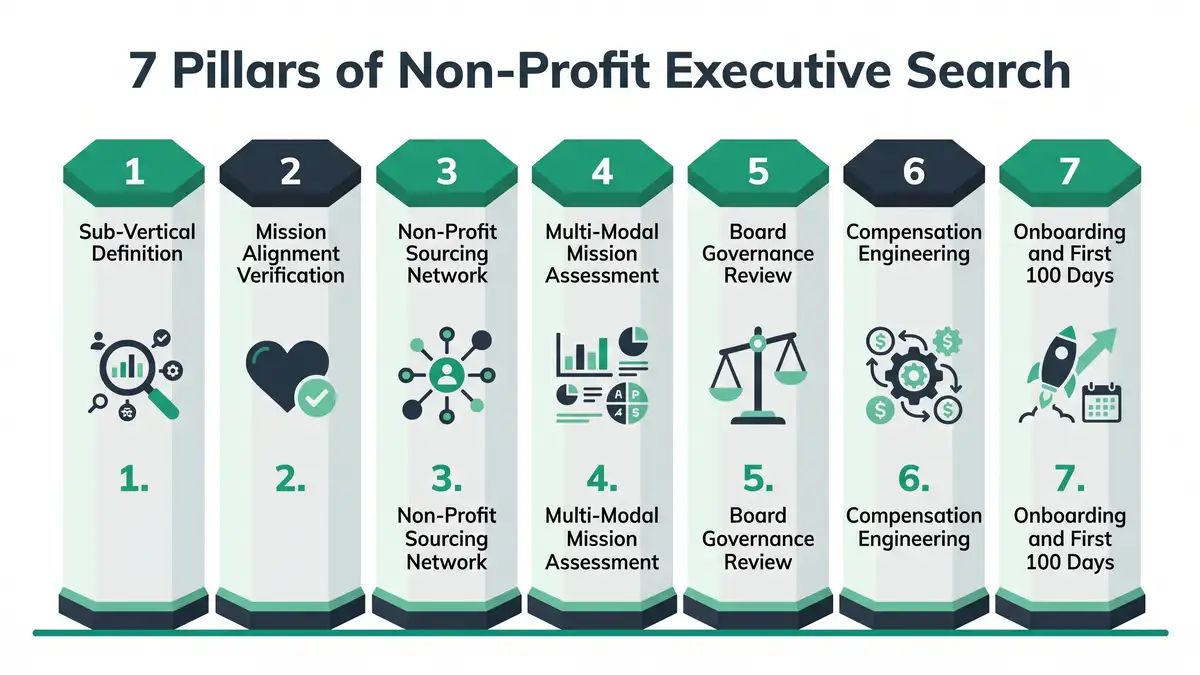
Sub-Vertical Definition
Map the role to large foundation, mid-size foundation, advocacy organisation, social services non-profit, higher education (president, provost, chancellor), healthcare non-profit, cultural institution, or international NGO. Each sub-vertical has distinct competency requirements, board dynamics, compensation structures, and sourcing channels.
Mission Alignment Verification
Assess theory-of-change articulation, prior mission commitment beyond resume claims, lived experience or deep program understanding, and demonstrated values alignment. Mission alignment is the primary predictor of 24-month retention in non-profit executive placements. Specialist firms verify at sourcing through structured mission interviews.
Non-Profit Sourcing Network
Combine LinkedIn with Council on Foundations, Independent Sector, AGB (higher education), BoardSource, AFP (Association of Fundraising Professionals), CASE (Council for Advancement and Support of Education), Inside Philanthropy, Stanford Social Innovation Review, Nonprofit Quarterly, Chronicle of Philanthropy, Inside Higher Ed networks.
Multi-Modal Mission Assessment
Combine fundraising case studies, board governance scenarios, theory-of-change presentations, mission alignment interviews, and stakeholder relationship reference calls (major donors, board chair, program officers, peer EDs). Pure interview-based assessment correlates poorly with 24-month placement success in non-profit roles.
Board Governance Review
Review the candidate's prior board governance experience using BoardSource and AGB standards. For university presidents, AGB Presidential Search guidance documents the Board Professional's collaborative role with the board throughout the search. Conduct board chair, governance committee chair, and development committee chair reference calls.
Compensation Engineering
Structure offers using 990 IRS public disclosure data, GuideStar/Candid Nonprofit Compensation Report benchmarks, Council on Foundations Grantmaker Salary and Benefits Survey, BoardSource compensation studies, ProPublica Nonprofit Explorer comparable analysis. Mission discount expectations must be calibrated against genuine market discipline; reflexive 50-70% discounts produce candidate rejection rates approaching 70%.
Onboarding and First 100 Days
Manage board orientation, major donor introductions, program officer relationship building, foundation peer network entry, and 100-day mission alignment validation. Time-to-productivity for non-profit executive placements runs 90-180 days post-acceptance, longer at universities due to faculty and stakeholder engagement requirements.
Want the full non-profit executive search audit checklist mapped to your specific sub-vertical?
Request the Non-Profit Search DiagnosticFoundation and Large Non-Profit CEO Search

Foundation CEO search at the largest endowments operates under intense public scrutiny via 990 disclosure. CharityWatch's 2026 tracking documents that Gates Foundation CEO compensation averages $1.8M, with comparable large foundations including Ford, MacArthur, Hewlett, Robert Wood Johnson, and Open Society Foundations all running $1M-$2M+ CEO compensation packages disclosed publicly via 990 (CharityWatch 2026). The competency assessment at this level demands philanthropic strategy track record, program officer leadership at scale, board engagement sophistication, and increasingly DEI accountability that boards now formally weigh.
Large healthcare non-profit CEO compensation often exceeds foundation CEO levels due to operational complexity. American Cancer Society, American Heart Association, March of Dimes, St. Jude Children's Research Hospital, and similar healthcare non-profits run CEO compensation in the $1M-$3M+ range, with the highest packages at organizations operating clinical research and treatment alongside fundraising. These roles require dual competency in healthcare operations and philanthropic mission orchestration.
The compensation engineering specifically must reconcile mission discount expectations with market discipline. Candid's Nonprofit Compensation Report, based on nearly 124,000 non-profits' IRS data, provides the empirical benchmark that boutique firms use to set "competitive yet defensible" offers (Candid Best Practices). The Candid Nonprofit Compensation Report itself is the only nonprofit compensation analysis based entirely on IRS data and is used by boards and search firms to maintain IRS compliance under the "reasonable and not excessive" standard (Candid Nonprofit Compensation Report, November 2024). Healthcare executive search at non-profit health systems overlaps with this discipline at the boundary between non-profit healthcare and traditional non-profit search.
The 990 Compensation Calculation
A foundation CEO offer at $1.8M will appear in next year's 990, available to board peers, donors, journalists, and competing search firms. Compensation engineering must therefore satisfy three audiences simultaneously: the candidate (versus corporate alternatives at 2-3x compensation), the board (versus 990 peer comparables), and the public (versus mission discount expectations). Specialist firms model all three; generalists optimize for the candidate only and produce board-level offer revocations.
University President and Higher Education Leadership Search
University president search is the slowest in any executive search vertical at 180-365 days due to the consultation requirements with board, faculty, alumni, students, and major donors. AGB (Association of Governing Boards of Universities and Colleges) provides the dominant governance framework, and AGB Search conducts the majority of US college and university president searches at the major institution level (Hunt Scanlon AGB Search Montana). AGB Search and its parent organization AGB are focused exclusively on higher education and conduct searches for college and university presidents, chancellors, system heads, provosts, vice presidents, and deans (University of Northern Iowa AGB Search PDF).
The search process at universities includes a Board Professional who serves as collaborative partner with the board, search committee, and external consultants throughout the process. AGB's guidance documents the Board Professional's integral role in ensuring effective process throughout the search (AGB Presidential Search Board Professional). Recent public examples include Jessup University's Board of Trustees national search for university president launched in March 2026, illustrating how boards publicize national searches (Jessup University Presidential Search Announcement).
Compensation at universities operates on a public-private divide. Private university presidents at major research institutions earn $800K-$2.5M+, while public university presidents at flagship state institutions earn $500K-$1.5M+, with elite public flagships approaching private compensation. The specialist firms running these searches must navigate not only IRS 990 disclosure (for private universities) but state open records law (for public universities), where state legislature scrutiny adds an additional governance dimension.
Specialist Recruitment Firms in Non-Profit Executive Search
The non-profit executive search market is dominated by specialist boutiques with deep mission alignment expertise. Bridgespan operates the largest non-profit search firm globally with deep practice across foundations, advocacy organizations, social services, and international NGOs. Koya Partners specializes in non-profit and higher education executive search with strong mission alignment depth. Isaacson Miller anchors the broader social impact specialty including foundations and higher education. Diversified Search Group operates a dedicated non-profit practice. AGB Search dominates higher education president and provost search.
Smaller specialist firms include Aly Sterling Philanthropy, Averill Fundraising Solutions, BRYANT GROUP, Ter Molen Watkins & Brandt, Campbell & Company, ThinkingAhead Executive Search, On-Ramps, m/Oppenheim Associates, and Scion Staffing. The Hunt Scanlon Non-Profit Top 75 Executive Search Firms ranking provides the most comprehensive annual competitive landscape view (Hunt Scanlon Non-Profit Top 75). DonorSearch's curated review of top non-profit search firms emphasizes specialty depth and fundraising network access as differentiators (DonorSearch Top Nonprofit Search).
The Big 5 (Korn Ferry Social Impact Practice, Spencer Stuart, Heidrick & Struggles Education and Social Enterprise, Russell Reynolds Education and Non-Profit, Egon Zehnder) operate dedicated non-profit and social impact practices but primarily compete at the largest foundation and healthcare non-profit CEO level where corporate executive search expertise outweighs deep philanthropic networks. Boutiques dominate mid-market non-profit and most university president search due to specialist depth that generalist firms cannot match.
Building a non-profit executive search practice and need mission alignment assessment infrastructure?
Book a Boutique Practice Audit990 Disclosure, Mission Alignment, and Board Governance Discipline
The 990 IRS disclosure dynamic shapes every aspect of non-profit executive search. The National Council of Nonprofits emphasises that the board of directors is responsible for hiring and establishing compensation that is "reasonable and not excessive" under IRS rules, with documented comparability data required (National Council of Nonprofits). Specialist firms run 990 peer benchmark analysis at the offer stage as standard practice; generalists discover the IRS compliance dimension late in negotiation and produce board-level rejection rates of 20-30% on otherwise-strong offers.
Mission alignment assessment is the most predictive variable in 24-month retention. A foundation CEO who articulated a credible theory of change at hire, with prior mission commitment evidenced beyond resume claims, has a materially higher probability of completing a 4-7 year tenure than one whose mission articulation was generic or corporate-translated. Specialist firms invest heavily in structured mission alignment interviews; generalists rely on standard executive assessment that misses the dimension entirely.
Board governance review at non-profits has become formalized through BoardSource and AGB standards. Boards now expect candidates to articulate their prior board engagement experience, governance committee participation, and DEI accountability track record. Diverse boards specifically formally weigh DEI accountability as a top-three assessment dimension in many CEO and president searches, which requires specialist sourcing and assessment infrastructure that generalist firms do not maintain.
8 Common Pitfalls in Non-Profit Executive Search
The first-12-month departure rate for non-profit executive placements runs 30-50% across the industry. Specialist boutiques produce 15-20% departure rates; generalists with no mission alignment or 990 compensation infrastructure produce 50%+ departure rates. The delta is concentrated in eight repeating pitfalls:
Pitfall 1: Insufficient Mission Alignment Assessment
Search firms that cannot conduct structured mission alignment interviews produce 50%+ first-12-month departure rates. A candidate's resume-level mission claims often fail to survive sustained board engagement and program officer interactions. Specialist firms verify alignment through structured interviews and reference call discipline.
Pitfall 2: Over-Emphasis on Corporate Background
Recruiting a Fortune 500 CMO as Executive Director of a $20M community non-profit produces 60%+ departure rates within 24 months. Context skills (program coordination, multi-stakeholder navigation, board governance) outweigh raw corporate executive credentials at small and mid-size non-profits. Specialist firms calibrate carefully; generalists default to corporate scaling.
Pitfall 3: Ignoring 990 Disclosure Dynamics
Search firms that do not run 990 peer benchmark analysis at offer stage produce board-level rejection rates of 20-30% on otherwise-strong offers. Specialist firms model the public-disclosure dimension explicitly; generalists discover the IRS compliance dimension late in negotiation.
Pitfall 4: Missing Board Chair and Development Chair Reference Calls
Calling the candidate's prior board chair and development committee chair produces a 0.7+ correlation with 24-month placement success. Search firms that skip these reference calls due to confidentiality concerns produce 35%+ first-12-month departure rates.
Pitfall 5: Single-Channel Sourcing
LinkedIn-only sourcing for senior non-profit roles misses 70%+ of qualified candidates. Council on Foundations, Independent Sector, AGB, BoardSource, AFP, CASE, and Inside Philanthropy networks each surface candidate pools not visible on LinkedIn.
Pitfall 6: Under-Pricing Despite Mission Discount Expectations
Boards often default to 50-70% mission discounts against corporate equivalents, then are surprised when their top candidates withdraw. Specialist firms model the realistic market clearing rate using Candid Nonprofit Compensation Report data, then engineer the offer to satisfy both mission constraints and candidate market reality.
Pitfall 7: Ignoring DEI Accountability
Non-profit boards now formally weigh DEI accountability as a top-three assessment dimension at most CEO and president searches. Search firms without DEI sourcing depth and structured DEI assessment scenarios produce candidates that boards systematically reject in late-stage evaluation.
Pitfall 8: Missing Fundraising Track Record Assessment
A non-profit CEO claim of "$100M raised" without verified major gift sources, capital campaign role specificity, and donor relationship continuity assessment is often resume inflation. Specialist firms verify fundraising track record through structured donor reference calls and capital campaign chair conversations.
The 7-Step Playbook for Building a Non-Profit Executive Search Practice
Boutiques entering or sharpening a non-profit practice need an 18-24 month transition runway and capital investment in 990 verification infrastructure, compensation data subscriptions, and non-profit advisor recruitment.
Choose Non-Profit Sub-Vertical with $50M+ Addressable Market
Large foundation CEO, university president, executive director at mid-size non-profit, healthcare non-profit CEO, cultural institution ED, or international NGO CEO. Each has $50M+ annual addressable market in retained search at premium fee economics.
Hire or Embed Non-Profit and Philanthropy Advisors
Former ED, foundation program officer, university president, Council on Foundations alumni at Director or Partner level. Without this, the firm cannot credibly assess mission alignment or board governance fit.
Build 990 Verification Infrastructure
Subscribe to GuideStar/Candid premium, ProPublica Nonprofit Explorer commercial access, Council on Foundations Grantmaker Salary database, BoardSource compensation studies, Inside Philanthropy database. Build automated 990 peer benchmark analysis into candidate intake workflow.
Develop Multi-Channel Non-Profit Sourcing
Council on Foundations, Independent Sector, AGB, BoardSource, AFP, CASE, Chronicle of Philanthropy, Stanford Social Innovation Review, Inside Philanthropy, Nonprofit Quarterly, Inside Higher Ed networks. Each channel requires dedicated relationship investment.
Develop Multi-Modal Mission Assessment
Mission alignment interview templates, theory-of-change presentation rubrics, fundraising case study scenarios, board governance role-plays, DEI accountability scenarios. Train all senior consultants on the methodology. Recruitment assessment methodology grounded in mission depth differentiates 75-85% completion-rate boutiques from generalists.
Install Compensation Engineering Capability
Subscribe to Candid Nonprofit Compensation Report, Council on Foundations Grantmaker Salary and Benefits Survey, BoardSource compensation studies, CharityWatch tracking, ProPublica Nonprofit Explorer commercial access. Train consultants on offer engineering across base salary, deferred compensation, retirement contributions, and 990 disclosure mechanics.
Build BD Around Philanthropy Thought Leadership
Publish proprietary research on foundation CEO compensation, university president dynamics, advocacy and social services leadership trends. Speak at Council on Foundations annual meeting, Independent Sector conferences, AGB conferences, BoardSource events. Co-author with Candid or BoardSource for distribution leverage.
Build the Non-Profit Executive Search Practice That Compounds
The boutiques that win in non-profit executive search are not the ones with the most LinkedIn outreach. They are the ones with integrated mission alignment verification, 990 compensation engineering, board governance review, and fundraising track record assessment infrastructure. peppereffect installs the AI-powered operating system that runs all four, so your senior consultants spend their time on judgment, not coordination. Architect your non-profit practice for 75-85% completion rates, 25-30% fee economics, and inbound pipeline that compounds.
Book Your Non-Profit Practice Architecture CallOr explore the 4 Pillars services
Frequently Asked Questions About Non-Profit Executive Search
What is non-profit executive search?
Non-profit executive search is the recruitment discipline focused on placing senior leaders at large foundations (Gates, Ford, Rockefeller, MacArthur), advocacy organisations (ACLU, World Wildlife Fund, Sierra Club), social services non-profits (United Way, Catholic Charities), higher education (university presidents, provosts), healthcare non-profits (American Heart Association, American Cancer Society, St. Jude), cultural institutions (Smithsonian, Met Museum, MoMA, Getty, PBS, NPR), and international NGOs (Save the Children, World Vision, Doctors Without Borders). The vertical differs from corporate executive search through 990 IRS compensation disclosure dynamics, mission alignment as primary assessment dimension, board governance review, fundraising track record verification, and multi-channel sourcing through Council on Foundations, Independent Sector, AGB, BoardSource, and AFP networks.
What are the 7 pillars of non-profit executive search methodology?
The 7 pillars are: 1) Sub-vertical definition; 2) Mission alignment verification including theory-of-change articulation; 3) Non-profit sourcing network through Council on Foundations, Independent Sector, AGB, BoardSource, AFP; 4) Multi-modal mission assessment with fundraising case studies and board governance scenarios; 5) Board governance review including BoardSource and AGB standards alignment; 6) Compensation engineering using 990 IRS public disclosure data, GuideStar/Candid benchmarks, Council on Foundations Grantmaker Salary Survey; 7) Onboarding and first 100 days with board orientation, major donor introductions, mission alignment validation.
How much do non-profit executives earn in 2026?
Large foundation CEO total compensation runs $400K-$2M+ at largest foundations, with Gates Foundation CEO averaging $1.8M per CharityWatch tracking. CharityWatch maintains an annual list of non-profit compensation packages of $1M or more. Large social services non-profit CEO $300K-$1M+. University Presidents at public universities $500K-$1.5M+, at private universities $800K-$2.5M+. Large healthcare non-profit CEO $1M-$3M+. Cultural institution executive directors $700K-$2M+. Sector compensation typically runs 30-50% below corporate equivalents at large foundations and 50-70% below at smaller community non-profits. Executive search compensation benchmarks at non-profits anchor on Candid IRS-data analysis.
Which firms specialise in non-profit executive search?
Specialist firms include Bridgespan (largest non-profit search firm globally), Koya Partners, Isaacson Miller, Diversified Search Group non-profit practice, Aly Sterling Philanthropy, Averill Fundraising Solutions, BRYANT GROUP, Ter Molen Watkins & Brandt, Campbell & Company, ThinkingAhead Executive Search, On-Ramps, m/Oppenheim Associates, AGB Search (exclusively higher education), Russell Reynolds Education and Non-Profit, Korn Ferry Social Impact Practice, and Heidrick & Struggles Education and Social Enterprise. Hunt Scanlon publishes an annual Non-Profit Top 75 Executive Search Firms ranking.
How long does it take to fill a non-profit CEO, foundation president, or university president role?
Foundation CEO searches run 120-180 days. Executive Director at mid-size non-profit 90-150 days. University President search is the slowest in any sector at 180-365 days due to board, faculty, alumni, and student consultation requirements. Hospital CEO at non-profit health system 90-150 days. Executive Director at small non-profit 60-90 days. International NGO Country Director 90-150 days. The extensive stakeholder consultation requirement at universities materially extends time-to-fill versus comparable executive search verticals.
What are common pitfalls in non-profit executive search?
The 8 most common pitfalls are: 1) Insufficient mission alignment assessment; 2) Over-emphasis on corporate background at small non-profits; 3) Ignoring 990 IRS disclosure dynamics; 4) Missing board chair and development chair reference calls; 5) Single-channel sourcing missing Council on Foundations and Independent Sector networks; 6) Under-pricing despite mission discount expectations; 7) Ignoring DEI accountability; 8) Missing fundraising track record assessment. AI candidate screening infrastructure helps automate 990 peer benchmark analysis and fundraising track record verification.
How do I build a non-profit executive search practice?
The 7-step playbook: 1) Choose non-profit sub-vertical with $50M+ addressable market; 2) Hire or embed non-profit and philanthropy advisors; 3) Build 990 IRS verification infrastructure with GuideStar/Candid premium access and ProPublica Nonprofit Explorer; 4) Develop multi-channel sourcing across Council on Foundations, Independent Sector, AGB, BoardSource, AFP; 5) Develop multi-modal assessment with mission alignment scenarios; 6) Install compensation engineering using 990 data, Candid Compensation Report, BoardSource compensation studies; 7) Build BD around philanthropy thought leadership at Council on Foundations, Independent Sector, and AGB events. Transition takes 18-24 months. Executive search business development grounded in non-profit thought leadership drives 2-3x conversion rates. real estate leadership search interim leadership deployment
Resources
- CharityWatch 2026 Update: Nonprofit Compensation Packages of $1M or More
- Candid Nonprofit Compensation Report Best Practices
- Candid Nonprofit Compensation Report
- Council on Foundations Grantmaker Salary and Benefits Report
- Hunt Scanlon Non-Profit Top 75 Executive Search Firms 2026
- DonorSearch Top 7 Exceptional Nonprofit Executive Search Firms
- People Managing People 10 Best Nonprofit Recruiting Firms 2026
- WOC FP Executive Search Ranking
- Hunt Scanlon AGB Search University of Montana 2026
- AGB Presidential Search Board Professional Role
- AGB Search University of Northern Iowa Presidential PDF
- Jessup University Presidential Search Announcement 2026
- National Council of Nonprofits Executive Compensation Guidance
- ProPublica Nonprofit Explorer
- GuideStar by Candid Nonprofit Data