

What Are Agentic Automation Platforms?
An agentic automation platform is software that builds, orchestrates, and governs autonomous AI agents — systems that perceive a situation, reason about a goal, plan multi-step actions, call tools and APIs, and act with limited human oversight. Unlike traditional workflow automation, which executes pre-scripted rules, an agentic platform hands the system an objective ("resolve this support ticket," "qualify this lead," "shortlist these candidates") and lets the agent decide how to get there. This is the architectural shift that separates 2026 from the rule-based automation era that preceded it.
The market is moving from hype to hard economics. Gartner forecasts that 40% of enterprise applications will feature task-specific AI agents by 2026, up from less than 5% in 2025, while IDC projects that 45% of organisations will orchestrate AI agents at scale by 2030. The specialised end of the market is compounding even faster: the US real-time decision-making AI agents segment is forecast to grow from USD 1.69 billion in 2025 to roughly USD 65.74 billion by 2035 — about 44% CAGR.
But choosing the right platform is now a high-stakes architectural decision, not a tooling preference. Gartner also predicts that more than 40% of agentic AI projects will be canceled by the end of 2027 because of escalating costs, unclear business value, and inadequate risk controls. The platform you install determines which side of that statistic you land on. This guide architects the decision.
What you'll learn in this guide:
- What actually makes a platform "agentic" — and how to spot "agent washing"
- A side-by-side comparison of 11 leading agentic automation platforms in 2026
- The seven-criteria evaluation framework we use to architect platform decisions
- What agentic automation really costs across per-execution, per-conversation, and per-seat models
- Why 40% of projects fail — and the governance design that de-risks yours
- Which platform fits a SaaS CEO, an executive-search MD, or a coaching founder
Key Takeaway
There is no single "best" agentic automation platform — there is the best platform for a specific workload, data environment, and governance requirement. The platforms that win in 2026 are chosen against an evaluation framework, integrated into a core workflow, and governed for trust. The ones that get canceled are chosen on hype and bolted onto a poor data foundation.
What Makes a Platform "Agentic" (vs Workflow Automation or RPA)?
The line between an "agentic" platform and a workflow tool with a language-model step bolted on is the difference between autonomy and automation. Make.com draws the distinction cleanly: a single AI agent combines a large language model (its "brain"), contextual data (its "memory"), and tools (its "hands") to pursue one goal, while agentic automation orchestrates dozens or hundreds of those agents into a coordinated digital workforce. Traditional automation, by contrast, runs deterministic flows: defined triggers, defined branches, defined outputs.
This is also where credibility gets tested. Gartner has warned of "agent washing" — vendors rebranding chatbots and basic RPA scripts as agents without meaningful autonomy. The category leaders are repositioning accordingly: UiPath, recognised as a Leader in the 2025 Gartner Magic Quadrant for Robotic Process Automation, now frames its platform as "agentic automation" that unifies agents, software robots, and humans. The shift is structural, not cosmetic. McKinsey estimates that, in an early scenario, agents and robots could perform 60–70% of today's global work hours.
For a deeper treatment of this boundary, see our analysis of agentic AI vs traditional automation and our playbook on agentic workflows. The five capabilities that define a genuinely agentic platform are summarised below.
| Capability | Traditional Workflow / RPA | Agentic Automation Platform |
| Control model | Pre-scripted rules and branches | Goal-directed; agent plans its own steps |
| Reasoning | None — deterministic logic | LLM reasoning over context and feedback |
| Adaptability | Breaks on unexpected input | Adapts plan based on tool results |
| Coordination | Single flow, single bot | Multi-agent orchestration across systems |
| Memory | Stateless between runs | Working + long-term memory (vector/graph) |
Source: Make — AI Agents vs Agentic Automation, UiPath (2025)
Key Takeaway
Before you evaluate features, verify autonomy. If the "agent" cannot choose which tool to call, interpret the result, and adjust its plan without you scripting every branch, you are buying workflow automation with a chatbot attached — not an agentic platform. The label is marketing; the architecture is the product.

The 2026 Agentic Automation Platform Landscape: 11 Platforms Compared

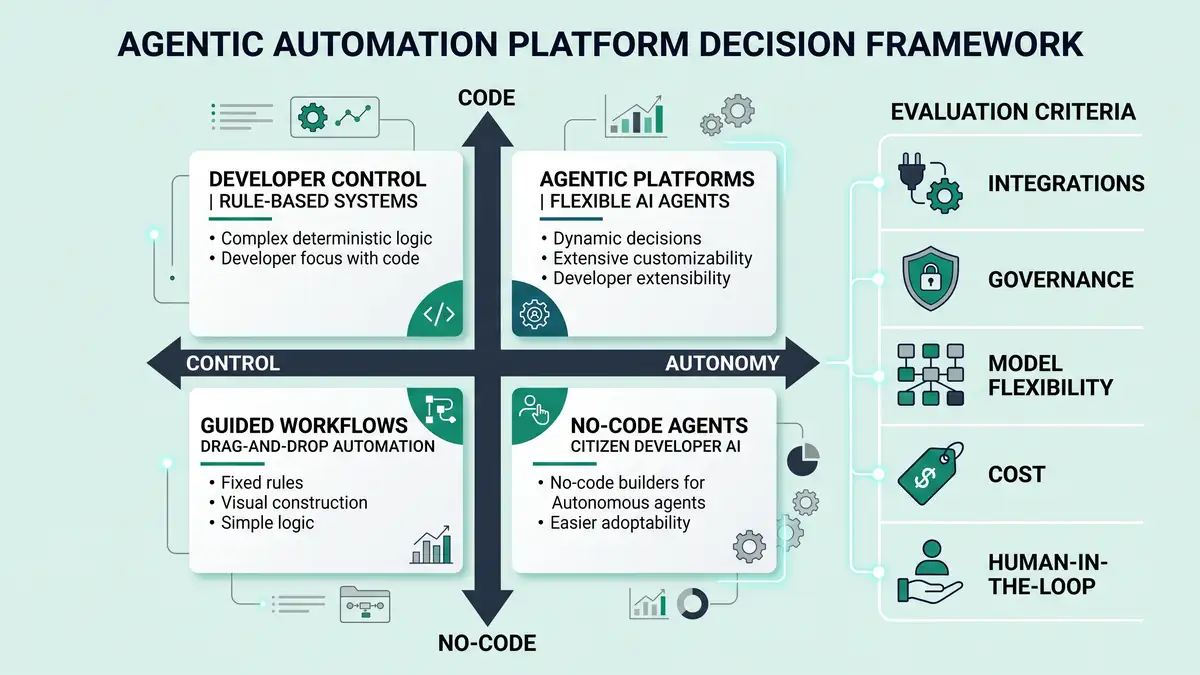
The landscape splits into four tiers: generalist workflow orchestrators adding agents, enterprise automation suites repositioning around agentic automation, hyperscaler and SaaS-native agent builders, and developer-first agent frameworks. Each tier serves a different buyer. A technical SaaS team optimising cost will weigh n8n against a developer framework; a regulated enterprise will weigh UiPath against Salesforce Agentforce; a lean consulting firm will weigh a no-code agent builder against a build partner.
The table below compares the platforms B2B operators most frequently evaluate. We score each on hosting model, build approach, ideal use case, and headline pricing so you can shortlist against your own constraints. This is the filter most "best of" lists skip — and the data an AI summary cannot reproduce without the underlying evaluation.
| Platform | Tier | Build Approach | Hosting | Headline Pricing |
| n8n | Workflow + agents | Low-code / code | Cloud or self-host | From EUR 20/mo (2,500 executions) |
| Make.com | Workflow + agents | No-code visual | Cloud | Free tier; operation-based plans |
| Zapier (Agents) | Workflow + agents | No-code | Cloud | Pro from $19.99/mo (750 tasks) |
| Microsoft Copilot Studio | SaaS-native | Low-code | Cloud (Azure) | Per-user + message consumption |
| UiPath | Enterprise suite | Low-code + pro | Cloud / on-prem | Enterprise / custom |
| Automation Anywhere | Enterprise suite | Low-code | Cloud / on-prem | Enterprise / custom |
| Salesforce Agentforce | SaaS-native | Low-code | Cloud | $2/conversation or $0.10/action |
| Google Vertex AI Agent Builder | Hyperscaler | Code + low-code | Cloud (GCP) | Consumption-based |
| LangGraph | Developer framework | Code | Self-host / cloud | Open-source core |
| CrewAI | Developer framework | Code | Self-host / cloud | Open-source core |
| Relevance AI | SaaS-native | No-code | Cloud | Free tier; usage-based |
Sources: n8n pricing, Zapier pricing, Salesforce Agentforce pricing, vendor documentation (2026)
Two patterns matter for B2B buyers. First, hosting model is a governance decision, not a convenience one: n8n's self-hosting option and per-execution pricing make it the default for technical teams that need data residency and predictable cost, which is why we compare it directly in our n8n vs Make comparison and document its limitations honestly. Second, developer frameworks (LangGraph, CrewAI) trade ease of adoption for control — powerful for bespoke agents, but they require engineering ownership most lean B2B firms do not have in-house.
How to Choose an Agentic Automation Platform: The Seven-Criteria Framework
We architect every platform decision against seven criteria, scored against the specific workload — not the vendor's marketing. IDC's guidance to "design for orchestration, deliver for scale, and govern for trust" maps directly onto these dimensions, and PwC stresses embedding guardrails and an orchestration layer before scaling. The platform that scores highest on your weighted criteria is your answer — and it will differ by use case.
Integration breadth and depth
Does it connect natively to your CRM, data warehouse, email, and the systems where the work actually happens? Shallow connectors create integration debt that kills ROI.
Model flexibility
Is the platform LLM-agnostic, or locked to one vendor's model? Model choice affects cost, latency, and capability — lock-in removes your leverage.
Human-in-the-loop controls
Can you insert approval gates on high-risk actions? Autonomy without oversight is the fastest route to the cancellation statistic. See our guide to human-in-the-loop AI.
Observability and logging
Can you see what every agent did, why, and with what result? Without audit trails you cannot debug, govern, or prove value.
Security, governance, and data residency
Self-host vs cloud, encryption, role-based access, and regional data controls. Non-negotiable for regulated B2B sectors. See our AI governance framework.
Cost model alignment
Per-execution, per-task, per-conversation, per-seat, or consumption? The model must match how the work scales, or cost will outrun value.
Reliability and scalability
Error handling, retries, rate limits, and the ability to grow from a single-agent pilot to an orchestrated digital workforce without re-platforming.
Score these against your readiness, not in the abstract. Our AI readiness assessment maps the data and governance maturity each criterion assumes, and our work on agentic automation metrics defines how to measure whether the platform is actually delivering.
Want this scored against your stack instead of in the abstract? We map your workload to the right platform in a 45-minute diagnostic.
Book a Growth Mapping CallWhat Agentic Automation Actually Costs in 2026
Pricing models are diverging sharply, and the model matters as much as the headline number. Automation Anywhere's analysis of more than 70 enterprise deployments found that AI service agents resolve over 80% of employee support requests and cut ITSM licensing costs by up to 50% — which is exactly why seat-based pricing is breaking down. As agents do the work that humans used to, paying per human seat becomes "disconnected from the work performed," pushing the market toward consumption and outcome-based models. IDC echoes this, urging providers to reimagine pricing beyond seats and licences.
| Platform | Pricing Model | Entry Point | Best Fit |
| n8n | Per workflow execution | EUR 20/mo (2,500 runs); EUR 50/mo (10,000) | Technical teams, predictable cost |
| Zapier | Per task | $19.99/mo (750 tasks); Team $69/mo (2,000) | Non-technical, light agents |
| Salesforce Agentforce | Per conversation / per action | $2/conversation; $0.10/action (Flex Credits) | Salesforce-native customer agents |
| Microsoft Copilot Studio | Per-user + consumption | Bundled with M365 + message packs | Microsoft 365 estates |
| UiPath / Automation Anywhere | Enterprise / consumption | Custom (annual contract) | Regulated, high-volume enterprises |
Sources: n8n, Zapier, Salesforce Agentforce, Automation Anywhere (2026)
The licence fee is rarely the real cost. Build, integration, prompt engineering, observability, and ongoing maintenance typically dwarf the platform subscription. We break the full picture down in our guide to what AI automation costs. The decisive question is not "which platform is cheapest" but "which cost model stays aligned with value as the workload scales" — a per-conversation model can be cheaper than per-seat at low volume and far more expensive at high volume.

Why 40% of Agentic Projects Fail — and How to De-Risk Yours

Failure is structural, not incidental. Gartner's prediction that over 40% of agentic AI projects will be canceled by end of 2027 is driven by a repeatable pattern: generic assistants with low domain specificity, weak integration into core workflows, no clear ROI, and inadequate governance. IDC adds a second failure mode — organisations that deploy agents on poor data foundations face a 15% productivity loss by 2027 as agents act on bad data.
The readiness gap compounds it. Deloitte's 2026 survey of 3,235 leaders found that insufficient worker skills is the single biggest barrier to integrating AI into existing workflows — even as 66% of organisations report productivity benefits where adoption succeeds.
Avoid This Mistake
Do not start with the platform. Starting with "we should use Agentforce / n8n / CrewAI" before defining the workload, the data foundation, and the success metric is the number-one cause of cancellation. Choose the problem first, prove the data is clean, define the ROI, then select the platform that fits. Our analysis of why AI projects fail details the full anti-pattern.
De-risking is a design choice. PwC reports that disciplined deployments — embedding guardrails, an orchestration layer, and responsible-AI controls — have delivered gains of up to 50% in IT, finance, and tax, with 88% of executives saying their function plans to use agents. The survivors share four traits: domain-specific scope, deep workflow integration, clean data, and observable governance. The platform enables those traits; it does not create them.
Which Agentic Platform Fits Your B2B Profile?
The "best" platform is the one matched to your operating model. Three B2B profiles illustrate how the same evaluation framework produces different answers.
The mid-market SaaS CEO scaling toward $50M ARR without scaling headcount needs revenue-operations agents wired into the CRM and product data. Model flexibility and observability rank highest; a self-hostable orchestrator (n8n) or a hyperscaler builder (Vertex AI) fits when an engineering team exists, while a SaaS-native agent layer fits when it does not. This connects directly to the goal of decoupling revenue from headcount.
The executive-search managing director drowning in manual sourcing needs domain-specific agents for candidate research, outreach, and shortlisting. Integration depth into the ATS and human-in-the-loop gates on client-facing actions rank highest — quality reputation cannot be risked to a hallucinating agent.
The coaching or consulting founder trapped as the bottleneck needs agents for client onboarding, content, and the student journey. No-code speed and low maintenance rank highest; a no-code agent builder or a managed build partner beats a developer framework that demands engineering they don't have. For customer-facing deployments, our guide to the conversational AI platform category is the natural next step.
Key Takeaway
Match the platform to the profile, not the hype to the headline. The SaaS CEO, the search MD, and the coaching founder should reach different conclusions from the same seven criteria — because their workloads, data, and risk tolerances differ. That is the entire point of evaluating against a framework rather than a "best of" list.
Frequently Asked Questions
What is the best agentic automation platform in 2026?
There is no universal best. For technical teams needing control and predictable cost, n8n leads on self-hosting and per-execution pricing. For Salesforce-native customer agents, Agentforce is the natural fit. For Microsoft 365 estates, Copilot Studio integrates most cleanly. For regulated, high-volume enterprises, UiPath and Automation Anywhere dominate. The right answer is whichever platform scores highest against your weighted evaluation criteria — integration, model flexibility, governance, and cost model — for your specific workload. Choosing on a generic ranking is a leading cause of the projects Gartner expects to be canceled by 2027.
What is agentic automation, and how is it different from RPA?
Agentic automation deploys AI agents that perceive, reason, plan, and act toward a goal with limited human scripting, often coordinating as a multi-agent digital workforce. Traditional robotic process automation (RPA) executes deterministic, pre-scripted rules and breaks on unexpected input. The practical difference: RPA needs you to define every step; an agentic platform takes an objective and decides the steps itself. We unpack this fully in our comparison of agentic AI vs traditional automation. Many vendors blur the line through "agent washing," so verify genuine autonomy before buying.
Are tools like ChatGPT, Claude, or Copilot agentic AI platforms?
Not on their own. ChatGPT, Claude, and Copilot are large language models with growing agentic features (tool use, browsing, task execution), but a true agentic automation platform adds orchestration, integration, memory, governance, and multi-agent coordination on top of the model. The model is the "brain"; the platform is the operating system that lets it act safely across your business systems. Most B2B deployments pair a model with a platform such as n8n, Copilot Studio, or a developer framework like LangGraph to handle the orchestration layer.
How much does an agentic automation platform cost?
Platform subscriptions range widely: n8n starts at EUR 20/month for 2,500 executions, Zapier at $19.99/month for 750 tasks, and Salesforce Agentforce at $2 per conversation or $0.10 per action. Enterprise suites like UiPath are custom-priced annual contracts. But the subscription is rarely the real cost — build, integration, prompt engineering, observability, and maintenance usually exceed it. The decisive factor is whether the pricing model stays aligned with value as volume grows. See our full breakdown of AI automation costs.
Why do so many agentic AI projects fail?
Gartner predicts over 40% will be canceled by end of 2027 due to escalating costs, unclear value, and weak risk controls. The pattern is consistent: teams start with the platform instead of the problem, deploy generic agents with shallow workflow integration, run them on poor-quality data (IDC warns of a 15% productivity loss from this alone), and skip governance. De-risking means choosing a domain-specific use case, cleaning the data foundation, defining ROI upfront, and building observable human-in-the-loop controls before scaling. Our guide on why AI projects fail covers the full anti-pattern.
Do I need engineers to use an agentic automation platform?
It depends on the platform tier. No-code platforms (Make, Zapier, Relevance AI) and low-code suites (Copilot Studio, UiPath) let non-technical teams build agents. Developer frameworks (LangGraph, CrewAI) require engineering ownership in exchange for maximum control. n8n sits in between — usable by technical operators, more powerful with code. If you lack in-house engineering, either choose a no-code platform or engage a build partner who installs and governs the system for you, then hands it over.
How do I evaluate agentic platforms without getting locked in?
Score every option against seven criteria: integration breadth, model flexibility (insist on LLM-agnostic where possible), human-in-the-loop controls, observability, security and data residency, cost-model alignment, and scalability. Prioritise platforms that avoid single-model lock-in and support exporting your logic and data. Run a narrow, domain-specific pilot with a defined ROI metric before committing to enterprise scale. Our AI readiness assessment helps you weight these criteria against your organisation's actual data and governance maturity.
Stop Comparing Platforms. Start Architecting the System.
The platform is one decision in a system. peppereffect architects the full agentic operating system — workload selection, data foundation, governance, and the platform that fits — so you land on the right side of the 40% cancellation statistic. We install autonomous systems that decouple your revenue from headcount.
Book Your Growth Mapping CallExplore our AI automation services → Compare the wider AI automation tool categories and their billing models.
Resources
- Gartner — Over 40% of Agentic AI Projects Will Be Canceled by End of 2027
- Gartner — 40% of Enterprise Apps to Feature Task-Specific AI Agents by 2026
- IDC FutureScape 2026 Predictions — Rise of Agentic AI
- IDC — Agent Adoption: The IT Industry's Next Great Inflection Point
- PwC — Midyear 2025 AI Predictions Update
- Deloitte — State of AI in the Enterprise 2026
- Precedence Research — Real-Time Decision-Making AI Agents Market
- Automation Anywhere — AI Agents Force Rethink of SaaS Pricing
- Make — AI Agents vs Agentic Automation
- UiPath — 2025 Gartner Magic Quadrant for RPA Leader
- McKinsey — Agents, Robots, and Skill Partnerships in the Age of AI
- n8n — Plans and Pricing