

The chatbot on your website and the bot answering your support line used to be separate, brittle projects. The shift in 2026 is that both now run on the same underlying system: a conversational AI platform. Instead of building one-off bots, enterprises build, deploy, and govern fleets of AI agents from a single environment that spans web chat, messaging, and voice.
This matters because the economics are enormous. Gartner projects that conversational AI in contact centres will cut agent labour costs by 80 billion USD by 2026, and best-in-class deployments now resolve 70 to 80 percent of conversations without a human. But a platform is not a chatbot, and choosing the wrong one wastes the investment. This guide explains what a conversational AI platform is, how it works, how it differs from a chatbot and from agentic AI, the market and ROI data, the use cases, the risks, and how to choose one.
What is a conversational AI platform?

A conversational AI platform is a software environment for building, deploying, and managing AI systems that converse with people in natural language across text and voice channels, with deep integration into enterprise data and processes. It combines natural language understanding (NLU), dialogue management, large language models and generative AI, connectors to customer and employee channels, integration tooling for CRM and back-office systems, and analytics for monitoring and optimisation.
The defining distinction is that a platform is a multi-tenant factory for conversational experiences, not a one-off application. It provides the runtime and tooling to create many different bots or agents that share a common architecture, security and compliance model, and observability framework. Enterprise-grade offerings embed governance, role-based access control, audit logging, and scaling so hundreds of bots and millions of interactions can be managed safely across regions and business units. Analysts now track conversational AI as its own category, with a 2024 Forrester Wave evaluating platforms specifically for customer service.
Because most B2B use cases rely on proprietary data, modern platforms are built around retrieval-augmented generation (RAG), which grounds model outputs in your knowledge bases and systems of record rather than the model's parameters alone. This is the same agentic shift behind the broader AI voice agent and the AI receptionist, generalised into a single environment that powers both text and voice.
Conversational AI platform vs chatbot, voice agent, and agentic AI
The terms get used interchangeably, but they describe different things. A chatbot is a single application; a platform is the factory that produces many. A voice agent is one channel; a platform spans them all. Agentic AI is a capability that the leading platforms are now absorbing.
| Term | What it is | Scope | Typical containment |
| Single chatbot | One app, one channel, narrow intents | Single use case | Below 35% (rule-based) |
| Voice agent | App oriented to telephony / IVR | Voice channel | Varies by design |
| Conversational AI platform | Environment to build many bots/agents | Omnichannel, enterprise-wide | 40-80% depending on maturity |
| Agentic AI | Agents that plan and act via tools/APIs | Conversation plus autonomous action | Extends beyond Q&A |
Source: Decagon, 2025; Forrester Wave, 2024
In practice, the line between conversational AI and agentic AI is blurring fast. Platforms like Microsoft Copilot Studio, IBM watsonx Orchestrate, Kore.ai, and Sierra now let agents call tools, run workflows, and trigger events, so a bot can discuss an HR question and then submit the change in the HR system. The core differentiator remains: a conversational AI platform is a general-purpose environment for conversation-centric applications, while agentic AI denotes the broader ability to plan and act beyond dialogue. The convergence mirrors what we cover in agentic workflows and the move toward intelligent automation.
How a conversational AI platform works
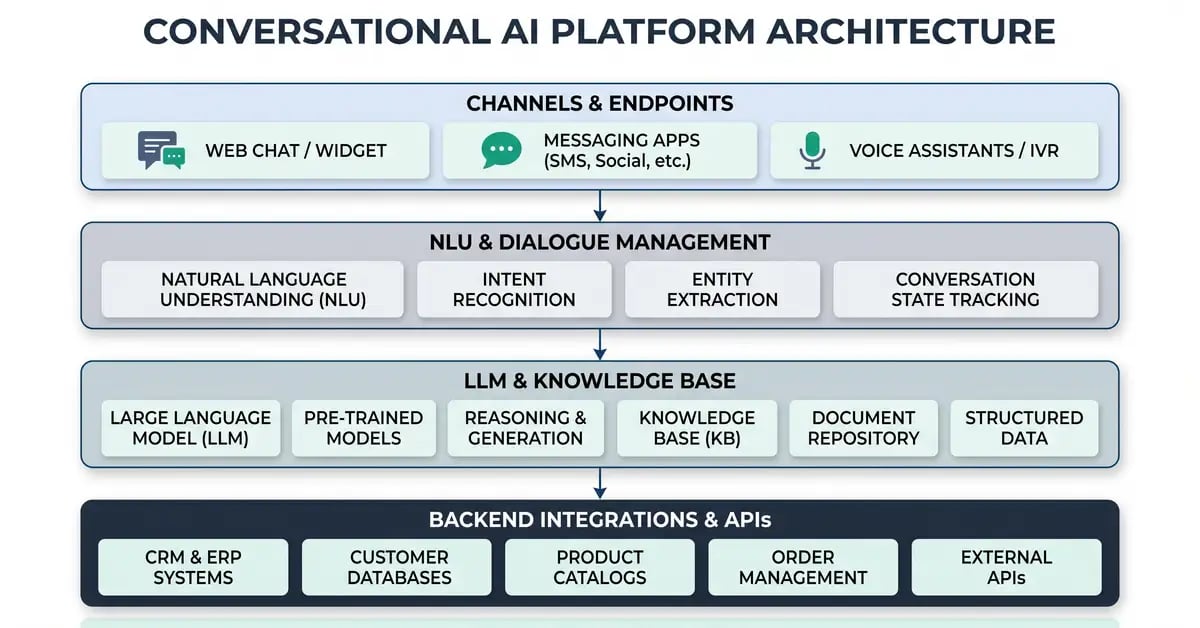
Under the hood, a platform runs a layered pipeline. Each layer can be inspected, governed, and optimised independently, which is what separates an enterprise platform from a single bot.
Natural language understanding
NLU converts raw input into structured meaning: the intent (the user's goal, like "check order status") and entities (parameters like an order number or date). Modern platforms blend transformer-based classifiers with direct LLM understanding, using confidence scores and clarifying questions to manage risk.
Dialogue management and orchestration
The dialogue manager tracks state, decides the next action, and orchestrates calls to knowledge bases, models, and backend systems. Platforms like Google Dialogflow CX handle complex multi-turn flows with hierarchical state machines, and agentic platforms extend orchestration to invoke workflows and approvals.
LLMs and retrieval-augmented generation
Generative models produce natural, context-aware responses, but enterprises cannot accept unconstrained output. RAG retrieves approved documents and data first, then instructs the model to answer from that context, reducing hallucination and keeping answers current with real policies and prices.
Omnichannel connectors and integrations
One agent deploys across web chat, mobile, WhatsApp, SMS, email, and voice/IVR from a single layer, maintaining context across channels. Integration with CRM, ticketing, and order systems lets the agent take real action, the biggest lever on containment and ROI.
Wrapping all of this is the analytics layer: containment rate, escalation rate, deflection, handle time, and satisfaction, increasingly at the intent level. That last point matters because integration with systems of record is what turns a bot from an FAQ reader into a resolver, the same principle behind effective CRM automation.
The market and the ROI

The category is large and growing fast. MarketsandMarkets puts the conversational AI market at 13.77 billion USD in 2024, rising to 17.05 billion USD in 2025 and 49.80 billion USD by 2030. Grand View Research forecasts a 23.7 percent CAGR from 2025 to 2030, and Fortune Business Insights projects the market reaching 82.46 billion USD by 2034. Estimates differ on the exact figure but converge on a 20 to 25 percent growth band. The category now sits among the most prominent AI automation tools in the enterprise stack, with both hyperscalers (Google, Microsoft, Amazon, IBM, Salesforce) and independents (Kore.ai, Cognigy, Sprinklr, Sierra, Ada) competing on enterprise features rather than core language ability.
The ROI is rooted in labour economics. Gartner, cited by NICE, estimates there are about 17 million contact-centre agents worldwide and that labour can be up to 95 percent of contact-centre cost. Gartner projects that by 2026 conversational AI will cut agent labour costs by 80 billion USD, with one in ten interactions automated, up from roughly 1.6 percent. At the interaction level, Decagon reports that on a 50,000-contact channel, each containment point shifts 500 contacts to automation; with human contacts at 8 to 15 USD and automated ones at 0.10 to 1.00 USD, a five-point containment gain is roughly 285,000 USD a year. Contained sessions also resolve 5 to 10 times faster than human queues.
| Platform | Positioning | Pricing note |
| Microsoft Copilot Studio | Copilots across Microsoft 365 / Power Platform | $200/mo per 25,000-credit pack |
| IBM watsonx Orchestrate | Agentic workflows + prebuilt agents | $530/mo Essentials; $6,360/mo Standard |
| Google Dialogflow CX | Complex multi-turn flows, voice + text | Usage-based, by quote |
| Salesforce Einstein Copilot | Embedded in Salesforce CRM, grounded in your data | By edition / quote |
| Kore.ai / Sierra | Agentic AI apps, omnichannel agents | By quote |
Source: Microsoft Copilot Studio pricing; IBM watsonx Orchestrate pricing; MarketsandMarkets, 2025
Want to know which conversations you could automate first?
Book a Growth Mapping CallUse cases by function and industry

Customer service is the dominant use case, but a platform pays off across the business because the same engine serves many functions:
- Customer service and support: 24/7 triage, FAQs, troubleshooting, and full resolution across channels, escalating to humans when needed. NICE notes conversational AI can transform support operations within a two-year horizon.
- Sales and lead qualification: greeting visitors, answering product questions, qualifying leads, and booking demos, often paired with an AI agent for sales on the outbound side.
- Marketing and engagement: interactive campaigns, product discovery, and personalised recommendations across web, WhatsApp, and SMS; Sprinklr's platform uses 750-plus prebuilt models across 100-plus languages.
- HR and IT helpdesk: instant answers on benefits, policies, access, and device setup, plus initiating requests inside Teams or Slack.
By industry, banking and financial services, retail and e-commerce, healthcare, telecom, and insurance lead adoption, where contact volumes are high and digital-first competition is fierce. Grand View Research notes retail and e-commerce took a prominent share of 2024 revenue. Many deployments wrap deterministic execution from robotic process automation beneath the conversation, so the agent both talks and acts, the foundation of mature customer service automation.
The risks and limits
A platform is powerful, but it is not plug-and-play. The failure modes are well documented. Hallucination is the headline risk: unconstrained generative output can state wrong policies or prices, which is dangerous in regulated industries. RAG and strict data governance mitigate it, but they must be configured deliberately. Intent detection still matters: Decagon warns that a bot with 80 percent overall containment but only 30 percent on refund requests is failing on a high-value intent that erodes trust fast.
Integration depth, not language quality, decides success
Without integration, a bot only answers FAQs. With it, the bot cancels orders, updates addresses, and initiates refunds, fully resolving issues instead of deflecting them. The other non-negotiables are data privacy and governance (especially with proprietary data and IP), clean human escalation paths, and multilingual accuracy. Evaluate a platform on the richness and maintainability of its integrations and its governance controls, not just how natural its language sounds.
The other constraint is organisational. A platform produces a fleet of bots, which only delivers value with ongoing optimisation: intent-level analytics, A/B tests, transcript analysis, and a team that owns the lifecycle. The platforms that win are the ones run as a living system, not a one-time launch.
How to choose a conversational AI platform

Treat selection as a structured evaluation tied to one concrete use case, not a feature beauty contest.
Start from your highest-value use case
Pick one high-volume, high-value workflow (support triage, lead qualification, an IT helpdesk) and define what "fully resolved" means for it. That anchors every other criterion.
Score integration, RAG, and governance
Assess the depth and maintainability of connectors to your CRM, ticketing, and backend systems, the strength of retrieval-augmented generation over your data, and the security, compliance, and audit controls. These decide real-world performance, and an experienced AI consultant earns their fee separating marketing claims from production reality.
Check omnichannel, analytics, and agentic depth
Confirm one agent can span your channels, that analytics report containment and deflection at the intent level, and that the platform supports workflow and tool-calling if you will move toward agentic automation.
Pilot, measure, and expand
Run a pilot on the chosen use case and track containment, cost per contact, and satisfaction against a human baseline. Prove the payback, then extend to more functions and channels. Most firms buy a platform rather than build one.
The bottom line
A conversational AI platform is the infrastructure layer that turns scattered chatbots into a governed fleet of AI agents across every channel. The market is growing 20 to 25 percent a year because the savings are real: best-in-class deployments contain 70 to 80 percent of conversations and resolve them in seconds. But the platform is only as good as its integration, its data governance, and the discipline behind its optimisation. Choose for depth, pilot on one valuable use case, and treat it as a living system.
Architect your conversational AI, don't just buy a bot
peppereffect deploys conversational AI as part of an integrated operating system, wired into your CRM, knowledge base, and fulfilment so every conversation resolves, acts, and is measured. We diagnose which interactions to automate first and engineer the logic-gated workflows that hold up at scale.
Book a Growth Mapping CallFrequently asked questions
What is a conversational AI platform?
It is a software environment for building, deploying, and managing AI systems that converse in natural language across text and voice, with deep integration into enterprise data and processes. It combines NLU, dialogue management, LLMs and generative AI, retrieval-augmented generation, omnichannel connectors, integrations, and analytics. Unlike a single chatbot, it is a multi-tenant factory for many bots and agents under one architecture, security model, and governance framework.
How is a conversational AI platform different from a chatbot?
A chatbot is one app for one channel and use case; rule-based ones often contain under 35 percent of conversations. A platform builds many bots and agents across web, messaging, and voice from one orchestration, analytics, and governance layer, with deep backend integration. Best-in-class platform deployments reach 70 to 80 percent containment.
How does a conversational AI platform work?
NLU turns input into intents and entities; a dialogue manager tracks state and orchestrates calls to knowledge bases, models, and systems; LLMs with retrieval-augmented generation ground answers in approved data; omnichannel connectors deliver one agent across channels; integrations let it take real action; and analytics track containment, deflection, and satisfaction for continuous optimisation.
What is the ROI of a conversational AI platform?
Gartner projects conversational AI will cut contact-centre agent labour costs by 80 billion USD by 2026, with one in ten interactions automated. Decagon reports automated contacts cost 0.10 to 1.00 USD versus 8 to 15 USD for human ones, so a five-point containment gain on a 50,000-contact channel saves about 285,000 USD a year. Best-in-class bots reach 70 to 80 percent containment.
What are the main use cases?
Customer service and support is dominant, followed by sales and lead qualification, marketing and engagement, and internal HR and IT helpdesks. By industry, banking and financial services, retail and e-commerce, healthcare, telecom, and insurance lead adoption.
How do I choose a conversational AI platform?
Evaluate NLU and generative quality, integration depth and maintainability, omnichannel coverage, retrieval-augmented generation and data governance, intent-level analytics, agentic and workflow capabilities, security and compliance, and pricing against your automation volume. Pilot on one high-value use case, measure containment, cost per contact, and satisfaction, then expand. Most firms buy rather than build.
Resources
- MarketsandMarkets, Conversational AI Market
- Grand View Research, Conversational AI Market
- Fortune Business Insights, Conversational AI Market
- Ender Turing, Conversational AI Market Size
- NICE, The Future of Customer Service
- Decagon, Chatbot Containment Rate
- Forrester Wave, Conversational AI for Customer Service 2024
- Microsoft Copilot Studio Pricing
- IBM watsonx Orchestrate Pricing
- Google Dialogflow Case Studies
- Juniper Research, Chatbots in Banking and Healthcare