

Most businesses still run on a hidden layer of human drudge work: people logging into systems, copying numbers from one screen to another, filling in the same forms, and reconciling spreadsheets. Robotic process automation (RPA) is the technology that hands that work to software. It deploys digital "bots" that mimic exactly what a person does on screen, at higher speed, around the clock, and without typos.
RPA is not artificial intelligence, and that distinction is the key to using it well. A bot follows a fixed script: it does not understand context or learn on its own. That makes it predictable, auditable, and excellent at high-volume, rules-based tasks, which is why the RPA software market reached 3.8 billion USD in 2024 and keeps growing. This guide explains what RPA is, how it works, how it differs from AI and the newer agentic automation, what it costs and returns, where it pays off, its real limits, and how to start.
What is robotic process automation?

Robotic process automation is a form of business process automation that uses software robots to automate the repetitive, rule-based tasks humans perform in digital systems. IBM describes RPA as bots that extract data, fill in forms, and move files between systems, often by combining application programming interfaces (APIs) with user-interface interactions. As Appian frames it, RPA imitates the way humans interact with a computer: clicking around an interface, browsing, collecting data, and entering inputs, taking over what most people would call the drudge work.
The defining trait is determinism. Given the same inputs and the same screen conditions, a bot executing a script will always do the same thing and produce the same result. It does not understand meaning, infer intent, or improve with experience. That predictability is exactly what makes RPA valuable in regulated, transactional B2B work where consistency and auditability matter, and it is why RPA sits at the foundation of nearly every intelligent automation programme. The trade-off is that anything requiring judgement or interpretation of messy data is out of scope for RPA alone.
Crucially, RPA overlays automation on top of your existing applications through their interfaces, so you can automate work trapped in legacy systems without ripping them out and replatforming. That low-friction path is a large part of why banking, insurance, healthcare, and retail adopted it early, and why it is one of the most-used AI automation tools categories in the enterprise.
How RPA works
Under the hood, RPA combines three things: a way to interact with applications, the rules that tell the bot what to do, and an orchestrator that runs and governs the bots at scale.
Interact with applications (UI or API)
In UI-driven automation, bots simulate user actions: clicking buttons, typing into fields, reading on-screen tables, and using OCR to screen-scrape when data is not otherwise accessible. In API-driven automation, bots call application interfaces directly, which is faster and more robust. Most enterprise tools use both, falling back to the UI for legacy mainframe or thick-client apps.
Follow rule-based scripts
A script specifies the exact sequence: log into the CRM, find the record, copy the account number, paste it into the ERP, update the transaction. Most platforms offer low-code or no-code visual designers so analysts can build these flows by dragging activities onto a canvas with conditional logic and exception handling.
Run attended, unattended, or hybrid
Attended bots run alongside an employee as a co-pilot for part of a task. Unattended bots self-trigger on a schedule or event and run without supervision, the workhorse of back-office processing. Hybrid blends the two across a single end-to-end process, per SS&C Blue Prism.
Orchestrate and govern
An orchestrator, or control room, schedules bots, distributes workloads, stores credentials in encrypted vaults, handles versioning and logging, and provides the audit trail. It is what lets organisations scale from a handful of bots to hundreds while keeping security and compliance intact.
This architecture is the same operational backbone behind AI workflow automation generally: the bots execute, the orchestrator coordinates, and increasingly an AI layer decides. Where data is unstructured, teams pair RPA with intelligent document processing so the AI reads the document and the bot files the result.
RPA vs AI, intelligent automation, and agentic AI
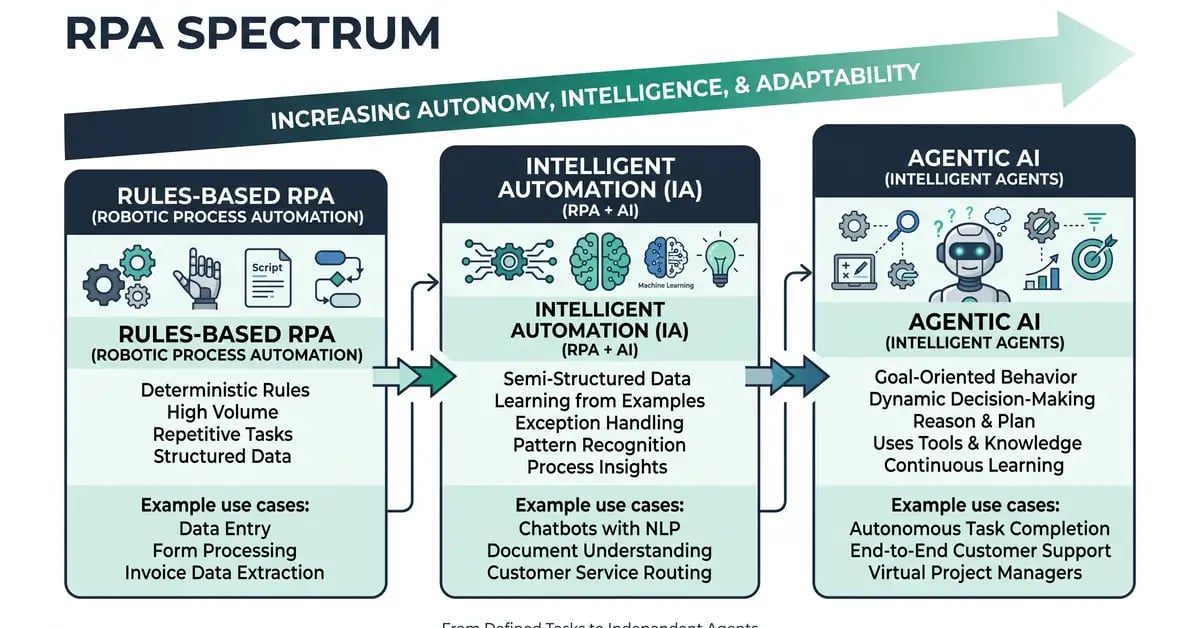
The most common confusion in this space is treating RPA and AI as the same thing. They are not. RPA reproduces the actions a human takes; AI reproduces the thinking. The table below maps the spectrum from deterministic bots to reasoning agents.
| Approach | What it does | How it decides | Best for |
| RPA | Mimics human UI/API actions | Fixed rules, deterministic | High-volume, structured, repetitive tasks |
| AI / machine learning | Interprets data, predicts, classifies | Probabilistic, learns from data | Unstructured data, pattern recognition |
| Intelligent automation (IA/IPA) | Combines RPA + AI + orchestration | Rules plus cognition | End-to-end processes with mixed data |
| Agentic AI | Perceives, reasons, plans, acts on a goal | Autonomous, LLM-driven reasoning | Complex, dynamic, multi-step objectives |
Source: Appian, 2024; IBM, 2025; MarketsandMarkets, 2024
The newest entrant is agentic AI: software agents that, given a high-level goal such as resolving an invoice dispute, decide for themselves how to achieve it, decomposing the task, calling APIs, and invoking RPA bots along the way. The natural question is whether agents will replace RPA. The evidence points to augmentation, not replacement. RPA is deeply embedded in operations, many systems still lack APIs so UI automation remains unavoidable, and regulators prefer deterministic, explainable automation. The realistic model, echoed by every major vendor, is agentic AI orchestrating RPA, the same convergence we cover in our guide to agentic workflows. RPA keeps doing the doing; the agent does the thinking.
The market and the ROI

RPA has moved from niche to mainstream. Gartner's 2025 Magic Quadrant put RPA software revenue at 3.8 billion USD in 2024, up 18 percent year on year. Technavio projects the market will add 54.27 billion USD between 2025 and 2030 at a 41.3 percent CAGR, while the adjacent intelligent process automation market is forecast to reach 25.9 billion USD by 2027. Gartner evaluated 13 vendors in its quadrant, with UiPath named a Leader for the seventh consecutive year.
| Vendor | Positioning | Pricing note |
| UiPath | Agentic automation platform, Gartner Leader | Per-bot / per-developer, by quote |
| Microsoft Power Automate | Tight Microsoft 365 / Azure integration | $15/user/mo; $150/bot/mo (process) |
| Automation Anywhere | Agentic process automation | By quote |
| SS&C Blue Prism | Enterprise RPA + AI platform | By quote |
| IBM | RPA plus watsonx for AI agents | By quote |
Source: UiPath / Gartner, 2025; Microsoft Power Automate pricing; Technavio, 2025
That growth sits inside a broader secular shift toward automated operations. The global retail automation market is projected to climb from 24.1 billion USD in 2023 to about 44.8 billion USD by 2030, and the service robotics market from 26.35 billion USD in 2025 toward 131.9 billion USD by 2034. RPA is one current of a much wider river, which is why most vendors have repositioned their platforms from pure RPA into combined AI-and-automation suites rather than standalone bot tools.
On returns, the most cited evidence is Forrester's Total Economic Impact study of the UiPath platform: a composite organisation realised about 12.08 million USD in benefits over three years against 6.14 million USD in costs, a net present value of 5.94 million USD and a 97 percent ROI, with hours saved climbing to more than 225,000 annually by year three. AutomationEdge has estimated that automating manual processes can cut processing costs by 30 to 70 percent. Those numbers are real but conditional: they depend on choosing stable, high-volume processes and governing the bots well, the same discipline behind any serious business process automation programme.
Not sure which of your processes are worth automating first?
Book a Growth Mapping CallTop use cases by function and industry

RPA pays off wherever work is high-volume, structured, and rules-based. By function, the strongest use cases cluster in a handful of areas:
- Finance and accounting: accounts payable, invoice matching, reconciliations, general ledger posting, and reporting. A Forrester analysis cited by IBM found about 36 percent of RPA use cases were in finance and accounting.
- HR: employee onboarding and offboarding, payroll data updates, and benefits administration.
- IT operations: user provisioning, password resets, system monitoring, and log analysis, often paired with AI anomaly detection.
- Customer service: pulling records, updating tickets, and routing, frequently as part of broader customer service automation.
- Data entry and migration: moving and validating data between systems, a classic CRM automation task.
By industry, banking and financial services lead adoption, with bots handling account opening, inquiry processing, and anti-money-laundering checks. Insurance automates claims, policy administration, and underwriting support. Healthcare uses RPA for records, prescription management, and claims. Retail applies it to order and inventory management and fraud detection, and manufacturing and logistics to order processing, supplier onboarding, and shipping documentation. The common thread is repeatable, compliance-heavy work where accuracy and speed translate directly into cost and risk reduction, and where RPA increasingly acts as the execution layer beneath AI agent workflow automation.
The limits of RPA
RPA's biggest strength, doing exactly what it is told, is also its biggest weakness. Because UI-driven bots depend on stable screen layouts and element identifiers, they break when an application changes: a moved button or an unexpected pop-up can stop a bot or throw an exception that needs manual intervention. In large estates where many bots depend on the same applications, that fragility becomes a substantial maintenance burden, which is the single most common reason RPA programmes stall.
Automating a broken process just makes it fail faster
RPA cannot interpret ambiguous inputs, handle unstructured data, or exercise judgement on its own. Bolting bots onto a messy, poorly designed process simply industrialises the mess. The lesson from experienced practitioners is to simplify and redesign the process first, then automate, and to stand up real governance (a centre of excellence, change management, monitoring) before scaling. Without that, maintenance costs can erase the savings.
This is precisely why the market is converging on intelligent and agentic automation. RPA handles the deterministic execution; AI handles the unstructured data and the decisions; an orchestration or agent layer coordinates the whole. Treating RPA as one tool in that wider kit, rather than a universal hammer, is what separates programmes that scale from those that quietly get abandoned.
How to implement RPA

The programmes that succeed start narrow, fix the process before automating it, and build governance early. The ones that fail try to boil the ocean.
Pick a stable, high-volume, rules-based process
Invoice processing, reconciliations, or report generation are ideal first targets: clear rules, high volume, structured data, and an obvious payback. Avoid processes whose underlying applications change constantly.
Simplify before you automate
Map and redesign the process first. Strip out unnecessary steps so you automate the streamlined version, not the legacy mess. Automating waste only produces faster waste.
Choose the tool, bot type, and governance
Match the platform to your stack and AI ambitions, decide between attended, unattended, and hybrid bots, and stand up an orchestrator plus a centre of excellence for credentials, change management, and monitoring. An experienced AI consultant earns their fee here.
Measure, prove, then scale with AI
Track hours saved, error reduction, and cost per transaction. Prove the payback on the pilot, then expand, layering AI for unstructured data and agentic orchestration on top as you go.
The bottom line
RPA is the dependable workhorse of enterprise automation: deterministic bots that execute high-volume, rules-based tasks faster and more accurately than people, with documented ROI when deployed well. It is not AI and will not think for you, and its UI-driven bots demand real maintenance discipline. The winners treat RPA as the execution foundation, fix the process before automating, govern the bot estate, and increasingly let AI and agents do the reasoning while RPA does the work.
Build automation that scales, not a brittle bot estate
peppereffect architects RPA as part of an integrated operating system, combining deterministic bots, AI for unstructured data, and agentic orchestration, wired into your real systems with governance built in. We diagnose which processes to automate first and engineer the logic-gated workflows that actually hold up.
Book a Growth Mapping CallFrequently asked questions
What is robotic process automation (RPA)?
RPA is a form of business process automation that uses software bots to mimic the actions a human takes in digital systems: logging in, clicking, copying and pasting data, filling forms, and moving files, guided by rule-based scripts that combine UI automation with API integrations. It is deterministic and excels at high-volume, repetitive, rules-based tasks like invoice processing and data entry, but it does not understand context or learn on its own.
Is RPA the same as AI?
No. RPA imitates what a person does; AI imitates how a person thinks. RPA follows fixed rules and does not learn, while AI and machine learning interpret unstructured data, recognise patterns, and improve over time. RPA handles structured execution; AI handles cognition. Intelligent automation combines the two.
Will AI and agentic automation replace RPA?
More likely augment than replace. Agentic AI reasons toward a goal and can call RPA bots as tools. RPA is deeply embedded, many systems lack APIs so UI automation is still needed, and regulators prefer deterministic, auditable automation. The practical model is agentic AI orchestrating RPA, not erasing it.
What are the main use cases for RPA?
High-volume, rules-based work: finance and accounting (accounts payable, reconciliations, reporting), HR onboarding and payroll, IT operations, customer service, and data entry and migration. By industry, banking and financial services lead, followed by insurance, healthcare, retail, and manufacturing. A Forrester analysis cited by IBM found about 36 percent of RPA use cases were in finance and accounting.
What is the ROI of RPA?
A Forrester Total Economic Impact study of the UiPath platform found about 12.08 million USD in benefits over three years against 6.14 million USD in costs, a 97 percent ROI, with more than 225,000 hours saved annually by year three. AutomationEdge estimates automation can cut processing costs by 30 to 70 percent. Returns depend on choosing stable, high-volume processes and governing the bots well.
How do you implement RPA?
Start small with a stable, high-volume, rules-based process, simplify and redesign it before automating, choose a tool and bot type that fit your stack, and stand up an orchestrator plus a centre of excellence for governance. Measure hours saved, errors, and cost per transaction, prove payback, then scale, layering AI for unstructured data and agentic orchestration on top.
Resources
- IBM, What Is Robotic Process Automation
- Appian, RPA vs AI
- IBM, RPA vs Agentic AI
- CIO, What Is RPA Explained
- UiPath, Gartner Magic Quadrant for RPA 2025
- Technavio, RPA Market Analysis
- Process Excellence Network, Gartner RPA Magic Quadrant
- MarketsandMarkets, Intelligent Process Automation Market
- Microsoft Power Automate Pricing
- Forrester, Total Economic Impact of UiPath
- SS&C Blue Prism, Attended vs Unattended RPA
- Krista, The Future of RPA